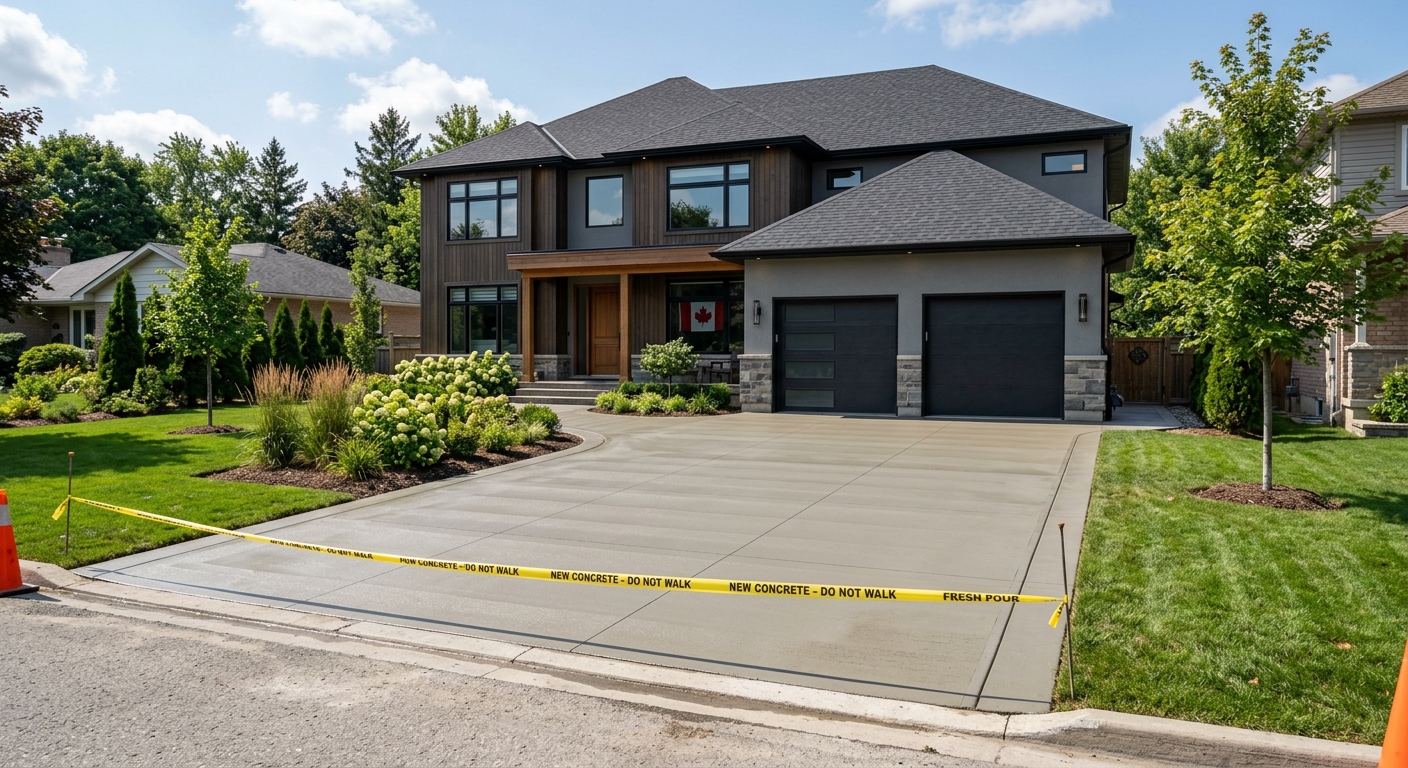
Concrete work options and costs in Alison
Concrete work is a common upgrade in Alison, Ontario, especially for homeowners looking to improve curb appeal and manage drainage. With a small local population of 2,697 (Statistics Canada, 2021 Census), demand is concentrated in a handful of residential pockets, and that can mean fewer crews on short notice—especially during the peak spring and early summer pour window. Alison’s broader Toronto economic region also has a strong base of single-family housing where driveways, patios and walkways are high-visibility projects tied to property value and daily use.
Toronto-area concrete pricing is driven by freeze–thaw performance and frost depth requirements. Exterior slabs and driveways need air-entrained concrete, a properly compacted granular base, and well-planned control joints to reduce random cracking. Most structural foundation work must extend below design frost depth; while frost depth varies across Ontario, the key is that footings are placed far enough down to prevent frost heave and differential settlement. That means longer excavation, taller forms, and more material—so foundation and footing work typically costs far more than flatwork.
In neighbourhoods around the Keswick/Schomberg direction where lot sizes and access can vary, contractors often see more price spread based on haul distance, base prep complexity, and whether truck access is tight. If your proposal includes air-entrained mix and a defined joint/sealing plan, it’s easier to compare quotes apples-to-apples—so the table below sets realistic starting points for common options.
| Application |
Typical Size |
Key Spec |
Finish Option |
Price Range |
| Concrete driveway (standard broom finish) |
400 sq. ft. (approx. 20' x 20') |
Air-entrained exterior mix; compacted granular base; control joints |
Light broom texture |
$7,200–$11,200 |
| Exposed aggregate driveway |
400 sq. ft. (approx. 20' x 20') |
Air-entrained exterior mix; proper curing and surface wash timing |
Exposed stone finish |
$9,000–$14,200 |
| Stamped concrete driveway or patio |
300 sq. ft. (approx. 15' x 20') |
Air-entrained mix; release agent; joint pattern planned for freeze–thaw |
Stamp patterns (field + border options) |
$7,200–$12,000 |
| Plain concrete patio or walkway |
200 sq. ft. (approx. 10' x 20') |
Air-entrained mix; compacted granular base; drainage slope |
Broom finish or light trowel |
$3,200–$5,200 |
| Garage floor (interior slab) |
480 sq. ft. (approx. 20' x 24') |
Vapour barrier optional; fibre or mesh; thickened edges as needed |
Float/smooth trowel or broom for traction |
$9,600–$14,400 |
| Foundation footings (structural, below frost) |
Typical 1,000–1,300 sq. ft. of footing plan area |
Engineered design; below-grade excavation; rebar placement; concrete pour plan |
Form-and-pour concrete footings |
$180–$300 |
Prices are estimates only and vary by project scope, site access and material selection.
What affects the price of concrete work in Alison
In Alison and across the Toronto economic region, even “the same” concrete job can land 30–50% apart because quotes often differ in base prep, mix specification, reinforcement details, and how freeze–thaw durability is handled. One contractor may assume a generic slab thickness or lighter base, while another designs around local performance needs—air-entrainment, joint layout, and cure protection—because Ontario winters punish weak specs. In practice, labour availability also swings during the short, reliable pour season, which can raise installed costs when schedules tighten.
Here’s the core reason: frost depth and freeze–thaw cycles dictate every structural choice. Footings must extend below design frost depth to prevent frost heave and differential movement, and Ontario projects typically need deep excavation and form height compared with milder climates. Exterior slabs and flatwork also rely on air-entrained concrete to survive repeated freeze–thaw; without that, spalling and surface scaling become much more likely—especially after wet fall freeze-ups and spring thaw. When temperatures drop toward about 10 °C or below, contractors often need cold-weather curing precautions (insulating blankets and/or temporary heating), which increases material and labour.
Two Alison examples that commonly move the price. First, a driveway with only a brushed finish may start in the $18–$28 per sq. ft. range, but upgrading to exposed aggregate generally adds extra labour for finishing and washing, pushing the total toward the upper end of the $28 band. Second, if your soil is saturated or the site needs thicker compacted base and better drainage, costs rise—because you’re paying for excavation, granular import, and compaction in addition to concrete itself. As homes age (and drainage paths change), localized soil conditions can also force thicker sections and more reinforcement, sometimes adding several thousand dollars compared to an “easy access” backyard pour.
| Price Factor |
Why It Matters |
Cost Impact |
| Frost line depth — determines footing depth and form height |
Deeper excavation and taller forms increase concrete volume and labour to reach stable bearing |
Higher for full-depth structural work; can materially change scope |
| Site preparation — excavation, grading, compacted granular base |
Proper base prevents settlement and pumping during freeze–thaw |
Often the biggest swing factor for exterior flatwork |
| Reinforcement — rebar or wire mesh requirement |
Controls cracking and improves structural performance under load |
Adds material and labour; required more often than homeowners assume |
| Mix design — air-entrainment and compressive strength spec |
Air-entrainment reduces spalling during freeze–thaw cycles |
Usually modest per cubic yard, but critical for longevity |
| Finish type — broom vs. stamped vs. exposed aggregate |
Complex finishes require extra steps and tighter timing |
Can push exterior costs toward the top end of driveway/patio bands |
| Pour size and concrete truck access to site |
Narrow access may require smaller placements, pumping, or extra labour handling |
Access issues can add significant labour hours |
| Cold-weather curing precautions — heating and blankets |
Protects early-age strength gain when temperatures fall |
Added cost for materials and time, especially late season |
| Control joint pattern and sealing cost |
Controls cracking locations and protects from de-icing salt scaling |
Sealing is relatively small cost compared to repair risk |
Permits & regulations in Ontario
In Ontario, structural concrete work—such as foundation walls, grade beams and the footings that support the foundation—typically requires a building permit, and engineered drawings are often reviewed by the municipality depending on your foundation system. Concrete flatwork like patios, walkways and most driveways usually does not require a permit, unless the work changes lot grading, impacts stormwater flow, or affects impervious surface coverage rules or the municipal right-of-way. Because by-laws and review triggers can vary by situation, the safe move is to confirm with your local authority before breaking ground.
On the contractor side, don’t rely on verbal assurances. Verify they carry liability insurance and have appropriate WSIB/WCB coverage for their workers. For engineered or structural scopes, ask whether the company will provide the concrete certification documents and pour records requested for permit/inspection files, and request references for similar-sized structural projects—not just cosmetic flatwork.
Step-by-step checks for Alison homeowners:
- Request the contractor’s certificate of insurance and confirm your name/address appears as an insured party or that they provide a valid certificate on request.
- Check WSIB/WCB clearance documentation (or equivalent proof) before work starts.
- Verify relevant business registration/licensing through provincial and municipal resources (your contractor should provide their details on the quote).
- Ask whether permits (when required) are pulled by the contractor or coordinated with you, and get that written in the scope.
- Confirm start/inspection timing so inspection windows aren’t missed for footings or structural pours.
Getting concrete right in Alison's freeze-thaw climate
Concrete failure in Alison is usually about water movement plus freeze–thaw stress. When saturated soil sits against concrete and then freezes, it can create upward and sideways pressures that lead to settlement, curling and cracking. The most common symptom homeowners notice is spalling or scaling on exterior surfaces—often tied to inadequate air-entrainment, rushed curing, or poor sealing choices after 28 days. In the Toronto market, contractors who routinely pour in late spring and early fall also plan around temperature drops toward 10 °C or below by protecting the slab during early strength gain, because weak early-age concrete can’t resist freeze damage as effectively.
To spec the job correctly, start with base preparation: compacted granular sub-base to the right depth for your soil and frost considerations, with proper drainage and slope. Next is mix design: exterior flatwork should use air-entrained concrete (typically 5–7% air content) and a minimum compressive strength spec such as 32 MPa. Then address cracking proactively with control joints placed on a practical pattern to limit random cracks, not just “where it happens.” Curing matters too—plan for at least 7 days of curing under suitable conditions. Finally, sealing should be penetrating sealer applied after the concrete cures (commonly after 28 days) to repel de-icing salts.
Cost-wise, sometimes the “cheaper” bid isn’t actually cheaper. For example, if your driveway quote is near the lower $18–$28 per sq. ft. band but excludes air-entrainment documentation and proper sealing, you may save only a few hundred to a couple thousand upfront—then pay more in patching and surface repairs later. In contrast, a clear spec with the right mix and joint/seal plan helps protect the durability you’re paying for.
| Spec |
Why It Matters in Alison |
What to Ask For |
Impact if Skipped |
| Compacted granular base (depth?) |
Proper thickness and compaction reduce settlement and water pumping in freeze–thaw |
Base depth specified on the drawing/quote + compaction method (mechanical compaction) |
Uneven cracking, slab rocking, and premature joint failure |
| Air-entrained concrete mix (target air %?) |
Air spaces allow freezing water to expand without destroying the cement paste |
Target air content and confirmation it’s air-entrained for exterior use |
Higher spalling and scaling risk after winter freeze-ups |
| Compressive strength (MPa rating) |
Strength development supports load capacity and durability through Ontario seasons |
Minimum 32 MPa (or higher if engineered) and mix documentation from supplier |
Reduced performance and increased cracking under early traffic or freeze stress |
| Control joints (spacing per ACI guidelines) |
Joints control where cracks form during shrinkage and temperature change |
Joint spacing and layout plan before the pour, plus saw-cut timing |
Random cracking and cosmetic failure that invites water intrusion |
| Minimum 7-day curing period |
Early-age curing is when concrete gains strength and resists damage from cold snaps |
Curing method stated, including cold-weather protection if needed |
Lower early strength and higher chance of surface scaling or cracking |
| Penetrating sealer (when applied after cure) |
Sealer helps repel de-icing salts and reduces water absorption in winter |
Type of penetrating sealer + application timing (commonly after 28 days) |
More salt scaling, quicker wear, and higher maintenance costs |
How to choose a concrete work contractor in Alison
Choosing the right contractor in Alison starts with verifying credentials and protecting yourself up front. In Ontario, ask for proof of liability insurance and WSIB/WCB coverage (or applicable clearance documentation). To check: request the certificates directly, confirm coverage dates match your project start window, and ensure the certificate clearly lists the business you’re hiring. If they can’t provide current documentation quickly, that’s a red flag.
Next, require quotes that are itemised, not just a single lump sum. Get 2–3 written proposals with a labour + materials breakdown (excavation/base prep, forms, rebar/mesh, concrete supply, finish labour, sealing, saw-cut joints). Clarify what’s excluded: disposal of excess soil, permit coordination if required, saw-cut timing, protection of the slab during curing, and whether driveway approaches or drainage work are included. For structural pours (footings/foundation elements), ask how engineering details are handled and when inspection points are scheduled.
Warranty should be spelled out: workmanship warranty length, what it covers (cracks, spalling, settlement), and whether product/manufacturer warranties apply to specific materials. Also ask if warranties are transferable to future owners. Payment schedule matters—never pay more than 10–15% upfront. Hold back the remainder until the job is complete, cleaned, and the finish matches the approved samples. Finally, get a start date and completion estimate in writing, including weather contingency plans tied to curing protection needs.
- Provide insurance certificate and WSIB/WCB clearance before signing.
- Quote includes air-entrained mix confirmation for exterior work.
- Base prep depth and compaction method are stated in the scope.
- Reinforcement method (mesh vs. rebar) is specified by application.
- Control joint spacing and timing (e.g., saw-cut schedule) are described.
- Cold-weather curing plan is included if temperatures drop.
- Sealing is either included or clearly excluded, with timing specified.
- Traffic/access protections are listed (what you can drive on and when).
- Disposal of excavated material and site restoration are detailed.
- Concrete delivery logistics are addressed (truck access, pumping if needed).
- Warranty terms are in writing with clear exclusions.
- Payment schedule respects the 10–15% upfront guideline and final holdback.
In Alison, concrete red flags include quotes that skip air-entrainment documentation for exterior slabs, no mention of control joints or sealing, vague curing timelines (“we’ll do it right”), unusually low pricing without base prep detail, and contractors who won’t provide insurance/WSIB proof or references that match your project scale.
Frequently asked questions — concrete work in Alison
Why does concrete crack in Alison and how is it prevented?
Concrete cracks in Alison primarily due to shrinkage, temperature change, and freeze–thaw pressure when water gets into vulnerable areas. In the Toronto economic region, winter wetting and refreezing can worsen surface scaling and spalling, especially if the mix isn’t properly air-entrained. The prevention approach is technical and specific: use air-entrained exterior concrete, specify a minimum strength (commonly 32 MPa), prepare a compacted granular base so the slab doesn’t settle, and plan control joints so cracking happens in predictable locations. You should also protect curing so early strength develops properly. Finally, penetrating sealing after cure helps reduce water and de-icing salt absorption, lowering the risk of repeated winter damage.
Stamped vs broom-finish concrete — cost difference?
In Alison, stamped concrete typically costs more than broom-finish because it adds labour steps (forms, stamp mats/release materials, pattern layout) and requires tighter timing to get consistent impressions. If your driveway or patio is priced in the standard exterior flatwork bands, broom-finish usually sits closer to the $18–$28 per sq. ft. region for driveways or $16–$26 for patios and walkways, depending on base prep and access. Stamped work often shifts totals toward the top end of the decorative range (commonly $24–$40 per sq. ft.). The best way to justify the upgrade is to compare scopes: stamped projects should still include air-entrainment, joint planning, proper cure protection, and sealing so you don’t pay extra for aesthetics while sacrificing durability.
When is the best time to pour concrete in Alison?
For Alison and the broader Toronto region, the most reliable time to pour concrete is during the warmer months when curing conditions can be protected. Contractors commonly target spring into early fall because consistent temperatures support strength gain and reduce the need for extensive cold-weather heating and blankets. Once temperatures begin dropping toward about 10 °C or below, crews may require curing protection to prevent early-age damage, which increases cost and can shorten schedule flexibility. Even if the concrete is technically “fine” on delivery, poor early curing is how you end up with weak surface performance that shows up later as scaling. If you’re planning around a specific date, ask your contractor how they’ll protect the pour if a cold snap hits.
How long does concrete take to cure?
Concrete curing is a two-part story: it gains strength over days, and it achieves near full maturity over weeks. For typical Ontario flatwork, you should plan for at least 7 days of curing under proper conditions before expecting normal use, and often longer before heavy loads. Even then, sealing for durability is usually applied after full cure—commonly around 28 days—so the sealer can penetrate and repel moisture and de-icing salts effectively. If cold weather occurs right after the pour, curing time can effectively need extension via insulation/heating. Ask your contractor for the curing plan and when you can drive on a driveway or place furniture on a patio safely.
Do I need a permit for concrete work in Ontario?
In Ontario, structural concrete work—like footings, foundation walls and grade beams—typically requires a building permit and may involve engineered drawings reviewed by the municipality. Concrete flatwork such as patios, walkways and most driveways usually does not require a permit unless it affects lot grading, impervious surface coverage limits, drainage patterns, or the municipal right-of-way. Since your specific lot conditions govern what triggers review, confirm with your local authority before the pour. Also verify your contractor will coordinate permits where required and that they carry liability insurance and WSIB/WCB coverage before work begins. For homeowners in Alison, getting this clarified in writing helps avoid inspection delays and schedule changes.
Concrete vs pavers for a patio in Alison?
Concrete and pavers both work well for patios in Alison, but the “better” choice depends on maintenance and how you want cracking risks managed in freeze–thaw weather. Concrete patios benefit from a monolithic slab approach with air-entrained mix, planned control joints and sealing; when done correctly, they can be very durable with predictable cracking in joint lines. Pavers offer a modular system where individual units can be replaced if damage occurs, which some homeowners like after harsh winters. Price-wise, concrete patios often land in the $16–$26 per sq. ft. band, while pavers commonly involve more labour and detailed base prep. If you’re comparing quotes, make sure you’re evaluating the same base depth, drainage slope, and joint/sealing approach—not just the surface finish.