Concrete work options and costs in Blake-Jones
Concrete work is a big part of home upkeep and curb appeal in Blake-Jones, Ontario, especially because the GTA’s freeze–thaw cycle is hard on exterior surfaces. With a 2021 population of 7,727 (Statistics Canada, 2021 Census), the local market has a steady flow of residential projects, from replacement driveways to patios and walkway renewals. In a typical neighbourhood build-out, many homes are single-family properties—these driveways and exterior flatwork are the first places you’ll notice cracking or uneven settlement when base prep and jointing aren’t right.
In the Toronto economic region, concrete pricing is driven by frost depth requirements and how reliably contractors can manage curing in shoulder seasons. Structural footings generally need to extend at least 1.2 m (about 4 ft) below grade to reduce frost heave and differential movement, and exterior slabs must use air-entrained concrete mixes to survive repeated winter freeze–thaw. GTA crews also tend to concentrate exterior pours in warmer months so concrete can cure properly; when temperatures drop toward 10 °C or lower, protection (insulating blankets, curing blankets, sometimes heat mats) adds cost and coordination time.
Trade demand is especially strong in established residential pockets such as around the Downtown Blake-Jones area and near major commuter corridors, where homeowners commonly refresh older driveways and add decorative finishes before listing or after home renovations.
Below is a practical comparison of common concrete options you’ll see quoted in Blake-Jones—use it as a baseline, then adjust based on thickness, base condition, access, and finish complexity.
| Application |
Typical Size |
Key Spec |
Finish Option |
Price Range |
| Concrete driveway (standard broom finish) |
16 ft x 20 ft (320 sq ft) |
4 in (100 mm) slab, compacted granular base, air-entrained mix |
Broomed surface with control joints |
$5,760 – $8,960 |
| Exposed aggregate driveway |
16 ft x 22 ft (352 sq ft) |
4 in (100 mm) slab, air-entrained mix, proper curing and wash timing |
Exposed aggregate with sealer-ready surface |
$7,000 – $10,900 |
| Stamped concrete driveway or patio |
12 ft x 20 ft (240 sq ft) |
4 in (100 mm) slab, air-entrained mix, colour and release timing |
Stamped pattern + integral/solid colour |
$5,760 – $9,600 |
| Plain concrete patio or walkway |
10 ft x 16 ft (160 sq ft) |
4 in (100 mm) slab, compacted base, drainage-friendly edge detail |
Float + light broom, joints as needed |
$2,560 – $4,160 |
| Garage floor (interior slab) |
20 ft x 22 ft (440 sq ft) |
4 in (100 mm) slab, vapour barrier where required, standard mix |
Light broom + hardener option |
$6,600 – $11,000 |
| Foundation footings (structural, below frost) |
Per linear foot equivalent |
Engineer/spec design, excavation, rebar, concrete below frost depth |
Structural concrete only (no decorative finish) |
$180 – $300 |
Prices are estimates only and vary by project scope, site access and material selection.
What affects the price of concrete work in Blake-Jones
In Blake-Jones and the broader Toronto economic region, two contractors can quote the “same” concrete project and still be 30–50% apart—usually because the scope around the slab is different. Concrete itself is only one part of the cost; excavation, hauling, compacted granular base, reinforcement, and finishing labour (especially for decorative work) often decide the final number. It’s also common for quotes to differ based on how each contractor plans for frost depth and freeze–thaw exposure, including the concrete mix design and curing protection during colder stretches.
For structural work, frost depth matters directly: Ontario specs typically require footings to extend at least 1.2 m below grade to limit frost heave and differential movement. On exterior flatwork—driveways, patios, and walkways—contractors generally use air-entrained concrete so the slab can handle repeated freeze–thaw without scaling and spalling. When temperatures drop toward 10 °C or below, the reliable pour season shrinks and crews may add insulating blankets, heat, and tighter scheduling to protect curing, which adds cost compared with a summer-only workflow. And because GTA winters often include de-icing salt, sealing becomes less optional for long-term durability.
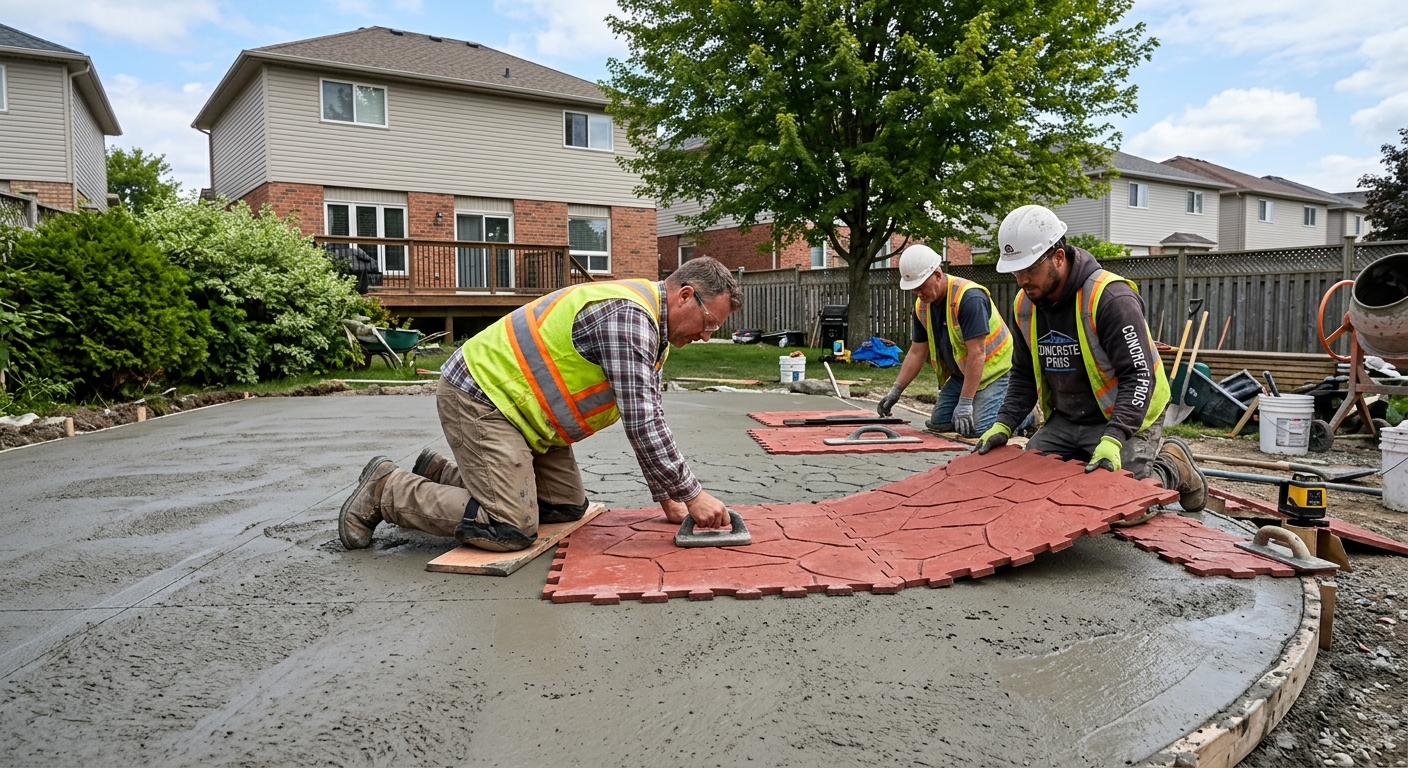
Local site conditions in Blake-Jones can also push prices up or down quickly. For example, a badly settled driveway over soft subgrade will require deeper excavation and extra granular base before you pour. Conversely, a straightforward replacement over well-compacted base may stay near the lower end of the driveway band (about $18–$28 per sq ft). A decorative upgrade—like stamped concrete—often looks expensive at first, but the cost jump (roughly $24–$40 per sq ft) can be justified if you’re replacing cracked flatwork and want a longer-lasting “finished” look that’s consistent with a full exterior refresh.
| Price Factor |
Why It Matters |
Cost Impact |
| Frost line depth — determines footing depth and form height |
Deeper footings reduce frost heave and settlement risk |
Can add significant excavation/formwork time; major driver for foundation/footings |
| Site preparation — excavation, grading, compacted granular base |
Compaction prevents voids that lead to cracking and uneven slab movement |
Often the biggest swing factor between quotes; can raise cost by removing unsuitable soils and adding base |
| Reinforcement — rebar or wire mesh requirement |
Reinforcement helps control cracking and supports load transfer |
Moderate increase; varies by slab thickness, engineering, and intended use |
| Mix design — air-entrainment and compressive strength spec |
Air-entrainment resists freeze–thaw scaling and spalling |
Small material cost increase, but reduces warranty risk; required for exterior work |
| Finish type — broom vs. stamped vs. exposed aggregate |
Decorative systems require labour, timing, and finishing materials |
Usually increases cost meaningfully; stamped/exposed often carry the highest labour and tooling |
| Pour size and concrete truck access to site |
Long carries, tight access, and staging slow production and increase costs |
Can add labour/time premiums and affect equipment needs |
| Cold-weather curing precautions — heating and blankets |
Protects strength gain when temperatures drop near or below 10 °C |
Can add crew time and rental/consumables; raises total price during shoulder season |
| Control joint pattern and sealing cost |
Joints manage shrinkage cracks; sealer helps resist de-icing salt damage |
Relatively low cost per square foot, but often skipped—when skipped, surface deterioration accelerates |
Permits & regulations in Ontario
In Ontario, structural concrete work is typically not “DIY-permit simple.” If you’re doing concrete that affects the structural system—such as new or altered footings, foundation walls, or grade beams—you’ll usually need a building permit, and municipalities often expect engineered drawings for review. For home renovations in Blake-Jones, it’s common for foundation-related concrete to be tied to inspections at key stages (excavation/footings and then foundation wall steps).
Concrete flatwork—like driveways, patios, and walkways—usually does not require a permit unless it changes grading, affects lot drainage, triggers impervious surface coverage limits, or impacts municipal right-of-way requirements (for example, if works extend close to a sidewalk boulevard area). Even when a permit isn’t typically required for flatwork, you should confirm with the local authority before breaking ground.
Here’s how a homeowner in Blake-Jones can verify a contractor properly: (1) check the contractor’s licence/registration status via the province’s online contractor registry; (2) request a certificate of liability insurance and confirm it’s current and appropriate for the job; (3) ask for proof of WSIB/WCB coverage (and ensure the name matches the contracting entity); (4) obtain a recent clearance letter if available; and (5) compare references on similar-scale projects—especially exterior slabs in freeze–thaw conditions.
Getting concrete right in Blake-Jones's freeze-thaw climate
Concrete can fail in Blake-Jones when the slab “moves” relative to the ground or when water gets into the surface and freezes. The most common homeowner-facing problem in Ontario is spalling—tiny chips and flaking at the surface—caused by inadequate air-entrainment and poor curing/protection. In the Toronto economic region, freeze–thaw cycles are repeated enough that even small mistakes in base prep, jointing, or mix design show up within a few winters.
To spec the job correctly, focus on five things. First, base preparation: use compacted granular sub-base to the right depth for local soil and frost-related movement. Second, mix design: for exterior flatwork, ask for air-entrainment at about 5–7% air content and a minimum 32 MPa compressive strength. Third, control joints: plan joints so random cracking is less likely and cracks form where they’re intended. Fourth, curing: require at least 7 days of curing under proper conditions; if temperatures drop toward the cooler range, the contractor should protect the pour (insulating blankets/curing protection). Fifth, sealing: apply a penetrating sealer after the slab cures fully (commonly at 28 days) to repel moisture and reduce de-icing salt impacts.
As a dollar example, a plain broom-finished patio might land near $16–$26 per sq ft, while stamped concrete typically runs about $24–$40 per sq ft. If your existing slab is already cracked, paying for improved finishing and proper system execution (base, joints, air-entrainment, and correct curing) is usually the better value than repeatedly patching a failed surface—decorative options only work as well as the durability details beneath them.
| Spec |
Why It Matters in Blake-Jones |
What to Ask For |
Impact if Skipped |
| Compacted granular base (depth?) |
Prevents settlement and frost-related movement through void-free support |
Confirm base depth and compaction method for your soil conditions |
Uneven slab, early cracking, trip hazards |
| Air-entrained concrete mix (target air %?) |
Protects against freeze–thaw scaling and spalling in Ontario winters |
Ask for exterior air content around 5–7% |
Surface flaking, spalling, rapid wear from moisture + salt |
| Compressive strength (MPa rating) |
Controls durability and long-term performance in variable weather |
Minimum 32 MPa (verify in the mix/order) |
Reduced strength gain and shortened service life |
| Control joints (spacing per ACI guidelines) |
Manages shrinkage cracking so cracks form where you can maintain them |
Ask for joint spacing and layout plan before the pour |
Random cracking and wider repair costs over time |
| Minimum 7-day curing period |
Strength gain must continue reliably despite cool/wet shoulder seasons |
Confirm curing protection plan, especially if temps trend cooler |
Weaker surface, higher risk of cracking and dusting |
| Penetrating sealer (when applied after cure) |
Repels moisture and helps reduce de-icing salt damage |
Apply after full cure (commonly at 28 days) with product specifics |
Faster scaling, staining, and higher maintenance frequency |
How to choose a concrete work contractor in Blake-Jones
Choosing the right concrete contractor in Blake-Jones comes down to verification, scope clarity, and technical discipline. Start with Ontario licensing/registration checks: ask for the contractor’s business details and verify the registration/licence status using the provincial online registry. Next, confirm insurance: request a certificate of liability insurance and ensure it covers the concrete scope (not just general contracting). For workers, ask for proof of WSIB/WCB coverage—then confirm the clearance letter or account status if provided. If anything doesn’t match the contracting entity on your quote/contract, pause and ask why.
Then get 2–3 itemised written quotes. Don’t accept vague “supply and install” language. You want a breakdown that shows labour versus materials (concrete, base materials, rebar/mesh if used, formwork, finishing, sealing) and clearly states what’s included in excavation and disposal. Scope exclusions matter: removal and disposal of old concrete, supply/haul distance, permit responsibilities (if any), and whether drainage adjustments are included can swing your final cost substantially.
Review warranty terms too. Look for a workmanship warranty length (how long they stand behind finishing/base/joints), plus any manufacturer warranty for admixtures/sealers. Ask whether the warranty is transferable if you sell the home. For payment schedule, avoid large deposits—generally keep upfront payments around 10–15% and hold back until substantial completion. Finally, require a start date and completion estimate in writing so scheduling doesn’t become a cost lever.
- Ask whether the mix will be air-entrained for all exterior work and what the target air content is.
- Require the contractor to describe the base thickness and compaction method before the pour.
- Confirm joint layout (spacing and where joints will be cut or formed).
- Ask how they’ll protect curing if temperatures drop toward cooler ranges.
- Get a line-item for sealing (product type and when it’s applied).
- Ensure excavation, hauling, and disposal are explicitly included or excluded.
- Verify reinforcement spec (rebar/wire mesh) matches slab thickness and use.
- Request photos of similar Blake-Jones exterior flatwork, not just interior slabs.
- Check insurance and WSIB/WCB coverage match the contractor’s legal name.
- Get truck access/staging assumptions in writing (long carries cost time).
- Confirm forms/edges, dowels/anchors (where relevant), and subdrain details.
- Make sure your contract states warranty scope, length, and exclusions clearly.
Concrete red flags in Blake-Jones include: quotes that don’t mention air-entrainment for exterior slabs, skipping or minimizing base preparation, no clear joint plan, vague “we’ll seal it” statements without timing/product details, and contractors who pressure for large upfront deposits or won’t provide proof of insurance and WSIB/WCB coverage.
Frequently asked questions — concrete work in Blake-Jones
How long does a concrete driveway last?
In Blake-Jones and across Ontario’s Toronto region, a properly built concrete driveway commonly lasts 25 to 35 years, sometimes longer. The big drivers are the base prep, correct frost-aware installation, air-entrained concrete for freeze–thaw durability, and a control joint plan that manages cracking. Driveways exposed to winter de-icing salts often need penetrating sealer after curing (commonly around 28 days) to slow surface wear. If the foundation under the slab is unstable or water is allowed to pool, the driveway can fail much sooner—sometimes within 5 to 10 years—because freeze–thaw will amplify movement.
Cost-wise, a standard broom-finished driveway often falls within the local band of $5,760 – $8,960 depending on size and access, while better-prepped work and premium finishes will trend higher. The best “longevity per dollar” usually comes from doing the durability specs, not the cheapest mix or skimpy base.
What is air-entrained concrete and why does it matter here?
Air-entrained concrete is mixed with microscopic air bubbles that give freezing water somewhere to expand safely. In Ontario, including Blake-Jones, exterior slabs are exposed to repeated freeze–thaw and humid wet conditions in fall and spring. Without the right air content (commonly about 5–7% for exterior flatwork), the surface can scale, chip, and eventually spall—especially where de-icing salt soaks in during winter.
This is why good Toronto-area contractors treat air-entrainment as a non-negotiable specification for driveways, patios, and walkways. If a quote doesn’t explicitly mention air-entrainment for exterior work, that’s a red flag. It’s also why exterior pours are scheduled for conditions that support proper curing—when temperatures drop toward 10 °C or below, contractors may add protective curing measures to reach the strength they need.
How do I prepare the base for a concrete slab?
Base preparation is where concrete jobs are won or lost in Blake-Jones. The contractor should excavate unsuitable material, establish proper grading for drainage, and place a compacted granular sub-base to the specified depth. The goal is a uniform, well-compacted support layer with no soft spots or voids that can cause uneven settlement. For exterior slabs, the base must also consider frost-related movement; that’s part of why Ontario expects structural footings to extend below frost depth, while exterior flatwork still needs well-draining, compacted granular support.
When you compare quotes, ask for the base thickness and whether they’ll compact in lifts (not just “we’ll bring gravel”). A good base prep is often the difference between staying nearer the lower end of the driveway band (around $18–$28 per sq ft) versus paying for repairs after early cracking. Also ask if they include removal/disposal of old concrete and whether any subgrade problems are addressed before forming.
How do I compare concrete quotes?
To compare concrete quotes fairly in Ontario, focus on like-for-like scope, not just the total price. Ask each contractor for an itemised breakdown: concrete supply, excavation and disposal, granular base materials and compaction, reinforcement (if required), forms and finishing labour, and sealing (including timing). Confirm whether the quote assumes standard broom finish or includes decorative work like stamping or exposed aggregate.
Then check technical specifics: exterior projects should include air-entrained concrete, and the quote should reference control joint spacing and curing protection if temperatures are cool. If one quote is noticeably lower, it may be skipping base prep, reinforcement, or sealing—or using less robust specs. As a reference point, stamped concrete commonly sits in the $5,760 – $9,600 range for smaller driveway/patio projects, while plain patio/walkway work often lands in the $2,560 – $4,160 range for typical sizes.
Can concrete be poured in cold weather in Blake-Jones?
Concrete can be poured during cold weather in Blake-Jones, but it needs careful temperature management to protect curing and strength gain. When temperatures trend toward cooler conditions (often referenced around 10 °C or below), contractors typically use curing blankets, insulation, and sometimes heating approaches to keep the concrete warm enough for proper set and early strength. Pouring without protection increases the risk of weak surfaces, cracking, and durability issues—especially in exterior slabs exposed to freeze–thaw after installation.
In the Toronto economic region, crews often concentrate exterior work in the warmer months because it’s simpler to meet curing targets consistently. If a contractor proposes a cold-weather pour, ask for their specific curing plan, including how long they’ll protect the slab and how they’ll monitor conditions.
How do I maintain concrete in Blake-Jones's freeze-thaw climate?
Maintenance is about keeping water out and reducing the impact of de-icing salt. In Blake-Jones and the GTA corridor, the freeze–thaw cycle plus moisture intrusion is what accelerates surface scaling and spalling. Start with sealing: a penetrating sealer applied after full cure (commonly around 28 days) helps repel moisture and salts. Reapply sealers on a schedule recommended by the product/manufacturer, because the sealer is sacrificial over time.
Next, keep drainage functioning: make sure downspouts discharge away from the slab and that the area around the driveway or patio doesn’t hold standing water. Use de-icing methods that are compatible with concrete (avoid overuse of harsh salts when possible). Finally, watch for small joint failures—if joints are missing sealant or have opened up, address them early to stop water from migrating under the slab.