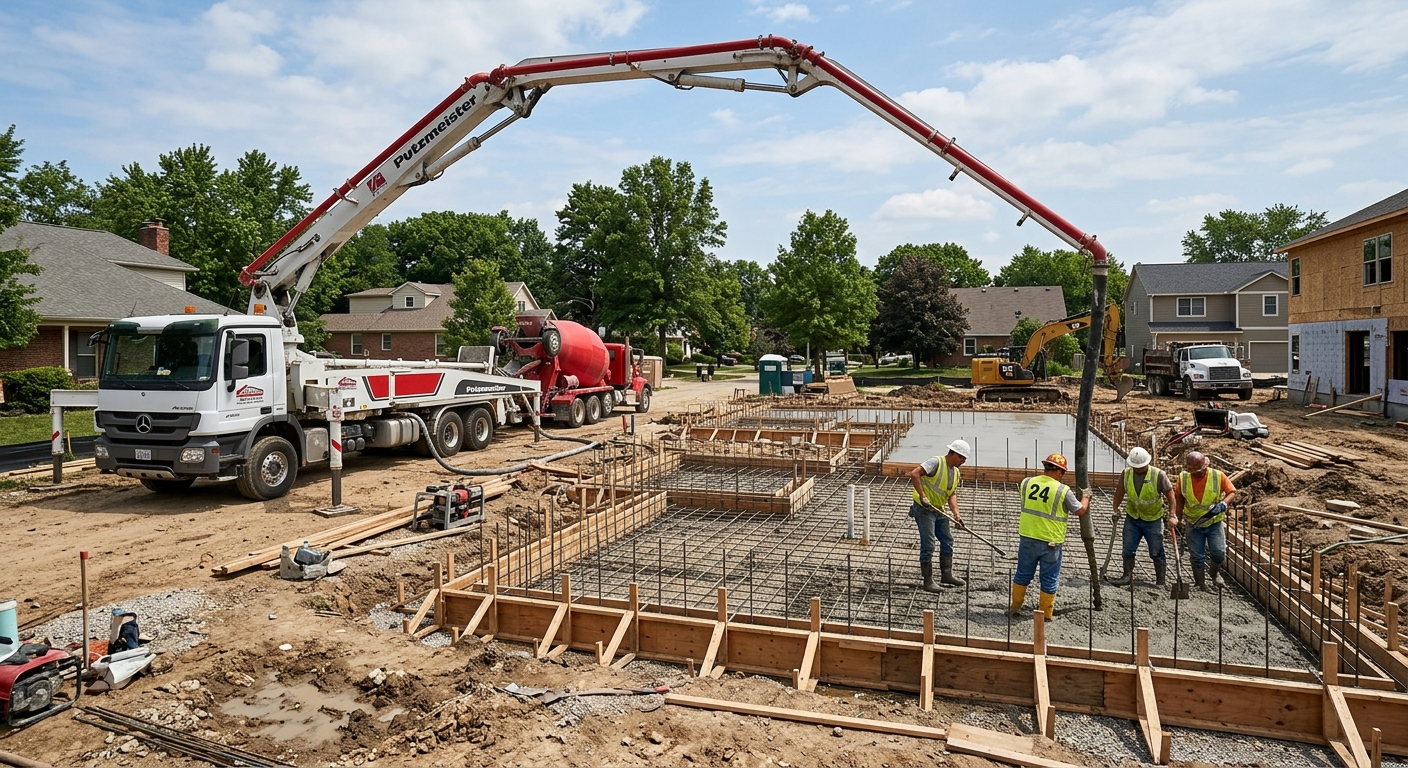
Concrete work options and costs in Tobermory
Tobermory homeowners typically book concrete work in the same neighbourhoods and seasons, because flatwork is exposed to the area’s wet fall, spring thaw, and long freeze–thaw swings. With a population of 1,427 (Statistics Canada, 2021 Census), the market is small, so trades may be scheduling several jobs at once across the Bruce Peninsula. Concrete flatwork is most common where residents live year-round, including around Tobermory’s harbour area where driveways and walkways get frequent use. If you’re part of the area’s older housing stock, it’s also common to see settled edges, failing steps, or cracked porch slabs that need either patching, full replacement, or re-lifting.
In the Toronto economic region, concrete pricing is shaped by frost depth requirements and freeze–thaw durability specs. Ontario Building Code practice generally drives structural footings down to at least 1.2 m (about 4 ft) below grade for frost protection, which affects excavation, formwork, and labour. For exterior patios, driveways, and walkways, crews also prioritize air-entrained mixes, adequate thickness, and proper control-joint layouts so you don’t get random cracking after winters. In practice, that means two companies might quote similar work, but one includes better base prep, joints, and sealing—while the lower quote may not.
In Tobermory, available labour can be tighter outside the main pour window, so scheduling and cure protection matter. When temperatures trend down toward cooler overnight conditions, contractors often adjust with curing blankets and longer protection—costing more upfront but helping the concrete reach full strength.
Use the table below to compare typical options and budget ranges, then we can narrow the scope based on your site access, soil condition, and desired finish.
| Application |
Typical Size |
Key Spec |
Finish Option |
Price Range |
| Concrete driveway (standard broom finish) |
400 sq. ft. |
Air-entrained exterior mix; control joints |
Broom finish, light edging |
$7,200 – $11,200 |
| Exposed aggregate driveway |
400 sq. ft. |
Air-entrained exterior mix; appropriate thickness |
Exposed aggregate with sealer |
$9,600 – $14,000 |
| Stamped concrete driveway or patio |
300 sq. ft. |
Air-entrained exterior mix; stamp release; joints |
Stamp pattern + integral/colour hardener |
$7,200 – $12,000 |
| Plain concrete patio or walkway |
200 sq. ft. |
Well-compacted base; proper slope/drainage |
Broom finish, tooled edges |
$3,200 – $5,200 |
| Garage floor (interior slab) |
500 sq. ft. |
Vapour barrier (as needed); reinforcement |
Steel-trowel finish or broom (per use) |
$9,500 – $14,500 |
| Foundation footings (structural, below frost) |
Typical 1,000 sq. ft. footprint |
Excavate to frost depth; rebar/engineered details |
Utility-grade formwork, clean pours |
$180,000 – $300,000 |
Prices are estimates only and vary by project scope, site access and material selection.
What affects the price of concrete work in Tobermory
In Tobermory, two quotes for what sounds like the same concrete job can differ by 30–50% because the “hidden” parts—excavation, base prep, reinforcement, truck access, and curing protection—aren’t always itemized. In the Toronto economic region, frost depth and freeze–thaw cycles dictate specs from the bottom up. Footings need to extend below the design frost depth (Ontario practice is often 1.2 m or more below grade) to prevent frost heave and differential movement. For exterior slabs and flatwork, air-entrained concrete is a must to survive repeated freezing and thawing, especially when humid conditions keep soils wet in shoulder seasons.
Cold-weather curing precautions also move the needle. When temperatures drop toward 10 °C or below, crews often need longer cure protection—insulating blankets, coverings, and sometimes supplemental heating—so the concrete reaches strength properly. That’s part of why exterior flatwork in Ontario can be higher than milder climates even when slab sizes look similar.
Local conditions can raise or lower cost quickly. For example: (1) poor drainage or saturated soil on a driveway site may increase granular base replacement, which can push you toward the upper end of the $18–$28 per sq. ft. driveway band; (2) restricted access near the harbour area can mean smaller equipment, additional labour hours, or multiple pours; and (3) if you’re adding stamping or exposed aggregate, you’ll pay closer to the $24–$40 per sq. ft. decorative range because of form set-up, labour intensity, and surface prep.
Finally, housing age matters. Older lots often have thicker organic topsoil, more buried debris, or drainage issues that show up only once we excavate—turning a “slab replacement” into a base rebuild. Even a small difference in excavation depth can translate into significant extra costs on a typical Tobermory flatwork project.
| Price Factor |
Why It Matters |
Cost Impact |
| Frost line depth — determines footing depth and form height |
Controls how far down you must excavate to prevent frost heave |
Major cost driver (more excavation and concrete volume) |
| Site preparation — excavation, grading, compacted granular base |
Proper base prevents settlement and pumping during freeze–thaw |
Can swing totals by thousands if soil is unsuitable |
| Reinforcement — rebar or wire mesh requirement |
Improves slab integrity for loads and reduces slab movement cracking |
Moderate to major depending on slab thickness and loading |
| Mix design — air-entrainment and compressive strength spec |
Air entrainment helps resist freeze–thaw damage |
Moderate added material cost, big durability payoff |
| Finish type — broom vs. stamped vs. exposed aggregate |
Finish dictates labour, timing, and surface preparation requirements |
Smaller flatwork can jump into premium ranges |
| Pour size and concrete truck access to site |
Shorter access routes reduce extra labour and pour delays |
High impact when crane/pump/extra wheelbarrow time is needed |
| Cold-weather curing precautions — heating and blankets |
Ensures proper strength gain when air temps drop |
Moderate additional labour/materials during cooler weeks |
| Control joint pattern and sealing cost |
Joints limit random cracking; sealing helps against de-icing salts |
Low-to-moderate cost that can prevent early surface damage |
Permits & regulations in Ontario
In Ontario, structural concrete work generally starts with a building permit. That includes items like footings, foundation walls, and grade beams—because these elements affect the structure’s load capacity and must align with engineered plans and inspected construction stages. Many municipalities also require engineered drawings for structural concrete, and inspections typically follow key milestones (forms/rebar, then concrete pour, and subsequent foundation stages).
Concrete flatwork such as driveways, patios, and walkways often does not require a permit on its own, as long as it doesn’t change lot grading, add drainage problems, or alter impervious surface coverage/right-of-way conditions. However, you should still confirm with the municipal authority before breaking ground—especially if you’re changing slopes, lowering grades near the foundation, building steps, or modifying drainage patterns.
For contractor verification in Tobermory, take a simple step-by-step approach: (1) confirm the contractor’s registration/licensing status through Ontario’s online contractor registry resources, (2) request a current certificate of insurance naming you as the certificate holder or additional insured where applicable, (3) verify WSIB/WCB coverage and ask for clearance documents or proof, and (4) review recent references on projects similar in scope and exposure (exterior flatwork and frost-prone sites). A reputable crew will provide documents quickly and will match the permit/engineering requirements to your scope.
Getting concrete right in Tobermory's freeze-thaw climate
The biggest concrete failures in Tobermory come from freeze–thaw stress, moisture movement, and poor base conditions. When water enters tiny surface defects and cycles between freezing and thawing, it can expand and push concrete particles loose—leading to spalling and scaling. The fix isn’t “stronger concrete only”; it’s a proper system: base, mix, joints, curing, and sealing. For exterior slabs, I recommend spec’ing a well-compacted granular sub-base sized correctly for your soils and frost considerations, because saturated or unstable subgrade is what allows slabs to move and crack.
Mix design is next. For exterior flatwork, air-entrainment is essential—typically 5–7% air content for freeze–thaw exposure. Even a small change can affect durability. Pair that with a minimum 32 MPa compressive strength spec and you’ll be protecting the slab’s ability to reach full performance.
Control joints should be planned, not “wherever it cracks.” Spacing that’s too wide increases random cracking risk. Finally, curing matters. Minimum 7-day curing under proper protection is critical, and in cooler snaps contractors should use insulating blankets or coverings to keep strength gain on track. Then seal after full cure—often 28 days post-pour—so the surface can better repel de-icing salts and moisture intrusion.
When is the price difference justified? Suppose you’re deciding between plain broom-finished patio versus stamped concrete: at roughly $16–$26 per sq. ft. for plain and $24–$40 per sq. ft. for stamped, the premium is worth it when you want the appearance of stone/brick and you’re still getting the same base prep, air-entrained mix, joints, and sealing. If a quote cuts corners on those items, the cheaper “looks fine now” option usually becomes more expensive to repair later.
| Spec |
Why It Matters in Tobermory |
What to Ask For |
Impact if Skipped |
| Compacted granular base (depth?) |
Stable base prevents settlement and reduces cracking in freeze–thaw |
Granular type and compacted thickness, plus confirmation of soil condition |
Higher chance of edge failure, cracking, and pumping |
| Air-entrained concrete mix (target air %?) |
Resists freeze–thaw scaling and spalling from trapped moisture |
Target air content of 5–7% for exterior flatwork |
Premature surface spalling and scaling |
| Compressive strength (MPa rating) |
Supports durability and performance under seasonal stress |
Minimum 32 MPa (or higher if engineered) |
Reduced long-term durability and increased damage risk |
| Control joints (spacing per ACI guidelines) |
Controls where cracking occurs during shrinkage and temperature swings |
Joint spacing plan and saw-cut timing |
Random cracks that telegraph to the surface |
| Minimum 7-day curing period |
Strength gain needs time, especially when nights are cool |
How curing is protected during cold snaps (blankets/covering) |
Lower strength at early ages; higher failure risk |
| Penetrating sealer (when applied after cure) |
Helps repel moisture and de-icing salts |
Penetrating sealer application after cure—typically 28 days |
More rapid surface deterioration in winter conditions |
How to choose a concrete work contractor in Tobermory
Start with verification. In Ontario, ask for proof of the contractor’s Ontario licence/registration, current liability insurance, and WSIB/WCB coverage. You can check licensing status through Ontario’s online registry resources, then verify the insurance certificate (ensure dates are current and coverage limits make sense for your project size). For WSIB/WCB, request a clearance letter or confirmation of coverage before work begins.
Next, get 2–3 itemised written quotes rather than one lump sum. A good quote breaks labour and materials so you can compare base prep depth, reinforcement type (mesh vs rebar and spacing), slab thickness assumptions, and whether air-entrainment and sealing are included. Also confirm whether the quote includes permit pull (if required), debris disposal, and any restoration like topsoil and sod/seed—these are common exclusions.
Warranty is where you protect yourself as a homeowner. Ask for: the length of workmanship warranty, what it covers (cracking and spalling limits), and whether the product/manufacturer warranty applies to the materials used. Confirm if coverage is transferable if you sell the home.
Payment schedule matters. Don’t pay more than 10–15% upfront. Hold back progress payments until key milestones are finished and verified—especially after base prep and before the pour. Finally, insist on a written timeline with a start date and concrete pour window; in Tobermory, weather and curing protection can shift the calendar.
- Confirm they specify air-entrained concrete for exterior flatwork.
- Ask for base prep details: compacted granular type and thickness.
- Check that slab thickness and reinforcement plan are included.
- Verify joint plan (spacing and saw-cut timing).
- Ask how they protect curing during cool nights.
- Confirm sealing is included or quoted separately (timing matters).
- Ensure they include excavation disposal/haul-off if soil removal is needed.
- Ask who supplies and sets forms, edges, and transitions.
- Request a detailed breakdown of labour vs materials.
- Get start date, pour date, and completion estimate in writing.
- Review warranty terms in plain language, not only marketing.
- Verify insurance and WSIB/WCB before signing.
Concrete red flags I see in Tobermory: quotes that omit base thickness and compaction, “no need for air-entrainment” claims for exterior slabs, no mention of control joints, vague curing language (especially in shoulder seasons), and contractors who want large upfront deposits without a milestone schedule.
Frequently asked questions — concrete work in Tobermory
How do I maintain concrete in Tobermory's freeze-thaw climate?
In Tobermory and across Ontario, maintenance is mostly about keeping moisture and salts from attacking the surface. Start by sweeping away grit so de-icing doesn’t sit in place. Use de-icing products carefully—when possible, choose lower-impact blends and avoid over-salting, because salt and water together can accelerate scaling and spalling on exterior flatwork. If your contractor sealed the slab, plan for periodic reapplication based on wear and rain exposure. For driveways and walkways, keep edges free of standing water and maintain any slope/drainage you had built into the slab. If you’re comparing options, a sealed broom-finished patio may land around $16–$26 per sq. ft., but the durability depends on joints, air-entrainment, and cure quality—not the finish name alone.
What causes concrete to spall in Tobermory winters?
Spalling in Tobermory winters usually comes from freeze–thaw damage plus moisture getting into the concrete pores. The big technical cause is inadequate air-entrainment, which is how the concrete gets room for freezing water to expand without rupturing the paste. Poor base prep can also contribute by creating movement and micro-cracks that let water reach the surface. Another common contributor is early surface exposure during curing—if the concrete isn’t protected long enough in cooler stretches (when temperatures trend down near 10 °C or below), it can reach strength slower and be more vulnerable. Finally, repeated de-icing salt use on unsealed or poorly sealed surfaces can worsen scaling. If you’re budgeting, broom-finish work in the $18–$28 driveway band can perform well when air content, joints, and sealing are handled correctly.
What is rebar and when is it required in Ontario?
Rebar is reinforcing steel bars placed inside concrete to control cracking and improve structural performance. In Ontario, whether rebar is required depends on the engineered design, slab thickness, soil support, and loading. For structural elements—like footings and foundation walls—rebar is typically part of the engineered requirements and is inspected at the rebar-and-form stage. For exterior flatwork, some jobs use wire mesh while others use rebar, especially where loads are higher (like some driveway sections) or where the design calls for it. Even when reinforcement is used, it doesn’t replace proper freeze–thaw durability specs like air-entrainment. If you’re getting quotes for a driveway or garage slab, ask the contractor to specify the reinforcement type and spacing and to confirm that air-entrained exterior concrete is being used.
How long does a concrete project take in Tobermory?
Project duration in Tobermory depends on excavation, base preparation, reinforcement setting, and weather/cure conditions. For small patios and walkways, the “active” work might be a few days, but you should plan around curing and protection—especially if nights are cool. Exterior flatwork typically needs at least several days of protection, with minimum 7-day curing practices to support strength gain. Full sealing is usually done after full cure (commonly around 28 days), meaning the project may feel “complete” visually sooner but still needs later care. For bigger driveways, schedule is affected by access, staging materials, and pour sequencing. Foundation work (footings below frost depth) is slower because it involves forms, rebar inspections, and staged pours—so timelines can extend beyond a typical week.
What is a concrete overlay and is it suited to Tobermory?
A concrete overlay is a new concrete layer placed over an existing slab, usually after grinding, patching, and preparing the surface for bonding. It can be suited to Tobermory when the existing slab is structurally sound (no major base failure, significant settlement, or widespread heaving). If the original slab has frost-related movement, water intrusion, or severe cracking tied to base issues, an overlay may not last because the problem continues under the new surface. Overlays also still need correct exterior durability measures—air-entrainment and proper jointing—and you should consider sealing because salt and moisture are common winter stresses in Ontario. If you’re comparing repair routes, a full replacement driveway often falls in the $18–$28 per sq. ft. band, while overlays may look cheaper but can cost more over time if the underlying base isn’t fixed. A contractor should diagnose before recommending overlay.
How do I seal concrete to protect it in Tobermory?
Sealing helps protect exterior concrete from moisture and de-icing salt exposure, which is important in Tobermory’s freeze–thaw climate. The key is timing: don’t seal too early. Most contractors plan for sealing after the concrete has fully cured—commonly around 28 days—so the sealer bonds properly and doesn’t trap excess moisture. Ask for a penetrating sealer rather than a film-forming coating for typical driveways and patios, as penetrating sealers are designed to repel water and slow down salt ingress. Before sealing, ensure the surface is clean and dry—power washing and allowing proper drying time is often required. If you’re choosing a finish, remember that decorative options can be in the $24–$40 per sq. ft. range, but sealing is still crucial for long-term performance, regardless of whether the finish is broom, stamped, or exposed aggregate.