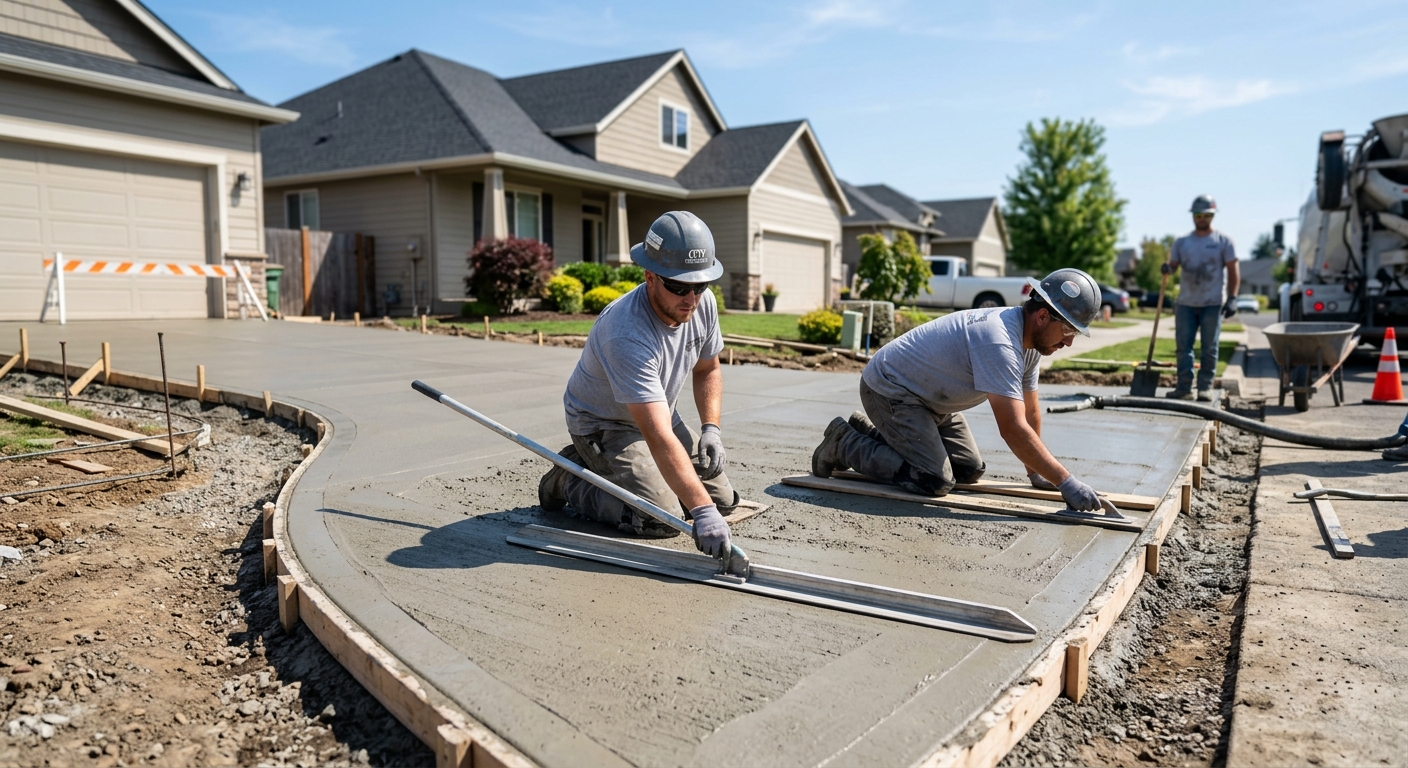
Concrete work options and costs in Junction Area
In Junction Area, Ontario, the right concrete choice usually comes down to how much wear you want to plan for—especially on exterior flatwork where freeze–thaw stress shows up over time. With a population of 14,366 (Statistics Canada, 2021 Census), this pocket of Toronto continues to attract homeowners who need durable driveways, patios, and walkways for daily use. Most residential properties here are classic GTA family homes, so demand is steady for upgrades that also improve curb appeal, like new driveway slabs and stamped patios in the neighbourhoods around St. Clair West and the Junction corridor.
Toronto-area concrete pricing is sensitive to timing and site conditions. Frost depth requirements drive footing depth and formwork height, while humid, wet shoulder seasons and occasional cold snaps affect curing and finish quality. That’s why contractors often focus exterior pours into the warmer months, then use cold-weather protection when temperatures trend down. On top of climate, labour availability and disposal/haul-off logistics can move costs up or down between quotes for the same scope—particularly where excavation is deeper or access is tight (common near established streets).
Below is a practical cost comparison to help you budget. Use these ranges as a starting point, then tighten your quote with specs for air-entrainment, reinforcement, base prep, and jointing.
| Application |
Typical Size |
Key Spec |
Finish Option |
Price Range |
| Concrete driveway (standard broom finish) |
400 sq. ft. (about 20 ft x 20 ft) |
Air-entrained mix, compacted granular base, control joints |
Broom finish |
$18,000–$28,000 |
| Exposed aggregate driveway |
400 sq. ft. (about 20 ft x 20 ft) |
Air-entrained mix, stone selection, base & drainage planning |
Exposed aggregate |
$22,000–$34,000 |
| Stamped concrete driveway or patio |
300 sq. ft. (about 15 ft x 20 ft) |
Air-entrained mix, reinforcement as needed, control joints |
Stamped pattern + release + seal |
$24,000–$40,000 |
| Plain concrete patio or walkway |
200 sq. ft. (about 10 ft x 20 ft) |
Compacted base, proper slope, joints |
Smooth/wood float + light broom edges |
$16,000–$26,000 |
| Garage floor (interior slab) |
500 sq. ft. (about 20 ft x 25 ft) |
Vapour barrier (as needed), reinforcement, saw-cut joints |
Plain float + densifier/seal (optional) |
$22,000–$34,000 |
| Foundation footings (structural, below frost) |
Typical small foundation perimeter |
Engineered rebar, below-frost depth forms and pours |
Structural concrete, no decorative finish |
$3,600–$7,200 |
Prices are estimates only and vary by project scope, site access and material selection.
What affects the price of concrete work in Junction Area
Even when two contractors are quoting what looks like the “same” concrete job, it’s common to see differences of 30–50% across Toronto-area projects. The big drivers are the hidden specs—how deep the base goes, what mix design is used, whether reinforcement is required, and how much protection is built into curing for our freeze–thaw cycles. In Junction Area, the starting point is the Ontario Building Code expectation that structural footings extend below design frost depth to prevent frost heave and differential settlement; that means more excavation and more formwork compared with shallow projects.
Those frost and freeze–thaw cycles dictate almost everything: exterior slabs should use air-entrained concrete to survive repeated expansion and contraction, and control joints must be planned to limit random cracking. When temperatures drop toward 10 °C or below, cold-weather curing precautions—like insulating blankets and, in some cases, supplemental heat—add cost and coordination time. De-icing salt can also accelerate surface scaling and spalling if the mix and finishing aren’t right, so sealing becomes a practical durability step.
In real Junction Area conditions, cost swings often come from soil and access. For example, a driveway replacement with poor drainage or saturated subgrade can push you toward deeper, more granular base and more time for grading; that can move a standard broom-finish driveway toward the upper part of the 18–28 band. Conversely, a small stamped patio may stay closer to the 24–40 band minimum if truck access is excellent and the excavation is shallow with good compaction.
Construction timing also matters. Many homeowners schedule spring and early summer work to avoid cold-weather curing, which can keep labour more predictable and reduce the need for add-on protection.
| Price Factor |
Why It Matters |
Cost Impact |
| Frost line depth — determines footing depth and form height |
Footings must extend below design frost to limit heave and settlement |
Higher excavation & concrete volume can raise structural costs significantly |
| Site preparation — excavation, grading, compacted granular base |
Concrete longevity depends on a stable, well-drained base |
Saturated soils or poor base can add days of work and extra aggregate |
| Reinforcement — rebar or wire mesh requirement |
Controls cracking and supports load capacity in driveway/slab areas |
More steel, chairs/ties, and placement time increase labour/material cost |
| Mix design — air-entrainment and compressive strength spec |
Air-entrainment improves freeze–thaw durability and reduces scaling/spalling |
Higher-spec mixes cost more but typically prevent early surface failure |
| Finish type — broom vs. stamped vs. exposed aggregate |
Finish complexity affects crews, materials, and sealing steps |
Stamped/exposed typically sits above standard broom finish pricing |
| Pour size and concrete truck access to site |
Access limits load counts; small lots can require pump trucks or extra logistics |
Pump rentals and extra labour for placement can add meaningful cost |
| Cold-weather curing precautions — heating and blankets |
Proper curing strength gain depends on temperature control |
Insulation/heaters and longer protection time increase total project hours |
| Control joint pattern and sealing cost |
Joints manage shrinkage cracking; sealing helps repel de-icing salts |
More saw cuts and sealer material/labour can add line-item cost |
Permits & regulations in Ontario
In Ontario, structural concrete work typically requires a building permit. That includes foundation footings, foundation walls, and grade beams—anything tied to the structural system. In many Junction Area projects, engineered drawings are also reviewed as part of the permit process, especially where soil conditions or structural loads require specific reinforcement layouts. Concrete flatwork such as patios, walkways, and driveways usually does not require a permit by itself, unless the work affects lot grading, impacts impervious surface coverage limits, or involves municipal right-of-way/sidewalk or drainage changes. Because municipal requirements can vary by site conditions, confirm with the local authority before you break ground.
Before the contractor starts, verify three things: (1) contractor accountability, (2) insurance, and (3) proof they can legally work. Step-by-step for Junction Area homeowners: first, ask the contractor for their Ontario registration/licence information and check it using the appropriate Ontario online business/contractor registry resources they reference in their paperwork. Second, request a Certificate of Insurance showing liability coverage that matches your project scope; the certificate should list you as an additional insured where applicable. Third, confirm WSIB coverage (and any applicable WCB/worker coverage for the trades they subcontract). Finally, request references for similar-size concrete work—driveways/patios with comparable access challenges—and speak to homeowners about base prep and cracking performance after freeze–thaw seasons.
Getting concrete right in Junction Area's freeze-thaw climate
Concrete failures in Junction Area usually start long before the surface looks “bad.” The most common problem is spalling and scaling from freeze–thaw, triggered by inadequate air-entrainment, insufficient curing protection, or a weak/poorly drained base. To spec the job correctly in this Toronto freeze–thaw environment, focus on five fundamentals: (1) base preparation, (2) mix design, (3) control joints, (4) curing, and (5) sealing.
Base prep means compacted granular sub-base to the right depth for local soils and frost considerations, then proper slope so water can drain away instead of saturating and expanding. Mix design should include air-entrainment for exterior flatwork (typically 5–7% air) and a minimum 32 MPa compressive strength spec to support durability. Control joints are your “planned cracks”—they reduce random cracking by creating stress-release points at an appropriate spacing. Curing should include at least 7 days under proper conditions; in cold snaps, insulating blankets and careful protection help strength gain and reduce early damage. Finally, sealing with a penetrating sealer after the slab has properly cured (often around 28 days) helps repel de-icing salts.
When it’s priced right, the cost difference is often justified. For example, moving from a plain broom-finish patio to a standard-sealed exterior slab can cost modestly compared with stamped work—where you’re commonly closer to the $24–$40 stamped band because of labour, pattern materials, and finishing steps. If your base and air-entrainment are done well, you’ll get durability first; appearance upgrades should come second.
| Spec |
Why It Matters in Junction Area |
What to Ask For |
Impact if Skipped |
| Compacted granular base (depth?) |
Stable support reduces differential movement during freeze–thaw |
Confirm granular type and compaction method; specify base thickness for your soil |
Settlement, cracking, and water pooling that accelerates scaling |
| Air-entrained concrete mix (target air %?) |
Air void system helps concrete survive repeated freezing and thawing |
Ask for target air content (typically 5–7% for exterior flatwork) |
Higher risk of spalling and surface scaling in winter |
| Compressive strength (MPa rating) |
Strength gain supports long-term durability and load performance |
Request minimum 32 MPa compressive strength |
Weaker concrete, faster wear, and more joint failure under traffic |
| Control joints (spacing per ACI guidelines) |
Manages shrinkage and temperature-related cracking patterns |
Ask for joint spacing, saw-cut timing, and thickness plan |
Random cracking that can widen and trap water |
| Minimum 7-day curing period |
Proper curing improves strength development before freeze–thaw seasons |
Confirm cure protection plan; ask what happens if temps drop |
Reduced strength and increased early cracking/spalling |
| Penetrating sealer (when applied after cure) |
Helps repel de-icing salts and reduces moisture uptake |
Ask when sealer is applied (often after full cure, around 28 days) |
More salt scaling and faster surface deterioration |
How to choose a concrete work contractor in Junction Area
Choosing the right concrete contractor in Junction Area is mostly about verification and clarity. In Ontario, start by confirming licensing/registration information the contractor provides and checking it through the appropriate Ontario online resources they reference. Then verify insurance: request a Certificate of Insurance showing liability coverage for the project and ensure it’s active for the job dates. For worker protection, ask for proof of WSIB coverage (and coverage for any subcontractors where applicable). Don’t assume—collect the paperwork up front and keep copies for your records.
Next, require 2–3 itemised written quotes rather than a single lump sum. You want line items for excavation and disposal, granular base, reinforcement, concrete supply and placement, finishing, saw-cutting, curing protection, and sealing (if included). Read what’s excluded: for example, is permit support included, is pump/telehandler access included, and is snow/ice removal from the site accounted for if a pour gets delayed?
Warranty matters too. Ask for workmanship warranty length in writing, product/manufacturer warranty details for any membranes/sealers, and whether the warranty transfers to a new homeowner if you sell. For payments, a safe approach is to never pay more than 10–15% upfront; hold back a portion until completion and cleanup are done. Finally, get the start date and estimated completion date in writing so you can plan around the GTA pour season and avoid rushed cold-weather cures.
- Ask for air-entrainment target and compressive strength spec on the quote
- Confirm granular base type and compaction method (not just “base included”)
- Request joint spacing and whether joints are saw-cut or formed
- Clarify reinforcement (mesh vs rebar, sizing, and where it’s installed)
- Ask how they protect curing concrete if overnight temperatures drop
- Confirm disposal/haul-off is included if they excavate to frost-appropriate depth
- Verify insurance coverage limits and request COI dates matching your schedule
- Request WSIB proof and confirm subcontractors are covered
- Ask for a detailed schedule: demo, excavation, base, pour, curing, seal (if included)
- Require itemised labour and materials, not one “concrete supply + labour” total
- Review warranty terms for workmanship and any exclusions (salt use, traffic timing)
- Confirm payment schedule and holdback amount in the contract
Concrete contractor red flags in Junction Area: vague specs (“regular concrete” without air content), no discussion of base depth and drainage, quotes that don’t mention jointing or curing protection, claims of “no need for sealing” where de-icing salt is expected, and refusing to provide insurance/WSIB documentation or itemised line items.
Frequently asked questions — concrete work in Junction Area
Concrete vs pavers for a patio in Junction Area?
For most Junction Area homeowners, concrete and pavers can both work, but they fail differently in our Toronto freeze–thaw cycle. Concrete patios (properly air-entrained, with good base compaction and control joints) tend to be lower maintenance and easier to keep flat over time. Pavers can shift if the base isn’t stabilized, but they allow individual panel replacement if something does move. Cost-wise, a plain concrete patio commonly fits in the $16,000–$26,000 band for typical residential sizes, while higher aesthetics like stamped concrete often falls into the $24,000–$40,000 range. If you’re getting frequent drainage runoff or heavy foot traffic, concrete with the right slope and sealing is usually a strong value—provided the contractor specifies air-entrainment and joint strategy, not just thickness.
How long does a concrete driveway last?
A well-built driveway in Ontario can last 20–30 years or more, but the timeline depends on freeze–thaw durability details. In Junction Area, the two biggest predictors are whether the mix is air-entrained for exterior exposure and whether the base is properly graded and compacted so water doesn’t sit under the slab. Control joints also matter because they guide cracking instead of letting random cracks widen and hold moisture. Many driveways fail early when de-icing salt is used on unsealed or under-specified concrete, leading to scaling or spalling. If your quote is in the $18,000–$28,000 band, ask whether sealing is included and whether cold-weather curing protection is used if the pour schedule slips.
What is air-entrained concrete and why does it matter here?
Air-entrained concrete is designed with microscopic air bubbles that give freezing water places to expand without destroying the cement paste. In Ontario’s repeated freeze–thaw cycles, that’s the difference between concrete that survives winter and concrete that scales or spalls over a few seasons. For exterior flatwork in Junction Area—driveways, patios, and walkways—contractors typically target air content in the 5–7% range and pair it with adequate thickness, reinforcement as needed, and properly placed control joints. If a contractor won’t discuss air-entrainment targets, they’re usually saving cost on the very spec that protects the slab during temperature swings.
How do I prepare the base for a concrete slab?
Base preparation should be treated as a full scope item, not an afterthought. For Junction Area projects, the contractor should excavate to the design grade and remove unsuitable material, then install compacted granular base to the specified depth for your soil and frost considerations. The base needs to be graded with the right slope for drainage, compacted in lifts, and leveled before any reinforcement is set. If the subgrade is saturated or unstable, you may need additional granular import, geotextile separation, or enhanced drainage detailing—these are common reasons quotes differ by 30–50% in the Toronto region. Ask your contractor to list the granular type, compaction approach, and whether drainage is included in the scope.
How do I compare concrete quotes?
To compare concrete quotes fairly in Junction Area, insist on itemised breakdowns: excavation and disposal, base material and depth, reinforcement, concrete mix spec (including air-entrainment and compressive strength), finishing method, curing protection, jointing plan, and sealing schedule. Watch for “apples-to-oranges” quotes where one price includes saw cutting, sealing, and proper curing blankets while the other leaves those out or describes them vaguely. Also compare the scope around access—if one contractor includes pump/telehandler logistics for a tight lane or driveway tie-in, that can explain differences without cutting corners. Finally, check the contractor’s insurance and WSIB coverage; a cheaper quote with missing documentation is a risk you don’t want to pay for later. For budget context, basic exterior work often starts in the $16,000–$28,000 ranges, with stamped finishes typically higher.
Can concrete be poured in cold weather in Junction Area?
Concrete can be poured in cold weather in Ontario, including Junction Area, but it should be done with a real cold-weather plan—not just “we’ll cover it.” The key is curing: you need to maintain proper temperature and protection so the concrete reaches adequate early strength before freezing. Contractors typically use insulating blankets, temperature monitoring, and sometimes supplemental heating around the pour and curing period when conditions drop toward 10 °C or below. If the quote doesn’t mention cold-weather curing precautions, ask directly. Also note that shorter daylight and faster temperature swings in the GTA can extend protection time and affect scheduling. It’s one reason reputable crews prioritize warmer pour windows. If weather forces a pour, ensure the contractor’s curing and protection steps are clearly written into the contract.