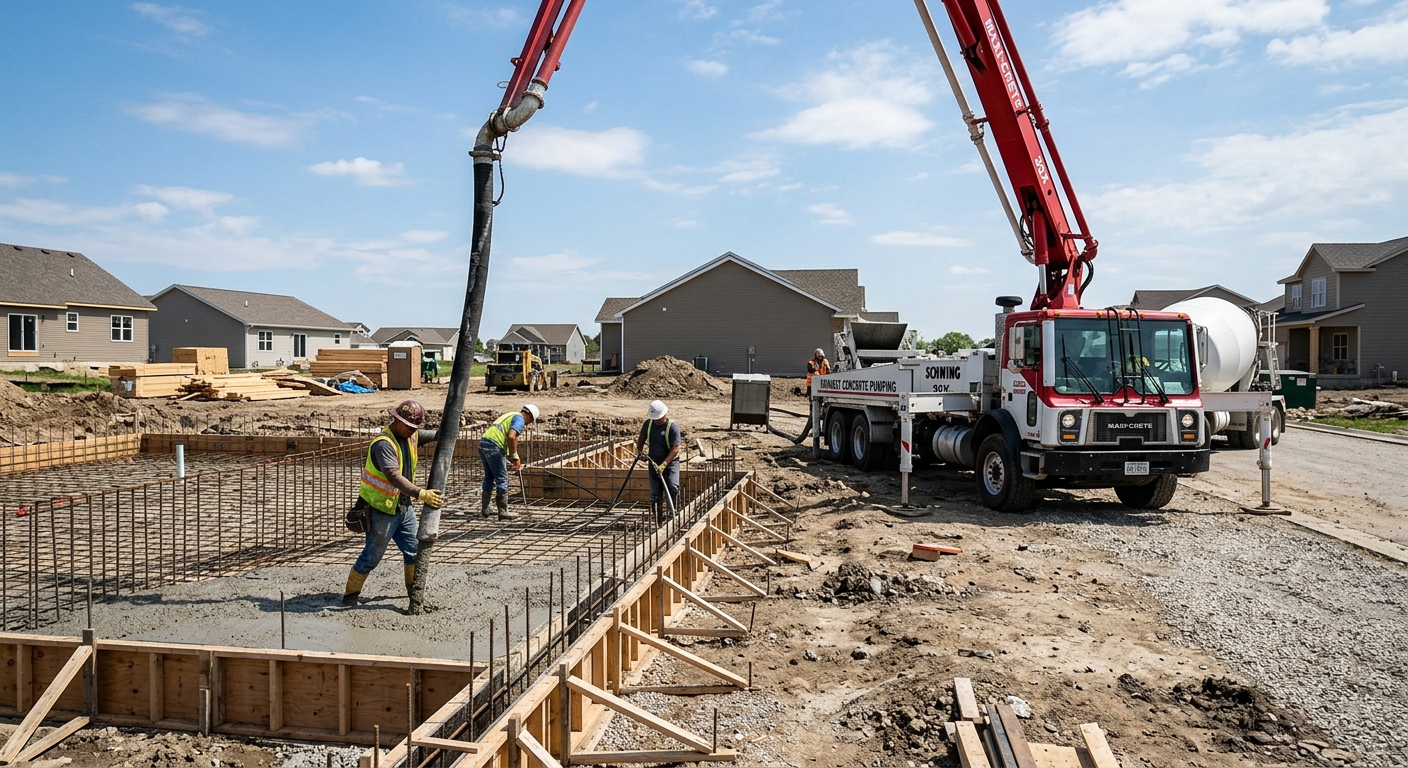
Concrete work options and costs in Newmarket
Newmarket is one of those GTA communities where homeowners expect concrete to last through long winters and wet shoulder seasons. With 59.8% of dwellings being single-detached homes (Statistics Canada, 2021 Census), driveways, patios and walkway repairs are constant across neighbourhoods like Bayview Heights and Central Newmarket—especially when owners upgrade entry paths, replace old slabs, or expand entertaining spaces. It’s also common to see work demand rise as older housing stock ages: 30.1% of homes were built before 1981 (Statistics Canada, 2021 Census), which often means earlier concrete and drainage details no longer match today’s needs.
In the Toronto economic region, concrete pricing is strongly influenced by frost depth and freeze–thaw cycles. Ontario Building Code expectations generally push structural footings to extend at least 1.2 m (about 4 ft) below grade, and exterior flatwork needs well-compacted granular base and proper drainage so saturated soils don’t expand and contract against the slab every winter. Contractors also manage a shorter, more temperature-sensitive pour window: in Newmarket, pours are usually concentrated in warmer months to protect curing, and crews plan for cold nights when temperatures drop toward 10 °C. That’s why you’ll often see quotes differ on the same scope—better base prep, air-entrained mixes, thicker slabs, and more robust jointing cost more, but they reduce repeat repairs.
Below are typical project ranges you can use to compare quotes for common concrete work in Newmarket before we get into the factors that swing pricing.
| Application |
Typical Size |
Key Spec |
Finish Option |
Price Range |
| Concrete driveway (standard broom finish) |
300–400 sq. ft. |
Air-entrained mix, compacted granular base, control joints |
Broom finish |
$18,000–$28,000 |
| Exposed aggregate driveway |
300–400 sq. ft. |
Air-entrained mix, proper base, seeding/finishing plan |
Exposed aggregate |
$22,000–$34,000 |
| Stamped concrete driveway or patio |
250–350 sq. ft. |
Air-entrained mix, thicker sections for texture, joint plan |
Stamp + release + coloring |
$24,000–$42,000 |
| Plain concrete patio or walkway |
150–300 sq. ft. |
Sloped to drainage, compacted base, joints where needed |
Float/trowel + broom or light texture |
$16,000–$26,000 |
| Garage floor (interior slab) |
240–520 sq. ft. |
Vapour control as required, reinforcement where specified |
Broom finish or smooth trowel |
$10,000–$20,000 |
| Foundation footings (structural, below frost) |
Varies with design |
Engineered footing sizes, below-grade formwork, rebar per plans |
Structural concrete |
$3,600–$7,500 |
Prices are estimates only and vary by project scope, site access and material selection.
What affects the price of concrete work in Newmarket
In the Toronto economic region, quotes for the “same” concrete job can vary by 30–50% because contractors price risk differently: soil conditions, excavation quantity, rebar requirements, access for a concrete truck, and how much time is spent getting the base right. Concrete itself may look straightforward, but in Newmarket (and across the GTA), freeze–thaw makes every spec matter—especially exterior work. Frost depth and winter cycles dictate that structural footings extend below design frost depth to prevent frost heave and differential movement, and most exterior slabs require an air-entrained mix to survive repeated expansion and contraction. When temps drop toward 10 °C or below, curing management becomes a real cost driver; some contractors add insulation blankets, heaters, or longer protection to meet durability targets instead of rushing the schedule.
Two common examples in Newmarket: (1) older homes near Central Newmarket or Bayview Heights often have mature landscaping and tighter driveways, so excavation and formwork take longer, and truck placement may require smaller pours—this can push driveway pricing toward the upper end of the $18–$28 per sq. ft. style bands you’ll see for driveways. (2) If your soil stays wet or drainage isn’t addressed, contractors need extra granular base depth and more robust slope/drainage, which increases the job cost but reduces spalling and scaling. Decorative work also changes the economics: stamped concrete typically carries a higher finish cost (commonly in the $24–$40 band depending on scope and texture) because it requires more crew time, controlled finishing, and a tighter joint plan.
When homeowners choose a “cheaper” option without the right base or jointing, it often shows up a few winters later—exactly when freeze–thaw stresses the surface. That’s why the lowest bid can cost more long-term.
| Price Factor |
Why It Matters |
Cost Impact |
| Frost line depth — determines footing depth and form height |
Deeper footings reduce frost heave and movement |
Can add substantial excavation and formwork costs |
| Site preparation — excavation, grading, compacted granular base |
Proper base prevents settlement and pumping under freeze–thaw |
Higher base depth and haul-away can increase labour and materials |
| Reinforcement — rebar or wire mesh requirement |
Controls cracking and supports slab performance where loads are higher |
Additional steel, tie-wire, chairs, and labour |
| Mix design — air-entrainment and compressive strength spec |
Air-entrainment helps resist freeze–thaw scaling/spalling |
Higher-quality mix and testing/spec compliance |
| Finish type — broom vs. stamped vs. exposed aggregate |
Complex finishes add steps and higher labour time |
Stamped/exposed usually increases cost vs plain broom |
| Pour size and concrete truck access to site |
Access affects how efficiently the crew can place and finish |
Extra crew time and possible smaller pours/extra equipment |
| Cold-weather curing precautions — heating and blankets |
Durable concrete needs protected, controlled curing |
Heaters/blankets and longer protection periods |
| Control joint pattern and sealing cost |
Joints manage shrinkage cracking; sealing helps resist water intrusion and de-icers |
Sealant/materials and additional scheduling after cure |
Permits & regulations in Ontario
In Ontario, structural concrete work generally requires a building permit and often engineered drawings reviewed by the municipality. That includes the core items that carry load: foundation footings, foundation walls, and grade beams. For concrete flatwork—driveways, patios, and walkways—a permit is often not required by default, but it can come into play if the work affects lot grading, drainage, or any municipal impervious surface/coverage requirements, or if it touches the municipal right-of-way. The safest approach in Newmarket is to confirm requirements before breaking ground.
Here’s a practical step-by-step way a homeowner can verify a contractor’s standing in Ontario:
- Confirm liability insurance: Ask for a current Certificate of Insurance showing liability coverage limits and the coverage period.
- Check WSIB status: Request proof of WSIB/WCB coverage clearance letter (or equivalent documentation). If the contractor is using subcontractors, ask about each party.
- Verify licensing/registration: Use Ontario’s business/contractor listing tools or the contractor’s registration details where available through provincial and municipal resources (and confirm the exact licence/registration type they use for their scope).
- Ask for references: Get contact info for similar-scale concrete jobs completed recently in the GTA.
- Match permits to scope: If your job includes structural elements, ensure the contractor states who pulls the permit and provides the permit number.
Doing this upfront helps prevent scope disputes and protects you if conditions change due to frost-depth excavations, groundwater, or required engineering revisions.
Getting concrete right in Newmarket's freeze-thaw climate
Concrete failures in Newmarket usually aren’t “mystery problems”—they’re tied to how the base, mix, joints, and curing respond to winter freeze–thaw. The first weak point is often base prep: if granular sub-base isn’t excavated to the right depth and compacted properly, water can collect and expand under freezing conditions. Next is mix design. Exterior flatwork should use air-entrained concrete—commonly targeting 5–7% air content—to create tiny spaces that relieve internal pressure as water freezes. Without that, you’re much more likely to see spalling and scaling on driveways and patios.
From a specification standpoint, control joints are crucial because shrinkage cracks will still happen—the goal is to guide cracking along planned joints, then seal where appropriate. For durability, aim for at least a minimum 7-day curing period under suitable protection. In the GTA, cold nights and damp fall/spring weather can slow strength gain, so crews may need blankets or heat to keep curing on track. Finally, sealing matters in Newmarket because de-icing salts accelerate surface breakdown; a penetrating sealer applied after the concrete has cured helps repel water and reduce salt intrusion.
When deciding between finishes, you’ll usually see justified cost differences where the extra steps improve performance and longevity. For example, a plain broom-finish patio might fall in the $16–$26 band, while a stamped job can land in the $24–$40 range—but that added finish cost only makes sense if the base and joint plan are done correctly. If the foundation of the slab isn’t right, decorative surfaces won’t save it from winter damage.
| Spec |
Why It Matters in Newmarket |
What to Ask For |
Impact if Skipped |
| Compacted granular base (depth?) |
Stable support reduces movement under freeze–thaw |
Base depth in inches/mm + compaction method and proof |
Settlement cracks, pumping, and faster deterioration |
| Air-entrained concrete mix (target air %?) |
Resists freeze–thaw scaling and spalling |
Target air content of 5–7% for exterior flatwork |
Surface scaling and spalling within a few winters |
| Compressive strength (MPa rating) |
Strength development supports durability and load performance |
Minimum 32 MPa (and confirm placement spec) |
Soft surface, increased cracking, reduced service life |
| Control joints (spacing per ACI guidelines) |
Controls shrinkage cracking in cold weather conditions |
Joint spacing plan + method (saw-cut timing/approach) |
Random cracking and easier water/salt intrusion |
| Minimum 7-day curing period |
Supports strength gain before winter exposure |
How they protect curing during cool nights |
Lower early strength, higher risk of early cracking |
| Penetrating sealer (when applied after cure) |
Helps repel water and salts that worsen freeze–thaw |
Schedule sealer application at about 28 days post-pour |
More salt/water absorption, faster spalling and scaling |
How to choose a concrete work contractor in Newmarket
Choosing a concrete contractor in Newmarket comes down to verifying coverage, getting apples-to-apples quotes, and making sure the scope matches the durability specs you need for Ontario winters. Start by confirming Ontario requirements: ask for a current Certificate of Insurance for liability and proof of WSIB/WCB coverage (or a clearance letter, depending on how the contractor is registered). For licensing/registration, request the specific Ontario registration they use for their work and confirm it’s active before any demolition starts. Don’t rely on verbal assurances—have them provide documents and match the company name on the paperwork to the quote.
Next, get 2–3 itemised written quotes. Ideally, you want a breakdown that separates labour, excavation/site prep, formwork, reinforcement, concrete supply, finishing, saw-cutting for joints, and disposal/hauling. Ask whether the quote includes the permit (if required), whether it covers traffic management/road access impacts, and what’s excluded (for example: removal of existing base, landscaping restoration, or underground drainage adjustments). For warranties, look for a workmanship warranty length (often different from product warranties), and clarify whether it transfers if you sell the home.
For payment, use a schedule that doesn’t front-load risk: typically no more than 10–15% upfront, then progress payments tied to milestones like base completion and pour day. Keep a holdback until final finishing, joint sealing/cleanup (where included), and walkthrough sign-off are done. Get a start date and estimated completion timeline in writing—concrete is schedule-sensitive in the GTA.
- Documents in hand: insurance and WSIB/WCB proof before signing.
- Itemised scope: base depth, reinforcement details, and finish type spelled out.
- Protection plan for curing when nights cool down.
- Joint plan included: spacing and saw-cut method/timing.
- Sealer included or clearly excluded (and if included, timing after cure).
- Haul-away/disposal stated (dump fees, trucking, and excavation changes).
- Permit pull responsibility stated for structural work.
- Site access described: truck placement, hose/boom use, and pour phasing.
- Concrete supplier/coatings noted if special mix designs are required.
- Walkthrough checklist before pour and after completion.
- Warranty in writing with coverage and exclusions clarified.
- Payment schedule with a holdback until final acceptance.
In Newmarket, concrete contractor red flags include: skipping air-entrainment on exterior slabs, refusing to provide insurance/WSIB/WCB documentation, vague quotes that don’t specify base preparation or jointing, promising “no-crack” results, and pushing a large upfront payment without milestones.
Frequently asked questions — concrete work in Newmarket
Can concrete be poured in cold weather in Newmarket?
Yes, concrete can be poured in winter conditions in Newmarket, but it needs the right cold-weather process. Once temperatures drop and curing slows, the concrete may not reach early strength quickly enough, which raises the risk of surface defects and early cracking. Ontario crews typically protect pours with insulating blankets and, when needed, temporary heating so the concrete stays within a workable temperature range during curing. It’s also why many exterior jobs are scheduled in warmer months in the Toronto area to reduce the need for extensive curing protection. If you’re comparing quotes, ask what cold-weather plan they use and whether the schedule includes the cost of heaters/blankets. As a reference point, plain exterior flatwork might sit in the $16–$26 band, but cold-weather precautions can push that upward if protection time is required.
How do I maintain concrete in Newmarket's freeze-thaw climate?
Maintenance in Newmarket is mostly about managing water and de-icing salt exposure. Keep the surface clean of grit and apply a penetrating sealer after the required cure period (commonly around 28 days) if it wasn’t included—this helps repel moisture that fuels freeze–thaw damage. Use de-icing products carefully: while they’re necessary for safety, aggressive salt use can accelerate spalling when the concrete isn’t well-protected or properly air-entrained. For small cracks, don’t ignore them—clean and seal them as recommended so water doesn’t migrate beneath the slab. Also, ensure downspouts and grading don’t direct water onto driveways and patios; drainage issues are a common cause of early failure. If your home is in an older area where 30.1% of dwellings were built before 1981 (Statistics Canada, 2021 Census), it’s worth inspecting drainage and edges annually. Preventing water intrusion usually costs far less than major replacement.
What causes concrete to spall in Newmarket winters?
Spalling (surface flaking/chipping) is most often a freeze–thaw problem tied to the concrete’s ability to handle internal pressure. The biggest culprit is inadequate air-entrainment in exterior concrete, especially when moisture gets into the surface and then freezes. Poor base preparation that allows water pooling can worsen it, because the slab experiences more moisture exposure each cycle. Another contributor is inadequate curing protection—if the concrete doesn’t gain strength properly during cool conditions, it becomes more vulnerable. De-icing salts increase the damage rate because they pull moisture into the surface pores. In Newmarket, where freeze–thaw cycles repeatedly stress exterior flatwork, air content and a robust joint/sealing plan are key. When you ask contractors for specs, focus on the mix (target 5–7% air for exterior), minimum 32 MPa strength, proper control joints, and a sealer applied after cure. These are the details that separate durable slabs from repeat repairs.
What is rebar and when is it required in Ontario?
Rebar (reinforcing steel) is used to strengthen concrete and control cracking, especially in structural elements and slabs that are designed to carry loads or resist movement. In Ontario, whether rebar is required depends on engineering design, soil conditions, and the type of concrete work. For example, foundation footings and foundation walls typically include reinforcement designed by engineers, and those structural elements generally require permits and engineered drawings. For exterior flatwork like driveways and patios, rebar or wire mesh may be specified depending on thickness, sub-base quality, and expected loading—especially where vehicle loads, uneven subgrade, or heavier use is expected. A contractor should be able to explain why they’re including (or not including) reinforcement and how it matches the slab thickness and local conditions. If you’re comparing quotes, ensure reinforcement details are stated rather than left as a vague “standard” assumption.
How long does a concrete project take in Newmarket?
Timing depends on the scope and the weather window. A typical exterior flatwork job often follows a sequence: site protection and layout, excavation and base compaction, formwork and reinforcing (if required), pour day, and then curing with required protection. Even after the concrete “sets,” strength gain continues—so you should expect more time than most people assume. For many driveway or patio projects, work can span several days, and then you’ll have a curing period before heavy loads or sealing (if included). Sealing is commonly scheduled about 28 days post-pour, so final surface protection may extend the timeline. Winter cold in the GTA can add days due to curing blankets/heating and slower strength gain. If you’re trying to plan around a sale or event, ask the contractor for a written start date and completion estimate that accounts for cure protection and joint/finishing steps—not just pour day.
What is a concrete overlay and is it suited to Newmarket?
A concrete overlay is an added concrete layer placed over an existing slab after preparation. It can be suited to Newmarket in select situations—usually when the original slab is still structurally sound, the base isn’t pumping, and the surface can be properly profiled/cleaned so the overlay bonds well. Overlays are not a cure-all: if the underlying concrete is failing from moisture intrusion, significant settlement, or widespread cracking, an overlay may crack or debond sooner and end up costing more. The biggest Newmarket considerations are freeze–thaw and water management. If water can still reach the interface or if drainage has changed, the overlay can inherit the same durability problems. If you’re considering an overlay, ask for a condition assessment: crack mapping, elevation check, and how they prepare the existing surface for bonding. As a rough guide for budgeting, overlay pricing often ends up closer to the cost of new work than homeowners expect once surface prep is extensive—especially compared with plain patio/walkway work in the $16–$26 band.