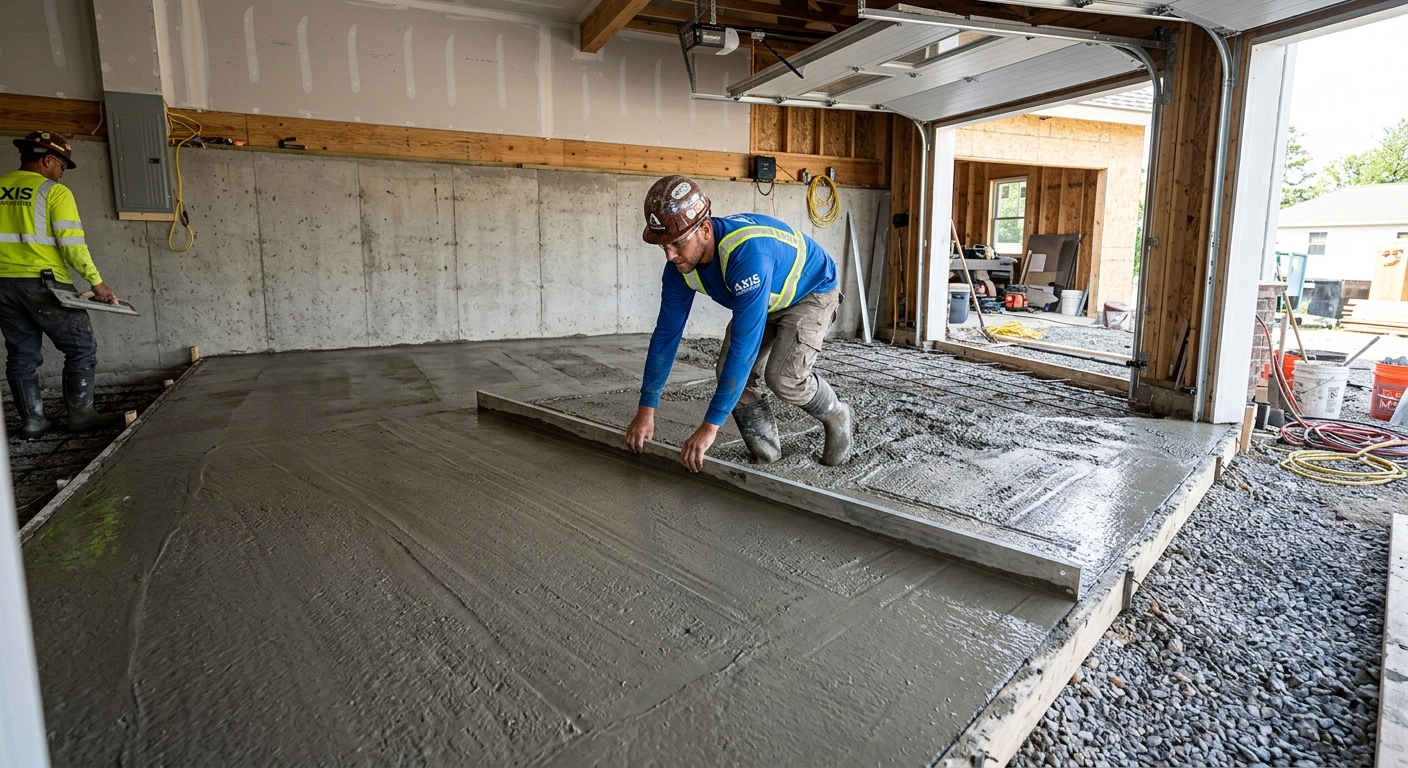
Concrete work options and costs in Parkwoods-Donalda
Parkwoods-Donalda, Ontario is a very concrete-friendly neighbourhood—especially in the south end near Donalda Club Drive and around the Don Mills Road corridor—because homeowners frequently upgrade older driveways, add patios, and replace settlement-prone walkways as they maintain their homes. With 34,805 people in the community (Statistics Canada, 2021 Census), there’s steady demand for exterior concrete work. The housing mix here is dominated by single-detached and larger properties, which typically means longer driveways and more curbside access constraints, both of which show up in contractor pricing.
In the Toronto economic region, concrete costs are driven by freeze–thaw cycles and frost depth requirements. Footings and foundation work must extend to at least 1.2 m below grade to reduce frost heave and differential movement. For exterior flatwork, contractors typically specify air-entrained mixes and control joints to manage cracking over repeated winter cycles. Scheduling matters too: most exterior pours are clustered in warmer months so concrete can cure properly, and crews often spend extra time protecting freshly placed slabs when temperatures trend toward 10 °C or below in shoulder season.
Because access, drainage, and base prep vary lot-to-lot in Parkwoods-Donalda, quotes can shift even when the finish looks similar. Use the table below as a realistic starting point for budgeting the most common options for driveways, patios, and foundation footings.
| Application |
Typical Size |
Key Spec |
Finish Option |
Price Range |
| Concrete driveway (standard broom finish) |
400–600 sq ft |
4" slab, compacted granular base, air-entrained mix |
Broom finish + control joints |
$7,200–$11,500 |
| Exposed aggregate driveway |
400–600 sq ft |
Proper base drainage, air-entrained mix, seeded/washed aggregate |
Exposed aggregate top finish |
$9,000–$14,500 |
| Stamped concrete driveway or patio |
300–500 sq ft |
Reinforcement as needed, air-entrained mix, integral colouring |
Stamp pattern + release agent + seal |
$9,000–$18,500 |
| Plain concrete patio or walkway |
120–300 sq ft |
4" (typical), granular base, air-entrained mix for exterior use |
Float/straightedge + light broom |
$2,000–$7,800 |
| Garage floor (interior slab) |
300–650 sq ft |
Vapour barrier, fibre or mesh, sealed as appropriate |
Plain + optional broom texture |
$6,200–$15,000 |
| Foundation footings (structural, below frost) |
Varies by design |
Excavation to design frost depth, engineered reinforcing, concrete below grade |
Structural concrete (no surface finish) |
$6,000–$18,000 |
Prices are estimates only and vary by project scope, site access and material selection.
What affects the price of concrete work in Parkwoods-Donalda
In the Toronto economic region, two contractors can price the “same” concrete project very differently—often by 30–50%—because the real work is in what happens before the concrete truck arrives: excavation quality, base preparation, reinforcement choices, and how the crew protects and cures the slab through Ontario’s freeze–thaw cycles. Even small differences in how thick the slab is, how deep the compacted granular base is, or how joints are planned can change both labour time and material requirements.
For Parkwoods-Donalda, frost depth and freeze–thaw cycles dictate every structural decision. Footings must extend below the design frost depth (Ontario typically requires at least 1.2 m below grade) to prevent frost heave and differential movement. Exterior flatwork also needs air-entrained concrete mixes to survive repeated winter expansion and contraction, and GTA crews often plan pours around temperature and cure conditions—especially when nights cool and temperatures drop toward 10 °C or below. Cold-weather precautions such as insulated blankets or temporary heating add cost, but skipping them risks weak surface strength and durability issues. Because de-icing salt accelerates surface wear and spalling, sealing is a frequent add-on, particularly on driveways.
Practical examples from Parkwoods-Donalda: a backyard patio may seem like “just concrete,” but if the soil is clayey or saturated, the cost climbs once we remove unsuitable material and rebuild with compacted granular base. Conversely, a short front walkway with good access and clean subgrade can land closer to the lower end of the plain patio/walkway band (about $16–$26 per sq ft). A stamped driveway is higher (often around $24–$40 per sq ft for decorative work) because it includes colouring, release, finishing labour, and curing/sealing attention—worth it when you’re trying to match a brick or stone elevation.
| Price Factor |
Why It Matters |
Cost Impact |
| Frost line depth |
Determines footing depth and form height |
$+ Excavation and concrete volume increase |
| Site preparation |
Excavation, grading, compacted granular base |
$+ More removal/compaction time when soils are poor |
| Reinforcement |
Rebar or wire mesh requirement |
$ Moderate variability depending on design and thickness |
| Mix design |
Air-entrainment and compressive strength spec |
$+ Better durability mix can cost more per yard |
| Finish type |
Broom vs. stamped vs. exposed aggregate |
$+ Decorative finishes add labour and materials |
| Pour size and concrete truck access to site |
Long pumps, staging time, restricted driveways |
$+ Extra equipment and labour if access is tight |
| Cold-weather curing precautions |
Heating and blankets in shoulder-season pours |
$+ Thermal protection and monitoring |
| Control joint pattern and sealing cost |
Crack control and resistance to de-icing salts |
$+ Adds materials/extra steps but reduces future repairs |
Permits & regulations in Ontario
In Ontario, structural concrete work—things like footings, foundation walls, and grade beams—generally requires a building permit, and municipalities often expect engineered drawings for review. That permit requirement is especially important where structural loads, foundation elevations, or soil conditions could affect long-term performance. For concrete flatwork (patios, walkways, driveways), permits are usually not required by default, unless the work impacts lot grading, affects municipal impervious surface coverage limits, or involves changes near the municipal right-of-way (for example, driveway approaches). Because rules can vary based on context and scope, you should confirm with the local authority before breaking ground in Parkwoods-Donalda.
Homeowners should also verify that the contractor carries liability insurance and has appropriate coverage for workers (commonly WSIB/WCB coverage). Ask for references on similar jobs—driveway replacements and exterior slabs are where freeze–thaw durability matters most.
Here’s a practical step-by-step process you can follow: (1) request the contractor’s certificate of insurance and confirm it covers concrete work and general liability; (2) ask for WSIB/WCB clearance documentation (or equivalent proof of coverage) and keep it on file; (3) check their registration/licensing status through Ontario’s public registry options (your contractor should provide a registration number); (4) confirm who pulls the building permit (if required) and whether the quote includes engineering drawings and inspection coordination for structural pours.
Getting concrete right in Parkwoods-Donalda's freeze-thaw climate
Concrete fails in Parkwoods-Donalda most often for predictable reasons: poor base support, inadequate air-entrainment, weak curing, and missing or poorly spaced control joints. Freeze–thaw cycles pull moisture into the slab and base; if the mix isn’t properly designed or the slab can’t relieve stress through joints, you’ll see surface scaling, spalling, and wider-than-expected cracks over the winters ahead. The fix is not “stronger concrete only”—it’s the full system.
To spec the job correctly, start with base preparation: use compacted granular sub-base to the proper depth for the expected loads and local soil conditions, then ensure drainage is directed away from the slab. Next, require an air-entrained mix with target air content for exterior flatwork (commonly about 5%–7% air, depending on the mix design), plus a minimum compressive strength of 32 MPa. Control joints matter: they should be planned so shrinkage and thermal movement crack in the right places rather than randomly. Curing is equally critical—plan for at least 7 days of curing under suitable conditions, and use cold-weather protection if temperatures drop early. Finally, sealing is a smart durability step: apply a penetrating sealer after the slab has cured (commonly around 28 days post-pour) to repel de-icing salts and reduce surface deterioration.
Dollar-wise, a stamped patio might cost more—often falling closer to the $24–$40 per sq ft decorative band—but the price is justified when you want a decorative look that still uses proper base prep and joints. On the other hand, going cheap on broom-finish driveway work without robust base and air-entrainment can lead to repeat repairs that erase the initial savings.
| Spec |
Why It Matters in Parkwoods-Donalda |
What to Ask For |
Impact if Skipped |
| Compacted granular base (depth?) |
Prevents pumping and settlement during wet spring/fall |
Base depth based on site conditions; compaction test approach |
Voids, uneven slab, rapid cracking |
| Air-entrained concrete mix (target air %?) |
Resists freeze–thaw damage and scaling |
Air content target around 5%–7% for exterior flatwork |
Spalling, surface pop-outs, early failure |
| Compressive strength (MPa rating) |
Supports loads and durability through seasonal movement |
Minimum 32 MPa (or engineered spec if required) |
Surface wear, reduced structural performance |
| Control joints (spacing per ACI guidelines) |
Keeps cracks where they’re planned, not random |
Joint layout and cutting schedule for your slab size |
Wider random cracking, water intrusion |
| Minimum 7-day curing period |
Develops strength before winter stresses hit |
Confirm curing protection plan; cold-weather steps if needed |
Lower strength, surface scaling and cracking |
| Penetrating sealer (when applied after cure) |
Helps protect against de-icing salts used in Ontario winters |
Sealer type and timing (commonly ~28 days after pour) |
Faster salt damage and loss of surface quality |
How to choose a concrete work contractor in Parkwoods-Donalda
Start with credibility. In Ontario, verify the contractor’s ability to legally work and insure against risk: request their liability insurance certificate and read the coverage details (the policy should cover concrete-related operations). Ask for WSIB/WCB clearance documentation for workers so you’re not stuck with liability if someone is injured on site. Then confirm licensing/registration status through Ontario’s public registry options—the contractor should provide a registration number you can verify online.
Next, don’t just request a number—request an itemised quote. Get 2–3 written estimates that break labour and materials, not a single lump sum. You want line items for excavation, forms, granular base, reinforcement (if included), concrete supply and air-entrainment mix design, finishing, curing/protection, saw-cut control joints, sealing, and disposal. Confirm exclusions: is permit pull included if required, is over-excavation for unsuitable soil included, and what’s the plan for removing the existing slab?
Warranty matters. Ask for the workmanship warranty length, what it covers (cracks from shrinkage vs. structural settlement), and whether it’s transferrable if you sell your home. For payment, use a practical schedule: never pay more than 10–15% upfront; hold back a portion until completion and final walkthrough. Finally, put the timeline in writing: start date, curing/protection period, and estimated completion date.
- Ask for proof of liability insurance and WSIB/WCB clearance before scheduling.
- Confirm who pulls permits for structural work and whether inspections are included.
- Require air-entrainment for any exterior slab and confirm the target range.
- Demand base prep details: granular depth, grading, and how it’s compacted.
- Check whether reinforcement is included (mesh vs. rebar) and why.
- Get the joint plan: spacing, cutting schedule, and sealing approach.
- Ask how they protect curing if nights cool early in fall.
- Confirm concrete thickness for driveways vs. patios and the load assumptions.
- Verify disposal/recycling of removed concrete is included or quoted separately.
- Review finish samples for broom vs. stamped vs. exposed aggregate look.
- Understand the warranty terms in plain language (what triggers service).
- Keep a final payment holdback until you accept surfaces and edges.
Concrete red flags in Parkwoods-Donalda include: “too-thin” slabs with minimal base prep, quotes that skip air-entrainment for exterior work, no plan for control joints, vague curing statements (especially for pours near cooler temperatures), and contractors who won’t provide insurance/WSIB/WCB documentation or itemised line items.
Frequently asked questions — concrete work in Parkwoods-Donalda
Why does concrete crack in Parkwoods-Donalda and how is it prevented?
Concrete in Parkwoods-Donalda cracks mainly due to shrinkage, temperature movement, and freeze–thaw stresses that come from moisture cycling in winter. When base prep is weak or drainage allows water to pool, the slab can settle or “pump,” widening cracks over time. Prevention starts with the right system: a properly compacted granular base, an air-entrained exterior mix (to resist freeze–thaw scaling and spalling), and a designed control joint pattern that gives shrinkage a predictable place to crack. Proper curing is also essential—at least 7 days under good conditions—because early damage can show up as surface crazing and later cracking. If de-icing salts are used (common in Ontario winters), sealing after full cure around 28 days helps reduce surface deterioration that can turn minor cracks into bigger problems. (Statistics Canada, 2021 Census)
Stamped vs broom-finish concrete — cost difference?
Stamped concrete costs more than broom-finish because it includes colouring, release agents, and extra labour to place and texture the moulds while the mix is workable. In Parkwoods-Donalda, the practical difference shows up in both materials and time on site—broom-finish driveways are usually a simpler build, while stamped driveways and patios require careful finishing and sealing coordination. As a baseline, typical decorative work in Ontario often falls around $24–$40 per sq ft, while standard driveway flatwork can land around $18–$28 per sq ft depending on thickness, base prep, and site access. You’ll also see price variation based on whether reinforcement is added and how many joints are planned. If you choose stamped, make sure the contractor still specifies air-entrainment and proper jointing—otherwise you pay for the look but lose long-term durability.
When is the best time to pour concrete in Parkwoods-Donalda?
The best time to pour in Parkwoods-Donalda is during the warmer, steadier part of the season—generally late spring through summer—when temperatures support consistent finishing and curing. Toronto-area crews concentrate exterior pours because concrete needs appropriate curing conditions; if temperatures drop toward 10 °C or below soon after placement, strength gain slows and surface damage risk increases. That doesn’t mean you can’t pour in shoulder season, but expect added protection steps such as insulating blankets or temporary heating, which affect cost. For scheduling, plan around site access too—excavation and base work often take several days, and busy driveways near Don Mills Road can require tighter staging. If you’re budgeting, decorative stamped work (often closer to the higher band) is especially sensitive to weather because timing affects how long colour and texture tools stay “in window.”
How long does concrete take to cure?
Concrete typically needs at least 7 days to cure properly for many flatwork projects, but “cure time” has a few layers. Strength development continues beyond the first week, and full durability and sealing readiness are usually based on reaching a strong cure state—commonly around 28 days before applying a penetrating sealer for exterior slabs. In Parkwoods-Donalda, freeze–thaw risk makes curing protection more important than in milder climates. If you pour late in the season and the temperature drops quickly, crews should protect the slab to maintain curing conditions and avoid early surface scaling. Your contractor should explain the curing plan (including any blankets/heating if needed) and provide details on when saw-cut control joints are planned. For driveways and patios, sealing timing matters because de-icing salts can start harming unprotected surfaces sooner.
Do I need a permit for concrete work in Ontario?
In Ontario, structural concrete work—such as footings, foundation walls, and grade beams—generally requires a building permit and often engineered drawings reviewed as part of the approval process. For concrete flatwork like patios, walkways, and driveways, permits are usually not required by default, unless the work changes lot grading, impacts impervious surface coverage rules, or affects municipal right-of-way areas (for example, driveway approach boundaries). In Parkwoods-Donalda, it’s smart to confirm before breaking ground because the answer can depend on whether you’re simply replacing a slab or changing drainage and elevations. Always ask your contractor what they’re handling: permit pull responsibility (if required), inspection scheduling, and whether disposal and site re-grading are included.
Concrete vs pavers for a patio in Parkwoods-Donalda?
Concrete and pavers are both viable for patios in Parkwoods-Donalda, but they behave differently over time. Concrete is often less expensive upfront and can be a great fit when you want a smooth, monolithic surface and your base is properly built for freeze–thaw. Plain patio concrete typically ranges from about $16–$26 per sq ft depending on thickness, access, and finish. Pavers can be easier to repair locally—if a section shifts or heaves, you may replace only a small area. However, pavers require careful base preparation and jointing (sand and maintenance) to prevent weed growth and edge movement. If your goal is durability with minimal ongoing maintenance in a climate where moisture cycles are common, correctly specified air-entrained concrete with control joints and sealing often performs well. If you love design flexibility or anticipate easier localized repairs, pavers may be worth the investment.