Concrete work options and costs in Parry Sound
Parry Sound is a cottage-and-year-round community where driveways, patios and walkways see heavy traffic from spring melt, summer use, and winter freeze–thaw. With 53.6% of dwellings being single-detached homes in the area (Statistics Canada, 2021 Census), a lot of concrete work is flatwork—especially new driveways, garage slabs, and patio upgrades that improve traction and curb appeal.
Concrete pricing here is also shaped by the area’s older housing stock: 69.6% of homes were built before 1981 (Statistics Canada, 2021 Census). That matters because older properties often need more prep—removing failing slabs, regrading to fix drainage, and rebuilding base materials around foundations and walkways.
Local climate plays a big role in the cost and scheduling. Parry Sound sees real winter severity, so every exterior pour needs an air-entrained mix, proper compaction, and a tight plan for curing. When temperatures drop early, crews may need curing blankets and insulated protection to avoid weak, scaling-prone concrete surfaces. On top of that, de-icing salt can be hard on untreated concrete, so many homeowners budget for penetrating sealer to reduce surface spalling and water intrusion.
In Parry Sound, concrete demand is especially strong in neighbourhoods and shoreline areas with lots of repeat driveway and walkway replacements—commonly around town links and access routes that service homes off Highway 400 and the downtown core. If you’re comparing options, the table below shows typical project sizes and realistic price bands for each common concrete type.
| Application |
Typical Size |
Key Spec |
Finish Option |
Price Range |
| Concrete driveway (standard broom finish) |
400 sq. ft. (about 20 ft x 20 ft) |
6 in. reinforced slab (wire mesh or rebar) + compacted granular base |
Broom finish, light edge rounding |
$18,000–$28,000 |
| Exposed aggregate driveway |
400 sq. ft. (about 20 ft x 20 ft) |
Exposed-aggregate mix + proper drainage and finishing timing |
Exposed aggregate surface with sealer |
$22,000–$34,000 |
| Stamped concrete driveway or patio |
300 sq. ft. driveway apron or patio area |
Air-entrained exterior mix + integral colour + reinforcement |
Stamped pattern (slip-resistant release) |
$25,000–$40,000 |
| Plain concrete patio or walkway |
200 sq. ft. patio or 60–80 sq. ft walkway |
4 in. slab + compacted base, control joints |
Light broom or steel-trowelled (typically broom outdoors) |
$15,000–$25,000 |
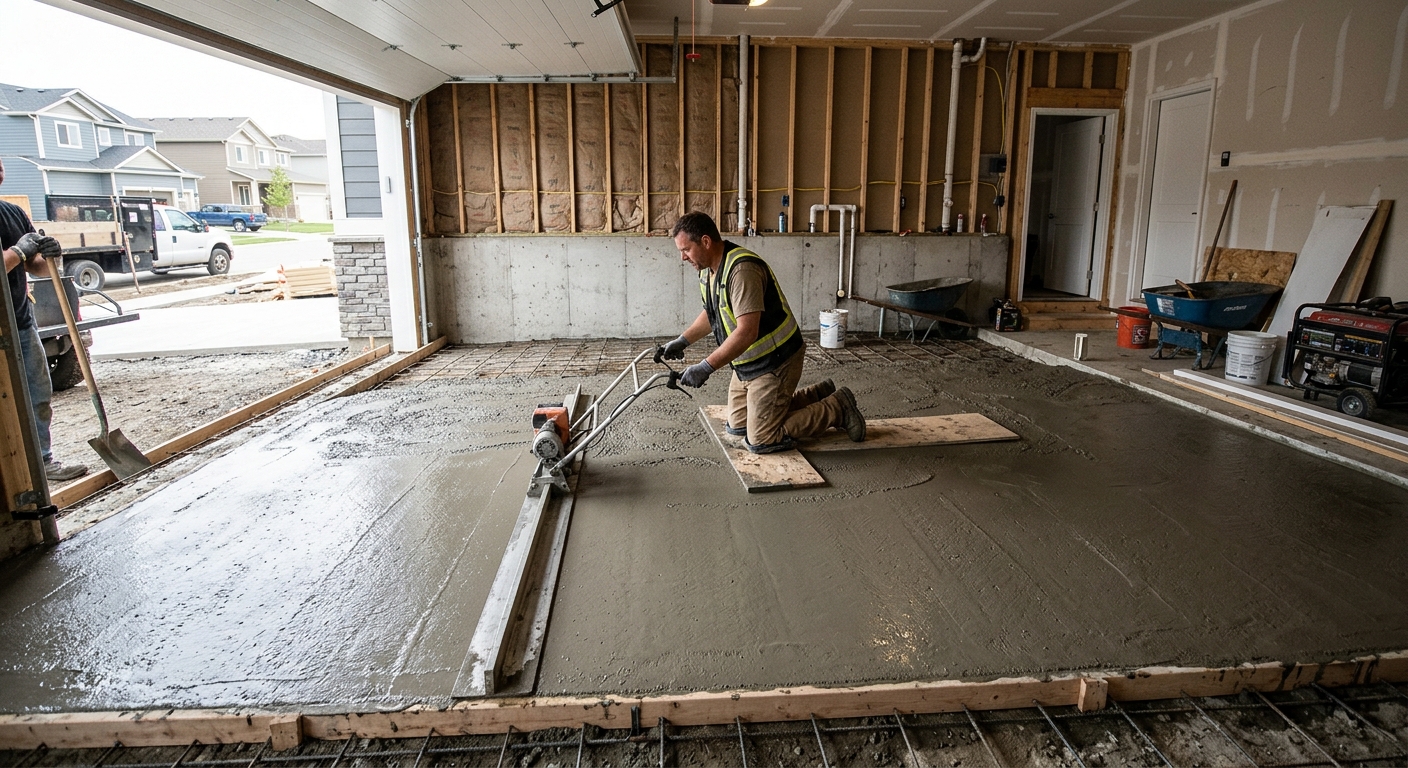
| Garage floor (interior slab) |
480 sq. ft. (about 20 ft x 24 ft) |
4–5 in. slab, vapour considerations, reinforcement |
Steel trowel finish, sealed or unsealed |
$18,000–$30,000 |
| Foundation footings (structural, below frost) |
Varies by home size; typical 1,000–1,800 lin. ft equivalent forms/support |
Engineered design, excavate to frost depth, concrete and rebar per plan |
Structural grade concrete |
$55,000–$90,000 |
Prices are estimates only and vary by project scope, site access and material selection.
What affects the price of concrete work in Parry Sound
In Parry Sound and across Northeast Ontario, two contractors can quote the “same” concrete driveway and still land 30–50% apart. The gap usually isn’t the concrete itself—it’s the hidden work: how much excavation is needed, how much base and reinforcement you truly get, and whether cold-weather curing precautions are included. Parry Sound also sits in a market where many crews balance residential work with a seasonal schedule, so availability during the short window for exterior concrete can move pricing.
At the spec level, frost exposure and freeze–thaw cycles dictate the design. Footings and grade beams (where applicable) must extend below the design frost depth to prevent frost heave and slab movement, and exterior flatwork must use air-entrained concrete to resist damage from repeated freezing and thawing. Cold weather also shortens the workable pour period and can force additional labour for protection—heating, insulating blankets, and curing time management—so you’re buying durability, not just a surface. Finally, de-icing salt accelerates surface scaling if the mix and finishing aren’t right; that’s where sealing becomes a practical cost add-on.
Here are a few real Parry Sound examples of cost drivers that move totals up or down. If your driveway needs full-depth removal and regrading due to drainage issues, base prep can add thousands of dollars. If the soil is frost-susceptible or you have soft spots near downspout discharge, expect extra granular base and compaction work before the pour—often pushing pricing toward the higher end of $18,000–$28,000 for standard driveways. Conversely, if you’re replacing a simple patio slab on solid base with good access, a plain pour can land closer to $15,000–$25,000 for the typical patio/work range. On older homes built before the early 1980s, drainage retrofits are common, and those retrofits can be a major portion of the overall budget.
| Price Factor |
Why It Matters |
Cost Impact |
| Frost line depth |
Determines footing depth and form height to resist frost heave |
Higher excavation and formwork; can add significant labour for foundations |
| Site preparation |
Excavation, grading, and compacted granular base affect settlement and cracking |
More prep = higher material and equipment costs; reduces callbacks |
| Reinforcement |
Rebar or wire mesh improves crack control and slab durability |
Additional steel and installation labour; often worth it outdoors |
| Mix design |
Air-entrainment and compressive strength spec for freeze–thaw survival |
Premium mix and batching; helps prevent spalling and scaling |
| Finish type |
Broom vs. stamped vs. exposed aggregate changes finishing time and materials |
Stamped/exposed usually adds labour and product; shifts toward higher bands |
| Pour size and concrete truck access |
Distance and access affect pumping, labour, and schedule |
Pumping or longer carries can add charges; tight sites raise costs |
| Cold-weather curing precautions |
Heating blankets and protected curing prevent weak, early-freezing concrete |
Extra materials and time; essential when temps drop near set |
| Control joint pattern and sealing cost |
Joints manage cracking; sealing repels moisture and de-icing salts |
Better cracking control reduces long-term repair; sealing adds a defined line item |
Permits & regulations in Ontario
In Ontario, structural concrete work generally needs municipal approval. For Parry Sound homeowners, that means projects like concrete footings, foundation walls, grade beams, and any reinforced structural elements typically require a building permit, and the municipality often expects engineered drawings or stamped calculations. Concrete flatwork such as patios, walkways, and driveways usually does not require a permit by itself, but it can trigger requirements when it affects lot grading, drainage patterns, or impervious surface coverage limits—especially if you’re changing elevations near the foundation or altering discharge routes.
Before breaking ground, verify your permit expectations with the local authority. Also confirm the contractor is properly insured and compliant: ask for evidence of liability insurance and proof of workplace coverage (WSIB/WCB, depending on the coverage structure used). Get references on similar-scale work in the Parry Sound area so you can see the finished slab, jointing, and drainage details.
Step-by-step verification you can do:
- Check the contractor’s Ontario business presence and licensing/registration information via provincial registries when applicable (and confirm they’re actively operating).
- Request a current Certificate of Insurance (COI) for liability—ensure it lists you (or your property) appropriately if that’s standard for your agreement.
- Ask for WSIB/WCB clearance documentation or proof of coverage, and verify the information is current.
- Confirm who pulls the permit (if required) and whether it’s included in the quoted scope.
- Review past project photos for exterior freeze–thaw performance: look for sealed edges, straight control joints, and no early scaling.
Getting concrete right in Parry Sound's freeze-thaw climate
Concrete failures in Parry Sound almost always trace back to a few preventable issues: poor base preparation, the wrong mix for exterior freeze–thaw, missing or poorly planned control joints, and inadequate curing. In a freeze–thaw environment, water expands in pores and along microcracks; that pressure can lead to scaling and spalling if air-entrainment and curing aren’t correct.
To spec your job correctly, start with base preparation. The slab needs a properly compacted granular sub-base to the right depth for local soils and frost conditions—then the concrete can be placed on a stable platform. Next is mix design: for exterior flatwork, air-entrainment is critical (commonly 5–7% air content for the right exterior performance) and the mix should meet a minimum 32 MPa compressive strength. Control joints matter because they “tell” the concrete where to crack—typical spacing should be planned to manage random cracking rather than letting joints wander. Curing is the durability step most people underestimate: give the concrete minimum 7 days under proper conditions, and if cold weather is in the forecast, use protection (blankets/insulation) and follow cold-weather practices.
Finally, sealing helps Parry Sound homeowners deal with moisture and de-icing salts. Apply a penetrating sealer after the cure is complete—commonly around 28 days post-pour—so it repels water and reduces freeze damage.
A concrete example: a broom-finished driveway at about $18,000–$28,000 can cost less than a stamped option (often $25,000–$40,000 for driveways/patios), but the real “value difference” is only justified if the base, air-entrainment, joints, and curing are equally done. If those fundamentals aren’t solid, the cheaper broom job will still fail—just with less decorative payoff.
| Spec |
Why It Matters in Parry Sound |
What to Ask For |
Impact if Skipped |
| Compacted granular base (depth?) |
Reduces settlement and limits frost-related movement under slabs |
Base depth and compaction method stated in writing |
Cracking, uneven slab, and faster deterioration |
| Air-entrained concrete mix (target air %?) |
Helps concrete resist freeze–thaw damage |
Target air content for exterior flatwork (commonly 5–7%) |
Higher risk of scaling and spalling, especially near edges |
| Compressive strength (MPa rating) |
Ensures the concrete reaches design strength for durability |
Minimum 32 MPa (or higher as specified) shown on the mix spec |
Weak surface, wear, and early failure under traffic |
| Control joints (spacing per ACI guidelines) |
Controls where shrinkage cracking occurs |
Planned joint spacing and location around curves/fixtures |
Random cracking that’s harder to repair neatly |
| Minimum 7-day curing period |
Cold nights and early freezing can prevent full strength gain |
Curing plan, temperature protection steps if nights are cold |
Lower strength and surface scaling risk |
| Penetrating sealer (when applied after cure) |
Reduces water and salt penetration during winter season |
Sealer type and timing (commonly after 28 days cure) |
Faster surface degradation and higher water absorption |
How to choose a concrete work contractor in Parry Sound
Choosing a concrete contractor in Parry Sound comes down to proof: proof of coverage, proof of capability, and proof that the bid reflects the freeze–thaw realities of Ontario. Start with licensing/registration information as applicable in Ontario, then verify insurance. Ask for a current Certificate of Insurance (liability) and confirm it covers the work at your address. Next, request proof of WSIB/WCB coverage (or appropriate clearance). If a contractor can’t produce these documents quickly, walk away—concrete is high-risk work due to excavation, truck traffic, and curing-time requirements.
Then demand at least two to three itemised quotes, not just a lump sum. You want labour and material line items so you can see how base prep, reinforcement, formwork, finishing, and disposal are handled. Read exclusions: is permit pulling included (if required), is concrete disposal included, and what happens if they find unsuitable soil? A good contractor will specify how drainage will be corrected and how thick the slab/base will be.
For warranty, ask for the workmanship warranty length, what it covers (cracking vs. surface scaling), and whether it’s transferable to future owners. For payment scheduling, don’t pay more than about 10–15% upfront; hold back a portion until the final inspection and cure/finish items are complete. Finally, require a start date and completion estimate in writing—concrete is schedule-driven, and winter conditions can affect curing timelines.
- Ask for COI (liability) and verify it’s current before signing.
- Confirm WSIB/WCB coverage and obtain proof/clearance.
- Request recent Parry Sound photos of driveways and patios, not just foundations.
- Ensure the quote lists slab thickness and base depth (not “as required”).
- Check whether reinforcement type (rebar vs. mesh) is stated.
- Confirm air-entrainment and exterior mix requirements in the written spec.
- Ask who handles permits if your scope affects grading or structural elements.
- Verify disposal is included (haul-away of unsuitable soils/spoil).
- Review joint layout—spacing and sealing plan should be written.
- Confirm curing and cold-weather protection measures are included if needed.
- Ask for a warranty in writing and what events are excluded.
- Use a payment schedule with a holdback until finish and cure steps are done.
Concrete contractor red flags in Parry Sound: vague quotes without base depth or mix specs; refusing to provide insurance/WSIB/WCB documents; skipping air-entrainment for “standard mix”; promising early use of driveways before proper curing; and avoiding details on drainage, joints, or sealing—especially when de-icing salt is part of your winter routine.
Frequently asked questions — concrete work in Parry Sound
How long does a concrete project take in Parry Sound?
In Parry Sound, most concrete flatwork projects are measured in days, but curing and protection drive the real schedule. A small walkway or patio can often be poured and finished in one working day, with follow-up the next day for cleanup and any joint/edge touchups. However, concrete needs time to gain strength: exterior slabs are typically given at least 7 days under appropriate conditions before you fully load them, and winter timing can extend that if nights are cold. If rain or temperature swings occur, crews may add curing blankets or insulated protection to maintain proper set conditions. For driveways in an active area, plan for equipment staging and truck access time, too. If your scope is a replacement, excavation and base rebuild can add several days before the first pour.
What is a concrete overlay and is it suited to Parry Sound?
A concrete overlay is a new concrete layer installed over an existing slab after surface preparation and—when needed—repairs to spalls and failed areas. It can be suited to Parry Sound when the original driveway is structurally sound (not badly heaving, undermined, or extensively cracked) and when proper bonding and drainage are addressed. If the base is failing or the slab has major settlement, an overlay only “covers” the problem and can lead to faster deterioration around joints and edges. Overlays also require disciplined control joint planning to manage shrinkage cracking in the new layer. In practice, homeowners who want the overlay benefit still often budget for sealing after cure because Parry Sound winters and de-icing salt can stress the surface. If your current slab is beyond repair, replacing—often within typical driveway pricing around $18,000–$28,000 for standard broom finish—may be the longer-lasting option.
How do I seal concrete to protect it in Parry Sound?
Sealing helps protect concrete from moisture and de-icing salts, which is important in Ontario winters. The key is timing: wait until the concrete has cured properly before applying a penetrating sealer—commonly around 28 days post-pour for exterior work. Before sealing, the surface needs to be clean and dry: sweep out debris, remove contaminants (oil/grease), and allow adequate drying time. Ask your contractor what sealer they use and whether it’s penetrating (water-repellent) rather than film-forming. A penetrating sealer is usually preferred for exterior slabs because it helps reduce water absorption without creating an overly slick surface. After sealing, you’ll still want to use de-icing carefully and avoid over-salting. If you’re comparing options, sealing is often a small add-on compared with the overall driveway budget, and it can extend service life when the slab was spec’d correctly for freeze–thaw.
What is the difference between concrete and cement?
Cement is one ingredient—it's the binder—inside concrete. Concrete is the finished material made from cement, water, and aggregates (sand and gravel), plus admixtures that can improve workability, strength, or freeze–thaw durability. In Parry Sound, for exterior slabs exposed to freeze–thaw, the mix design details matter: air-entrainment and the specified compressive strength are what help the slab resist scaling and spalling during winter cycles. So when contractors talk about “the concrete mix,” they mean the overall concrete recipe, not cement alone. That’s also why two quotes can differ even when both list “concrete driveway”: one contractor may include an air-entrained exterior mix and the other may not, and the difference can show up as surface breakdown within a few seasons. If you’re budgeting, pricing for standard driveway work commonly sits around $18,000–$28,000, but spec quality is what keeps it from becoming a repeat project.
How much does concrete work cost in Parry Sound?
Concrete costs in Parry Sound vary by scope, base prep, access, and finish type. For common exterior work, typical bands for this area’s tier are: concrete driveways (standard broom finish) often run about $18,000–$28,000, plain patios/walkways about $15,000–$25,000, and stamped concrete driveways or patios generally about $25,000–$40,000. Foundation footings (structural, below frost) are usually priced separately and can fall within $55,000–$90,000 depending on engineered scope and excavation conditions. If your job needs significant excavation, regrading, drainage fixes, or additional cold-weather curing precautions, you’ll land toward the higher end. Older homes built before 1981 often require more removal and re-prep around drainage patterns, which can push total costs up.
How deep must footings be for Parry Sound's frost line?
Footing depth is determined by Ontario’s frost protection requirements and soil conditions, and it’s ultimately set by the project’s design (often engineered plans). In practical terms, that means footings must be placed below the design frost depth to reduce the risk of frost heave and movement that can crack foundations. You should not guess the depth based only on local experience—especially on variable soils or sites with poor drainage. For your estimate and permitting, rely on the engineered foundation drawings and local building requirements for Parry Sound. When contractors discuss frost depth, they should also explain what excavation depth they expect, how they confirm soil bearing, and how they handle water management during the build. If you’re comparing quotes for foundation work, ask whether the listed excavation depth already accounts for frost depth and site conditions so you’re not comparing apples to oranges.