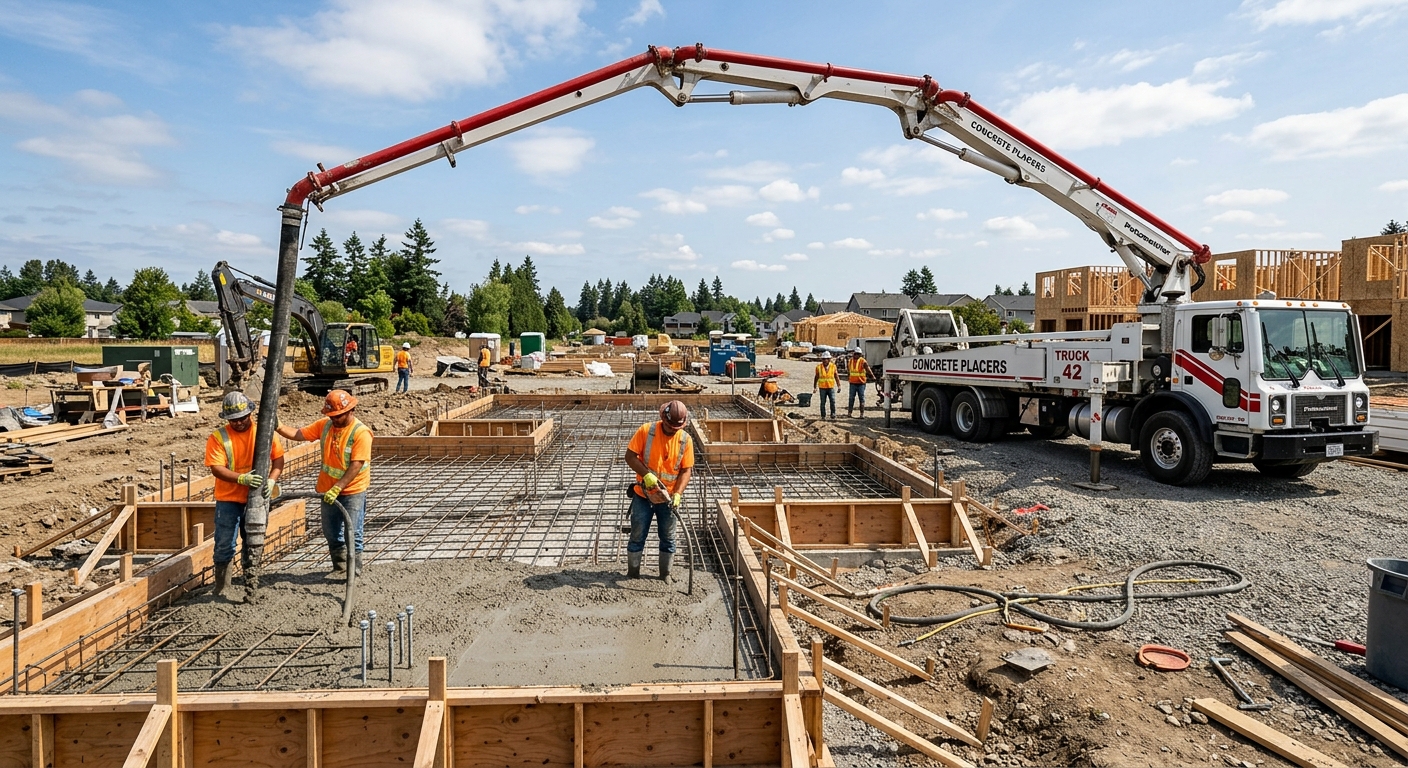
Concrete work options and costs in Niagara-on-the-Lake
Niagara-on-the-Lake is a beautiful place to live, and it’s also a demanding spot for concrete. With 79.2% of local dwellings being single-detached homes (Statistics Canada, 2021 Census), most driveway, patio and walkway projects are tied to long-term curb appeal—then tested by the cold, wet Great Lakes freeze-thaw cycle. Add in that 38.1% of homes were built before 1981 (Statistics Canada, 2021 Census), and you often see older grading, drainage and foundation conditions that influence how we prep the sub-base and how deep we design footings.
In the Hamilton–Niagara Peninsula region, concrete pricing is shaped by deeper excavations (footings typically need to be set below frost), tighter control joint planning, and air-entrained mixes for exterior flatwork. Labour availability can also swing with the shorter local pour season (roughly May–October), and winter work requires hoarding, heating, and curing protection—so the same job can cost noticeably more if it slips into shoulder season. We also see higher moisture exposure near the lake, so drainage and curing practices aren’t optional.
Contractors are especially busy around the older core and lake-adjacent pockets—commonly the Niagara-on-the-Lake area near Queen Street and the historic neighbourhoods where access is tighter and residents expect a clean finish. If you’re comparing options, the table below gives typical “all-in” price ranges for common installs so you can budget for both practical and decorative upgrades.
| Application |
Typical Size |
Key Spec |
Finish Option |
Price Range |
| Concrete driveway (standard broom finish) |
400–600 sq. ft. |
Air-entrained mix, compacted granular base, joints as required |
Broom finish, light sealer |
$14,000–$22,000 |
| Exposed aggregate driveway |
400–600 sq. ft. |
Staged aggregate exposure, air-entrained mix, proper cure timing |
Exposed aggregate (washed) |
$16,000–$26,000 |
| Stamped concrete driveway or patio |
300–500 sq. ft. |
Coloured/stamped mix, release agent, adequate curing and joint layout |
Stone/brick stamp pattern |
$22,000–$35,000 |
| Plain concrete patio or walkway |
200–400 sq. ft. |
Air-entrained mix, compacted base, control joints |
Broom or smooth trowel (as suitable) |
$12,000–$20,000 |
| Garage floor (interior slab) |
300–600 sq. ft. |
Minimum 32 MPa concrete, vapour considerations as needed |
Broom finish, optional integral colour |
$18,000–$26,000 |
| Foundation footings (structural, below frost) |
Typical single house |
Below frost depth excavation, rebar placement, engineered sections |
Structural concrete (no decorative finish) |
$60,000–$120,000 |
Prices are estimates only and vary by project scope, site access and material selection.
What affects the price of concrete work in Niagara-on-the-Lake
It’s common to see quoted costs for the “same” concrete job swing by 30–50% across the Hamilton–Niagara Peninsula and Ontario. The difference usually isn’t the concrete itself—it’s the spec required to survive Niagara-on-the-Lake’s climate, plus the hidden site work that’s hard to see from a quick look. In cold, wet Great Lakes conditions, frost depth and repeated freeze‑thaw cycles dictate every step: footings must be placed below the design frost depth to prevent heave and cracking, and exterior flatwork should use air-entrained concrete mixes to resist scaling and spalling. Cold-weather curing precautions (heating, blankets, extended protection time) also add labour and equipment costs when pour dates shift later in the season.
Locally, the biggest drivers tend to be: (1) how deep we must excavate and how much granular base we need, (2) whether soil is stable or requires extra removal and backfill, and (3) how accessible the site is around older neighbourhoods where equipment can’t always stage close to the work. A driveway with a thicker structural section and better drainage can push you toward the $14,000–$22,000 band, while decorative upgrades like stamped work can move into the $22,000–$35,000 range because they require colour, labour-intensive finishing, and more careful curing protection.
To make this real with dollar impact: if your driveway area needs more base thickness and reinforcement to address soft subgrade or poor drainage, it can easily add several thousand dollars even before finish upgrades. And if work happens during shoulder season, the added curing and protection steps can increase costs even for a plain patio or walkway—because durability starts before the surface ever dries.
| Price Factor |
Why It Matters |
Cost Impact |
| Frost line depth — determines footing depth and form height |
Deeper excavations and taller forms are required to prevent frost heave |
Moderate to high; can add major structural excavation costs |
| Site preparation — excavation, grading, compacted granular base |
Correct base thickness and compaction control settlement and cracking |
Moderate; “unknown subsoil” often increases totals |
| Reinforcement — rebar or wire mesh requirement |
Improves slab performance where loads or movement risk is higher |
Low to moderate; more for larger slabs or weak subgrades |
| Mix design — air-entrainment and compressive strength spec |
Air-entrainment helps resist freeze‑thaw damage on exterior pours |
Low to moderate; typically worth it for durability |
| Finish type — broom vs. stamped vs. exposed aggregate |
Decorative systems add materials, labour, and curing attention |
Moderate to high; stamp/exposed is usually the biggest jump |
| Pour size and concrete truck access to site |
Smaller staging zones and longer wheelbarrow distances add labour |
Low to moderate; access constraints can become high quickly |
| Cold-weather curing precautions — heating and blankets |
Maintains strength gain and reduces surface/thermal shock issues |
Moderate; winter work can add significant overhead |
| Control joint pattern and sealing cost |
Correct joints manage shrinkage; sealing reduces salt-driven surface damage |
Low to moderate; often necessary for exterior longevity |
Permits & regulations in Ontario
In Ontario, structural concrete work generally needs permits and often engineered drawings. For Niagara-on-the-Lake homeowners, that means projects like foundation footings, foundation walls, grade beams, and other load-bearing structural elements typically require a building permit, and the municipality may review the design details before work starts. If you’re underpinning, rebuilding a foundation, or modifying the structural footprint, don’t assume “it’s just concrete”—the permit path is part of keeping the work code-compliant.
Concrete flatwork (patios, walkways, sidewalks, driveways) usually does not require a permit on its own. However, it can require approval if it affects lot grading, roof drainage direction, or impervious surface considerations, and if the work impacts municipal right-of-way or existing curb/sidewalk interfaces. Because rules can be project-specific, confirm with the Town of Niagara-on-the-Lake building or planning staff before breaking ground.
When hiring, verify three essentials:
- Licensing/eligibility: ask the contractor for their business registration and any applicable trade credentials.
- Liability insurance: request a current certificate of insurance naming you (where applicable) and covering general liability.
- WSIB/WCB coverage: confirm their workplace coverage is active for workers on your site.
Step-by-step: start with a written quote that lists the work and inclusions; then ask for insurance certificates and WSIB/WCB clearance documents; finally, confirm the permit requirements with the municipality for your specific scope. Clear documentation up front saves headaches later.
Getting concrete right in Niagara-on-the-Lake's freeze-thaw climate
Niagara-on-the-Lake concrete failures almost always trace back to the same handful of issues: weak or poorly prepared base, the wrong mix (especially lack of air-entrainment), incorrect jointing, and rushed curing. In a freeze‑thaw environment near Lake Ontario, water gets into pores and microcracks; repeated cycles expand that damage until you see scaling, spalling, or random cracking. The fix isn’t “more concrete”—it’s specifying the right assembly for our conditions.
Start with base preparation: we excavate to the correct depth, install compacted granular sub-base, and confirm the grade so water drains away from the slab. Next, the mix design: for exterior flatwork, specify air-entrained concrete—commonly in the 5–7% air range—and a minimum 32 MPa compressive strength. Then plan control joints so shrinkage cracks form where they’re least visible and most manageable. Curing matters too: aim for minimum 7 days of proper curing under suitable conditions, and when cold weather approaches, we use blankets/heating so the slab gains strength without thermal shock. Finally, sealing is a key step for repelling de-icing salt—apply a penetrating sealer after the slab has cured (often around 28 days post-pour).
For technical questions, ask your contractor directly: “What air content is specified?” and “How is the base compacted and to what depth?” This is where many cost-saving shortcuts backfire. For example, skipping air-entrainment may drop the materials cost slightly, but it can be the difference between a driveway that stays serviceable and one that starts spalling—meaning you’ll pay again sooner. If you’re choosing between broom-finish and stamped, the price jump (often reflected in the $22,000–$35,000 stamped/decorative range versus $14,000–$22,000 for standard driveway work) is justified when the contractor still meets these durability specs—not just when they apply pigment and stamps.
| Spec |
Why It Matters in Niagara-on-the-Lake |
What to Ask For |
Impact if Skipped |
| Compacted granular base (depth?) |
Controls settlement and cracking under freeze‑thaw movement |
Base depth and compaction method (proof of density/roller passes) tied to your soil |
More cracking, uneven settling, premature slab damage |
| Air-entrained concrete mix (target air %?) |
Helps concrete resist scaling/spalling from repeated freezing and thawing |
Specify target air content for exterior flatwork (commonly 5–7% air) |
Increased risk of surface scaling and spalling in Ontario winters |
| Compressive strength (MPa rating) |
Strength gain supports load capacity and durability |
Minimum 32 MPa rating for exterior slabs |
Lower long-term performance and higher cracking risk |
| Control joints (spacing per ACI guidelines) |
Directs shrinkage cracking and reduces random cracks from thermal movement |
Proposed joint spacing, layout around edges, and curing plan for joints |
Uncontrolled cracking and more difficult repairs |
| Minimum 7-day curing period |
Cold/wet conditions require time for proper hydration and strength development |
Curing method and how the slab is protected if temperatures drop |
Surface weakness, cracking, and reduced durability |
| Penetrating sealer (when applied after cure) |
Repels de-icing salts and reduces water ingress near the surface |
Confirm sealer type and timing after cure (often around 28 days post-pour) |
Faster salt damage and more visible scaling |
How to choose a concrete work contractor in Niagara-on-the-Lake
Choosing the right concrete contractor in Niagara-on-the-Lake starts with proof, not promises. In Ontario, confirm that the contractor’s insurance coverage is active before work begins. Ask for:
- Liability insurance: request a current certificate of insurance and ensure it covers work at your address.
- WSIB/WCB coverage: verify workers on your site are covered (ask for documentation/clearance evidence).
- References: specifically for similar-scale driveway, patio, walkway, or foundation projects—ideally in the Niagara-on-the-Lake area.
Then request 2–3 itemised written quotes. You want a breakdown of labour, concrete supply, base/excavation, reinforcement, forming, finishing, control joints, sealing (if included), and disposal. Avoid “lump sum only” quotes without inclusions, because small exclusions—like hauling, saw-cutting timing, or curing protection—often explain why final bills change.
Read the scope carefully: what’s excluded? Is permit pulling included (when required for structural work)? Is disposal of excavated material included? What’s the warranty—workmanship for how long, and is the product/manufacturer warranty listed? Finally, the payment schedule should be reasonable: never pay more than about 10–15% upfront, and hold back the balance until the job is complete and any deficiencies are addressed. Get a start date and completion estimate in writing so you’re not stuck waiting during the short local pour season.
- Quote lists rebar/wire mesh (or explicitly notes “not required” with justification).
- Concrete mix is specified as air-entrained for exterior work.
- Base depth and compacted granular material are included, not just “graded and levelled.”
- Joint layout is shown or described (spacing and where cuts will be made).
- Drainage plan is described (slopes away from house, not ponding on the slab).
- Curing method is stated (blankets/heating when cold conditions occur).
- Sealing is included when appropriate, with timing after cure.
- Truck access and staging plan are mentioned (wheelbarrowing distance limits).
- Disposal/hauling is clearly included or excluded.
- Written schedule with weather contingencies is provided.
- Warranty states duration, scope, and how defects are handled.
- Insurance certificates and WSIB/WCB documentation are provided before signing.
Red flags in Niagara-on-the-Lake: contractors who won’t confirm air-entrainment specs; “we’ll just make it level” without base depth/compaction details; no written warranty or unclear scope; asking for large upfront payments; and crews that start without discussing curing protection if temperatures change.
Frequently asked questions — concrete work in Niagara-on-the-Lake
How do I seal concrete to protect it in Niagara-on-the-Lake?
In Niagara-on-the-Lake, sealing is about managing moisture and de-icing salt exposure. The key is timing: most exterior slabs should be allowed to cure fully before sealing—commonly around 28 days post-pour—so the concrete is ready to accept the penetrating sealer. Ask your contractor for a penetrating sealer designed for freeze-thaw conditions, not just a film-forming topcoat. We also recommend sealing the areas that get salted regularly (driveways and steps), and re-checking after your first full winter cycle.
What is the difference between concrete and cement?
Concrete is the finished material you pour: a mix of cement, water, sand, and gravel/stone (and sometimes additives). Cement is only one component—basically the “binder” that reacts with water to form the hardened matrix. When you see air-entrained concrete specified for Niagara-on-the-Lake exterior flatwork, that refers to the full concrete mix, not the cement alone. Good contractors specify the concrete performance (air content and strength) and the whole assembly (base, reinforcement, joints, curing), because freeze-thaw durability depends on the complete system.
How much does concrete work cost in Niagara-on-the-Lake?
Typical pricing in Niagara-on-the-Lake often falls into the region’s bands. For example, a concrete patio or walkway commonly budgets in the $12,000–$20,000 range depending on size and site access. A standard broom-finish driveway is often around $14,000–$22,000, while stamped concrete projects frequently land higher—about $22,000–$35,000—because of colouring, extra labour, and careful curing. Foundation/footings (below frost) are a separate structural category and can run far higher.
How deep must footings be for Niagara-on-the-Lake's frost line?
Niagara-on-the-Lake uses Ontario design assumptions where frost depth typically drives footing placement. In practice, that means footings are generally designed to extend below the design frost depth (often around 4 ft or deeper for many typical residential scenarios in Ontario), and the exact depth depends on your soil conditions and engineering/design requirements. The important homeowner takeaway: don’t guess—confirm the footing depth from the engineer’s foundation design or municipality-reviewed drawings. Proper below-frost placement is what prevents frost heave and the cracking that can show up after several winters.
Why does concrete crack in Niagara-on-the-Lake and how is it prevented?
Concrete cracking is mainly about shrinkage and movement—made more visible by Niagara-on-the-Lake’s freeze‑thaw cycles and moisture exposure. Even with great workmanship, concrete wants to crack as it dries and as temperatures change. The prevention strategy is to control where cracks happen by using proper control joints (with spacing appropriate to the slab layout) and to ensure the base is compacted correctly so the slab isn’t flexing from settlement. Also, ensure the exterior mix is air-entrained and curing is protected so the concrete develops the durability needed for winter conditions.
Stamped vs broom-finish concrete — cost difference?
Stamped concrete is usually more expensive than broom-finish because it involves decorative materials and added labour: colour, release agents, stamp mats, and careful finishing—plus more time planning joint locations so the decorative surface doesn’t look random after cuts. In Niagara-on-the-Lake, a broom-finish driveway budget often sits around $14,000–$22,000, while stamped concrete driveways/patios often fall into the $22,000–$35,000 band. The real value question: confirm the contractor still meets the durability specs (air-entrained mix for exterior, base depth/compaction, curing protection, and proper jointing) rather than treating it as “only decoration.”