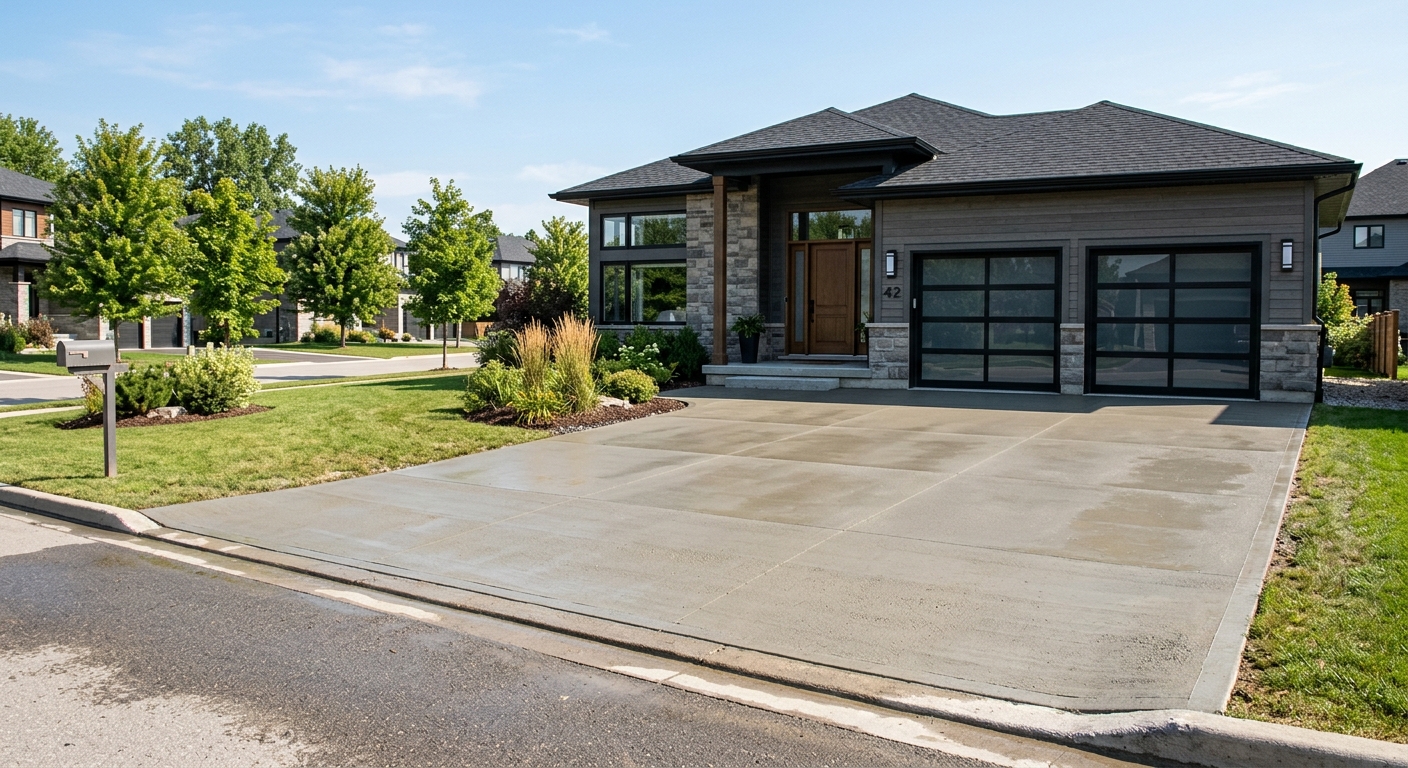
Concrete work options and costs in Casa Loma
Casa Loma is a postcard-pretty neighbourhood in Toronto, but it’s also a place where concrete performance has to hold up to real freeze–thaw winters. With a 2021 Census population of 10,968 in Casa Loma (Statistics Canada, 2021 Census), the market is busy enough that homeowners often see multiple crews competing for the same summer/early-fall pour slots. That matters for pricing and scheduling. A big share of local demand is driven by single-family homes—exactly the kind of properties that commonly need new driveways, patios, and walkways when homeowners renovate landscaping, add parking pads, or replace ageing flatwork.
In the Toronto economic region, frost depth and repeated freeze–thaw cycles shape almost every spec in the job. Most structural footings are designed to extend below grade—typically at least 1.2 m (about 4 ft)—and exterior flatwork needs air-entrained concrete plus proper drainage so saturated soils don’t expand and contract against the slab each winter. Because curing is harder when temperatures trend toward 10 °C or below, GTA contractors concentrate exterior pours in warmer months and may budget extra protection and longer cure monitoring. That’s why a driveway and a patio can both be “simple” on paper, yet land in different price bands once base prep, access, and mix/air specs are included.
In Casa Loma, flatwork is especially in demand around the hillier streets and older residential lanes where grades shift and drainage details are critical, so expect more attention to granular base and joint layout than in flatter backyards. Use the table below to compare typical options and cost ranges before you ask for your quote.
| Application |
Typical Size |
Key Spec |
Finish Option |
Price Range |
| Concrete driveway (standard broom finish) |
400–500 sq. ft. |
Air-entrained mix, 100 mm–125 mm slab with granular base |
Broomed surface + control joints |
$8,000–$14,000 |
| Exposed aggregate driveway |
400–500 sq. ft. |
Air-entrained mix, wash/expose timing controls |
Exposed aggregate texture for slip resistance |
$10,000–$16,000 |
| Stamped concrete driveway or patio |
300–450 sq. ft. |
Air-entrained mix, thicker sections depending on pattern area |
Stamped mats + colouring + sealer |
$10,000–$18,000 |
| Plain concrete patio or walkway |
150–300 sq. ft. |
Air-entrained mix, proper base and slope |
Float/straightedge + light broom (as required) |
$3,000–$7,500 |
| Garage floor (interior slab) |
300–500 sq. ft. |
Vapour barrier and reinforced slab per design |
Broom finish or smooth trowel (depending on use) |
$6,500–$14,000 |
| Foundation footings (structural, below frost) |
Varies; often 40–80 linear ft. |
Below-frost depth, reinforced concrete per engineering |
Structural concrete—no decorative finish |
$7,200–$24,000 |
Prices are estimates only and vary by project scope, site access and material selection.
What affects the price of concrete work in Casa Loma
In Toronto and across Ontario, it’s common to see quotes for the “same” concrete job vary by 30–50%. The difference usually isn’t just the concrete—it’s the unseen scope: how much excavation is needed, how well the base is compacted, what reinforcement is required, and whether the contractor is including the freeze–thaw durability upgrades that the GTA market expects. In a city with busy summer pour windows, labour availability and truck access can also swing costs quickly.
Here’s the core driver: frost line depth and freeze–thaw cycles dictate specs. Structural footings must extend below the design frost depth to prevent frost heave and differential movement, and exterior slabs require air-entrained concrete to survive repeated freezing and thawing. When you’re working in colder temperatures, contractors may need cold-weather curing precautions—insulating blankets or temporary heating—because concrete that doesn’t cure properly is more likely to crack, dust off, or scale. Surface damage from de-icing salts is another Toronto reality; sealing (and choosing the right sealer) becomes a smart line item for long-term durability.
Concrete prices also react to site conditions. For example, if your driveway needs deeper base to stabilize soft subgrade or to correct drainage near the garage approach, you may move toward the higher end of the concrete driveway bands (often closer to $8,000–$14,000). A small patio might look inexpensive, but if it needs reinforcement, thickened edges, or tight forms due to mature trees, it can drift from the lower range toward $3,000–$7,500. If you’re replacing older, poorly drained slabs on a typical older-home lot, expect higher prep costs than homeowners anticipate—sometimes more than the difference between broom-finish and basic decorative options.
| Price Factor |
Why It Matters |
Cost Impact |
| Frost line depth — determines footing depth and form height |
More depth means more excavation, forming, and concrete volume |
Can add significant labour and material cost on foundations |
| Site preparation — excavation, grading, compacted granular base |
Poor base leads to settlement and cracking; Ontario soils vary lot-to-lot |
Often the biggest swing factor for flatwork |
| Reinforcement — rebar or wire mesh requirement |
Exterior flatwork and interior garage slabs often need reinforcement for cracking control |
Moderate cost increase, but reduces future failures |
| Mix design — air-entrainment and compressive strength spec |
Air-entrainment supports freeze–thaw durability; strength affects long-term performance |
Usually adds cost, but avoids spalling and scaling |
| Finish type — broom vs. stamped vs. exposed aggregate |
Decorative finishes require extra labour time, finishing workflow, and sealing |
Stamps and exposed aggregate typically cost more per sq. ft. |
| Pour size and concrete truck access to site |
Long carries or restricted access increases labour and may require pumping |
Pumping/access constraints can bump labour and coordination costs |
| Cold-weather curing precautions — heating and blankets |
Toronto spring/fall can drop temperatures; curing determines strength gain |
Can meaningfully add to the schedule and materials |
| Control joint pattern and sealing cost |
Joints manage cracking; sealing protects from salt scaling and moisture ingress |
Small line items that prevent big repairs later |
Permits & regulations in Ontario
In Ontario, the rule of thumb is: structural concrete typically needs a permit, while most simple flatwork usually doesn’t—unless it impacts drainage, grading, or municipal surface limits. Structural items such as footings, foundation walls, and grade beams generally require a building permit and often engineered drawings that the municipality reviews. If you’re underpinning, adding a foundation, or doing work that affects the structural system, assume you’ll be in permit territory.
Concrete flatwork like driveways, patios, and walkways typically does not require a building permit on its own. However, it can require approvals when it changes lot grading (for example, diverting water toward a neighbour), alters impervious surface coverage limits, or affects any municipal right-of-way connection, such as driveway approaches. Because Casa Loma lots can be tight and grade-sensitive, it’s worth confirming with the local authority before the first shovel hits the ground.
For contractor verification in Ontario, start with the contractor’s business info and credentials: ask for proof of liability insurance (certificate of insurance) and confirmation of WSIB coverage where applicable. Then request a clearance letter or proof documents your contractor can provide for current coverage. Finally, verify licensing (where required for the contractor’s scope) using the relevant online registry, and insist on clear references—not just photos—on projects of similar size and complexity (particularly exterior work that must endure Toronto’s freeze–thaw). This protects you if the job ends up needing rework due to base or curing issues.
Getting concrete right in Casa Loma's freeze-thaw climate
Concrete failures in Casa Loma almost always trace back to three things: moisture movement under the slab, insufficient freeze–thaw protection, and poor curing. In freeze–thaw conditions, the wrong air content, a weak or poorly cured matrix, or an under-designed base can lead to scaling and spalling—especially once de-icing salts start. To spec the job correctly, pay attention to base, mix, joints, curing, and sealing rather than only the finish.
(1) Base preparation: The slab needs a compacted granular sub-base to the right depth for your soil and local frost requirements, with proper grading so water drains away from the house. (2) Mix design: For exterior flatwork in Ontario, you typically want an air-entrained mix with about 5–7% air and minimum 32 MPa compressive strength (higher specs may apply depending on thickness and design). (3) Control joints: Joint spacing is what limits random cracking; once the concrete dries and shrinks, joints give cracks somewhere predictable to occur. (4) Curing: Plan for at least 7 days of proper curing conditions. If the weather drops toward 10 °C or below, protection (insulation blankets, wind protection) becomes crucial. (5) Sealing: A penetrating sealer is typically applied after curing—commonly at 28 days post-pour—so it can better repel salt and moisture.
Ask technical questions like: “Will your exterior mix be air-entrained?” and “How are joints laid out so cracking doesn’t become a pattern?” A concrete driveway in the GTA might run closer to $8,000–$14,000 for standard broom finish. If someone offers a bargain by skipping air-entrainment or sealing, you might save upfront—but you can end up paying again when winter scaling shows up. Spending for the right mix and base is usually the justified difference; skipping them is the expensive shortcut.
| Spec |
Why It Matters in Casa Loma |
What to Ask For |
Impact if Skipped |
| Compacted granular base (depth?) |
Controls settlement and moisture movement under freeze–thaw |
Granular base depth sized to soil and excavation; proof of compaction |
Uneven settlement, cracking, early deterioration |
| Air-entrained concrete mix (target air %?) |
Builds freeze–thaw durability against scaling and spalling |
Exterior air content target around 5–7% |
Higher risk of spalling with winter salts |
| Compressive strength (MPa rating) |
Strength gain supports abrasion resistance and long-term performance |
Minimum 32 MPa (confirm spec for your thickness/usage) |
Surface wear, cracking, and faster breakdown |
| Control joints (spacing per ACI guidelines) |
Limits random cracking during shrinkage |
Joint layout and spacing plan before the pour |
Wider random cracks and costly patch repairs |
| Minimum 7-day curing period |
Ensures adequate strength development in changing temperatures |
Curing method and protection plan if temps drop |
Weaker concrete and increased scaling risk |
| Penetrating sealer (when applied after cure) |
Repels moisture and helps protect from de-icing salts |
Penetrating sealer applied about 28 days after pour |
Salt scaling, water ingress, and faster surface degradation |
How to choose a concrete work contractor in Casa Loma
Choosing the right contractor in Casa Loma is mostly about verifying three things upfront: coverage, clarity, and commitment to freeze–thaw durability. In Ontario, confirm the contractor carries liability insurance—ask for a current certificate of insurance naming you/your property as required—and verify WSIB coverage (or applicable clearance documentation). You should also be able to provide proof of coverage before work starts; don’t wait until the day the crew arrives. For licensing, use the appropriate Ontario online registry for the contractor’s credentials where required for the scope, and confirm the business name on the quote matches the name on insurance and invoices.
When you request quotes, ask for 2–3 itemised, written estimates with a breakdown of labour and materials—not just a single lump sum. Check whether the quote includes permit pull (when needed for structural work), excavating and hauling/disposal, forms, base prep, reinforcement, concrete supply, and finishing/sealing. Exclusions are where surprises happen: “concrete only,” “no disposal,” or “pricing assumes level access” are common gaps.
Warranty should be in writing. Look for a workmanship warranty length (for example, cracking that results from workmanship failures) and understand whether product/manufacturer warranties apply to materials. Ensure it’s transferable if you sell your home. Payment terms should protect you: never pay more than 10–15% upfront; hold back the remainder until the job is complete and cleaned up. Finally, get a start date and completion estimate in writing—Toronto schedules shift quickly in spring and fall when cold snaps shorten the reliable pour window.
- Ask for proof of liability insurance (current COI) before signing.
- Verify WSIB/clearance coverage and keep the documents for your records.
- Confirm the contractor’s address/business name matches the quote and invoices.
- Request an itemised breakdown: excavation, granular base, reinforcement, concrete, finish, sealing.
- Check whether disposal and hauling are included or excluded.
- Ask how they manage drainage and slope so water doesn’t pond on your slab.
- Require exterior work to specify air-entrained concrete (target air %).
- Confirm joint layout and the plan for saw-cutting or forming joints.
- Ask about curing protection if temperatures fall near 10 °C or below.
- Get written timeline details: start date, curing window, and when you can use the area.
- Ensure sealing is included where appropriate (often after a full cure period).
- Look for clear cleanup and site restoration at completion.
Concrete contractor red flags in Casa Loma include: refusing to discuss air-entrainment and curing methods, giving only a lump-sum price with no base/soil plan, starting work without verifying insurance/WSIB, promising “no cracks” as an outcome, or skipping sealing while assuming de-icing salt won’t affect the surface.
Frequently asked questions — concrete work in Casa Loma
How long does concrete take to cure?
Concrete curing is about temperature and moisture, not just time on a calendar. In Ontario, a typical exterior project should be treated as minimum 7 days of curing before normal light use, assuming proper conditions. Full strength develops over longer periods—often closer to 28 days—especially for weather-sensitive Toronto freeze–thaw cycles. If the pour happens when temperatures drift toward 10 °C or below, a good contractor will protect the slab with insulation blankets or other curing measures so the concrete gains strength safely. This is one reason exterior work in the GTA is concentrated in warmer months. If you’re planning sealing, many contractors schedule penetrating sealer around 28 days post-pour to repel water and de-icing salts more effectively.
Do I need a permit for concrete work in Ontario?
In Ontario, permit requirements depend on what concrete work you’re doing. Structural concrete—such as footings, foundation walls, and grade beams—typically requires a building permit and often engineered drawings reviewed by the municipality. For most simple flatwork like driveways, patios, and walkways, a permit is often not required by default. However, you should still confirm if your work changes lot grading, affects impervious surface limits, or connects to any municipal right-of-way elements. In Casa Loma, drainage and grade changes can be a common trigger because many lots have older contours and slope-related water concerns. Before demolition or excavation, ask the contractor whether a permit is needed for your specific scope and have them document the plan in writing.
Concrete vs pavers for a patio in Casa Loma?
Pavers can be a good option where you want easy spot repairs, but concrete often wins on durability and long-term sealing simplicity—especially in Toronto’s freeze–thaw climate. With pavers, movement from wet base or drainage issues can show up as unevenness; with concrete, the key is base compaction, air-entrainment for freeze–thaw, and control joints that manage cracking. If you want a clean, continuous surface, plain concrete patios commonly land around $3,000–$7,500 depending on size and site access. Pavers may cost more once you include excavation depth, edge restraints, and a well-compacted granular base. In many Casa Loma backyards with slope and seasonal water, the “right base + right concrete” approach can be more predictable than small, individual unit settling.
How long does a concrete driveway last?
A properly built concrete driveway in Ontario commonly lasts 25 years or more, and sometimes longer, but only if the base, drainage, and freeze–thaw durability are done right. The driveway’s lifespan is most affected by how water drains off the slab, whether the concrete is air-entrained, and whether control joints and sealing were handled correctly. In Casa Loma, de-icing salt exposure plus winter cycling is a real factor—surface scaling can start if the mix and curing weren’t durable or if the sealer wasn’t applied after the full cure period. Repairs are usually patchwork when cracks are already well established, which is why the upfront spec matters. If you’re budgeting, standard broom-finished driveway work is typically within $8,000–$14,000, and cutting corners to “save a few dollars” can shorten the service life.
What is air-entrained concrete and why does it matter here?
Air-entrained concrete is designed with tiny, evenly distributed air bubbles in the mix. Those microscopic bubbles give freezing water a place to expand safely, reducing internal damage that leads to scaling and spalling. In Ontario’s Toronto freeze–thaw cycles, that’s not optional—it’s a performance requirement for exterior durability. For Casa Loma driveways, patios, and walkways, you’ll typically want air-entrainment in the range of about 5–7% for exterior flatwork, along with adequate thickness, proper base prep, and correct joint spacing. If a contractor uses non-air-entrained mix or doesn’t manage the mix design and placement properly, the slab can look fine initially and then deteriorate over winters once de-icing salts and moisture get to the surface.
How do I prepare the base for a concrete slab?
Base preparation is where strong concrete work is won or lost. For a slab in Casa Loma, the contractor should excavate to the correct depth, remove topsoil and soft/unstable material, and then install a compacted granular base in layers to reach the proper final elevation. The base must be well graded for drainage so water doesn’t pond near the foundation or garage approach. Proper compaction is essential—if the base isn’t densified, the slab can settle and crack even if the concrete itself is high quality. For exterior pours, this base work also helps manage freeze–thaw movement by preventing repeated wetting and drying. When you’re comparing quotes, insist the proposal states the base depth/section and compaction approach, not just the concrete finish.