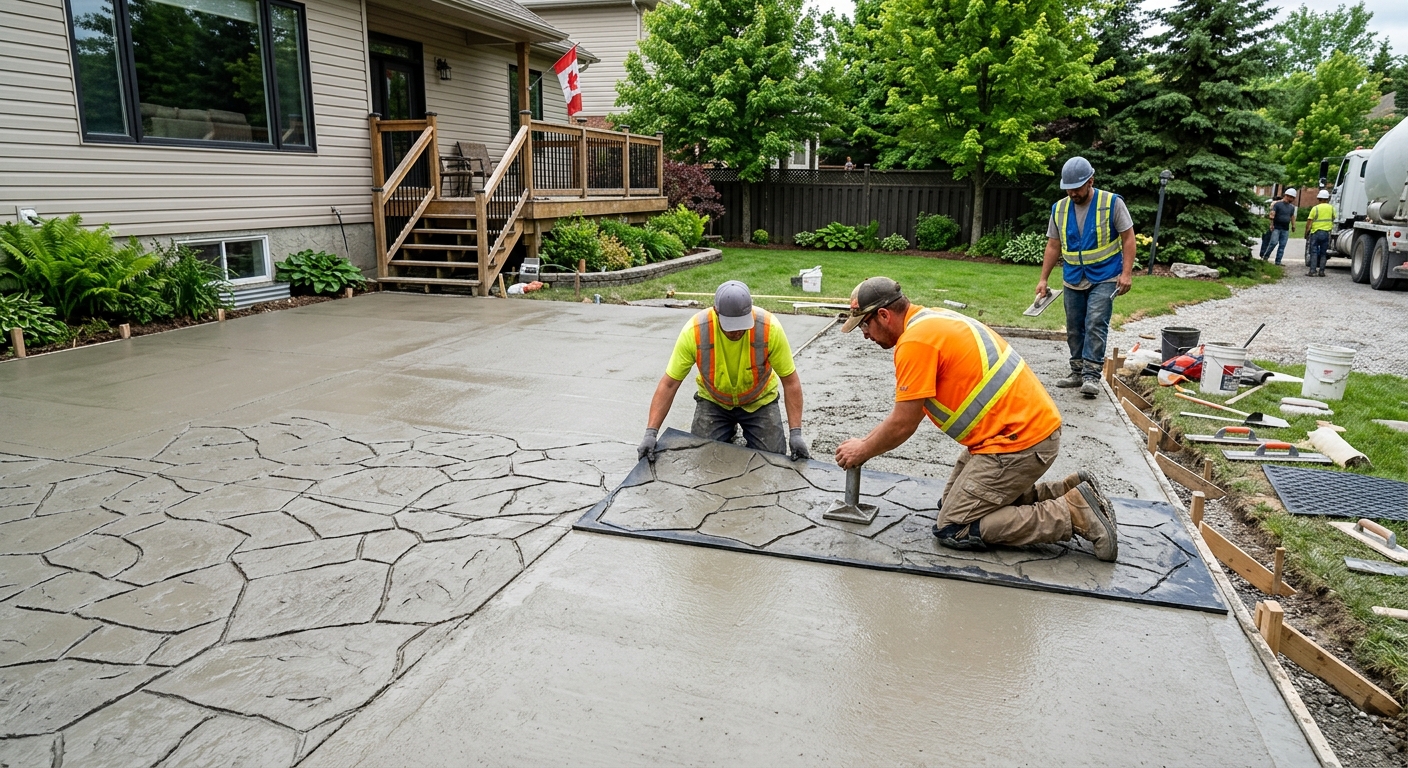
Concrete work options and costs in Bells Corners
Bells Corners, Ontario is a great place to build durable concrete flatwork, but the costs still add up when you account for the Toronto region’s freeze–thaw cycles and deeper frost protection requirements. The area is home to a large, established residential base—around 9,272 residents in the 2021 Census (Statistics Canada, 2021 Census)—which means steady demand for driveways, patios, walkways, and foundation-related work. In neighbourhoods like Bells Corners Village, where many homes have older driveways and walk patterns that have been patched over the years, concrete contractors are especially busy when spring approvals and weather window open.
In the Toronto economic region, pricing is shaped by the same core drivers on almost every quote: excavate and build the granular base correctly, use an air-entrained mix for exterior exposure, and control cracking with a smart joint plan. Exterior pours are typically concentrated in warmer months so concrete can cure reliably; when temperatures trend down toward 10 °C or below, contractors often budget more labour for protection (insulating blankets) and longer curing time. Access also matters—tight suburban lots can require more time for prep, managing forms, and coordinating concrete truck deliveries.
To help you compare apples-to-apples, here are the most common options homeowners request in Bells Corners, along with typical size expectations and the key specs that usually separate a basic job from a long-lasting one. Use this table as a starting point, then confirm the scope, thickness, and joint/sealing plan in your itemised quote.
| Application |
Typical Size |
Key Spec |
Finish Option |
Price Range |
| Concrete driveway (standard broom finish) |
400–600 sq. ft. |
Air-entrained exterior mix, compacted granular base, control joints |
Broom finish with sealer-ready surface |
$7,200 – $16,800 |
| Exposed aggregate driveway |
400–600 sq. ft. |
Air-entrained exterior mix, proper curing timing, seeded aggregate selection |
Exposed aggregate with proper curing |
$10,000 – $21,500 |
| Stamped concrete driveway or patio |
300–500 sq. ft. |
Reinforced slab where needed, air-entrained mix for exterior durability |
Stamped patterns and colour release |
$11,000 – $24,500 |
| Plain concrete patio or walkway |
200–400 sq. ft. |
Compacted granular base, edge forms, air-entrained mix |
Steel trowel or broom finish (final depends on exposure) |
$3,200 – $10,400 |
| Garage floor (interior slab) |
300–500 sq. ft. |
Vapour control prep where needed, reinforcement as specified |
Broom or light broom for traction |
$5,400 – $14,000 |
| Foundation footings (structural, below frost) |
Per linear foot; common example 50–100 ft. |
Excavation and formwork to frost depth; structural concrete and inspection |
Functional structural finish (engineered) |
$9,000 – $30,000 |
Prices are estimates only and vary by project scope, site access and material selection.
What affects the price of concrete work in Bells Corners
Two quotes for the same concrete job in Bells Corners can differ by 30–50% because “concrete” isn’t one product—it’s excavation, base prep, mix design, reinforcement, finishing labour, curing protection, and how much rework is avoided through good details. In the Toronto region, contractors also price in the realities of frost depth and freeze–thaw: for exterior concrete, footings must extend below the design frost depth to prevent frost heave and differential movement, and the slab needs an air-entrained mix to resist damage over repeated winters. Most exterior work is planned around a reliable pour season; as temperatures fall toward about 10 °C, crews spend more time on temperature protection, blankets, and longer curing schedules to protect compressive strength development.
De-icing salt is another Ontario cost driver. In freeze–thaw areas, salts can accelerate surface spalling if the surface is too porous or if the mix/curing isn’t right—so sealing is commonly recommended. That’s why you might see a standard broom driveway priced nearer the lower end of the local driveway band (often closer to the $18–$28 per sq. ft. range), while stamped or exposed aggregate can climb toward the $24–$40 per sq. ft. decorative band once labour, materials, and finishing complexity are included.
In Bells Corners, costs also shift based on site conditions. For example, a driveway tied into an existing walkway with poor drainage may require extra grading and removal before the new pour—adding days of labour. Conversely, a straightforward patio replacement on clean, well-draining soil with good access can come in closer to the low end of the patio band (roughly $16–$26 per sq. ft.). When you have a 20- to 30-year-old home stock, the “hidden work” (sub-base failure and settlement) can add hundreds to thousands—especially if old patches break down and need full-depth rebuild rather than minor patching.
| Price Factor |
Why It Matters |
Cost Impact |
| Frost line depth — determines footing depth and form height |
Footings must be below design frost depth to reduce frost heave risk. |
Can add significant excavation/formwork labour; typically a large portion of foundation pricing (often within the $180–$300 band per footing element, depending on scope). |
| Site preparation — excavation, grading, compacted granular base |
Poor base leads to settlement and cracking, especially in wet spring/fall cycles. |
Often the difference between “average” and “long-lasting,” commonly driving 10–25% swings on flatwork quotes. |
| Reinforcement — rebar or wire mesh requirement |
Helps control cracking and supports loads (especially garages and thicker driveways). |
Material + placement labour can add 5–15%. |
| Mix design — air-entrainment and compressive strength spec |
Exterior air-entrainment improves freeze–thaw durability. |
Moderate material cost, but skipping specs can cause early surface scaling/spalling. |
| Finish type — broom vs. stamped vs. exposed aggregate |
Decorative finishes require extra labour, timing, and finishing steps. |
May move you from roughly $18–$28 per sq. ft. up toward $24–$40 per sq. ft. for stamped/exposed work. |
| Pour size and concrete truck access to site |
Narrow driveways and long carry distances add time and can limit pour logistics. |
Can add 5–20% depending on access and batching/placement approach. |
| Cold-weather curing precautions — heating and blankets |
Ensures concrete reaches strength when temps dip; reduces scaling risk. |
Often adds a day or more of labour/protection; can increase totals by 3–10% on borderline pour days. |
| Control joint pattern and sealing cost |
Joints manage shrinkage cracking; sealing helps repel de-icing salt impacts. |
Relatively small line items, but skipping them can lead to costly repairs. |
Permits & regulations in Ontario
In Ontario, structural concrete work generally triggers permit requirements. That includes foundation elements such as footings, foundation walls, and grade beams—work that affects structural stability and load paths. These projects often require engineered drawings that the municipality reviews before you start. In contrast, concrete flatwork like patios, walkways, and driveways typically does not require a permit just to replace concrete on the same grade. That said, you should still confirm with the local authority if the work changes lot grading, impacts municipal drainage, or alters impervious surface coverage or ties into a right-of-way.
For your Bells Corners project, don’t just rely on a contractor’s “we’ll handle it.” Do a quick verification step-by-step:
- Confirm the contractor’s business information is active and valid through Ontario’s online licence/registration lookup (use the exact legal company name on the contract).
- Ask for a current Certificate of Insurance for liability—ensure it matches the legal entity doing the work and shows a clear coverage amount.
- Verify WSIB/WCB coverage: request the clearance letter or account status proof before work begins.
- Request references on similar-scale concrete jobs (same thickness/specs, exterior exposure, and frost-critical details).
- If structural work is involved, ask whether permit/engineering review is included in their scope and timeline.
Taking these steps protects you from uninsured job sites and reduces the risk of delays from incomplete approvals.
Getting concrete right in Bells Corners's freeze-thaw climate
Bells Corners winters are the test: freeze–thaw cycling, humid weather swings, and de-icing salt exposure push concrete systems to the limit. The biggest cause of early failure in our climate is spalling and scaling—usually traced back to inadequate air-entrainment, rushed finishing, or weak/insufficient curing. You can avoid most problems by specifying the build-up that matches Toronto-area soil behaviour and frost movement, then locking in execution details in writing.
Start with base preparation: the slab must sit on compacted granular sub-base to the correct depth for local soil and frost conditions. If the base is thin or poorly compacted, the slab can settle, allowing water to collect at weak spots and accelerate damage. Next, specify the mix design. For exterior flatwork, contractors typically target about 5–7% air content using an air-entrained mix, and a minimum 32 MPa compressive strength (as specified on the work order). Control joints are then used to limit random cracking—spacing needs to be planned so shrinkage cracks occur at joints rather than through the surface.
Curing is just as important. Plan for at least 7 days of curing under proper conditions; in cooler weather, crews often use blankets or temporary heat to protect strength gain. Finally, sealing matters for salt resistance: apply a penetrating sealer after the slab has cured (commonly around 28 days post-pour) to help repel moisture and salts.
If you’re comparing options, this is where price differences can be justified. For example, moving from a basic broom-finish slab toward a well-specified standard driveway package (air-entrained mix, proper base, joints, and sealing) may cost more upfront, but that’s often the difference between staying closer to the $18–$28 per sq. ft. range versus paying later for grinding, patching, or full replacement.
| Spec |
Why It Matters in Bells Corners |
What to Ask For |
Impact if Skipped |
| Compacted granular base (depth?) |
Prevents settlement and keeps water from undermining the slab in wet spring/fall. |
Granular type, required depth, and compaction method (proof/inspection if available). |
Cracks, unevenness, and premature edge failure that worsen with freeze–thaw. |
| Air-entrained concrete mix (target air %?) |
Reduces internal ice damage during freeze–thaw cycles. |
Target air content (often 5–7% for exterior flatwork) and confirmation it’s air-entrained. |
Higher risk of scaling and spalling on the surface, especially with salt exposure. |
| Compressive strength (MPa rating) |
Ensures durability and load performance in a climate that challenges early-age strength. |
Minimum 32 MPa (or project-specific engineered requirement) stated in the quote/work order. |
Soft or weak concrete leads to easier surface wear and cracking. |
| Control joints (spacing per ACI guidelines) |
Controls where shrinkage cracks form to protect the rest of the slab. |
Joint layout, saw-cut/formed timing, and spacing plan relative to slab size. |
Random cracking that can become trip hazards and water entry points. |
| Minimum 7-day curing period |
Cold spells can slow strength gain and increase surface damage risk. |
Curing plan and protection if temps drop; clarify curing start and duration. |
Weaker surface, increased scaling risk, and reduced long-term performance. |
| Penetrating sealer (when applied after cure) |
Helps resist moisture and de-icing salt penetration that contribute to spalling. |
Type of penetrating sealer and the timing (commonly about 28 days after pour). |
Faster surface deterioration and higher maintenance costs. |
How to choose a concrete work contractor in Bells Corners
Start with proof that the contractor is set up for Ontario job sites. Ask for their Ontario business registration/licence details, then request a current Certificate of Insurance showing liability coverage. For workers on site, verify WSIB/WCB coverage by asking for the clearance letter or equivalent proof of account status—get it before the first pour. If they’re vague or can’t provide documents promptly, move on. Concrete work is unforgiving: if something goes wrong, you want a contractor with the right coverage to stand behind workmanship and handle jobsite incidents.
Next, get 2–3 written, itemised quotes instead of a single lump sum. You want line items for excavation and disposal, granular base supply and compaction, forms, reinforcement, concrete supply/mix, finishing labour, curing protection, joints, and sealing. Clarify what’s excluded: tree stump removal, hauling, permit fees (if any), and electrical/snow management during work days. Make sure the quote states the slab thickness and footing depth where applicable—especially if you’re near porch steps or garage transitions.
Look for a workmanship warranty length and what it covers (cracks due to shrinkage vs. installation defects). Also check whether any product/manufacturer warranty is included and whether it’s transferable to you as the homeowner. On payment, keep deposits modest—never more than about 10–15% upfront—and use holdback tied to substantial completion. Finally, demand a start date and completion estimate in writing so scheduling is accountable in the Bells Corners seasonal window.
- Confirms air-entrained mix for exterior work and states target air content.
- States min compressive strength (e.g., 32 MPa) in the quote.
- Provides joint layout and when joints will be cut/formed.
- Includes granular base depth and compaction expectations.
- Specifies slab thickness and footing depth where required.
- Lists disposal and dump fees separately (so scope can’t shrink).
- Clarifies whether sealing is included and the timing (after cure).
- Shows reinforcement details (mesh size, rebar grade/spacing if used).
- Has a written curing/protection plan for cooler pour days.
- Includes concrete truck access/placement notes for your driveway width.
- Uses a reasonable payment schedule with holdback.
- Provides warranty terms in plain language, in writing.
Concrete contractor red flags in Bells Corners: they skip discussing air-entrainment; they won’t commit to slab thickness and joint spacing; they ask for large upfront payments; they provide only lump-sum estimates with no breakdown of excavation/base/disposal; or they can’t produce proof of liability insurance and WSIB/WCB coverage before starting.
Frequently asked questions — concrete work in Bells Corners
When is the best time to pour concrete in Bells Corners?
In Bells Corners, the best time to pour concrete is during the warmer months when temperatures stay reliably above the working range for finishing and curing. In the Toronto economic region, crews typically concentrate exterior pours in spring and summer, because proper curing becomes harder when weather trends cooler—especially when temperatures approach 10 °C or below. That’s not just about comfort; it affects how quickly concrete develops strength and how well the surface resists scaling. If you’re planning a driveway or patio replacement, aim for a schedule that avoids late fall. If weather turns colder mid-project, the right contractor will plan for cold-weather curing using insulating blankets or temperature protection, which may affect the timeline but improves durability.
How long does concrete take to cure?
Concrete cure time has two practical stages in everyday homeowner terms. First, you need early-age curing—commonly at least 7 days—so the concrete reaches sufficient strength for basic protection and proper performance. Second, certain finishing-related steps like sealing are usually done later, often around 28 days post-pour, when the slab has fully cured under suitable conditions. In Bells Corners’ freeze–thaw climate, curing matters even more because cold snaps can slow strength gain and increase the risk of surface scaling. Your contractor should describe curing protection (especially if weather changes) and confirm when the slab will be ready for vehicle loads or furniture placement—don’t assume “a few days” is enough for long-term exterior durability.
Do I need a permit for concrete work in Ontario?
In Ontario, structural concrete work—like footings, foundation walls, and grade beams—usually requires a building permit and often engineered drawings reviewed by the municipality. Concrete flatwork (driveways, patios, and walkways) often does not require a permit if it’s a like-for-like replacement that doesn’t change lot grading or drainage, and it doesn’t affect municipal right-of-way requirements or impervious surface limits. That said, Bells Corners homeowners should still confirm with the local authority before breaking ground if the project changes elevations, redirects water, or impacts drainage patterns. A solid contractor will ask these questions up front and will be clear about whether permits are included in the scope and timeline.
Concrete vs pavers for a patio in Bells Corners?
Concrete and pavers can both work well in Bells Corners, but the decision is usually about maintenance, appearance, and the base preparation strategy. Concrete patios benefit from a monolithic slab approach with proper air-entrained mix for exterior freeze–thaw durability; prices for plain concrete patios commonly land in the local band of about $16–$26 per sq. ft. Pavers can offer easier spot repairs if a single unit shifts, but pavers still rely heavily on a well-compacted base and correct drainage—otherwise they can heave or settle over winter cycles. If you want a low-maintenance, clean look, a well-built concrete patio with control joints and sealing is often the better value. If you prefer pattern variety and flexible future repairs, pavers can be worth considering.
How long does a concrete driveway last?
A properly built concrete driveway in the Toronto region can last many years—often decades—when the slab is designed for freeze–thaw exposure. The biggest determinants are base preparation, air-entrained mix, thickness, reinforcement (if required), joint spacing, curing, and sealing. In Bells Corners, de-icing salt increases the need for a surface plan: penetrating sealer applied after curing (commonly around 28 days) helps repel moisture and salts that can lead to spalling. A driveway poured and finished without air-entrainment or with weak curing practices may show scaling sooner, sometimes within just a few winters. When you’re comparing quotes, a driveway at the lower end of the local band (often nearer $18–$28 per sq. ft.) can still be long-lasting if the specs and workmanship are solid—don’t choose solely on per-square-foot price.
What is air-entrained concrete and why does it matter here?
Air-entrained concrete is designed with tiny, evenly distributed air bubbles that give water a place to expand when it freezes. That reduces internal pressure and helps the surface resist scaling and spalling during freeze–thaw cycles—exactly what we see around Bells Corners and across Ontario. For exterior flatwork, contractors commonly target about 5–7% air content. Without air-entrainment, concrete can look fine initially, then deteriorate as water gets into tiny pores and expands during winter cold. This is why Toronto-area contractors typically treat air-entrainment and curing protection as non-negotiable specs, not optional upgrades. If someone’s quote doesn’t mention air-entrainment or exterior durability details, ask directly—your long-term maintenance cost will depend on it.