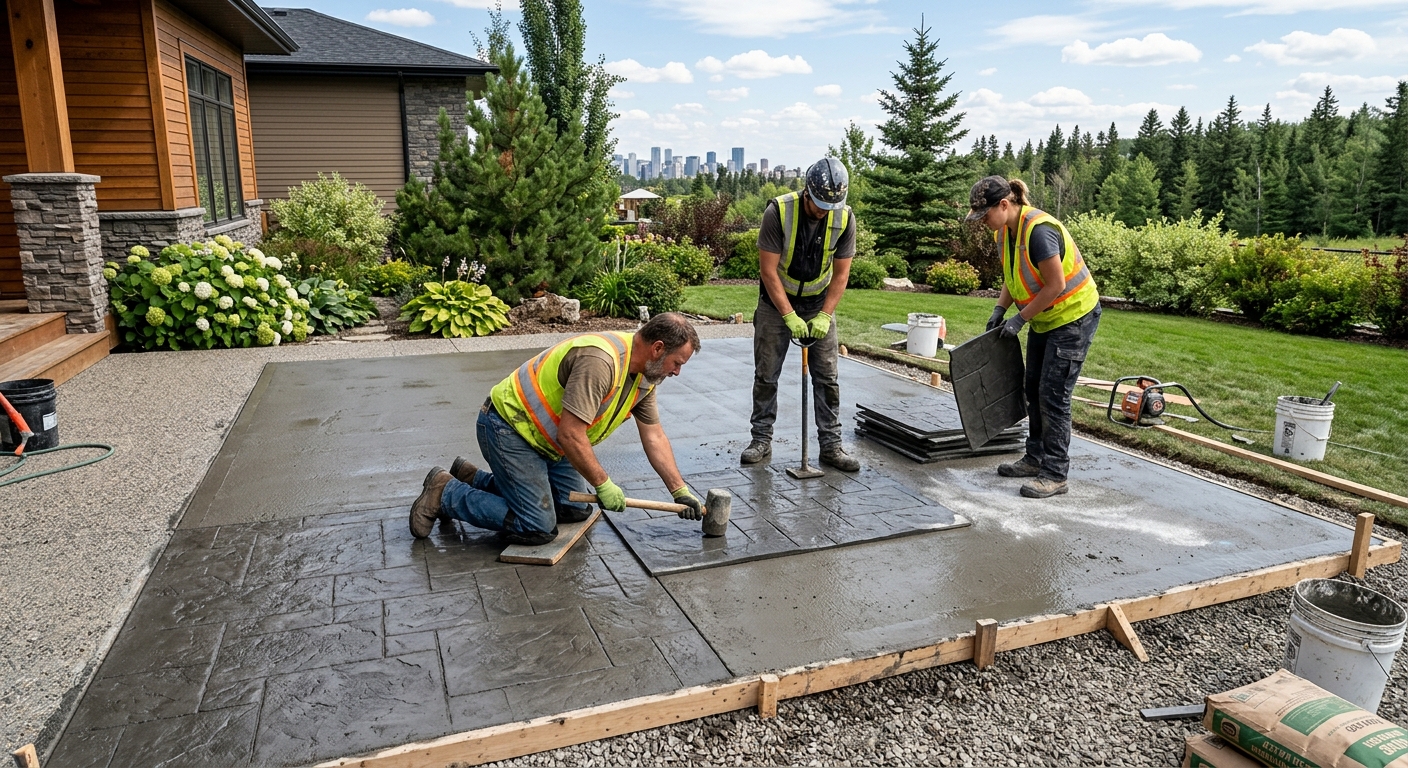
Concrete work options and costs in Eringate-Centennial-West Deane
Concrete work in Eringate-Centennial-West Deane, Ontario, is a little different from other parts of the province because the GTA’s freeze–thaw cycle is relentless: slabs and sidewalks are repeatedly stressed as moisture in the soil expands and contracts each winter. With a population of 18,588 in the area (Statistics Canada, 2021 Census), there’s steady demand for driveways, patios and walkways as homeowners update older homes and curb appeal. In this neighbourhood, workmanship availability is strong, but the schedule is busiest late spring through early fall—when contractors can protect curing concrete and keep surface finishing consistent.
Most exterior flatwork projects also compete for attention with foundation work and landscaping. That matters because the same fundamentals—depth to frost, well-compacted granular base, proper drainage and air-entrained concrete—drive both durability and cost. In the Toronto economic region, local specs typically require structural footings to sit at least 1.2 m (about 4 ft) below grade to help prevent frost heave and differential movement. For driveways, patios and walkways, builders plan for cracking control using thicker sections, air-entrained mixes and properly spaced control joints.
In Eringate-Centennial-West Deane, this trade is especially in demand around the Eringate and Centennial Park area where many lots see driveway replacements and patio upgrades. When you’re comparing bids, it helps to start with realistic production costs by application, then adjust for site access, base conditions and the finish you want—see the cost comparison table below.
| Application |
Typical Size |
Key Spec |
Finish Option |
Price Range |
| Concrete driveway (standard broom finish) |
400–600 sq. ft. |
Air-entrained mix, compacted base, control joints as needed |
Broom finish |
$3,900–$7,000 |
| Exposed aggregate driveway |
400–600 sq. ft. |
Air-entrained mix, proper curing protection, drain-safe edge details |
Exposed aggregate |
$6,000–$10,500 |
| Stamped concrete driveway or patio |
300–500 sq. ft. |
Reinforced slab where required, air-entrained mix, colour integral |
Stamp + integral colour |
$7,200–$14,000 |
| Plain concrete patio or walkway |
200–400 sq. ft. |
Well-compacted granular base, slope for drainage, control joints |
Float + broom or light broom finish |
$3,000–$8,000 |
| Garage floor (interior slab) |
300–600 sq. ft. |
Vapour barrier where appropriate, reinforcing per design, saw cuts |
Steel trowel or broom finish |
$5,000–$10,500 |
| Foundation footings (structural, below frost) |
Per footing system |
Excavation + concrete below frost depth; engineered where required |
Structural concrete |
$6,500–$12,000 |
Prices are estimates only and vary by project scope, site access and material selection.
What affects the price of concrete work in Eringate-Centennial-West Deane
In Eringate-Centennial-West Deane and across the Toronto region, quotes for the same “looking” concrete job can vary by 30–50% because the real work is in what you can’t always see: excavation depth, soil conditions, base thickness, drainage details, reinforcement and how the contractor protects curing in cold nights. Two neighbours can both request a driveway replacement, but one lot may have soft, saturated subgrade that needs more granular base and undercutting. The other may have stable fill and straightforward access for concrete trucks.
Frost and freeze–thaw cycles are the main cost drivers. Structural footings generally need to extend below the design frost depth (often at least 1.2 m in Ontario practice for many foundation designs) to reduce frost heave and settlement risk. For exterior slabs, contractors typically specify air-entrained concrete so the mix survives repeated freeze–thaw. In colder stretches of Ontario, contractors face a shorter pour season and sometimes need cold-weather precautions—heating, insulated blankets and longer protection periods—especially if temperatures trend down near 10 °C or below. Add to that de-icing salt: it can accelerate surface spalling if the surface and mix aren’t specified correctly, which is why sealing is often recommended on flatwork.
Cost can go up or down quickly in Toronto. For example, if your driveway base is already compacted and drains well, a standard broom-finish driveway may land closer to the mid-range of the local $18–$28 per sq. ft. band. If you want stamped concrete, the extra labour, colour work and longer finishing time can move the project toward the $24–$40 per sq. ft. band. On the other hand, if you’re doing a simple plain patio with easy access, you may stay nearer the lower end—while foundation/footings costs often follow the $180–$300 per linear foot-style range depending on design and quantities.
| Price Factor |
Why It Matters |
Cost Impact |
| Frost line depth — determines footing depth and form height |
Controls how deep excavation and concrete volume must go to prevent frost movement |
Major; deeper specs increase excavation, rebar, and concrete quantity |
| Site preparation — excavation, grading, compacted granular base |
Removes soft spots and provides uniform support to prevent settlement and cracking |
Major-to-high; soft soils can add undercut and trucking of granular material |
| Reinforcement — rebar or wire mesh requirement |
Helps control cracking and supports loads, especially on driveways and garage slabs |
Medium; depends on slab thickness, spans and engineer/contractor requirements |
| Mix design — air-entrainment and compressive strength spec |
Air-entrainment reduces freeze–thaw damage; strength controls structural and durability performance |
Medium; a higher-spec mix costs more but reduces early failure risk |
| Finish type — broom vs. stamped vs. exposed aggregate |
Finish complexity changes labour time, materials and curing/handling |
High; stamped and exposed work typically costs substantially more |
| Pour size and concrete truck access to site |
Impacts crew productivity and whether pumping/extra equipment is needed |
Medium; tight access may add labour and equipment rental |
| Cold-weather curing precautions — heating and blankets |
Protects strength gain when temperatures drop and reduces cracking from early freezing |
Medium-to-high; can add materials and schedule time |
| Control joint pattern and sealing cost |
Manages where cracks form and helps protect the surface from moisture and de-icing salt |
Low-to-medium; small cost to avoid larger spalling repairs later |
Permits & regulations in Ontario
In Ontario, the permitting depends on whether the concrete work is structural or if it’s considered exterior flatwork without major drainage/grade changes. Structural concrete work—such as footings, foundation walls, grade beams and other load-bearing components—requires a building permit and often engineered drawings that are reviewed through the municipal process. For example, if you’re doing new foundation footings below frost depth, replacing foundation walls, or adding a supported beam system, you should expect permit involvement.
Concrete flatwork like driveways, patios and walkways typically does not require a building permit unless your project affects lot grading, stormwater management, impervious surface coverage limits, or the municipal right-of-way (for example, work tied into a curb line or sidewalk area). Even when a permit isn’t usually required, your contractor may need municipal approval for private-into-public drainage connections or specific municipal boundaries—so it’s smart to confirm with the local authority before breaking ground.
For homeowners in Eringate-Centennial-West Deane, your safety checks are as important as the permit. Ask the contractor for a WSIB/WCB clearance letter and current certificate of liability insurance before work starts, and verify they carry the right Ontario coverage for their crews. For licensing, confirm their business registration and any required contractor licensing in Ontario through online government resources, then cross-check references and photos of similar-size concrete jobs.
Step-by-step: (1) request insurance + WSIB/WCB documents; (2) verify coverage dates match the project start; (3) confirm the scope in writing (including any permit responsibility); (4) check references on similar exterior flatwork or footing work; (5) keep copies of everything for your records.
Getting concrete right in Eringate-Centennial-West Deane's freeze-thaw climate
Concrete failures in Eringate-Centennial-West Deane are usually predictable: moisture gets into the slab or base, freezes, expands, and then the cycle repeats—leading to scaling, spalling at the surface, and random cracking. The way to prevent that is to spec the job for Toronto’s freeze–thaw realities, not just for appearance. Start with base preparation: you need a compacted granular sub-base to the right depth for your local soil and the design thickness, with proper grading and drainage so water doesn’t sit under the slab. If water is trapped, air-entrainment alone can’t do the job.
Next, the mix design: for exterior flatwork, contractors should use air-entrained concrete—typically targeting about 5–7% air—and specify a minimum 32 MPa compressive strength. Then, plan control joints early: joints are the “pressure release valve” that limits random cracking. For curing, plan for minimum 7 days of proper curing conditions; in cold snaps, protection becomes more than “nice to have.” Finally, sealing matters: a penetrating sealer applied after cure (commonly after 28 days) helps repel water and de-icing salts that can otherwise roughen the surface over time.
When comparing options, the price difference can be justified—or not. For instance, moving from a plain broom-finished patio to stamped concrete may cost more due to labour and finishing time (often aligning with the higher $24–$40 per sq. ft. band). If your main goal is longevity against salt scaling, it’s often smarter to put the budget into base quality, air-entrainment and sealing rather than paying extra for decorative stamping on a poorly prepared base.
| Spec |
Why It Matters in Eringate-Centennial-West Deane |
What to Ask For |
Impact if Skipped |
| Compacted granular base (depth?) |
Stable support prevents settlement and reduces moisture retention during freeze–thaw cycles |
Base thickness and material type; compaction method and drainage slope |
Higher risk of rocking, cracking and pumping of fines under the slab |
| Air-entrained concrete mix (target air %?) |
Air voids provide space for freezing water to expand without fracturing the paste |
Target 5–7% air for exterior flatwork; air-entrainment verified in mix design |
Spalling and surface scaling, especially with de-icing salt exposure |
| Compressive strength (MPa rating) |
Strength gain supports durability and load performance across Ontario seasonal swings |
Minimum 32 MPa compressive strength (confirm on the mix paperwork) |
Premature wear, cracking and reduced long-term resistance |
| Control joints (spacing per ACI guidelines) |
Controls where cracks form to protect the slab edges and surface finish |
Joint pattern/spacing plan and saw-cut timing |
Random cracking and possible trip hazards along joints |
| Minimum 7-day curing period |
Ensures strength development before weather stresses the young concrete |
How curing will be protected; blankets/heating plan if cold nights occur |
Weak surface, higher crack risk and poor long-term durability |
| Penetrating sealer (when applied after cure) |
Improves resistance to moisture and salt exposure through the GTA winter |
Penetrating sealer applied after cure (commonly 28 days post-pour) |
Faster water uptake, scaling and more frequent maintenance |
How to choose a concrete work contractor in Eringate-Centennial-West Deane
Choosing the right contractor in Eringate-Centennial-West Deane starts with proof. First, verify Ontario requirements: confirm the contractor is properly registered for business operations in Ontario and request documentation for liability insurance (certificate of insurance) and WSIB/WCB coverage. You should see coverage dates that overlap your planned start date, and you should be able to request a current clearance letter. For footing work that is structural, ensure the contractor is comfortable coordinating engineered details and permits.
Next, get 2–3 written itemised quotes that break out labour and materials (concrete, base materials, reinforcement, formwork, saw cutting, curing/blankets, disposal). Avoid quotes that are only a lump sum without describing what’s included—because the missing line items are usually where cost and problems appear later (subgrade prep, geotextile if needed, reinforcement schedule, sealing, and joint layout). Ask whether permit pulls (where required) and inspections are included, and whether demolition/disposal is part of the price or billed separately.
Warranty matters for concrete. Ask for a clear workmanship warranty length and what it covers—cracks from shrinkage that weren’t controlled by joints may be treated differently than structural defects. Also ask about product/manufacturer warranty for specific items such as sealers or admixtures and whether any warranty is transferable to you.
Finally, plan the payment schedule: never pay more than 10–15% upfront, and hold back a portion until the final grade, clean-up, and finish quality are confirmed. Get a written timeline with an estimated completion date; in the GTA, rain, temperature dips and curing protection can affect the schedule.
- Ask for insurance + WSIB/WCB clearance before any work starts.
- Request a written, itemised quote (labour, materials, equipment, disposal).
- Confirm slab thickness and base thickness—don’t accept vague “proper base”.
- Ask for the mix spec: air-entrained + target strength.
- Review joint layout: spacing plan and how joints will be cut/supported.
- Check finish details: broom type, stamp/exposed aggregate method, colour system.
- Ask how they protect curing in cold nights (blankets/heating plan).
- Clarify sealing: product type and when it will be applied (typically after cure).
- Confirm accessibility for concrete trucks (pumping vs wheelbarrow plan).
- Make sure drainage and slope are included in scope for exterior flatwork.
- Get a start date and completion estimate in writing.
- Verify warranty terms in writing, including crack policy and exclusions.
Red flags we commonly see with concrete contractors in Eringate-Centennial-West Deane include: refusing to provide WSIB/WCB clearance, quoting “one price fits all” without base and thickness details, skipping air-entrainment discussion for exterior work, rushing curing (no protection plan for colder nights), and offering vague warranties (“guaranteed no cracks”) without tying to control joints and mix specifications.
Frequently asked questions — concrete work in Eringate-Centennial-West Deane
Do I need a permit for concrete work in Ontario?
In Ontario, structural concrete work generally requires a building permit. That includes footings, foundation walls and grade beams, or any other load-bearing concrete that becomes part of the foundation system. In Eringate-Centennial-West Deane, if your project goes below grade and affects the structural support of the home, assume a permit will be required and ask your contractor how they handle the permit process and inspections. For typical exterior flatwork—driveways, patios and walkways—permits are often not required unless the work changes lot grading, stormwater drainage, impervious surface limits, or ties into municipal right-of-way areas. Also confirm your contractor carries liability insurance and has WSIB/WCB coverage for their crews.
Concrete vs pavers for a patio in Eringate-Centennial-West Deane?
For patios in Eringate-Centennial-West Deane, concrete is often the best fit when you want a smooth, uniform surface and lower maintenance over time—especially when it’s built with a well-compacted base and proper drainage. Pavers can be attractive for easy local repairs because individual stones can be replaced, and they can visually break up large areas. But pavers still need careful base preparation and edging to prevent shifting. In cost terms, a plain concrete patio commonly fits the local $16–$26 per sq. ft. band, while paver projects vary widely based on stone choice and labour complexity. If you’re battling Toronto freeze–thaw and de-icing salt exposure, ask both installers how they manage water shedding and joint spacing—because base failure drives problems for both systems.
How long does a concrete driveway last?
A properly built concrete driveway in Ontario often lasts decades. In the Toronto market, the biggest durability factors aren’t just the concrete—they’re air-entrainment, correct base thickness, drainage, jointing and curing. With those in place, many homeowners see 20+ years with only surface-level upkeep like cleaning and periodic sealing. The driveway may start to look rough sooner if salt-laden meltwater sits on the slab, if joints aren’t sealed, or if the contractor pours in conditions without protecting early curing. If you’re comparing options, a standard broom-finish driveway in the local band of roughly $18–$28 per sq. ft. can be very durable when it includes quality base prep. If the cheaper quote cuts corners on preparation, you typically pay later in repairs or full replacement.
What is air-entrained concrete and why does it matter here?
Air-entrained concrete is mixed with microscopic air bubbles that give expanding freezing water somewhere to go. That’s critical in Ontario’s freeze–thaw climate because moisture that enters the paste can otherwise cause internal damage that shows up as spalling, scaling and premature surface deterioration. In the Toronto region, we treat air-entrainment as non-negotiable for exterior flatwork like driveways, patios and walkways. Ask your contractor to specify air-entrainment in the mix design and target air content for exterior work (commonly in the 5–7% range). Pair that with proper curing and control joints, and you significantly reduce early failure. If a quote doesn’t clearly discuss air-entrainment for exterior concrete, that’s a warning sign—especially in neighbourhoods like Eringate-Centennial-West Deane where winter exposure and road salt are routine.
How do I prepare the base for a concrete slab?
Good concrete starts with the base. For an exterior slab in Eringate-Centennial-West Deane, the goal is a stable, well-drained, properly compacted granular sub-base to the right depth for your soil and design frost requirements. Preparation typically includes removing topsoil/soft material, excavating to grade, shaping the slope, and compacting granular layers to avoid future settlement. If drainage is poor or water pools, freeze–thaw will attack the slab from below, regardless of how decorative the top looks. Ask the contractor what granular material will be used, how thick the base will be, whether they’ll use geotextile where appropriate, and how they’ll confirm compaction. This is also where price differences appear: you can keep a plain patio closer to the $16–$26 per sq. ft. band when the base is straightforward, but difficult soils can add cost through additional excavation and granular fill.
How do I compare concrete quotes?
To compare concrete quotes in Ontario, don’t start with the total price alone—start with scope. Request itemised breakdowns showing labour and materials (including concrete, base materials, reinforcement, saw cutting, curing/blankets if needed, disposal and finishing). Confirm what’s included for site access and whether truck/pump requirements are addressed. Look for technical specs: air-entrained mix for exterior work, minimum compressive strength (often at least 32 MPa for many applications), slab thickness, reinforcement details and the control joint plan. Then compare the finish: broom-finished driveways typically sit around the $18–$28 per sq. ft. band, while stamped concrete projects often align with the higher $24–$40 per sq. ft. range. If one quote is dramatically cheaper without explaining reduced scope, missing base prep, or different mix/finish specs, it’s likely not apples-to-apples.