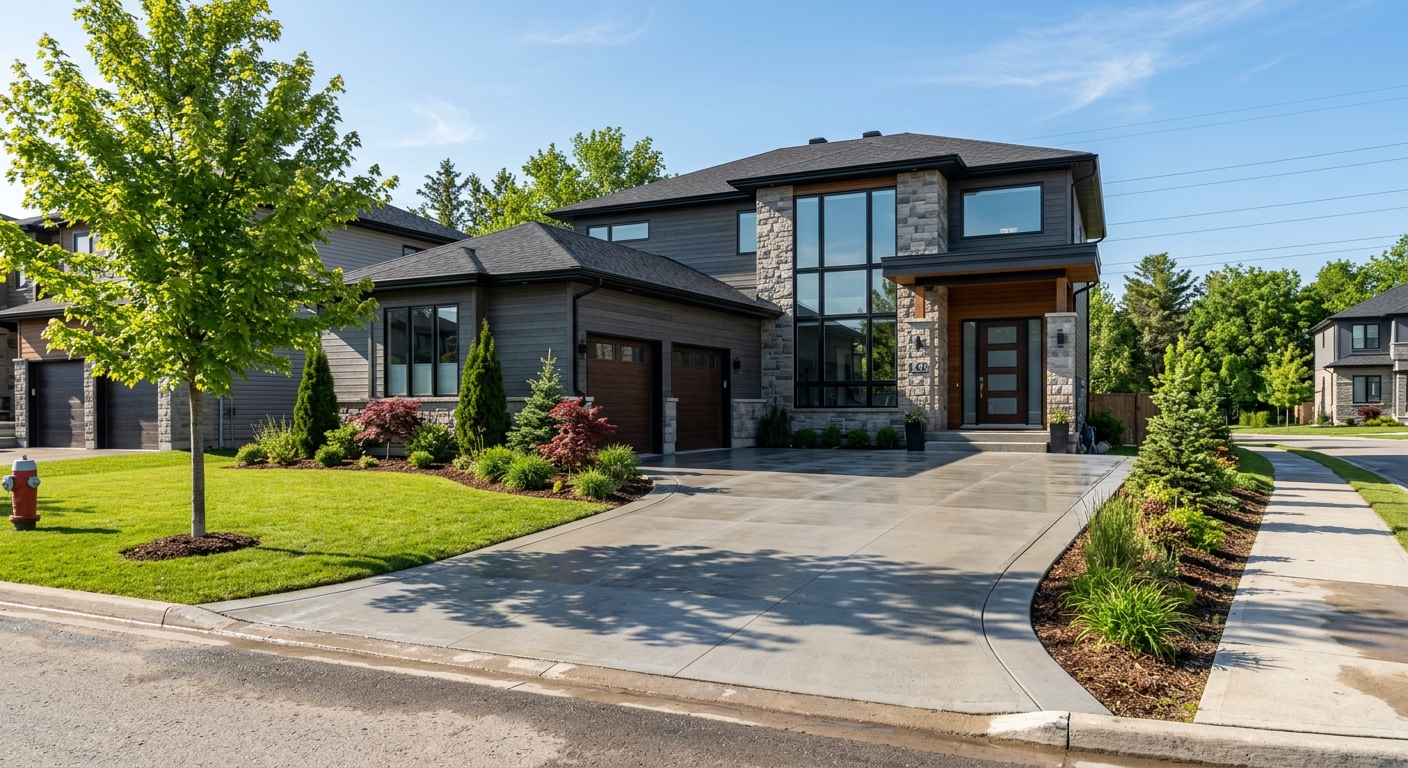
Concrete work options and costs in Elliot Lake
Elliot Lake is a tight-knit community where most homes are built for long winters, and that directly affects concrete flatwork choices and pricing. In our local housing stock, about 45.0% of dwellings are single-detached houses, so driveways, patios and walkways are constant demand items. With 3,550 homeowner households (60.8% of households own), homeowners typically want practical, long-lasting surfaces that can handle freeze–thaw cycling, winter moisture, and snow-clearing impacts.
Concrete work in Elliot Lake also feels the Northeast climate in a very real way: freeze–thaw cycles drive micro-cracking if the base isn’t compacted correctly and if the mix isn’t air-entrained for exterior exposure. Even though Elliot Lake is in Ontario rather than the Northeast of B.C., the outcome is similar—cold weather slows strength gain and increases the risk of early freezing. That means contractors plan pours carefully, use cold-weather protection when needed, and often budget for longer curing and surface protection.
Labour availability can tighten around the main pour months, and that can make “same-day” estimates swing depending on the contractor’s schedule. In neighbourhoods such as Westmount and West End, where lots tend to be busy with seasonal landscaping and driveway access, removal, regrading and proper base prep often become the deciding cost items. From there, it’s easiest to compare options side by side—standard broom finishes versus decorative and structural work—using the ranges below.
| Application |
Typical Size |
Key Spec |
Finish Option |
Price Range |
| Concrete driveway (standard broom finish) |
16 ft x 40 ft (640 sq ft) |
Air-entrained exterior mix; compacted granular base |
Broom finish + control joints |
$18,000 – $28,000 |
| Exposed aggregate driveway |
16 ft x 40 ft (640 sq ft) |
Staged wash exposure; proper curing to prevent scaling |
Exposed aggregate |
$22,000 – $34,000 |
| Stamped concrete driveway or patio |
12 ft x 24 ft (288 sq ft) |
Integral colour; air-entrained mix for exterior |
Stamp + release + sealer |
$10,000 – $18,000 |
| Plain concrete patio or walkway |
10 ft x 20 ft (200 sq ft) |
Compact sub-base; slope for drainage |
Light broom or smooth trowel depending on use |
$3,000 – $5,000 |
| Garage floor (interior slab) |
20 ft x 22 ft (440 sq ft) |
Vapour barrier (as required); reinforced slab |
Standard trowel finish |
$6,000 – $10,000 |
| Foundation footings (structural, below frost) |
Per project (varies by footing size/layout) |
Engineered footing elevations; rebar as specified |
Structural concrete (not decorative) |
$8,000 – $14,000 |
Prices are estimates only and vary by project scope, site access and material selection.
What affects the price of concrete work in Elliot Lake
In Elliot Lake, it’s common to see quote differences of 30–50% for what looks like the “same” concrete job. That gap usually isn’t the concrete itself—it’s the package around it: excavation depth, base preparation, reinforcement choices, finish complexity, and how the crew protects curing when temperatures drop. In the Northeast region across Canada, contractors price higher when the schedule compresses and when the job requires extra measures to prevent freeze–thaw damage. Even in Ontario, Elliot Lake’s winter conditions push the same levers: deeper frost protection, air-entrained mixes for exterior surfaces, and cold-weather curing precautions.
Specifically, frost line depth and freeze–thaw cycles drive every foundational and exterior detail. Footings must be set below the design frost depth to prevent frost heave and slab cracking, and exterior flatwork should be air-entrained to survive repeated moisture freezing and thawing. When a pour lands near cold nights, crews often use curing blankets, insulation, and temperature management, which adds labour and materials. De-icing salt further accelerates surface deterioration—so sealing (and the right finishing timing) matters for durability and appearance.
Two practical examples in Elliot Lake: first, if your existing driveway requires full removal and deeper regrading, you can move from a “typical” concrete driveway band (roughly $18,000 – $28,000) toward the higher end because excavation and backfill time are baked into the real cost. Second, a stamped patio might start near the plain patio range, but the labour for forming, stamping, and decorative finishing can justify stepping up into the decorative concrete band (about $10,000 – $18,000 for a typical stamped area). Lastly, homes built before 1981 (79.8% of local dwellings) often have older access constraints—narrow approaches, established trees, and outdated drainage—which can increase prep time and disposal.
| Price Factor |
Why It Matters |
Cost Impact |
| Frost line depth — determines footing depth and form height |
Deeper excavation prevents frost heave and uneven settlement |
Higher excavation, formwork and backfill costs; can noticeably raise foundation/footing budgets |
| Site preparation — excavation, grading, compacted granular base |
Base stability controls cracking, settlement, and drainage |
Extra truckloads of stone and longer labour can add substantial cost |
| Reinforcement — rebar or wire mesh requirement |
Rebar/wire mesh improves structural capacity and reduces premature failure |
Material and placement labour; cost increases with thicker slabs or larger spans |
| Mix design — air-entrainment and compressive strength spec |
Air voids protect from freeze–thaw damage; strength supports load performance |
Higher-spec mix can add a modest material premium but prevents expensive rework |
| Finish type — broom vs. stamped vs. exposed aggregate |
Complex finishes require more time, timing and skill |
Stamped and exposed work typically adds labour, colour system, and finishing/sealing steps |
| Pour size and concrete truck access to site |
Smaller access challenges require more labour for moving materials and placing |
Extra crew time, longer setup, and sometimes smaller batches increase cost |
| Cold-weather curing precautions — heating and blankets |
Early freezing can weaken concrete and create surface/strength issues |
Costs rise with temperature risk; blankets, heaters and monitoring add expense |
| Control joint pattern and sealing cost |
Joints manage cracking; sealer helps resist salt-related scaling |
Sealing and joint labour can add a moderate line item but improves longevity |
Permits & regulations in Ontario
In Ontario, structural concrete work typically needs a building permit, and many projects also require engineered drawings reviewed by the municipality. Work such as foundation footings, foundation walls, grade beams, and any structural slab tied into a building’s support system is generally considered part of the building structure and is handled through the permit process. Concrete flatwork (patios, walkways and most driveways) usually does not require a permit unless it affects lot grading, changes drainage, or impacts impervious surface coverage limits or municipal right-of-way rules.
For Elliot Lake homeowners, the practical approach is to confirm the scope with the local authority before breaking ground—especially if you’re changing elevations, adding a new driveway apron, or redirecting water. Also verify the contractor carries liability insurance and the required workplace coverage (WSIB/WCB) before work starts; reputable crews will provide documents without pushing back.
Here’s a simple step-by-step checklist you can follow:
- Ask the contractor for their certificate of insurance (liability) and current workplace coverage proof.
- Check the insurance certificate for active dates, coverage limits, and that your address is correctly referenced where applicable.
- Look for evidence of Ontario compliance where applicable (business registration details and contractor documentation tied to the work).
- Request references for similar Elliot Lake projects and ask specifically about exterior freeze–thaw performance.
- Confirm whether a building permit is required for your specific structural scope and whether the contractor will coordinate inspections.
Getting concrete right in Elliot Lake's freeze-thaw climate
Concrete fails in Elliot Lake winters when the system is built on shaky ground or the mix and finishing aren’t tuned to freeze–thaw exposure. The most common homeowner-visible issue is spalling (surface scaling and flaking), which often traces back to inadequate air-entrainment, poor drainage, or curing that allowed early freezing. To spec the job correctly, you need five layers working together: base preparation, proper mix design, a control joint strategy, curing, and sealing.
Start with base preparation: use a compacted granular sub-base to the required depth for local soil conditions and frost protection so the slab won’t heave or settle. Next, the mix design matters—exterior flatwork should use air-entrainment, commonly targeting about 5–7% air content, and a minimum compressive strength of 32 MPa. Then control joints: they’re not optional cosmetic features; they manage where cracking happens. Curing is the hidden budget killer in cold weather: exterior pours should be protected long enough to reach strength, and a minimum 7-day curing period under proper conditions is a good baseline. Finally, apply a penetrating sealer after the concrete has cured—typically around 28 days post-pour—so de-icing salt has less access to the pore structure.
Ask the right questions to avoid spalling: “What air content are you designing for?” and “How do you protect curing if night temperatures drop?” A concrete example: a plain broom-finished patio might land in the general patio band (often around $3,000 – $5,000 for a typical 200 sq ft area). If the contractor proposes to skip proper base depth or air-entrainment to save money, you might “save” a few hundred dollars up front—but the surface deterioration can cost far more in repairs and re-pouring. In freeze–thaw conditions, the correct spec is cheaper than failure.
| Spec |
Why It Matters in Elliot Lake |
What to Ask For |
Impact if Skipped |
| Compacted granular base (depth?) |
Prevents frost heave and minimizes settlement cracks |
Base thickness plan based on site conditions and frost considerations; proof of compaction |
Cracking, uneven slabs, and early edge failures |
| Air-entrained concrete mix (target air %?) |
Provides freeze–thaw durability against scaling |
Air content target (commonly 5–7% for exterior flatwork) and mix design details |
Spalling, surface scaling, and rapid deterioration |
| Compressive strength (MPa rating) |
Strength gain supports long-term load performance |
Minimum 32 MPa specified for exterior structural exposure |
Reduced durability and increased risk of cracking under load |
| Control joints (spacing per ACI guidelines) |
Controls where shrinkage and cracking occurs |
Proposed joint spacing, saw-cut timing, and sealing plan if required |
Random cracking and wider deterioration at edges |
| Minimum 7-day curing period |
Ensures proper strength development before freeze conditions intensify |
Curing method (curing compound vs blankets/insulation in cold weather) |
Weak surface layer and poor freeze–thaw resistance |
| Penetrating sealer (when applied after cure) |
Repels water and slows salt ingress |
Penetrating sealer after cure (often around 28 days post-pour) |
Faster scaling from de-icing salts and moisture |
How to choose a concrete work contractor in Elliot Lake
Choosing a contractor is mostly about verifying three things: they’re legally set up to do the work, they carry the right coverage, and they build to the correct technical specs for Elliot Lake’s freeze–thaw reality. Start with Ontario requirements: ask for their liability insurance certificate and proof of WSIB/WCB coverage before work begins. A valid certificate should show active dates, coverage limits, and your project details where applicable. For contractor legitimacy, also ask for business registration details and any applicable licensing documentation tied to contracting in Ontario—don’t rely on a verbal “we’re insured.”
Next, get 2–3 quotes that are itemised—labour and materials breakdowns, not just one lump sum. Look for whether disposal, form removal, granular base, reinforcement, finishing materials, curing protection, and sealing are included. Confirm if permits are included or if you’re expected to pull them. Pay attention to exclusions like “weather permitting” clauses that could reduce curing protection during cold snaps.
Use a schedule that protects you: never pay more than 10–15% upfront. Hold back a portion until the project is complete and cleaned up. Ask for a written start date and a completion estimate, and clarify what happens if frost limits scheduling.
- Ask for their proposed mix design details (air-entrainment and strength rating).
- Confirm base depth and compaction method for exterior slabs.
- Require an itemised quote (labour, materials, equipment, disposal).
- Verify liability insurance certificate is current.
- Verify WSIB/WCB coverage is current.
- Ask about temperature monitoring and curing blankets/insulation plans.
- Ask for reinforcement details (mesh vs rebar, spacing, and thickness).
- Confirm control joint layout and saw-cut timing.
- Ask what finishing is included (broom, trowel, stamp/exposed aggregate system).
- Confirm sealing plan for exterior flatwork (often after cure, around 28 days).
- Get warranty terms in writing (workmanship duration and coverage scope).
- Ensure the quote includes site protection, cleanup, and accessibility for truck delivery.
Concrete red flags I see in Elliot Lake include: quotes that ignore air-entrainment for driveways/patios, “no need for sealing” claims for salt-exposed surfaces, vague cure-and-protection wording when night temperatures drop, missing evidence of insurance/WSIB/WCB, and warranties that cover materials only (not workmanship). If you see those patterns, move on.
Frequently asked questions — concrete work in Elliot Lake
How do I compare concrete quotes?
In Elliot Lake, comparing concrete quotes is about matching specs, not just the total price. Ask each contractor to itemise labour and materials and to include base prep, reinforcement, finish type, and curing protection. For exterior work, confirm the mix is air-entrained (commonly 5–7% air) and the finishing includes proper control joints. Also compare whether sealing is included after cure—this is important with winter de-icing salts. If one quote lands at the “typical” driveway band (around $18,000 – $28,000) but omits base depth, reinforcement, or cold-weather curing, it’s not truly comparable. Finally, ask about truck access and disposal because removal and regrading can swing costs quickly in older neighbourhood streets.
Can concrete be poured in cold weather in Elliot Lake?
Yes, concrete can be poured in cold weather in Elliot Lake, but it depends on temperature, wind, and how you protect the pour. The main risk is early freezing before the concrete gains enough strength—this can weaken the surface and lead to premature cracking or spalling later. A reliable crew will monitor temperature, manage set time, and use cold-weather curing methods such as insulation blankets and/or controlled heating where needed. They’ll also plan logistics so concrete arrives quickly and is placed without excessive delays. Make sure the quote spells out their cold-weather plan rather than vague “weather permitting” language. If you’re comparing options, don’t assume the cheapest price includes proper curing protection—this can shift the true cost and durability outcome significantly.
How do I maintain concrete in Elliot Lake's freeze-thaw climate?
Maintenance in Elliot Lake is mostly about controlling water and salt contact. Keep runoff directed away from the slab by maintaining proper slope and clearing debris from edges and joints. Use de-icing salts carefully: they’re necessary for safety, but frequent heavy application can accelerate scaling if the surface isn’t properly sealed. A penetrating sealer applied after the concrete has cured (commonly around 28 days post-pour) helps repel moisture and slows salt ingress. For small repairs, address spalls and joint damage early rather than waiting—freeze–thaw can enlarge defects quickly. Also, avoid sanding or aggressive scraping that can damage the surface finish. If your contractor specified control joints and sealing, you’ll generally get better long-term performance in freeze–thaw cycling.
What causes concrete to spall in Elliot Lake winters?
Spalling in Elliot Lake winters is usually driven by a combination of moisture intrusion and freeze–thaw stress. The biggest spec issue is inadequate air-entrainment: without the right air void system, water inside the paste freezes and expands, breaking the surface layer. Poor base drainage and bad joint sealing can also let water sit in pores and along edges, worsening the cycle. Early freezing during curing is another contributor—weak or improperly developed surface concrete is more vulnerable once temperatures swing. Even a well-finished driveway can spall if curing protection is skipped. That’s why it matters to ask for mix design details and curing steps, not just the finish. If you’re budgeting for durability, it’s typically money well spent even when the decorative or premium option raises the initial price into higher bands.
What is rebar and when is it required in Ontario?
Rebar is reinforcing steel used to strengthen concrete and control cracking under load and movement. In Ontario, whether rebar is required depends on the engineered design and the structural function of the slab or foundation element—not every concrete pour uses it. Structural items like foundation footings and grade beams are commonly specified with reinforcement, based on soil conditions, loads, and engineered drawings. For exterior slabs like driveways, many contractors use wire mesh or rebar (or both) depending on slab thickness, soil support, and design load assumptions. The key point for homeowners in Elliot Lake: don’t accept “we’ll just pour it” with no reinforcement plan. Ask for slab thickness and reinforcement details in writing. A contractor should be able to explain what’s required and why, aligned with the scope and any permit/engineering requirements for structural work.
How long does a concrete project take in Elliot Lake?
Timing depends on weather, pour size, and how much demo and base work is required. For exterior flatwork in Elliot Lake, the physical pour day may be only part of the schedule: excavation, hauling, grading and compaction can take 1–3 days depending on site access and base depth. The concrete placement itself is often completed in a single day, but finishing, curing protection, and joint work follow closely. After placement, curing time is crucial—minimum 7 days is a common baseline before you expect normal handling, and cold weather can extend the protection period. If your project includes sealing, remember that sealer is typically applied after full cure (often around 28 days). In budgeting, this matters because schedule delays can be more expensive than material differences—especially when you’re trying to complete work during the main pour season.