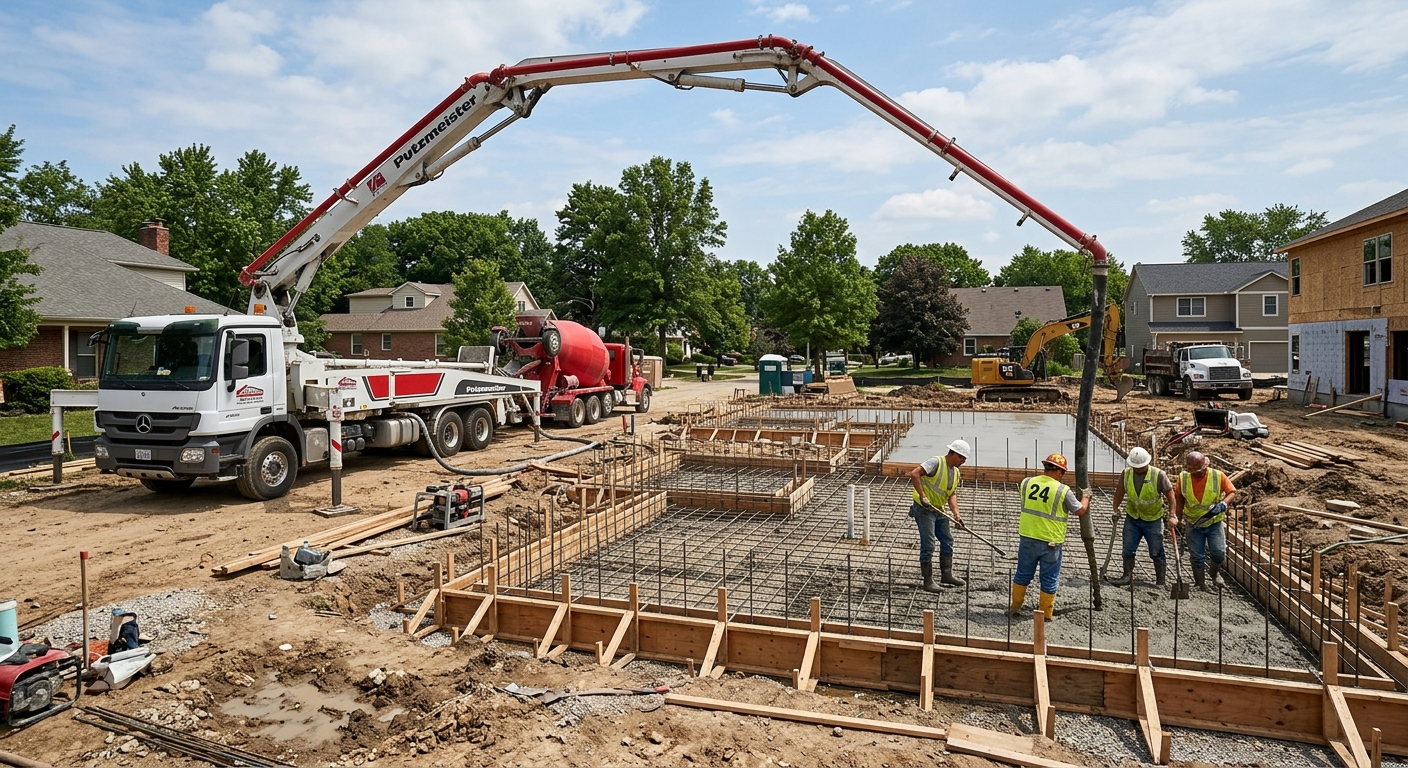
Concrete work options and costs in Caledonia-Fairbank
In Caledonia-Fairbank, Ontario, choosing the right concrete option is largely about managing the area’s cold, wet Great Lakes climate. With a population of 9,955 (Statistics Canada, 2021 Census), the town’s housing demand is a steady driver of concrete flatwork like driveways, patios, and walkways—work that’s especially common in neighbourhoods such as Fairbank/“the west end” where many single-detached homes sit on older lots and need periodic replacement or upgrades. You’ll also feel the pressure of the Hamilton–Niagara Peninsula’s freeze-thaw cycles: water in the ground expands, and repeated temperature swings stress weaker bases and mixes. That’s why contractors here typically build deeper excavation and granular base, use air-entrained concrete for exterior slabs, and pay close attention to control joints. The region’s shorter outdoor pour season (roughly May to October for many exterior projects) also tightens scheduling—when we do work in shoulder months, you often see higher labour and heating/blanket costs.
Prices can look confusing at first because a “driveway replacement” can include very different scopes: some bids assume simple tear-out and placement, while others include new forms, reinforced edging, upgraded drainage, or a premium finish like stamping or exposed aggregate. As a practical guide, most Caledonia-Fairbank projects land within the regional price bands—so use the table below to compare like-for-like options before you request quotes.
| Application |
Typical Size |
Key Spec |
Finish Option |
Price Range |
| Concrete driveway (standard broom finish) |
12 ft x 24 ft (288 sq. ft.) |
Air-entrained exterior mix, compacted base, control joints |
Broom finish |
$3,900–$6,400 |
| Exposed aggregate driveway |
12 ft x 24 ft (288 sq. ft.) |
Air-entrained mix, proper curing before exposing surface |
Exposed aggregate |
$5,100–$8,600 |
| Stamped concrete driveway or patio |
10 ft x 20 ft (200 sq. ft.) |
Air-entrained mix, integral colour, release + sealer |
Stamped pattern (e.g., stone/brick) |
$4,400–$7,000 |
| Plain concrete patio or walkway |
10 ft x 12 ft (120 sq. ft.) |
Air-entrained mix, compacted base, joints |
Standard trowel + light broom |
$1,600–$2,400 |
| Garage floor (interior slab) |
22 ft x 20 ft (440 sq. ft.) |
Vapour control planning (as applicable), standard mix, reinforcement where needed |
Float/trowel finish |
$6,600–$10,200 |
| Foundation footings (structural, below frost) |
Typical 1-storey perimeter (approx. 60 lin. ft.) |
Engineered sizing, below-design frost depth, reinforced as specified |
Structural concrete |
$3,600–$7,200 |
Prices are estimates only and vary by project scope, site access and material selection.
What affects the price of concrete work in Caledonia-Fairbank
In the Hamilton–Niagara Peninsula, two bids for what sounds like the “same” concrete job can differ by 30–50% once you factor in how each contractor is handling frost, moisture and curing. The reason is simple: in Ontario’s cold-wet conditions, frost depth and freeze-thaw cycles dictate the entire foundation and slab design. For Caledonia-Fairbank, exterior work typically needs air-entrained concrete mixes so the slab survives repeated cycles without scaling or spalling, and footings must extend below the design frost depth to control frost heave. Contractors also adjust the granular base (depth and compaction), reinforcement placement, and control joint spacing because shrinkage and thermal movement can’t be “patched later.”
Seasonality matters too. Most exterior pours are scheduled roughly May–October; when weather turns, cold-weather curing precautions—like insulating blankets, heating and slower finishing schedules—can add labour and materials. Add de-icing salt exposure to sidewalks, steps and drive lanes, and the conversation shifts toward sealing timelines and surface durability. That’s why you’ll often see a standard driveway broom job land near the lower end of regional rates, while decorative work—stamped or exposed aggregate—costs more because colouring, labour time, and finish steps are higher (and you still need the same frost-resilient foundation specs underneath).
Concrete cost can also swing based on site realities. For example, if your driveway replacement in Fairbank/“the west end” includes removing an old slab and hauling debris, haul-away and downtime can push costs up. Conversely, a smooth, well-graded site with easy truck access can keep a patio closer to the $12–$20/sq. ft. band. For a typical 12 ft x 24 ft driveway (288 sq. ft.), that can mean the difference between a broom-finish range near $14–$22 per square foot and a premium stamped job that’s closer to the upper decorative range—when the added value is real (patterning, integral colour, and extra finishing and sealing). If the contractor tries to reduce base depth or skip proper joints, you’ll “save” today and pay later through random cracking.
| Price Factor |
Why It Matters |
Cost Impact |
| Frost line depth |
Determines footing depth and form height to prevent frost heave |
Higher excavation and steel/formwork; can swing a footing quote significantly |
| Site preparation |
Excavation, grading, and a compacted granular base affect settlement and cracking |
More hauling and compaction steps raise price; good sites reduce it |
| Reinforcement |
Rebar/wire mesh helps control cracking and supports load transfer |
Material and labour add cost, especially for larger slabs |
| Mix design |
Air-entrainment and specified strength improve freeze-thaw durability |
Premium mix and careful batching can add dollars per square foot |
| Finish type |
Broom vs. stamped vs. exposed aggregate changes labour and materials |
Stamped/exposed finishes typically add cost over plain finishes |
| Pour size and concrete truck access to site |
Access affects pumping, labour time, and whether extra equipment is needed |
Poor access may require pumping/extra crew; larger pours need coordination |
| Cold-weather curing precautions |
Heating/blankets protect strength gain and surface durability |
Seasonal premiums can move exterior work toward the top of its band |
| Control joint pattern and sealing cost |
Joints manage shrinkage; sealing reduces salt-driven surface damage |
More joints/labour and a later sealer step increase total project cost |
Permits & regulations in Ontario
In Ontario, structural concrete work generally requires a building permit and often engineered drawings reviewed by the municipality. If you’re pouring or altering foundation elements—such as footings, foundation walls, grade beams, underpinning, or structural slab-on-grade supporting loads—assume a permit is required. Concrete flatwork (patios, walkways, driveways) usually doesn’t require a permit by itself, but it can trigger review if the work affects lot grading, drainage, or impervious surface coverage limits, or if it impacts the municipal right-of-way/sidewalk areas. The safest approach in Caledonia-Fairbank is to confirm with the local authority before breaking ground, especially if you’re changing elevation or moving drainage patterns.
Before hiring, verify three things: (1) the contractor’s business registration/appropriate licensing level (where applicable), (2) liability insurance, and (3) WSIB/WCB coverage. Step-by-step, ask for a current Certificate of Insurance (COI) showing active general liability with your job address listed as a certificate holder or additional insured (where the insurer and contractor agree). Next, request proof of WSIB clearance for the firm and, if they subcontract, ask whether the subcontractor is covered as well. For licences and status, start with Ontario’s online registries and the contractor’s own website documents. Finally, ask for references on similar-scale local pours—especially exterior slabs built for freeze-thaw durability.
Getting concrete right in Caledonia-Fairbank's freeze-thaw climate
Concrete fails in Caledonia-Fairbank when water gets in and the slab cycles through freeze-thaw stress faster than it can resist it. The most common homeowner-visible issue is scaling/spalling—small surface chips that start after winter salts and expand with each cycle. The fix is to spec the whole system correctly: base preparation, mix design, control joints, curing, and sealing. Start with the compacted granular sub-base. You want the right base depth and compaction for your soil and frost conditions—because weak base leads to pumping and voids that crack concrete even if the surface finish looks good. Next is the mix design: exterior flatwork should use air-entrained concrete with a target air content of about 5–7% for freeze-thaw durability, and at least 32 MPa compressive strength. Control joints need to be placed to limit random cracking, and they’re not optional “later”—if you skip them or place them too far apart, the concrete will crack where it wants.
Curing is the quiet cost driver that prevents premature surface damage. Plan for a minimum 7-day curing period under proper conditions; in shoulder months, contractors should protect the slab with blankets and/or heat to avoid rapid temperature swings. Then, seal the surface: apply a penetrating sealer after the concrete has cured (commonly around 28 days) to repel de-icing salts and reduce moisture ingress.
Ask technical questions that prevent spalling. For example, if someone offers a “cheap” driveway near the low end of the $14–$22/sq. ft. band but won’t confirm air-entrainment and base specs, that savings is usually borrowed from durability. A typical 288 sq. ft. driveway might be $4,000–$6,300 broom-finish; paying the higher end is justified when it includes the right granular base, proper joints, and the correct exterior air-entrained mix—because a replacement driveway later costs far more than the premium up front.
| Spec |
Why It Matters in Caledonia-Fairbank |
What to Ask For |
Impact if Skipped |
| Compacted granular base (depth?) |
Controls settlement and frost-related movement in Ontario soils |
Base depth and compaction method appropriate for your subgrade |
Cracking, unevenness, and premature failure of the slab |
| Air-entrained concrete mix (target air %?) |
Helps concrete survive repeated freeze-thaw cycles |
Confirm target air content (about 5–7% for exterior flatwork) |
Spalling/scaling, surface damage accelerated by winter salts |
| Compressive strength (MPa rating) |
Strength gain supports durability under freeze-thaw and loads |
At least 32 MPa (or as engineered/spec’d) |
Higher risk of wear, cracking, and early deterioration |
| Control joints (spacing per ACI guidelines) |
Limits random cracking from shrinkage and thermal movement |
Joint layout and spacing plan before the pour |
Random cracks that can widen and let water in |
| Minimum 7-day curing period |
Strength development prevents early surface weakness |
Cure protection plan; cold-weather curing if needed |
Surface dusting, reduced durability, and increased scaling risk |
| Penetrating sealer (when applied after cure) |
Reduces salt and moisture penetration during Ontario winters |
Apply after full cure (commonly ~28 days post-pour) |
Faster salt-driven deterioration and higher maintenance costs |
How to choose a concrete work contractor in Caledonia-Fairbank
When you’re hiring for concrete in Caledonia-Fairbank, verify Ontario coverage and document quality—not just price. First, check licensing/registration status for the business (where applicable) and request proof of general liability insurance with a current policy. Second, confirm WSIB/WCB coverage: ask for a clearance letter for the contractor and ensure any subcontractors are also covered. You can start by checking online registries for business status, then rely on the paperwork they provide—COIs and WSIB clearance are what you should keep for your records.
Next, get 2–3 itemised written quotes. You want a labour + materials breakdown or at least a clear scope: demolition and disposal, excavation, granular base, reinforcement, concrete supply (including air-entrainment), forming, finish, joint layout, curing protection, and sealing (if offered). Avoid “lump sum” quotes that don’t say what’s included—especially on exterior work where drainage details can shift the price dramatically. Also ask whether a permit pull is included (for structural foundation work it’s often part of the process; for flatwork it may not be required unless grading impacts are involved).
Warranty should be in writing. Ask for workmanship warranty length and what it covers (cracks, settlement, spalling), plus any manufacturer warranty terms for concrete products or sealers and whether it transfers to you if you sell the home. For payment, never pay more than 10–15% upfront; keep a holdback until the work is complete and acceptable. Insist on a written timeline with start date and completion estimate, since pour season constraints in the Hamilton–Niagara Peninsula affect scheduling.
- Ask what frost protection and below-frost footing depth approach they use for your project.
- Confirm they specify an air-entrained mix for exterior slabs and patios/walkways.
- Require a base preparation description (depth, granular type, compaction method).
- Get a clear joint plan (location, spacing, and whether joints are saw-cut/tied in correctly).
- Ask how they handle curing in cool nights or shoulder-season weather.
- Verify reinforcement plan (mesh vs. rebar, and where it’s used).
- Check whether demolition and hauling/disposal are included in the quote.
- Confirm concrete truck access plan (and whether pumping is required).
- Request the exact finish method (broom pattern, exposure procedure, stamp release + curing/sealer steps).
- Make sure a project supervisor will be on-site and that schedule trades are coordinated.
- Get permit responsibility in writing for structural work (footings/foundation elements).
- Keep copies of COI and WSIB/WCB proof before any payment.
Concrete red flags I see around Caledonia-Fairbank include: skipping/undervaluing the granular base and compaction, refusing to confirm air-entrainment for exterior slabs, vague curing practices (no mention of blankets/heating when needed), no written joint layout, and quotes that don’t clearly state what’s included for demolition, drainage adjustments, and disposal.
Frequently asked questions — concrete work in Caledonia-Fairbank
How do I maintain concrete in Caledonia-Fairbank's freeze-thaw climate?
Maintenance in Caledonia-Fairbank is mostly about moisture and salt control. In winter, use de-icing products carefully: avoid rock salt where possible and keep application light to reduce surface spalling risk. Sweep away debris in fall so water doesn’t sit in joints. For exterior flatwork (driveways, patios, sidewalks), sealing helps—especially because the Hamilton–Niagara Peninsula sees repeated freeze-thaw cycles that stress saturated concrete. If your contractor didn’t include sealing, ask about a penetrating sealer after the slab reaches full cure (commonly around 28 days). Plan inspections each spring for hairline cracks, joint gaps, and surface scaling; small sealant or joint repairs are cheaper than waiting for structural problems. If your project was priced near the $14–$22/sq. ft. broom-finish band, durability depends on those joints and sealing as much as the finish look.
What causes concrete to spall in Caledonia-Fairbank winters?
Spalling usually comes from freeze-thaw damage plus de-icing salt exposure, and it’s often traced back to mix design and curing choices. The biggest technical cause is inadequate air-entrainment: without the proper air void system, water inside the concrete freezes, expands, and breaks down the surface. In Ontario’s colder, wetter conditions, poor base prep can also allow water to infiltrate and create voids, which worsens cracking and scaling. Curing problems matter too—if concrete is finished or exposed to cold snaps too early, the surface can be weaker and more vulnerable to the first winter. If you’re seeing spalling, a good contractor will ask about when the slab was poured (temperature), whether blankets/heating were used, whether the mix was exterior-rated, and whether the joint pattern matched shrinkage needs. For exterior work, proper air-entrainment and sealing are what protect you; even a stamped look won’t hold up if the slab wasn’t built for freeze-thaw durability.
What is rebar and when is it required in Ontario?
Rebar is reinforcing steel that helps concrete resist cracking and handle tensile stresses from shrinkage, loads, and ground movement. In Ontario, whether rebar is “required” depends on the engineered design or the applicable spec for your foundation/flatwork, soil conditions, and slab thickness. For structural concrete—like footings, foundation walls, and grade beams—reinforcement is typically specified by engineering and building permit requirements, especially when footings must be designed below frost depth to prevent heave. For driveways and patios, reinforcement may be recommended for larger slabs, heavy loads (like vehicle parking), or poor subgrade conditions, but the exact need should be based on the contractor’s assessment and your slab thickness. A reputable Caledonia-Fairbank contractor will show you the reinforcement plan (mesh vs. rebar, placement, chairs/spacers) and how it ties to the control joints. If someone tries to cut reinforcement on a thick exterior slab without justification, ask what spec supports that choice.
How long does a concrete project take in Caledonia-Fairbank?
Timelines depend on whether it’s flatwork or structural work, and how weather affects curing and crew scheduling. For typical exterior flatwork in Caledonia-Fairbank, you can often expect demo and prep the first day, the pour on a scheduled day, and finishing and joint work the same day; curing protection may extend the practical “don’t walk/drive on it” timeline. Most homeowners plan for at least a few days for access restrictions, and a longer period for full strength—often requiring at least 7 days of proper curing for many uses, with sealing typically coming after cure (commonly around 28 days). If it’s a foundation/footing scope (structural below frost), schedules stretch because forms, inspections (where applicable), and engineering-driven steps can add time. Also remember Ontario’s shorter pour season in the Hamilton–Niagara Peninsula; cool nights can slow progress unless cold-weather curing precautions (blankets/heating) are used, which can add time and cost.
What is a concrete overlay and is it suited to Caledonia-Fairbank?
A concrete overlay is a new concrete layer placed over an existing slab that’s been prepared (usually by grinding, cleaning, and repairing delaminated areas) to restore surface performance and appearance. Overlays can be suited to Caledonia-Fairbank when the existing slab is still structurally sound and the issue is mainly surface wear or appearance—common on older driveways where the base hasn’t failed. They’re less suitable if the original slab has significant settlement, major heaving from frost, or widespread structural cracking, because the overlay can still reflect movement and eventually fail. Overlays don’t replace the need for correct drainage and jointing strategy, and they require careful preparation so the new layer bonds. If your existing driveway needs full replacement due to spalling or major cracking, you’ll often be closer to standard driveway pricing (for example, broom-finish driveway estimates commonly land within the $14–$22/sq. ft. band). A good contractor will assess the slab and tell you whether overlay economics truly work for your situation rather than promising a “one-size-fits-all” fix.
How do I seal concrete to protect it in Caledonia-Fairbank?
To protect concrete in Caledonia-Fairbank, sealing is mainly about reducing moisture and salt penetration. The key is timing: wait until the concrete has cured sufficiently—often around 28 days post-pour for many sealers—so you don’t trap moisture beneath the surface. Use a penetrating sealer designed for exterior concrete; it should soak in rather than forming a film that can wear unevenly. Prep matters as much as the product: clean off dirt and loose debris, repair cracks where needed, and make sure joints are properly handled. If your driveway or walkway sees heavy de-icing use, plan for reapplication based on product recommendations (many homeowners set expectations for periodic maintenance). When quotes include sealing, compare what product type is used and whether it’s included at the time of pour or scheduled later. In practice, sealing is one of the most effective ways to extend service life after exterior pours built for the region’s freeze-thaw cycles.