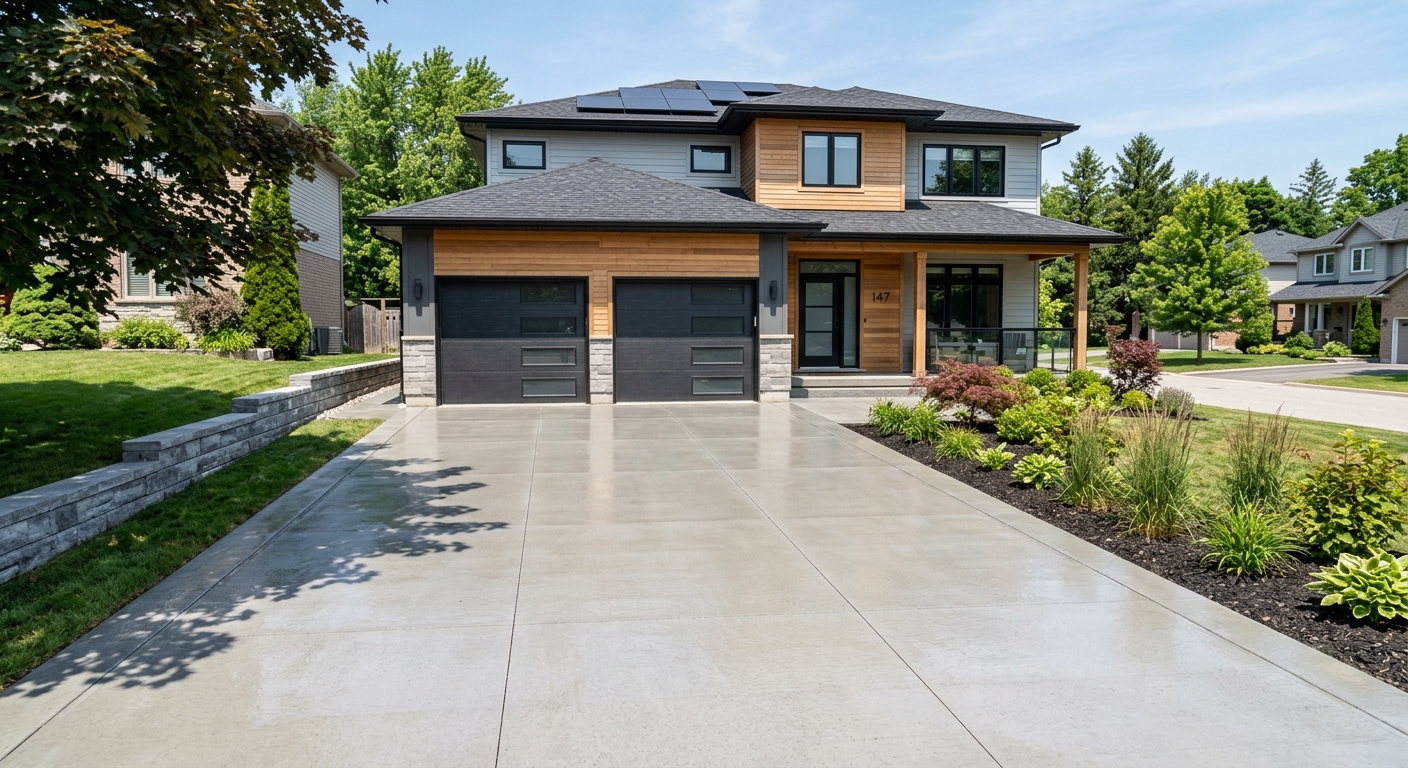
Concrete work options and costs in Amigo Beach
Amigo Beach, Ontario is a small community (population 1,545 per the Statistics Canada, 2021 Census) where homeowners usually want concrete that looks clean in summer and survives winter. Most concrete flatwork goes in on typical suburban lots and, in the Toronto economic region, the market is dominated by single-detached-style properties that benefit from driveways, patios and walkways that are built to handle the local freeze–thaw cycle. Because you’re balancing a wet spring/fall with repeated freezing, Toronto-area specs routinely emphasize proper sub-base, air-entrained concrete, and control joints—cost items that reduce long-term cracking and surface wear.
Contractor availability and pricing also swing with the pour season. Exterior work is best planned when daytime temperatures stay reliably warm enough for curing; when conditions drop toward 10 °C or below, crews often need additional protection and longer cure time, which adds labour and material allowances. That’s one reason many homeowners see stronger demand—and quicker scheduling—around established neighbourhoods with higher turnover and home improvements.
In Amigo Beach, you’ll typically notice this trade-in-demand along the main residential stretches where driveways and entry walks are common. If you’re budgeting, the table below compares common options and the key specifications that drive cost, so you can compare quotes apples-to-apples.
| Application |
Typical Size |
Key Spec |
Finish Option |
Price Range |
| Concrete driveway (standard broom finish) |
400 sq. ft. |
Air-entrained mix; compacted granular base; control joints |
Broom finish |
$7,200–$11,200 |
| Exposed aggregate driveway |
400 sq. ft. |
Air-entrained mix; base prep; retarder timing |
Exposed aggregate (broomed/washed look) |
$9,000–$13,500 |
| Stamped concrete driveway or patio |
300 sq. ft. |
Air-entrained mix; integral colour; release agent |
Stamped pattern (wood/stone look) |
$7,200–$12,000 |
| Plain concrete patio or walkway |
200 sq. ft. |
Compact granular base; proper drainage slope |
Plain broom or trowel-light |
$3,200–$5,200 |
| Garage floor (interior slab) |
320 sq. ft. |
Vapour barrier (if needed); reinforcement; curing |
Steel-trowel finish |
$6,000–$10,400 |
| Foundation footings (structural, below frost) |
Typical small addition: 60–100 lin. ft. |
Structural concrete; below-grade excavation; rebar per design |
Structural finish (formed) |
$10,800–$30,000 |
Prices are estimates only and vary by project scope, site access and material selection.
What affects the price of concrete work in Amigo Beach
In Toronto and nearby Ontario markets, it’s common to see quotes for the “same” concrete job vary by about 30–50%. The difference usually isn’t the concrete itself—it’s the spec behind it. In the Toronto economic region, frost depth and freeze–thaw cycles dictate every part of the build: structural footings generally must extend at least 1.2 m below grade (to reduce frost heave and differential movement). For exterior slabs like driveways, that same risk leads crews to specify air-entrained concrete mixes and to manage curing carefully. If air isn’t right, or if the slab cures too cold, surface scaling and cracking show up early.
Cold-weather curing precautions can also change the cost. When temperatures fall and crews need heated enclosures or insulating blankets, labour time and material handling rise—even if the slab size is unchanged. De-icing salt in winter accelerates spalling when concrete has inadequate air content or weak surface density, so sealing is frequently recommended (which adds a line item, but can protect your finish).
Local site conditions matter too. For example, if your driveway base requires additional excavation and import granular fill to reach a stable, well-compacted depth, the project can drift toward the higher end of the driveway pricing band ($18–$28 per sq. ft.). Conversely, a straightforward patio/walk with good drainage and easy truck access is often closer to the lower end of the patio/walkway band ($16–$26 per sq. ft.). Also, housing stock in the area often includes older, uneven approaches where regrading is needed before pouring—small changes that translate into hundreds to over a thousand dollars.
| Price Factor |
Why It Matters |
Cost Impact |
| Frost line depth |
Determines footing depth and form height |
More excavation and rebar can push structural work toward the upper range |
| Site preparation |
Excavation, grading, compacted granular base |
Unstable soils or poor drainage increase hauling and granular import |
| Reinforcement |
Rebar or wire mesh requirement |
Steel adds material cost and labour to place and support |
| Mix design |
Air-entrainment and compressive strength spec |
Higher-performance air-entrained mixes reduce spalling risk but can add cost |
| Finish type |
Broom vs. stamped vs. exposed aggregate |
Decorative finishes typically cost more due to colour, formwork and extra labour |
| Pour size and concrete truck access to site |
Working time, pumping vs. wheelbarrowing |
Tight access can require smaller pours or extra labour for placement |
| Cold-weather curing precautions |
Heating and blankets |
Shorter pour season can increase scheduling premiums and add protection materials |
| Control joint pattern and sealing cost |
Limits random cracking and protects against salt damage |
Better jointing and sealing typically adds a measurable line item but reduces failure risk |
Permits & regulations in Ontario
In Ontario, structural concrete work generally needs a building permit. That includes footings, foundation walls, and grade beams, especially where the work is part of a foundation system for a new build, addition, or major structural alteration. In many cases, you’ll also see engineered drawings reviewed by the municipality because the footing dimensions, rebar placement, and loads are structural in nature.
Concrete flatwork—driveways, patios, and walkways—typically does not require a permit by itself. However, a permit or confirmation can be required if the project affects lot grading, drainage, impervious surface coverage limits, or ties into work near a municipal right-of-way (for example, changes to a driveway approach). Always check with the local authority before breaking ground.
To verify your contractor in Amigo Beach, ask for three things and check them in writing: (1) Ontario contractor licence/registration where applicable (use the online registry and confirm the correct legal entity); (2) a certificate of insurance showing general liability (and verify it hasn’t expired); and (3) WSIB/WCB clearance or proof of coverage consistent with their work. Then request references for similar-scale projects completed in the last 12–24 months. If they can’t provide clear documentation, treat it as a red flag.
Getting concrete right in Amigo Beach's freeze-thaw climate
Concrete fails in Amigo Beach’s freeze–thaw climate mainly when water gets into the slab or base and then freezes, expanding and stressing the surface. The biggest drivers are inadequate base prep, poor mix design (especially air-entrainment), and weak curing when the weather drops. To spec the job correctly for the Toronto market, start with (1) base preparation: use a compacted granular sub-base to the required depth for local soil conditions, with drainage slopes so water can move away from the slab. Next, (2) mix design: for exterior flatwork, air-entrainment is typically targeted at about 5–7% and concrete should meet at least 32 MPa compressive strength for durability. (3) Control joints need a planned spacing to limit random cracking—then (4) curing should be at least 7 days under proper conditions, with added protection during cold spells. Finally, (5) sealing is usually applied after the concrete has cured—often around 28 days—to help repel de-icing salts.
A practical way to protect your budget is to ask where quality changes actually matter. For example, the price gap between a broom-finished driveway and a stamped one can be justified: stamped concrete typically costs in the decorative band ($24–$40 per sq. ft.), because you’re paying for colour, pattern work, and finishing time. But for durability, you shouldn’t pay for aesthetics at the expense of freeze–thaw durability—if the contractor cuts corners on air content or jointing, you risk early scaling and spalling.
| Spec |
Why It Matters in Amigo Beach |
What to Ask For |
Impact if Skipped |
| Compacted granular base (depth?) |
Prevents pumping and movement during freeze–thaw in Amigo Beach soils |
Granular type and compacted depth; proof of grading/drainage slope |
Settlement, cracking, and premature slab failure |
| Air-entrained concrete mix (target air %?) |
Helps concrete resist freeze–thaw scaling and spalling |
Target air content (typically 5–7% for exterior flatwork) |
Surface scaling/spalling in winters within a few seasons |
| Compressive strength (MPa rating) |
Supports structural integrity and long-term durability |
Minimum 32 MPa specified on the mix design |
Higher risk of cracking and surface wear under traffic and salt |
| Control joints (spacing per ACI guidelines) |
Directs cracking to predictable lines in Ontario temperature swings |
Planned joint spacing and sawcut/depth schedule |
Random cracking that compromises appearance and water entry |
| Minimum 7-day curing period |
Ensures proper strength gain before winter exposure |
How they cure in cold weather (blankets/heating if needed) |
Reduced durability, cracking, and weaker surface resistance |
| Penetrating sealer (when applied after cure) |
Repels moisture and de-icing salt to reduce damage |
Application timing (often after full cure, around 28 days) and product spec |
Faster salt-driven deterioration and loss of finish quality |
How to choose a concrete work contractor in Amigo Beach
Start with verification. For Ontario work, confirm the contractor is properly licensed/registered where required for their business type, and that they can provide a current certificate of general liability insurance. Next, ask for WSIB/WCB coverage (or applicable proof/clearance). In practice, you check by looking for the contractor’s legal name on the insurance certificate, and then using online lookup tools for licence/coverage where available. Don’t rely on verbal assurances—request copies before you sign.
Then get 2–3 itemised written quotes. The best quotes break pricing into labour and materials (excavation and grading, granular base, reinforcement, concrete supply, finish labour, joints, sealing, and any waste/disposal). Avoid lump-sum quotes that don’t say what’s included. Ask what’s excluded: permit fees (if any), disposal of unsuitable soil, sawcutting and sealing, and cold-weather protection. For warranty, confirm workmanship coverage length in writing, whether it includes corrective repairs for surface issues, and whether the product warranty (if provided) is tied to the homeowner or transferrable.
For payment, never accept a deal that requires a large upfront deposit. A safer approach is keeping upfront at roughly 10–15% and using a holdback until the job is fully complete and cleaned up. Finally, require a written timeline with start date, curing/protection steps, and an estimated completion date—especially important when Toronto-area weather can shift quickly.
- Request licence/registration details and confirm the exact legal business name.
- Verify general liability insurance is current (ask for certificate).
- Confirm WSIB/WCB coverage or clearance proof before work begins.
- Get 2–3 quotes that list labour and materials separately, not just one total.
- Ensure the quote states concrete mix details (air-entrained for exterior) and target strength.
- Ask for base prep scope: excavation depth, granular type, and compaction expectations.
- Confirm reinforcement (wire mesh vs rebar) and where it’s placed.
- Check finishing spec: broom vs stamped vs exposed aggregate, including timing.
- Make sure control joints are included with a stated spacing and sawcut plan.
- Ask how they protect curing if temperatures drop toward 10 °C or below.
- Confirm sealing is included or excluded, and when (after full cure) it will be applied.
- Use a payment schedule with a meaningful holdback until final acceptance.
Concrete red flags I see around Amigo Beach include: vague quotes that skip air-entrainment or joint spacing, crews that start without confirming drainage/grading, no documentation of insurance/WSIB coverage, refusal to put curing/protection steps in writing, and promises like “no need for sealing” even when de-icing salt use is expected.
Frequently asked questions — concrete work in Amigo Beach
How do I maintain concrete in Amigo Beach's freeze-thaw climate?
For Ontario homes like those in Amigo Beach, maintenance is mostly about managing water and salt. Start with routine inspection: after winter, look for small chips along edges and hairline cracks near joints. Keep surfaces clean of debris so water can’t sit, and when removing snow, avoid gouging with metal shovels. Use de-icers carefully—some rock salts are more aggressive and can worsen surface scaling on weaker concrete. If your slab is new, consider applying a penetrating sealer after cure (commonly around 28 days) to help repel moisture and de-icing chemicals. If your concrete is older and already spalling, a patch and re-leveling plan is often better than repeated surface treatments. In budgets, sealing is usually a small add-on compared with replacing a driveway, which commonly falls around the $18–$28 per sq. ft. range for standard driveway work.
What causes concrete to spall in Amigo Beach winters?
Spalling is usually the result of moisture entering the concrete and then freezing, which expands water inside the pores. In Amigo Beach’s Toronto-region climate, freeze–thaw cycles plus de-icing salts can accelerate this process, especially if the mix isn’t properly air-entrained. Air-entrainment creates microscopic voids for freeze–thaw relief; when it’s missing or incorrect, the surface can scale and eventually spall. Another common cause is inadequate base prep or drainage, which lets water pool under/against the slab and repeatedly saturate it. Poor curing—especially when pours happen near colder conditions—can also reduce durability. Finally, if control joints and sealing aren’t planned, water finds pathways through cracks. If you’re comparing options, don’t trade durability for looks: decorative driveways may cost $24–$40 per sq. ft., but durability specs (air content, joints, curing, sealing) matter just as much for preventing winter damage.
What is rebar and when is it required in Ontario?
Rebar (reinforcing steel) is used to help concrete resist cracking and structural tension forces. It doesn’t make concrete “unbreakable,” but it improves performance when loads or movement occur—particularly in foundation elements and in slabs that are designed for higher stresses. In Ontario, whether rebar is required depends on the structural design, soil conditions, slab thickness, and engineering requirements for the specific application. For structural work like footings and foundation walls, rebar is typically specified by the engineer and is part of permitted structural drawings. For concrete flatwork such as driveways and patios, some projects use wire mesh or rebar based on thickness, sub-base quality, and expected loads; others may rely on thickness plus properly compacted base. The key for homeowners is to ask your contractor to specify what reinforcement is included in the quote and why. If the quote is silent, insist on confirmation before you pay.
How long does a concrete project take in Amigo Beach?
Timelines depend on the size of the slab, site access, weather, and curing requirements. For a typical exterior flatwork project like a driveway or walkway, the placement day may be only one workday, but the total schedule includes base prep, formwork, finishing, and protection during cure. Most pours still require at least a functional curing period—many contractors plan for minimum 7 days before treating the slab as ready for regular use, with full strength gain continuing longer. In Toronto-area fall and spring, you may also see delays if conditions drop and crews need cold-weather curing precautions (blankets/heating). Foundation/footings work takes longer because excavation, inspection, reinforcement placement, and sometimes multiple stages are involved—plus municipal review when permits apply. If you’re deciding between standard and decorative finishes, stamped concrete can add extra time due to colouring and pattern steps, which affects overall calendar time even if the pour volume is similar.
What is a concrete overlay and is it suited to Amigo Beach?
A concrete overlay is a new concrete layer placed over an existing slab to restore appearance and add surface performance. In Amigo Beach and across Ontario, overlays can be a good solution when the underlying slab is mostly stable (not moving) and the existing surface is properly prepped for bonding. The contractor typically profiles the surface, cleans it thoroughly, and prepares it so the overlay can adhere. Overlays are usually most suitable for driveways and patios where the base isn’t failing and the cracking is limited or repairable. They’re less suitable when the original slab has widespread heaving, major structural deterioration, or severe drainage problems—because the overlay can mirror those issues and fail prematurely. If you’re considering an overlay, ask for a walkthrough of what they will inspect: subgrade stability, existing joint condition, and drainage. If the project is priced like a full replacement, it may be worth comparing costs to new driveway work in the $18–$28 per sq. ft. range and evaluating long-term durability.
How do I seal concrete to protect it in Amigo Beach?
Sealing helps repel water and de-icing salts, which is important for Ontario’s freeze–thaw cycle and winter maintenance in Amigo Beach. The most important rule is timing: sealers should be applied after the concrete has cured properly—often around 28 days—so the concrete isn’t still releasing moisture. Before sealing, the slab must be clean, dry, and free of curing compounds, dust, and surface debris. A good contractor will also check that the concrete surface is suitable (no active spalling, no loose material) and will use a penetrating sealer that’s designed for exterior use. Apply according to product instructions—usually with controlled coverage so you avoid puddling or streaking. Plan to re-seal based on traffic and exposure; exterior driveways take more abuse than a covered walkway. If you’re budgeting, sealing is typically far less than replacing cracked flatwork and can help preserve the finish you pay for, whether you chose a standard broom driveway or a decorative option.