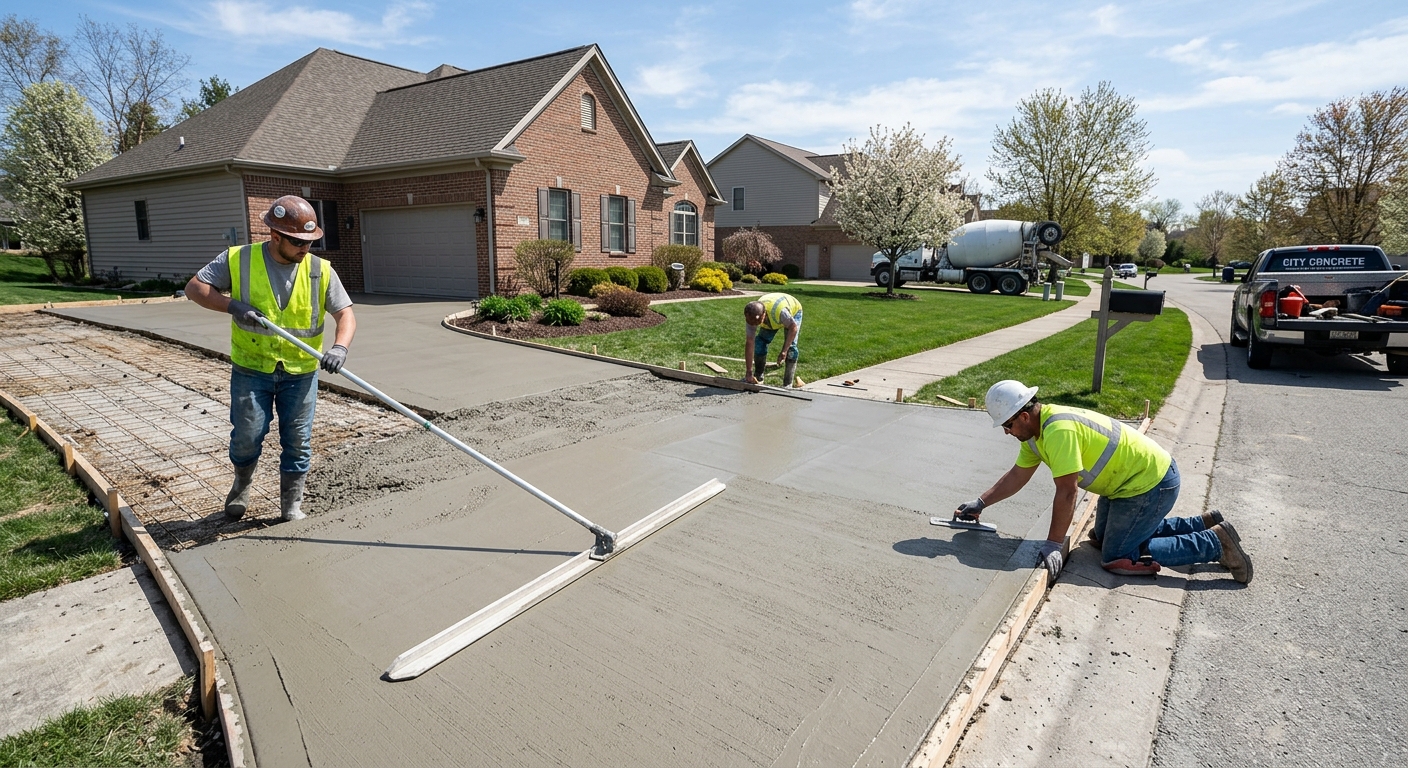
Concrete work options and costs in Whitchurch-Stouffville
Concrete work in Whitchurch-Stouffville is in high demand because most homes there are owned and many are single-detached—about 74.3% of dwellings are in that category, and homeowners make up 87.9% of households (Statistics Canada, 2021 Census). That mix drives steady spending on driveways, patios, walkways, and garage slabs, especially as families update curb appeal and add backyard living space. The Toronto economic region also influences how those projects get scheduled and priced. Concrete contractors plan around freeze–thaw and frost depth, so you’ll see deeper footing requirements for structural work and a heavier emphasis on drainage and air-entrained mixes for exterior flatwork. In Whitchurch-Stouffville, humid fall and wet spring conditions can slow down excavation, base prep, and curing, and colder snaps near the pour season push up costs for cold-weather protection (insulating blankets, wind screens, and sometimes heat). Labour availability can also tighten during the same months when many homeowners want exterior work completed before early winter.
If you’re in the Stouffville hamlet area or along the routes heading toward Main Street, we typically see strong interest in driveway replacements and stamped patios due to older homes (22.4% built before 1981) and frequently worn walkways. When you compare options, the differences usually come down to base prep quality, reinforcement, mix design, and finish detailing—so prices can move significantly even for “similar” concrete. Use the table below as your budgeting starting point, then match the specs to your soil conditions and drainage plan.
| Application |
Typical Size |
Key Spec |
Finish Option |
Price Range |
| Concrete driveway (standard broom finish) |
400 sq. ft. (about 18 ft x 22 ft) |
Air-entrained mix, compacted granular base, control joints |
Broom finish |
$7,200 – $11,200 |
| Exposed aggregate driveway |
400 sq. ft. (about 18 ft x 22 ft) |
Air-entrained mix, good drainage, retarder/blasting process |
Exposed aggregate |
$9,200 – $13,800 |
| Stamped concrete driveway or patio |
300 sq. ft. (about 15 ft x 20 ft) |
Air-entrained mix, integral colour, control joint strategy |
Stamp + colour |
$7,200 – $12,000 |
| Plain concrete patio or walkway |
200 sq. ft. (about 10 ft x 20 ft) |
Compacted base, mesh or fibre as specified, proper slope |
Float/steel + broom or smooth finish |
$3,200 – $5,200 |
| Garage floor (interior slab) |
480 sq. ft. (about 20 ft x 24 ft) |
Vapour barrier (if required), reinforcement, thickened edges |
Light broom or steel-trowel finish |
$8,200 – $13,400 |
| Foundation footings (structural, below frost) |
Typical small foundation project: 40 linear ft |
Footings below design frost depth; engineered rebar layout |
Reinforced structural concrete |
$7,200 – $12,000 |
Prices are estimates only and vary by project scope, site access and material selection.
What affects the price of concrete work in Whitchurch-Stouffville
In the Toronto economic region, two contractors can quote the same “driveway replacement” and be 30–50% apart because the price is really a summary of what they’ll do below the surface. Sub-base thickness and compaction, reinforcement details, concrete mix design, finish thickness, and how they manage curing in shoulder-season weather all affect durability—and those choices change labour time and material waste. If your site requires extra excavation due to soft topsoil, or if access limits concrete truck placement, costs rise fast. Conversely, a straightforward job with good base soils and easy truck access can land closer to the lower end of the local price bands (for example, concrete patio/sidewalk work often starts around $16 – $26 per square foot, while standard driveway work commonly sits around $18 – $28 per square foot).
Frost depth and freeze–thaw cycles dictate every exterior spec here. Structural footings must extend at least 1.2 m (about 4 ft) below grade to prevent frost heave and differential movement, and exterior slabs need air-entrained concrete so they can survive repeated expansion/contraction. When temperatures drop toward 10 °C or below, curing management matters: protection (insulation blankets, coverings, sometimes temporary heating) can add both direct costs and schedule delays because crews often won’t pour without the right conditions. De-icing salt in winter also increases spalling risk if the surface isn’t sealed after cure, so sealing may be recommended to protect your finish.
In Whitchurch-Stouffville, we often see older properties (pre-1981) with drainage issues that force regrading and higher base prep, which can add thousands versus a simple overlay. On the other hand, new builds with cleaner grade control can reduce excavation and keep you closer to standard broom-finish pricing. A stamped patio may cost more than plain concrete, but if you’re upgrading from a basic float-and-broom surface to textured, coloured finish, the added cost is usually justified by appearance and reduced maintenance—provided the base and joints are done correctly.
| Price Factor |
Why It Matters |
Cost Impact |
| Frost line depth — determines footing depth and form height |
Deeper footings reduce frost heave and settlement risk |
More excavation, concrete volume and forming labour |
| Site preparation — excavation, grading, compacted granular base |
Wrong base depth or poor compaction causes settlement and cracking |
Can add significant labour and disposal/hauling costs |
| Reinforcement — rebar or wire mesh requirement |
Controls crack width and improves slab performance |
Material + added labour for spacing and chairs |
| Mix design — air-entrainment and compressive strength spec |
Exterior freeze–thaw survival depends on correct air content and strength |
Higher-spec mix and QC time |
| Finish type — broom vs. stamped vs. exposed aggregate |
Texture and colour systems add steps and curing/processing time |
Stamped/exposed typically increases total cost per sq. ft. |
| Pour size and concrete truck access to site |
Truck distance and lift times affect schedule and labour needs |
May add pump/hosing, extra crew hours or smaller pours |
| Cold-weather curing precautions — heating and blankets |
Protects concrete from early temperature drop and weak curing |
Heating/blanket rental + extended protections |
| Control joint pattern and sealing cost |
Joints direct cracking; sealing reduces salt-driven surface damage |
Saw-cut labour + sealer material and application |
Permits & regulations in Ontario
In Ontario, structural concrete work—things that support a building or transfer loads—generally needs a building permit, and you may also see engineered drawings reviewed by the municipality. That includes foundation footings, foundation walls, grade beams, and other below-grade or load-bearing structural elements. Concrete flatwork (driveways, patios, walkways) usually does not require a permit on its own, as long as it doesn’t change lot grading, interfere with drainage requirements, or affect municipal requirements around impervious surface coverage or any right-of-way conditions. Even when a permit isn’t expected, always confirm with the local authority before breaking ground, because setbacks, drainage tie-ins, and curb/sidewalk connections can trigger additional requirements.
For homeowners hiring in Whitchurch-Stouffville, verify three things in order: licensing/credentials (as required for the contractor’s scope), liability insurance, and WSIB/WCB coverage. Step-by-step:
- Ask for the contractor’s insurance certificate (COI) showing general liability and the project address or applicant named.
- Confirm WSIB or WCB coverage status (or exemption documentation where applicable) before work starts.
- Request references from similar-scale projects—ideally exterior flatwork in freeze–thaw conditions.
- Check the scope includes any required site protection, disposal, and erosion controls as applicable to your property.
- For anything structural, require permit/engineering details in writing, including who pulls the permit.
Clear documentation up front protects you when changes happen (extra excavation, reinforcement adjustments, or drainage fixes), and it’s the difference between a smooth build and a dispute after the first winter.
Getting concrete right in Whitchurch-Stouffville's freeze-thaw climate
Concrete fails here most often for predictable reasons: water and salt get into weak surfaces, and the freeze–thaw cycle expands that damage. In Whitchurch-Stouffville, the biggest prevention steps are base preparation, correct mix design, good jointing, proper curing, and sealing. Start with (1) base prep: excavate to the right depth for your soil and frost considerations, then build a compacted granular sub-base and ensure the slab has proper slope and drainage so it doesn’t trap water. Next (2) mix design: for exterior flatwork, specify air-entrainment (commonly 5–7% air content for good freeze–thaw resistance) and a minimum 32 MPa compressive strength so the concrete can handle winter cycles. (3) control joints: joints should be laid out to manage shrinkage and limit random cracking—especially in longer driveway runs. (4) curing: allow a minimum 7 days of curing under proper conditions; if the weather cools quickly, protection is critical so the slab doesn’t cure too slowly or unevenly. (5) sealing: apply a penetrating sealer after the cure period (commonly around 28 days post-pour) to repel de-icing salts and reduce spalling risk.
When homeowners ask questions like “Is it air-entrained?” and “What’s the joint spacing plan?”, they avoid the most common failure—surface scaling/spalling caused by inadequate air content or rushed curing. As an example of value, a stamped patio costs more than plain concrete, but if the contractor still provides air-entrainment, a properly compacted base, and the right saw-cut pattern, the added finish price is justified. If those fundamentals are skipped, you’ll pay twice through early cracking and surface damage—often before the next winter.
| Spec |
Why It Matters in Whitchurch-Stouffville |
What to Ask For |
Impact if Skipped |
| Compacted granular base (depth?) |
Supports the slab and prevents settlement through freeze–thaw |
Base depth by your soil, compacted to spec; drainage slope confirmed |
Uneven settling, cracking, and premature surface failure |
| Air-entrained concrete mix (target air %?) |
Reduces internal freeze pressure and scaling |
Air-entrained mix with target air content (commonly 5–7% for exterior) |
Spalling/scaling, especially after salt exposure |
| Compressive strength (MPa rating) |
Helps concrete reach intended durability and performance |
Minimum 32 MPa specified on the pour ticket or in the proposal |
Weaker surface, higher risk of cracking and abrasion damage |
| Control joints (spacing per ACI guidelines) |
Directs shrinkage cracking to predictable lines |
Planned joint spacing and saw-cut timing to avoid random cracks |
Random cracking and irregular repair costs |
| Minimum 7-day curing period |
Ensures strength gain despite cool nights and humid shoulder seasons |
How they protect curing (blankets/wind screens) when temps drop |
Low strength and higher long-term damage |
| Penetrating sealer (when applied after cure) |
Helps repel water and de-icing salts |
Sealer applied after the cure period (commonly ~28 days) |
Faster salt-driven deterioration and more frequent patching |
How to choose a concrete work contractor in Whitchurch-Stouffville
Choosing a concrete contractor in Whitchurch-Stouffville is mostly about proof: proof they spec the right materials, proof they’re insured, and proof they’ll build to a plan you can follow. First, verify Ontario licensing/credentials relevant to the scope (especially for structural work), then confirm liability insurance and WSIB/WCB coverage. How to check each: request a certificate of insurance (COI) that lists you/your property correctly and shows current coverage limits; for WSIB/WCB, ask for confirmation of account status or exemption documentation before work begins. If they can’t provide these on request, that’s a major warning sign.
Next, get 2–3 itemised written quotes. Don’t accept one lump-sum number without line items. You want a breakdown for labour and materials (concrete quantity, reinforcement, granular base, forms, saw-cut joints, disposal/hauling, and any finishing products). Confirm what’s excluded: permit fees (if any), regrading beyond the slab boundary, landscaping restoration, and concrete removal/disposal. Warranty matters too—ask for workmanship warranty length and whether the concrete product/manufacturer warranty applies, and whether it’s transferable to future homeowners if you sell.
Payment schedule should be controlled. For most exterior concrete work, don’t pay more than 10–15% upfront; hold back a portion until you’ve confirmed final grading, cleanup, and documentation (like pour tickets, if provided). Finally, require a start date and completion estimate in writing, and ask how they’ll protect curing if temperatures drop—because GTA freeze–thaw conditions don’t pause for scheduling.
- Request a site-specific proposal (base thickness, slope/drainage plan, and joint layout).
- Verify they use air-entrained concrete for exterior flatwork.
- Ask for reinforcement details (mesh vs. rebar and placement depth/chairs).
- Confirm concrete specs: minimum 32 MPa and curing plan.
- Get written clarification on disposal/hauling of removed concrete.
- Confirm whether saw-cut control joints are included.
- Ask when the slab will be protected during curing (covers/blankets).
- Request the timeline for sealing if sealing is recommended.
- Ensure the quote includes traffic management and protection of adjacent landscaping.
- Verify liability insurance and WSIB/WCB coverage before work starts.
- Make sure permits/engineering are clearly stated for any structural scope.
- Confirm who pulls permits (if required) and when inspections occur.
Concrete red flags we see in Whitchurch-Stouffville: quotes that ignore base prep depth and drainage, no mention of air-entrained mix for exterior work, “we’ll cure it when we can” language during cool periods, missing control joints or delayed saw-cutting, and contractors who won’t show insurance/WSIB proof or provide itemised pricing. If you hear any of these, pause before signing.
Frequently asked questions — concrete work in Whitchurch-Stouffville
Concrete vs pavers for a patio in Whitchurch-Stouffville?
For a patio in Whitchurch-Stouffville, concrete is usually a better fit when you want a uniform surface and predictable maintenance, especially under freeze–thaw and winter salt exposure. Plain concrete patios commonly start around $16 – $26 per square foot depending on thickness, reinforcement, and finishing. Pavers can be excellent for flexibility and easier local repairs, but you’ll often pay more attention to base drainage and joint sand maintenance because shifting or washout can create uneven areas. If your yard has drainage challenges, concrete done with a compacted granular base, correct slope, and control joints typically performs well when sealed after cure. Ask your contractor how they handle water shedding and what base specs they’re using—regardless of whether you choose concrete or pavers.
How long does a concrete driveway last?
A well-built concrete driveway in Ontario can last 25–40 years, sometimes longer, but the real answer depends on the details that fight frost and salt. In Whitchurch-Stouffville, proper excavation, a compacted granular base, air-entrained concrete, and a joint plan are the difference between long-term performance and early cracking/spalling. Cold weather curing protection also matters: if the mix isn’t protected as temperatures fall, durability drops. Many homeowners see the sharp contrast during the second or third winter when de-icing accelerates surface damage on poor-quality work. Budget-driven choices (like skipping sealing) can shorten that lifespan, too. If you’re replacing a worn surface, ask whether the quote includes air-entrainment, control joints, and sealing strategy—those are key to longevity.
What is air-entrained concrete and why does it matter here?
Air-entrained concrete is mixed with tiny, evenly distributed air bubbles that give water a place to expand when it freezes. In Ontario’s freeze–thaw climate, that significantly reduces scaling and spalling—especially on exterior slabs exposed to winter salt. For Whitchurch-Stouffville, it’s one of the most important specs you can request for driveways, patios, and walkways. If the contractor uses the wrong mix (or doesn’t verify air content), you can get surface damage even when the slab looks fine initially. Air-entrainment typically costs a bit more than non-air mixes, but it’s far less than the cost of redoing a failed driveway. In your quote, confirm they’re using an air-entrained mix (commonly targeting about 5–7% air for exterior flatwork) and that curing and protection are planned during cool periods.
How do I prepare the base for a concrete slab?
Base preparation is where quality is either won or lost. For a concrete slab in Whitchurch-Stouffville, preparation usually means excavating to the correct depth for your site conditions, removing soft or organic soil, then installing a compacted granular sub-base designed for support and drainage. The goal is a firm, well-graded base that won’t pump water or settle when temperatures cycle. A proper slope matters so surface water doesn’t pond. The crew should compact in lifts and confirm compaction is achieved, not just “levelled.” For exterior flatwork, ask whether the contractor includes granular base thickness, compaction approach, and a drainage plan at the edges. If those details aren’t specified, don’t assume they’ll be done correctly—especially in an area with frequent wet seasons.
How do I compare concrete quotes?
Comparing quotes in Ontario is easiest when you make them apples-to-apples. Start by looking for line items, not just the total. Compare: base depth and granular type, whether reinforcement is included (and how it’s positioned), concrete strength (often minimum 32 MPa) and whether the mix is air-entrained for exterior work, finish type, and control joint layout. Also check access and schedule assumptions: will they need a pump, extended handling, or additional crew time? Concrete quotes that land near $18 – $28 per square foot for driveways or $16 – $26 per square foot for patios should still meet the same durability specs—don’t pick the lowest price if it skips air-entrainment, base prep, or curing protection. Finally, confirm what’s included for disposal, site protection, and (if relevant) sealing after cure.
Can concrete be poured in cold weather in Whitchurch-Stouffville?
Concrete can be poured in cold weather in Whitchurch-Stouffville, but only with the right cold-weather practices—otherwise you risk weak curing and long-term cracking or scaling. When temperatures drop toward about 10 °C or below, contractors typically need protection like insulating blankets, wind screens, and sometimes temporary heating so the concrete maintains workable and curing temperatures. It’s not just about the air temperature; overnight lows and wind exposure matter. Also, the pour schedule may compress the available finishing window, which can affect labour time. A responsible contractor should explain how they’ll manage curing for at least the minimum 7 days, and how they’ll protect the surface afterward. If a quote doesn’t mention cold-weather curing precautions and timing, ask directly—this is one of the fastest ways to detect a quote that’s missing critical cost items.