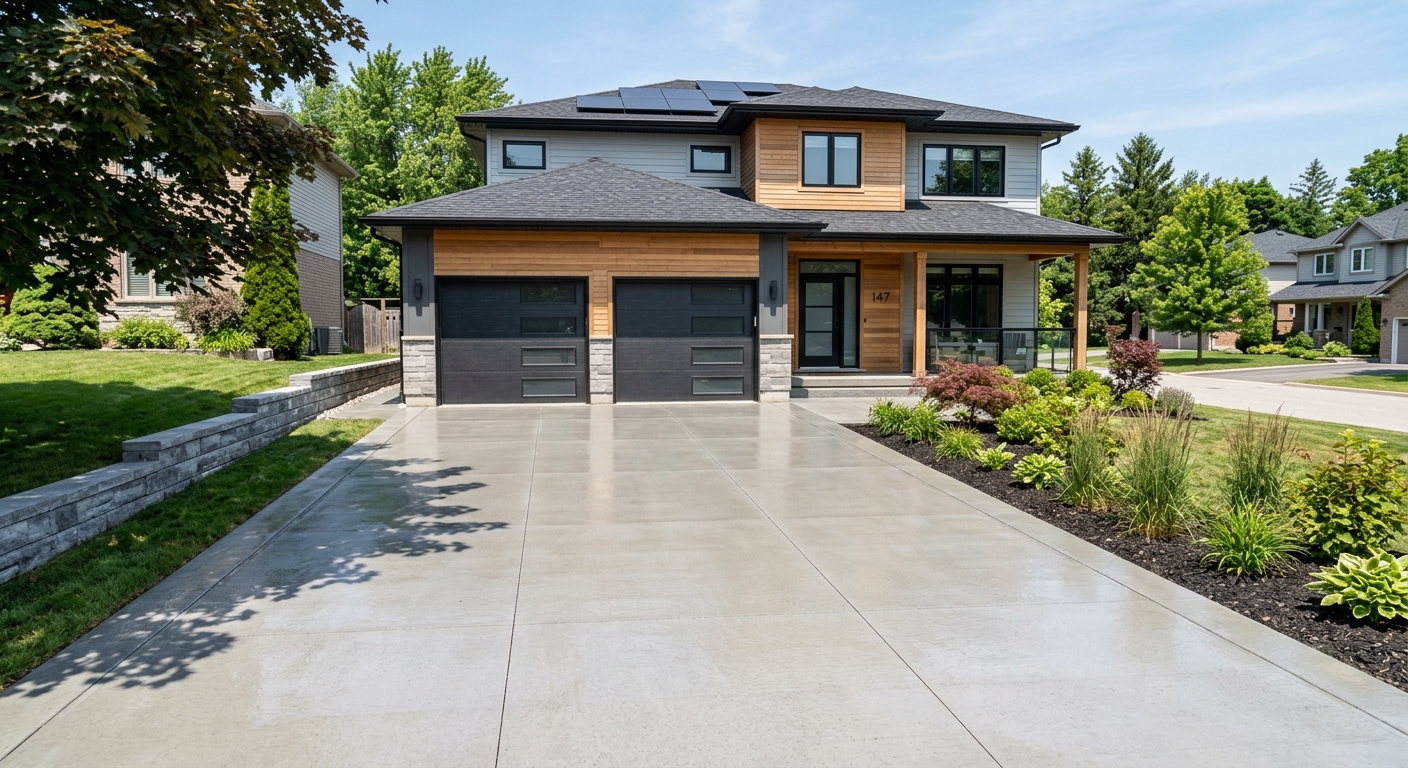
Concrete work options and costs in Whitby
Whitby is one of the GTA communities where concrete flatwork is a constant demand—driveways, patios and walkways wear out, settle, or get replaced as homeowners upgrade older homes. With 69.5% of dwellings being single-detached in the area (Statistics Canada, 2021 Census), most concrete projects are tied directly to private property: new driveway approaches, rear yard patios, and accessibility upgrades. At the same time, 24.8% of homes were built before 1981 (Statistics Canada, 2021 Census), which is when many original driveways and slab edges were poured on older drainage and base practices—so you’ll often see cracking, scaling, and heaving around the joints.
In the Toronto economic region, pricing is shaped by frost depth and freeze–thaw cycles. Local specs typically call for structural footings to extend at least 1.2 m (about 4 ft) below grade, and exterior slabs need air-entrained mixes plus well-compacted granular base and proper drainage. The humid, often wet fall and spring conditions also mean contractors concentrate exterior work in the warmer months, and they spend more on curing control when temperatures drop toward 10 °C or below. That mix of deeper excavation, higher-quality concrete, and labour logistics is why driveway and slab quotes don’t just come down to “square feet.”
In Whitby—especially around Downtown Whitby and the growing residential pockets along Taunton Road—concrete crews are in demand because replacement and upgrade work tends to stack back-to-back during the pour season. The table below compares common options and what typically drives their price in this market.
| Application |
Typical Size |
Key Spec |
Finish Option |
Price Range |
| Concrete driveway (standard broom finish) |
16 ft x 30 ft (480 sq ft) |
4 in slab, air-entrained mix, rebar where required |
Broom finish with control joints |
$9,000–$13,500 |
| Exposed aggregate driveway |
16 ft x 30 ft (480 sq ft) |
Higher cement content, air-entrained mix |
Exposed aggregate (e.g., medium/pea blend) |
$12,500–$17,500 |
| Stamped concrete driveway or patio |
20 ft x 16 ft (320 sq ft) |
Stamped system, release agent, air-entrained mix |
Stamp pattern (slate/stone look), sealer |
$8,000–$12,800 |
| Plain concrete patio or walkway |
12 ft x 20 ft (240 sq ft) |
4 in thickness, compacted base, joints |
Smooth or light broom finish |
$3,800–$6,200 |
| Garage floor (interior slab) |
22 ft x 20 ft (440 sq ft) |
Vapour barrier (as required), air-entrained mix |
Light broom/steel trowel finish |
$7,900–$12,500 |
| Foundation footings (structural, below frost) |
Typical 40 ft perimeter |
Engineered reinforcement, below frost depth |
Formwork and finish as per structure |
$10,000–$18,000 |
Prices are estimates only and vary by project scope, site access and material selection.
What affects the price of concrete work in Whitby
In Whitby and the wider Toronto economic region, two contractors can quote the “same” concrete project and still come in 30–50% apart. Usually it’s not the concrete itself—it’s the unseen scope: excavation depth, base preparation, reinforcement, access for the concrete truck, how joints are planned to resist random cracking, and how winter-proof the crew is when temperatures start to slide. Contractors also price differently based on whether they include haul-away/disposal, permitting support, or extra curing protection for cold nights.
For this region, frost depth and freeze–thaw cycles dictate most specs. Structural footings must extend below the design frost depth to prevent frost heave and differential movement, and most exterior slabs should be air-entrained to handle repeated freezing and thawing. When work sits closer to the edge of the pour season, crews add cold-weather curing precautions—insulating blankets, temporary heating, and tighter temperature monitoring—which adds both materials and time. De-icing salts further stress surfaces, so sealing and correct surface finishing become more important for long-term appearance and reduced spalling risk.
In practical Whitby terms, a driveway that needs deeper regrading or removal of poor sub-base will push costs up quickly. Likewise, homes built before 1981 are more likely to have older drainage patterns, so you may pay extra to improve runoff control and reduce saturated subgrade. On the other hand, a straightforward replacement on a well-drained lot can stay closer to typical ranges—plain concrete flatwork often falls in the mid-teens to mid-twenties per square foot, while decorative options like stamped or exposed aggregate generally move you toward the higher end (for example, decorative driveway/patio pricing is commonly in the $24–$40 band).
To show how spec choices justify cost: the difference between a standard broom-finish driveway and an exposed aggregate driveway can be meaningful. If a standard pour comes in near $18–$28 per square foot range, exposed aggregate typically needs added labour and process steps; paying for it makes sense when you’re protecting the surface against winter wear, not just buying colour.
| Price Factor |
Why It Matters |
Cost Impact |
| Frost line depth — determines footing depth and form height |
Deeper frost protection prevents heaving and future settlement |
Higher excavation and formwork can add thousands |
| Site preparation — excavation, grading, compacted granular base |
Weak or wet subgrade leads to cracking and pumping |
More hauling/extra base can swing the quote 15–25% |
| Reinforcement — rebar or wire mesh requirement |
Controls cracking and improves load capacity |
Materials + placement labour often add 5–15% |
| Mix design — air-entrainment and compressive strength spec |
Freeze–thaw durability depends on the right air content |
Higher-spec mix may add 3–8% but reduces failure risk |
| Finish type — broom vs. stamped vs. exposed aggregate |
Surface durability and aesthetics under de-icing salts |
Decorative finishes add labour and materials (often a noticeable premium) |
| Pour size and concrete truck access to site |
Smaller pours cost more per unit due to mobilization; tight access slows placement |
Can add significant labour time or require pump services |
| Cold-weather curing precautions — heating and blankets |
Proper cure protects strength gain and surface quality |
Often increases labour/materials for late-season work |
| Control joint pattern and sealing cost |
Joints manage cracking; sealing helps repel salts and moisture |
Sealer and correct jointing add cost, but can reduce future repairs |
Permits & regulations in Ontario
In Ontario, structural concrete work generally requires more oversight than a backyard patio. In most cases, work such as foundation footings, foundation walls, grade beams, and other structural elements that support the building need a building permit and often engineered drawings that the municipality reviews. For flatwork—patios, walkways, and driveways—permits are usually not required unless the work affects lot grading, involves drainage changes, triggers impervious surface/lot coverage considerations, or impacts the municipal right-of-way (for example, any work touching curbs/sidewalk areas).
Before you break ground in Whitby, confirm permit requirements with the local building department. Also verify the contractor carries liability insurance and has WSIB/WCB coverage in place (or the appropriate coverage status for the business). It’s smart to ask for references on similar-scale projects—especially flatwork on older neighbourhood lots where the sub-base and drainage conditions can be unpredictable.
Here’s a homeowner-friendly way to verify compliance step-by-step:
- Ask for the contractor’s certificate of liability insurance and ensure the start/end dates are current.
- Request proof of WSIB/WCB coverage (or a clearance letter if applicable) and confirm the name matches the contracting business.
- Check for business standing/registrations as required locally (contractors should be able to explain their process and documentation clearly).
- Get the permit plan clearly listed in the written scope—who pulls it, what dates are expected, and what inspections are required.
- Ensure the quote includes any required saw cutting, disposal, and site protection so they’re not cutting corners to avoid paperwork costs.
If a contractor is vague about permits, exclusions, or insurance documentation, that’s a warning sign—especially with structural pours tied to engineered drawings.
Getting concrete right in Whitby's freeze-thaw climate
Concrete failures in Whitby usually come from the same repeating causes: water in the base, insufficient insulation of curing conditions, and concrete that isn’t specified for freeze–thaw durability. The fix starts at the bottom of the job. (1) Base preparation should include a compacted granular sub-base to the right depth for the soils and local frost considerations—if the base is too thin or not compacted, the slab can pump and crack. (2) Mix design matters: for exterior flatwork, specify air-entrained concrete with about 5–7% air content and minimum 32 MPa compressive strength so the paste has room to resist expansion when water freezes. (3) Control joints should be planned to limit random cracking; skipping or spacing joints incorrectly pushes cracking into the worst locations. (4) Curing should be at least 7 days under appropriate conditions—when the weather dips and you’re near ~10 °C or below at night, the contractor should use curing protection (insulating blankets and/or temperature monitoring) so strength develops properly. (5) Sealing should be penetrating sealer applied after the concrete cure (commonly around 28 days post-pour) to help repel de-icing salts and reduce surface scaling.
To keep your scope from becoming “cheap concrete,” ask specific questions. For example: “What air content does the supplier target for this exterior slab?” and “How are joints laid out and sealed (if included)?” Spalling—small flakes or surface pop-outs—often traces back to inadequate air-entrainment and poor finishing/curing rather than just traffic.
Dollar example: if you’re comparing plain patio/walkway work in the $16–$26 per square foot band versus stamped concrete that can land around $24–$40, the added cost is usually justified when the contractor also improves durability details: stronger drainage control, correct thickness, and proper jointing. If the job is underbuilt, decorative finishes won’t save it from salt and freeze–thaw.
| Spec |
Why It Matters in Whitby |
What to Ask For |
Impact if Skipped |
| Compacted granular base (depth?) |
Prevents pumping and heaving during freeze–thaw cycles |
“How many inches of granular sub-base, and what compaction standard do you use?” |
Cracking, settling, and premature edge failure |
| Air-entrained concrete mix (target air %?) |
Protects against freeze–thaw damage and scaling |
“What air content do you target (about 5–7%) for exterior exposure?” |
Spalling, surface deterioration, and poor durability |
| Compressive strength (MPa rating) |
Ensures strength gain and surface integrity in cold seasons |
“Confirm minimum 32 MPa and mix design for our exposure class.” |
Higher chance of abrasion damage and early wear |
| Control joints (spacing per ACI guidelines) |
Limits random cracking from shrinkage and thermal movement |
“Show me the joint layout and spacing plan before the pour.” |
Uncontrolled cracks and moisture intrusion |
| Minimum 7-day curing period |
Cold/humid conditions can slow strength development |
“How will you protect curing in cooler nights and wet weather?” |
Reduced strength, surface weakness, and finishing defects |
| Penetrating sealer (when applied after cure) |
Helps repel de-icing salts and limits moisture uptake |
“Will penetrating sealer be applied after full cure (around 28 days)?” |
More scaling, staining, and winter maintenance issues |
How to choose a concrete work contractor in Whitby
Choosing a concrete contractor in Whitby is mostly about verifying documentation and matching the quote to the freeze–thaw requirements—not just the lowest number. Start by confirming Ontario compliance. Ask for proof of liability insurance (current certificate) and proof of WSIB/WCB coverage (or an applicable clearance letter). You can also confirm the business details via publicly available records where applicable, but the key is that the paperwork matches the contractor who will be on-site and billing you. If a contractor can’t produce insurance/coverage quickly, don’t proceed.
Next, get 2–3 itemised written quotes (not a single lump sum). A good quote breaks labour and materials and clarifies what’s included: excavation depth, granular base thickness, reinforcement type, concrete mix spec, finishing, joint cutting, sealer (if applicable), and disposal/haul-away. Confirm whether permits are included or whether you’ll pull them, and whether site access constraints (tight gates, overhead wires, soft lawns) will require special handling. Make sure the scope lists weather protections and curing steps for cold evenings—Toronto-area crews should plan for proper curing rather than “powering through.”
Warranty matters too. Ask for a workmanship warranty length and whether product/manufacturer warranties apply to admixtures, sealers, or decorative systems. Also clarify whether warranties are transferable to a future buyer. For payments, avoid large upfront deposits; a common safe approach is no more than 10–15% upfront, with a holdback until completion and cleanup. Get a start date and completion estimate in writing.
- Request certificate of liability insurance with matching business name.
- Verify WSIB/WCB coverage or obtain a clearance letter if applicable.
- Ask for proof of similar Whitby/GTA exterior flatwork projects.
- Get itemised labour/materials—not just “concrete supply and install.”
- Confirm excavation depth, base thickness, and compaction method.
- Ask for the concrete mix spec (air-entrainment and target strength).
- Require a written joint layout plan before the pour.
- Check whether disposal/haul-away is included.
- Confirm concrete truck access and whether a pump is included if needed.
- Ask how they protect curing if temps drop or rain is forecast.
- Clarify sealing: product type and timing after cure.
- Review warranty terms in writing (workmanship and any product coverage).
Concrete contractor red flags: vague air-entrainment details, refusing to discuss joint spacing, no written cure/weather plan, minimal base prep (just “pour on what’s there”), and quotes that exclude disposal or sealing while implying “better durability.” In Whitby’s freeze–thaw climate, those omissions usually show up as cracks, scaling, and costly rework.
Frequently asked questions — concrete work in Whitby
How long does a concrete driveway last?
In Whitby, a well-built concrete driveway commonly lasts 20 to 30 years, sometimes longer, depending on sub-base quality, drainage, and how the slab is detailed for freeze–thaw. The Toronto-area climate punishes concrete that’s porous, underbuilt, or missing proper air-entrainment. If your neighbourhood has older housing stock—remember, 24.8% of homes were built before 1981 (Statistics Canada, 2021 Census)—you may see earlier issues where original drainage and base prep weren’t as durable as today’s expectations. A key factor is whether the contractor used an air-entrained mix and installed control joints correctly; those details can be the difference between surface scaling after a few winters and a driveway that stands up to decades of de-icing salt and traffic.
What is air-entrained concrete and why does it matter here?
Air-entrained concrete includes tiny, uniformly distributed air bubbles that give freezing water somewhere to expand, reducing internal pressure that causes freeze–thaw damage. In Whitby and the broader Toronto economic region, repeated freeze–thaw cycles are a major driver of deterioration, especially surface spalling when salts saturate the concrete. This is why exterior work typically needs air-entrained mix and correct curing, not just “standard concrete.” If you’re budgeting, decorative driveways or patios can be in the higher range—often around $24–$40 per square foot for stamped work—so it’s crucial that the contractor doesn’t compromise the mix design to save money. A good finish looks best when the base durability is engineered.
How do I prepare the base for a concrete slab?
Base prep is where concrete longevity is won or lost. For Whitby’s soils and winter conditions, the contractor should excavate to the proper depth, remove unsuitable material, and install a compacted granular sub-base to the specified thickness. Proper grading is critical so water doesn’t pond at the slab edge. Compaction should be done in lifts (not dumped and left loose), because weak or saturated base layers can lead to pumping and cracking during freeze–thaw cycles. When quotes include the full scope—excavation, granular base, compaction, and disposal—you’re more likely to get a slab that performs. If a quote looks too good, check whether base preparation is clearly included; that’s often where corners get cut.
How do I compare concrete quotes?
Compare quotes like an engineer, not like a shopper. Ask each contractor to provide an itemised breakdown that includes excavation depth, granular base thickness, reinforcement type (if required), concrete mix spec (including air-entrainment for exterior), finishing method, joint layout, curing steps, and whether sealing is included. Don’t accept “we’ll pour concrete” without specifying air-entrainment and strength (commonly minimum 32 MPa for durability). If you’re comparing driveway options, make sure the finish matches the scope: standard broom-finish driveways often land around $18–$28, while decorative finishes can run higher (for example, stamped work often falls into the $24–$40 band). Finally, confirm who handles permits (where needed) and what happens with disposal and site protection.
Can concrete be poured in cold weather in Whitby?
Yes, but it has to be planned. Whitby’s freeze–thaw climate means cold evenings can slow strength gain and increase risk if curing isn’t protected. Contractors may pour later in the season, but they should use cold-weather precautions such as insulating blankets, temperature monitoring, and (when appropriate) controlled heating so the concrete cures properly. Pouring without protection when temperatures drop toward 10 °C or below at night can lead to weak surfaces, finishing issues, and long-term durability problems. This is also why “when can you pour?” should be a written part of your schedule—not an afterthought. Ask each contractor what protection they use, how they monitor conditions, and whether the quote includes curing protection.
How do I maintain concrete in Whitby’s freeze-thaw climate?
Maintenance in Whitby is mostly about keeping water out of vulnerable areas and protecting the surface from salts. After a new exterior pour, allow full curing (often around 28 days) before applying penetrating sealer if it’s included in your scope. Reapply sealant according to the product guidance or your contractor’s recommendation. Keep joints clean and check them periodically—if joints fail to function, cracking can spread. When shovelling, use plastic tools when possible to reduce surface abrasion. Avoid over-salting; de-icing salts accelerate scaling when moisture penetrates. For homes with older driveways and patios, especially where drainage may have changed over time, maintaining slope and runoff control is as important as the sealer. If you see spalling, address it early rather than waiting for large repairs.