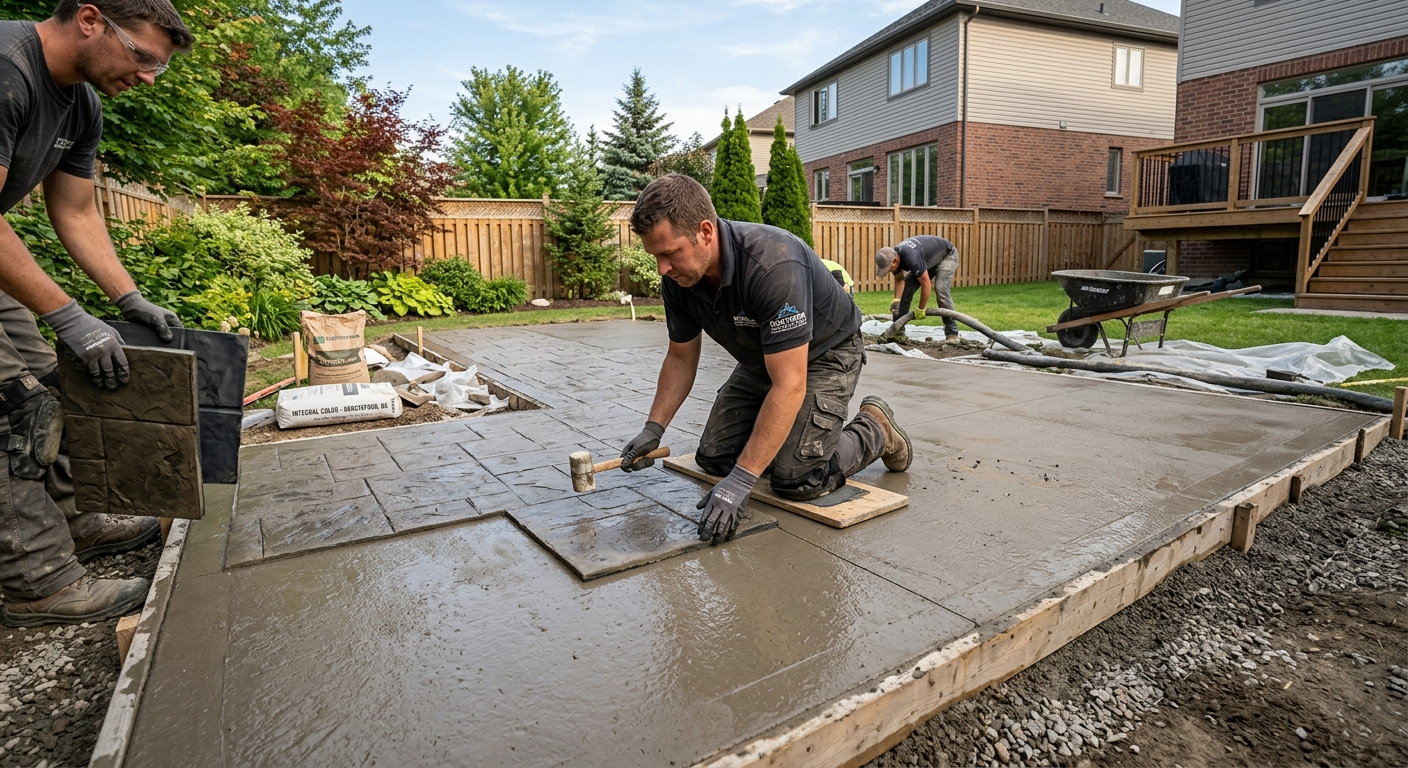
Concrete work options and costs in Long Branch
Concrete contractors in Long Branch, Ontario serve a steady stream of homeowners updating driveways, patios, walkways, and foundation systems—especially in areas where older housing stock is being renovated or where families are extending their home’s outdoor living space. With a population of 10,084 (Statistics Canada, 2021 Census), demand is concentrated and scheduling can get tight during the best weather window. You’ll also see a lot of the work tied to single-detached homes and growing backyards, because flatwork like driveways, patios and walkways is among the highest-impact improvements for curb appeal and day-to-day use.
In the Toronto economic region, pricing is shaped by frost depth requirements and repeated freeze–thaw cycles. That means exterior slabs need air-entrained concrete, proper thickness, and a well-compacted granular base so saturated soils don’t expand and contract against the concrete every winter. Locally, contractor availability and workload are strongest from late spring into early fall; pours planned for colder shoulder months require more protection and longer curing controls. These added steps are why even “similar” jobs can land in different bands—for example, a straightforward broom-finished driveway is usually more predictable than stamped or exposed work that needs extra labour and tighter surface preparation. In Long Branch, demand is particularly noticeable around the lakeshore corridors and the Renforth/Princess Margaret area, where many properties are keeping up with seasonal access and drainage upgrades.
Below is a realistic comparison of common concrete options you’ll see quoted in Long Branch, with typical sizes and specs so you can line up apples-to-apples before you ask for any final pricing.
| Application |
Typical Size |
Key Spec |
Finish Option |
Price Range |
| Concrete driveway (standard broom finish) |
10 ft x 40 ft (400 sq. ft.) |
Air-entrained mix, compacted base, control joints |
Broom finish |
$7,200–$11,200 |
| Exposed aggregate driveway |
10 ft x 40 ft (400 sq. ft.) |
Air-entrained mix, proper retarder/wash timing, base prep |
Exposed aggregate (bush-hammer/wash depending on system) |
$9,000–$14,800 |
| Stamped concrete driveway or patio |
10 ft x 30 ft (300 sq. ft.) |
Air-entrained mix, stiffer base, colouring allowance |
Stamped pattern + colouring/sealer |
$7,200–$12,000 |
| Plain concrete patio or walkway |
12 ft x 16 ft (192 sq. ft.) |
Air-entrained mix, compacted granular base, joints |
Float and broom/steel-trowel depending on use |
$3,100–$5,000 |
| Garage floor (interior slab) |
20 ft x 22 ft (440 sq. ft.) |
Vapour barrier, fibre or mesh, typically 4 in thickness |
Steel trowel / light broom (finish tied to use) |
$8,000–$13,500 |
| Foundation footings (structural, below frost) |
Per project (often 1.2 m+ depth) |
Engineered section, excavation, formwork, rebar as required |
Structural concrete only (not decorative) |
$180,000–$300,000 |
Prices are estimates only and vary by project scope, site access and material selection.
What affects the price of concrete work in Long Branch
In Toronto and nearby communities, it’s common to see quotes for the “same” concrete job vary by 30–50%. A lot of that spread comes down to whether bidders assume the same level of site prep, drainage correction, and frost-proofing. In Long Branch, where the local freeze–thaw cycle is repeated every winter and soils can stay wet through seasonal swings, small differences in base thickness or mix design can change both labour and material costs—especially when contractors need to manage curing when temperatures drop.
Frost depth and freeze–thaw cycles dictate every spec: structural footings must extend below the design frost depth. In Ontario, that commonly means at least 1.5–2.4 m (with engineered projects sometimes deeper) to reduce frost heave and differential movement. Exterior slabs are typically poured with air-entrained concrete, and GTA contractors plan the pour and curing around the fact that cold conditions (near 10 °C or below) can extend protection time. De-icing salt also accelerates surface wear and spalling, which is why sealing and surface protection are often recommended for driveways and walkways. In practice, colder or late-season work adds cost because you may see extra labour for insulation blankets, temperature monitoring, and extended curing windows.
Here are a few real Long Branch examples of why your price may land toward the higher end: (1) If your driveway base is undersized or drainage is poor, you’ll pay for deeper excavation and more granular fill—this is one reason a standard driveway might shift from the mid range into the higher one. (2) If you want stamped concrete, the extra prep, colouring, stamping labour and sealing push it closer to the $24–$40 per sq. ft. band for decorative work. (3) If you’re adding proper joints and sealing to reduce seasonal cracking and salt damage, you may pay slightly more up front, but you avoid early surface failure that often costs far more later.
| Price Factor |
Why It Matters |
Cost Impact |
| Frost line depth — determines footing depth and form height |
Deeper excavation/formwork is required to prevent frost heave |
Can add material and labour; biggest driver on foundation/footings scopes |
| Site preparation — excavation, grading, compacted granular base |
Dry, compacted base reduces settlement and helps slabs stay flat |
Often shifts quote by thousands if existing base is unsuitable |
| Reinforcement — rebar or wire mesh requirement |
Controls cracking for driveways, garage slabs and some flatwork |
Additional steel and labour; higher if engineering demands it |
| Mix design — air-entrainment and compressive strength spec |
Air-entrainment improves freeze–thaw durability |
Premium mix cost plus QA/testing allowance |
| Finish type — broom vs. stamped vs. exposed aggregate |
Decorative finishes require extra steps and tighter tolerances |
Stamped/exposed typically costs more than standard broom |
| Pour size and concrete truck access to site |
Access affects placement time and may require pumping |
Hard-to-access sites can increase labour and equipment |
| Cold-weather curing precautions — heating and blankets |
Maintains strength gain when temps drop near 10 °C or below |
Extra materials, labour, and longer protection window |
| Control joint pattern and sealing cost |
Joints guide cracking; sealing helps resist salt-related surface damage |
Relatively small line items, but can prevent expensive early repairs |
Permits & regulations in Ontario
In Ontario, structural concrete work needs the right approvals—most importantly when you’re affecting load-bearing elements. Concrete foundation walls, grade beams, footings, and any engineered structural concrete components generally require a building permit. Municipal review often relies on engineered drawings (and the permit process may reference those details for footing size, rebar placement, and foundation wall requirements). For flatwork like patios, walkways and driveways, a permit is often not required by default; however, it can be required if your project changes lot grading, alters drainage patterns, affects impervious surface coverage limits, or involves work within municipal right-of-way or sidewalk/curb interfaces. Because rules can hinge on drainage and grading, homeowners in Long Branch should confirm with the local authority before excavation starts.
To verify a contractor in Ontario step-by-step, start with their insurance and worker coverage documentation. First, ask for their certificate of insurance showing liability coverage (and ensure it matches your project scope and addresses). Next, ask for their WSIB clearance letter or proof of WSIB coverage for workers. Then confirm the contractor’s licence/registration information through the appropriate Ontario registry channel (the exact registry depends on the contractor’s category and whether they’re acting as a licensed trades contractor). Finally, request references on similar-scale work in the GTA—driveways and exterior flatwork that survived multiple freeze–thaw cycles are a better indicator than a one-off interior job.
For any structural scope, insist that the permit and engineered drawings are handled correctly; that’s where mistakes get expensive.
Getting concrete right in Long Branch's freeze-thaw climate
In Long Branch, concrete usually fails for a few repeat reasons tied to freeze–thaw: weak or poorly drained base, insufficient air-entrainment, cracking that isn’t controlled, and curing that doesn’t allow strength gain. The fix starts with how you spec the job. (1) Base preparation: the slab or walkway must sit on compacted granular sub-base to the correct depth for your soil and frost conditions. If the base is too thin or not compacted, water can collect and push on the slab as it cycles between wet and freezing. (2) Mix design: exterior flatwork should use air-entrained concrete (commonly 5–7% air content for exterior exposure) and a minimum compressive strength such as 32 MPa for typical residential exterior work. (3) Control joints: joints must be cut or formed to limit random cracking to predictable locations. (4) Curing: aim for a minimum 7 days of proper curing conditions; in colder pours, you need added protection (insulating blankets, temperature monitoring) to prevent early freezing. (5) Sealing: apply a penetrating sealer after the concrete has fully cured—often around 28 days post-pour—so de-icing salts and moisture don’t accelerate surface deterioration.
When you’re interviewing bidders, ask how they manage spalling risk. Spalling after a few winters is frequently linked to inadequate air-entrainment or rushed cure conditions, not “bad luck.” To ground it in cost: a decorative stamped patio is often priced around $24–$40 per sq. ft., while a plain broom-finished option can be closer to the lower band. If one contractor cuts corners on base prep or mix, the “cheap” option can look good at signing but costs more after repairs.
| Spec |
Why It Matters in Long Branch |
What to Ask For |
Impact if Skipped |
| Compacted granular base (depth?) |
Reduces water retention and settlement under freeze–thaw movement |
Proposed granular base depth, compaction method, and drainage plan |
Early cracking, unevenness, and pumping/voids at slab edges |
| Air-entrained concrete mix (target air %?) |
Air pores provide freeze–thaw tolerance and reduce spalling |
Air content target (typically 5–7% for exterior flatwork) and mix sheet |
Surface scaling/spalling within a few winters |
| Compressive strength (MPa rating) |
Ensures durability and strength gain for exterior exposure |
Minimum 32 MPa rating and when strength is expected |
Weaker surface wear and higher risk of damage under traffic/de-icing |
| Control joints (spacing per ACI guidelines) |
Limits uncontrolled cracking patterns |
Proposed joint layout and spacing (and whether joints are saw-cut) |
Random cracks that widen and admit water |
| Minimum 7-day curing period |
Allows strength development before the freeze–thaw cycle ramps up |
Curing plan and cold-weather protection when temps drop |
Reduced strength, surface damage, and premature scaling |
| Penetrating sealer (when applied after cure) |
Repels moisture and helps resist salt-related surface breakdown |
Sealer type and application timing (often around 28 days post-pour) |
Faster deterioration and higher maintenance frequency |
How to choose a concrete work contractor in Long Branch
Choosing the right concrete contractor in Long Branch comes down to verification and clarity. Start by confirming they have the correct Ontario registrations/licensing for their trade category and that they carry liability insurance for the work. Ask for a current certificate of insurance showing coverage limits that reasonably match the scope (driveways and foundation work can carry higher risk due to excavation and traffic-area impacts). Then request their WSIB clearance letter or proof of WSIB coverage for their workers—this matters because crews can change depending on season and staffing, and you want real coverage, not a past screenshot.
Next, get 2–3 itemised written quotes, not just a lump sum. You want a breakdown of labour, concrete supply, base/grading, excavation, reinforcement, forming, finishing and—if applicable—permit/paperwork handling, disposal and any cold-weather protection allowance. Carefully review what’s excluded: removal of old asphalt, how they handle trees/roots, regrading for drainage, patching edges, and whether sealing is included for exterior flatwork. For foundations/footings, ask how engineered details and rebar placement are documented and inspected.
Look for a workmanship warranty (how many years, what it covers), plus any manufacturer/product warranty. Payment should be staged responsibly: generally no more than 10–15% upfront, with a holdback until the job is complete and deficiencies are addressed. In a freeze–thaw market, timelines matter—ask for a written start date and completion estimate, and confirm what happens if temperatures drop during cure.
- Verify Ontario licensing/registration for the contractor’s trade category before scheduling.
- Request a certificate of liability insurance and confirm dates match your project period.
- Ask for WSIB clearance letter (or WSIB coverage proof) and keep it with your contract.
- Get itemised quotes: labour, materials, base prep, reinforcement, and disposal listed separately.
- Confirm whether permit pulling is included (structural work usually requires it).
- Insist on written scope for drainage: base thickness, compaction, and slope away from the house.
- Ask what mix design they’ll use and whether it’s air-entrained for exterior flatwork.
- Confirm minimum curing expectations (at least 7 days) and cold-weather protection plan.
- Ask about joint pattern: spacing and whether joints are saw-cut or formed correctly.
- Clarify finishing: broom vs stamped vs exposed, and whether sealer is included (timing matters).
- Warranty terms in writing: workmanship length, process for fixes, and transferability if you sell.
- Payment schedule: cap upfront at 10–15% and hold back until final inspection and cleanup.
Concrete red flags in Long Branch include: vague “we’ll pour a good mix” wording with no air-entrainment details, skipping base compaction depth and drainage slope, no mention of control joints or curing protection when temps drop, pressuring you for large upfront payments, and quoting structural scopes without referencing engineered drawings/permit requirements.
Frequently asked questions — concrete work in Long Branch
How long does concrete take to cure?
In Long Branch, Ontario, concrete is not “ready to fully load” immediately after the pour, even if it feels hard the next day. For most residential exterior flatwork, crews plan for at least a 7-day curing period before you treat the surface as durable under normal use. Full strength continues building beyond that, and that’s why sealing is typically done later—often around 28 days post-pour—so the sealer bonds properly. If the forecast includes cold nights, reputable GTA contractors add curing protection (insulating blankets/heating and temperature monitoring) because freezing can interrupt strength gain. This is one of the biggest reasons concrete quotes can differ: better curing management costs labour and time, but it reduces early scaling and spalling that show up after multiple freeze–thaw cycles.
Do I need a permit for concrete work in Ontario?
In Ontario, structural concrete work usually requires a building permit. That includes footings, foundation walls, and grade beams—especially when engineering drawings are involved. For typical exterior flatwork like driveways, patios and walkways, permits are often not required by default, but you may need one if the project affects lot grading, impervious surface limits, drainage patterns, or involves work near municipal right-of-way/sidewalk interfaces. For homeowners in Long Branch, the best approach is to confirm with the local authority before you break ground, particularly if you’re lowering/raising grades, changing slopes, or adding drainage improvements. Also make sure your contractor provides clear documentation on what they’re pulling (or not) in your written scope and contract. If structural elements are involved, insist the permit process is handled and documented.
Concrete vs pavers for a patio in Long Branch?
Concrete and pavers both work well in Ontario freeze–thaw conditions, but they fail differently. Concrete patios rely on a consistent base, correct slope, air-entrained mix and good joint design; when it’s done right, a simple broom finish can hold up well. Pavers can be more forgiving if settlement occurs because individual units may be lifted and reset, but you still need proper base drainage. In Long Branch, if you’re budgeting, a plain concrete patio is often in the $16–$26 per sq. ft. band for many typical scopes, while decorative looks (like stamped concrete) commonly run higher. Stamped or decorative concrete can be a cost-effective way to achieve a high-end look without the same ongoing interlock maintenance. Choose based on your aesthetic goals, slope/drainage needs, and how much repair tolerance you want if anything shifts over the next few winters.
How long does a concrete driveway last?
A well-built concrete driveway in the GTA often lasts decades. In Long Branch, lifespan is mainly driven by base compaction, air-entrained mix, thickness, jointing, and whether sealing and snow/ice management are reasonable through winters. If the driveway is poured with correct air-entrainment and joints and it’s protected from early freeze damage during curing, it typically holds up much better against salt and moisture. A driveway that’s poured over weak or wet base, or one that’s finished without adequate curing precautions, can start showing scaling/spalling within a few seasons even if the first summer looked fine. For pricing, a standard broom-finished driveway commonly sits in the $18–$28 per sq. ft. band; spending toward the higher end usually reflects better base prep, reinforcement assumptions, and more careful finishing/curing.
What is air-entrained concrete and why does it matter here?
Air-entrained concrete is mixed with tiny, evenly distributed air bubbles that give the hardened concrete room to expand and contract during freezing. In Long Branch, Ontario, the repeated freeze–thaw cycle is what turns small weaknesses into visible failure—especially surface scaling and spalling. That’s why exterior flatwork should use an air-entrained mix (often targeting about 5–7% air for exterior exposure) and why your contractor should be able to explain the mix spec rather than just saying “it’s concrete.” When air-entrainment is missing or off-target, water in the concrete can’t relieve pressure during freezing, and the surface breaks down faster—often after multiple winters of de-icing salt exposure. This directly affects cost because air-entrained mix and proper curing add upfront value. It’s also why two driveway quotes can differ by 30–50% even if the drawings look similar.
How do I prepare the base for a concrete slab?
Base preparation is where long-term performance is won or lost in Long Branch. The contractor should remove unsuitable material, then grade and compact a granular sub-base to the correct depth for your soil conditions and the slab’s exposure. They’ll typically place and compact in lifts to achieve good density—especially important because Ontario’s winter moisture can push against slabs when the ground freezes. Proper drainage matters too: the slab should slope away from the house and avoid areas where water pools. Ask your contractor for the base depth they propose, what material they’ll use (type of granular), the compaction approach, and how they’ll handle any soft spots or high water table areas. A strong base reduces settlement and curling, and it prevents cracking from becoming a pathway for water. If base prep is skipped, even good finishing won’t stop freeze–thaw damage from developing.