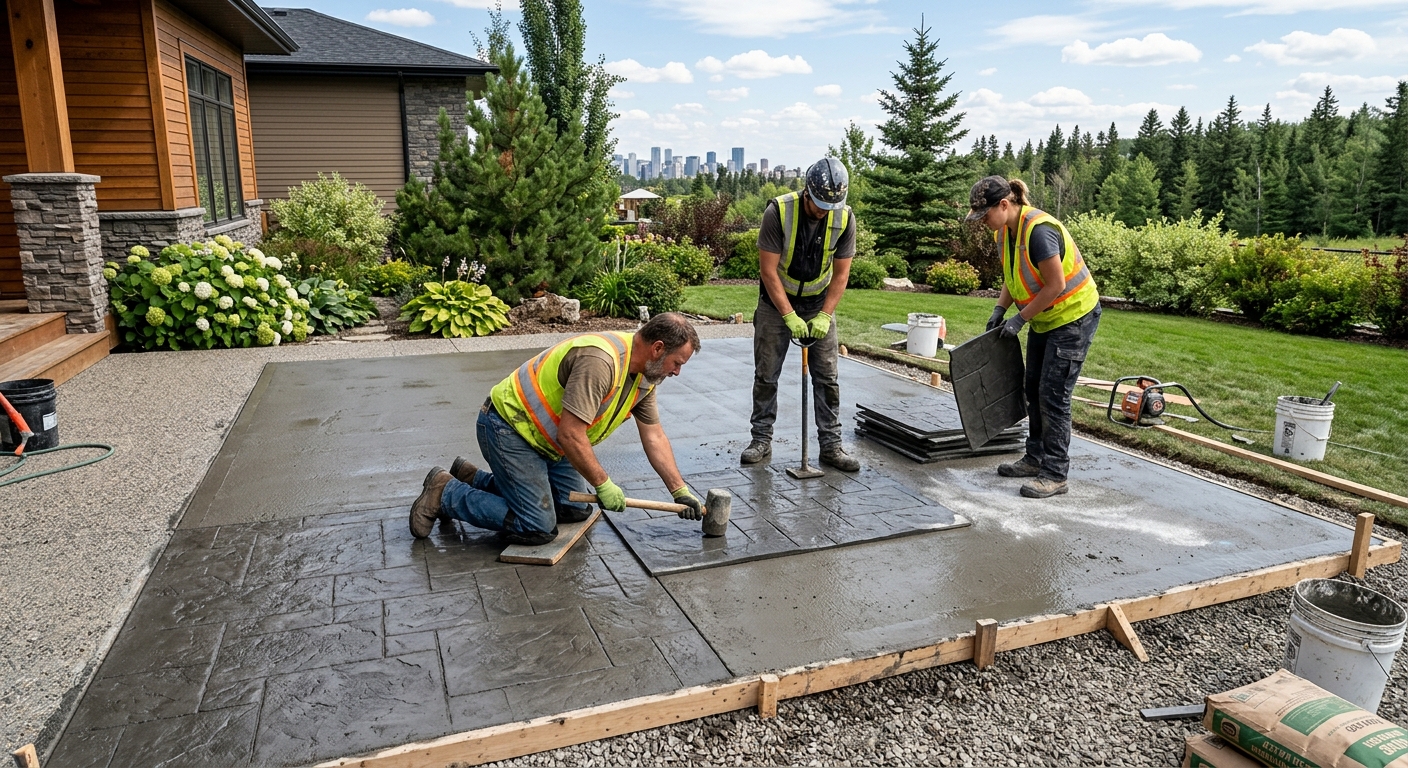
Concrete work options and costs in Golden
Concrete work in Golden is mostly about getting the right build-up for frost, drainage, and freeze–thaw—because small failures show up fast here. Homeowners in this area are typically building on stable routines: Golden’s population is 1,154 (Statistics Canada, 2021 Census), and the local housing stock tends to be dominated by single-detached homes, which creates steady demand for driveways, patios, and walkways. In the Toronto economic region, concrete pricing is strongly shaped by frost depth, seasonal freeze–thaw, and how long concrete can be cured reliably after it’s poured. That’s why contractors often schedule exterior flatwork in the warmer part of the year and build extra time into curing and surface protection. When temperatures drop toward 10 °C or below, crews may need insulation blankets or heated enclosures, which adds labour and equipment costs.
In Golden, you’ll see especially strong demand around the downtown/rail corridor area where infill and renovations commonly upgrade existing entrances and sidewalks. If you compare options, the biggest swings in cost usually come from base preparation, reinforcement, and surface finish: a basic broom driveway is usually the lowest-cost exterior option, while exposed aggregate and stamped work require more labour and more careful finishing to look crisp and hold up through winter.
Below is a practical comparison of common concrete applications and realistic price ranges for Golden. Use it as a starting point before you ask for itemised quotes.
| Application |
Typical Size |
Key Spec |
Finish Option |
Price Range |
| Concrete driveway (standard broom finish) |
400 sq. ft. |
4 in. slab, air-entrained mix, control joints |
Broom finish |
$7,200–$11,200 |
| Exposed aggregate driveway |
400 sq. ft. |
Air-entrained mix, proper drainage/granular base |
Exposed aggregate |
$9,200–$14,000 |
| Stamped concrete driveway or patio |
300 sq. ft. |
Air-entrained mix, release agent, sealing system |
Stamp pattern + integral colour |
$8,000–$12,000 |
| Plain concrete patio or walkway |
200 sq. ft. |
4 in. slab, compacted granular base |
Light broom / steel trowel |
$3,200–$5,200 |
| Garage floor (interior slab) |
400 sq. ft. |
4 in. slab, vapour barrier (as applicable), mesh |
Power trowel / smooth finish |
$8,800–$13,200 |
| Foundation footings (structural, below frost) |
1,000 linear ft. |
Excavation, formwork, rebar, engineered dimensions |
Structural concrete |
$180,000–$300,000 |
Prices are estimates only and vary by project scope, site access and material selection.
What affects the price of concrete work in Golden
Even when two homeowners request “the same” concrete job in Golden, you can see swings of about 30–50% across the Toronto region because concrete is only one part of the system—excavation, base prep, reinforcement, and curing controls are what protect the finished slab. In practice, the specs that contractors must follow for Ontario’s frost conditions push labour and material costs up or down. For exterior work, quotes rise when crews need deeper excavation and more robust drainage to manage freeze–thaw movement. Ontario Building Code requirements typically drive most structural footings to extend at least 1.2 m (about 4 ft) below grade, and contractors will often target deeper than that based on soil and frost depth design.
Exterior slabs also require air-entrained concrete mixes to survive repeated freeze–thaw cycles. If a contractor under-specs the air content or skips proper thickness, you may save on the front end but risk spalling within a few winters. Additionally, colder stretches toward 10 °C or below shorten the reliable pour season and can add cold-weather precautions (heating, insulating blankets), which increases labour and equipment. De-icing salt compounds the problem by accelerating surface breakdown—sealing is a key part of long-term durability.
In Golden, cost can increase when you’re replacing a driveway where the existing base is poorly compacted or when the site needs heavy regrading for drainage. It can also decrease when you have good access for a concrete truck and when existing forms/edges allow cleaner, faster placement. For budgeting, many homeowners find broom-finished driveways commonly land in the $18–$28 per sq. ft. band, while stamped & decorative work often sits higher (about $24–$40 per sq. ft.) due to labour intensity and sealing requirements.
| Price Factor |
Why It Matters |
Cost Impact |
| Frost line depth — determines footing depth and form height |
Deeper frost protection means more excavation and concrete volume. |
Higher cost where soils require deeper engineered depth |
| Site preparation — excavation, grading, compacted granular base |
Improper base leads to settlement and cracking. |
Can add major labour if haul-away/grading is needed |
| Reinforcement — rebar or wire mesh requirement |
Controls cracking and improves slab performance. |
Moderate increase, especially for thicker or structural pours |
| Mix design — air-entrainment and compressive strength spec |
Air entrainment helps resist freeze–thaw scaling and spalling. |
Small material increase, but often required for exterior durability |
| Finish type — broom vs. stamped vs. exposed aggregate |
Finishes change labour time and curing/sealing process. |
Stamped/exposed generally push you into the higher price band |
| Pour size and concrete truck access to site |
Access affects placement speed, labour, and equipment needs. |
Restricted access can raise labour and cause smaller pours |
| Cold-weather curing precautions — heating and blankets |
Concrete needs protected curing for strength development. |
Adds cost when pours can’t wait for warm temperatures |
| Control joint pattern and sealing cost |
Joints manage crack locations; sealing helps resist de-icing damage. |
Sealing and joint saw-cutting add labour but reduce callbacks |
Permits & regulations in Ontario
In Ontario, structural concrete work typically requires a building permit and may require engineered drawings reviewed by the municipality or by the applicable building approval process. This includes footings, foundation walls, and grade beams, because they carry structural loads and must meet frost and load requirements. For concrete flatwork—driveways, patios, and walkways—permits are often not required on their own, unless the work affects lot grading, drainage, or impervious surface coverage rules, or involves work near a municipal right-of-way. Even when a permit isn’t usually triggered, you should still confirm with the local authority before breaking ground, especially if you’re changing elevations, adding retaining elements, or altering existing drainage.
Before you hire in Golden, verify three basics: (1) the contractor’s Ontario licensing status (where applicable for the trade and project type), (2) liability insurance, and (3) WSIB/WCB coverage. Then request a certificate of insurance that matches the project address and dates. Many contractors will also provide a WSIB clearance letter or acceptable proof of coverage. For licences/registry checks, use the Ontario government contractor/registered trade lookup (or the contractor’s declared registration details), then compare the company name and address on the quote to what you see on the registry. Always ask for recent references on similar-scale Ontario flatwork or foundation-related concrete so you can confirm they’ve delivered comparable specifications—especially air-entrainment and jointing for exterior projects.
Getting concrete right in Golden's freeze-thaw climate
Golden’s freeze–thaw cycles punish concrete that’s built like a summer-only project. The most common failures you’ll see are surface scaling, spalling, and random cracking—usually tied to insufficient air entrainment, weak or poorly prepared base, and missed control joint/curing steps. To spec the job correctly, start with base preparation: concrete is only as stable as the compacted granular sub-base beneath it. Exterior slabs should sit on well-compacted granular material sized and graded for drainage, with the correct thickness for local soil conditions and frost performance. Next is mix design: for exterior flatwork, air-entrained concrete is essential (typically about 5–7% air content), along with a minimum of 32 MPa compressive strength so it develops adequate durability through winter cycles.
Then lock in crack control with control joints placed to limit where cracks occur. A typical guideline is to plan joints so panel sizes stay manageable, and joints should be cut (or formed) at the right time. Curing matters as much as placement: concrete should cure at least 7 days under proper conditions, and when temperatures fall toward the colder end of the season, crews need cold-weather protection like insulating blankets or temporary heating to prevent damage to early-age strength. Finally, apply penetrating sealer after the cure period—commonly at 28 days post-pour—to help repel moisture and de-icing salts.
Where price differences are justified: upgrading a plain patio/walkway (often in the $16–$26 per sq. ft. band) to a sealed, properly jointed exterior build is usually worth it. Sealing and correct jointing are typically small compared with redoing failed slabs after two or three winters.
| Spec |
Why It Matters in Golden |
What to Ask For |
Impact if Skipped |
| Compacted granular base (depth?) |
Stability prevents settlement and cracking through freeze–thaw. |
Confirm base depth and granular gradation + compaction method |
Uneven movement, cracked edges, premature spalling |
| Air-entrained concrete mix (target air %?) |
Air voids reduce freeze–thaw damage and surface scaling. |
Ask for target air content (typically 5–7% for exterior flatwork) |
Spalling/scaling after a few winters, costly repairs |
| Compressive strength (MPa rating) |
Strength development supports durability and impact resistance. |
Minimum 32 MPa specified for the slab |
Lower performance, higher risk of cracking and surface wear |
| Control joints (spacing per ACI guidelines) |
Creates planned crack locations and limits randomness. |
Ask for joint spacing and timing for saw-cut or formed joints |
Random cracking and water infiltration into slab edges |
| Minimum 7-day curing period |
Early strength controls long-term durability in winter conditions. |
Confirm curing plan and cold-weather protection if needed |
Reduced strength, higher chance of surface defects |
| Penetrating sealer (when applied after cure) |
Helps repel moisture and slows salt-related surface deterioration. |
Ask for penetrating sealer application after cure (commonly at 28 days) |
Faster deterioration, staining, and increased scaling |
How to choose a concrete work contractor in Golden
Choosing the right contractor matters as much as the mix design. Start by verifying Ontario compliance and jobsite safety. Liability insurance should be current and specific to the project timeframe; ask for a certificate of insurance naming you as an additional insured where possible. For WSIB/WCB coverage, request proof (often a clearance letter or coverage verification) and confirm it covers the workers who will be on your site. Then check whether the contractor’s credentials and trade registrations are valid for the type of work being quoted. When in doubt, ask for documentation before signing—legitimate operators won’t hesitate.
Next, get 2–3 itemised written quotes (not only lump sums). You want a breakdown of labour and materials, including concrete thickness, base prep, reinforcement, finishing method, and sealing (if applicable). Ask whether disposal/haul-away is included and whether permits (if required for structural work) are covered or separately billed. A good scope also states exclusions clearly, like winter curing protection or tree root removal. For warranty, confirm the length of the workmanship warranty and whether it’s backed by the company you’re hiring (not just a manufacturer sheet). Product warranties may require correct installation and may not be transferable to future owners.
For payments, keep it conservative: never pay more than 10–15% upfront, and hold back until completion and walk-through acceptance. Make sure you receive a start date and completion estimate in writing, along with a plan for weather delays—critical in Golden’s freeze–thaw schedule.
- Request proof of liability insurance (valid dates, correct project site details).
- Provide WSIB/WCB coverage verification for workers who will be on site.
- Confirm what permit responsibility is for structural concrete vs flatwork.
- Insist on itemised quote details: thickness, base build-up, reinforcement, and finishing steps.
- Ask for air-entrained mix confirmation for exterior slabs.
- Confirm joint plan: spacing, saw-cut timing, and sealing plan.
- Get curing and cold-weather protection plan in writing if work overlaps cooler weeks.
- Clarify disposal/haul-away of excavated material and any disposal fees.
- Confirm truck access method and whether smaller loads/pumping are included if access is tight.
- Check warranty wording: workmanship length, who honours it, and what voids coverage.
- Schedule payment milestones tied to measurable completion steps (e.g., base ready, pour day, seal day).
- Ask for references showing similar exterior flatwork that has survived Ontario winters.
Red flags in Golden: (1) quotes that don’t mention air entrainment, jointing, or sealing for exterior work; (2) too-low pricing that doesn’t include granular base preparation or proper compaction; (3) unwillingness to provide insurance/WSIB/WCB proof; (4) pressure to pay large deposits (over 10–15%); and (5) vague timelines with no weather protection or curing plan.
Frequently asked questions — concrete work in Golden
What is rebar and when is it required in Ontario?
Rebar (reinforcing steel) is added to concrete to improve tensile strength and control cracking. In Ontario, whether rebar is required depends on the structural design and the engineered drawings. For example, foundation walls and grade beams typically involve reinforcement because they carry loads and must resist bending and movement. For exterior slabs like driveways and patios, reinforcement may be specified based on thickness, sub-base condition, and design requirements, but many broom-finished slabs still use mesh or dowels at joints where the plan calls for it. In Golden’s freeze–thaw climate, reinforcement alone isn’t a guarantee—air-entrainment, correct base prep, and control joints are just as critical to prevent spalling. When you get a quote, ask the contractor to specify thickness and whether mesh/rebar is included, along with spacing and concrete strength (commonly at least 32 MPa) and exterior air targets (typically 5–7% air).
How long does a concrete project take in Golden?
Timelines in Golden depend on scope and curing conditions. A typical small concrete flatwork job—like a walkway or a small patio—often takes about 1–3 days on site for excavation/base prep, form setting, and the pour, but curing continues after placement. Most crews plan on at least 7 days of curing before expecting full performance, and sealing is commonly scheduled around 28 days post-pour for penetrating sealers. Driveways are usually a bit longer because they require more base prep and better drainage grading, especially when frost depth performance and driveway slope are involved. Larger or structural projects (footings, foundations) take longer due to inspections, formwork, and engineered reinforcement placement. In Ontario, cold nights can slow progress; if temperatures drop toward 10 °C or below during the pour window, contractors may add insulating blankets or heating, which can extend the overall schedule. A contractor who gives you only a pour-day date without noting curing and weather contingencies is usually too optimistic.
What is a concrete overlay and is it suited to Golden?
A concrete overlay is a new concrete layer installed over an existing concrete surface—often to improve appearance or extend life where the existing slab is stable. In Golden and across Ontario, overlays can be suitable when the original concrete is still structurally sound: low settlement, minimal spalling, and good drainage below the slab. However, overlays are not a cure-all. If water is pooling, the base is failing, or there are widespread deterioration and voids, putting new concrete on top can trap the problem and accelerate failure around edges and cracks. Freeze–thaw cycles can also push moisture through joints, so overlay performance depends heavily on surface preparation, bonding/priming methods, and joint treatment. If you’re considering an overlay, ask for a condition assessment: crack mapping, elevation checks, drainage review, and whether saw-cut joints will be re-established. If your existing driveway is due for replacement anyway, the all-in cost may be closer to a new broom-finished driveway range (often $18–$28 per sq. ft.) than you expect.
How do I seal concrete to protect it in Golden?
For Golden’s winter conditions, sealing is about keeping moisture and de-icing salt from attacking the surface. The most homeowner-friendly option is usually a penetrating sealer applied after the concrete has fully cured. A common practice is to apply sealer at about 28 days after the pour, provided the surface is clean, dry, and prepared properly. Before sealing, make sure joints are properly formed/cut and the slab has had time to dry to the recommended moisture condition. Sealer doesn’t replace good base prep, air entrainment, or control joints—it’s an added layer of protection. If you use salt in winter, sealer can reduce scaling risk, but it can’t stop freeze–thaw movement if drainage is poor. For exterior flatwork, ask your contractor to include sealing in the scope and to specify the sealer type, application method, and coverage rate. If your quote is only for concrete and doesn’t mention sealing, plan for it as a separate line item even if the base price looks lower.
What is the difference between concrete and cement?
Cement is an ingredient; concrete is the finished material. Cement is the powder that reacts with water to create the binding paste. Concrete is made by combining cement with water, sand, gravel (or other aggregates), and often admixtures such as air-entrainment for freeze–thaw durability. When you hear “air-entrained concrete mix,” that refers to the overall concrete formulation—not cement alone. In Ontario, the concrete you pour for exterior flatwork needs air entrainment and appropriate strength so it can handle winter scaling and freeze–thaw cycles. It also needs correct thickness, base preparation, and control joints. So if someone quotes “cement only” or talks loosely about mix design, that’s a sign the job may not meet exterior performance expectations. When budgeting, homeowners typically compare per-square-foot ranges for the full concrete scope. In Golden, broom-finished driveways often land around the $18–$28 per sq. ft. band, while stamped and decorative concrete is usually higher (commonly $24–$40 per sq. ft.) because of the finishing and sealing system.
How much does concrete work cost in Golden?
Concrete pricing in Golden varies by scope, thickness, base work, access, and finish, but you can budget using the local per-square-foot bands for this tier. For example, a concrete driveway with a broom finish often prices roughly within $18–$28 per sq. ft., while patios and walkways commonly land around $16–$26 per sq. ft. Plain floors are usually less complex than exterior work because they may not require as much drainage/frost detailing. Stamped and decorative concrete typically costs more—about $24–$40 per sq. ft.—because of labour-intensive placement, finishing, and sealing. For structural concrete like foundation footings, pricing is typically quoted as part of a larger structural scope rather than simple flatwork, and the contractor’s excavation/forming/rebar work drives the total. Concrete in Ontario also costs more when crews must add cold-weather curing precautions or when the site needs significant grading to ensure proper drainage. If you’re comparing quotes, ask for itemised line items so you can tell whether the difference is real (e.g., sealed, air-entrained mix and correct base) or just reduced prep.