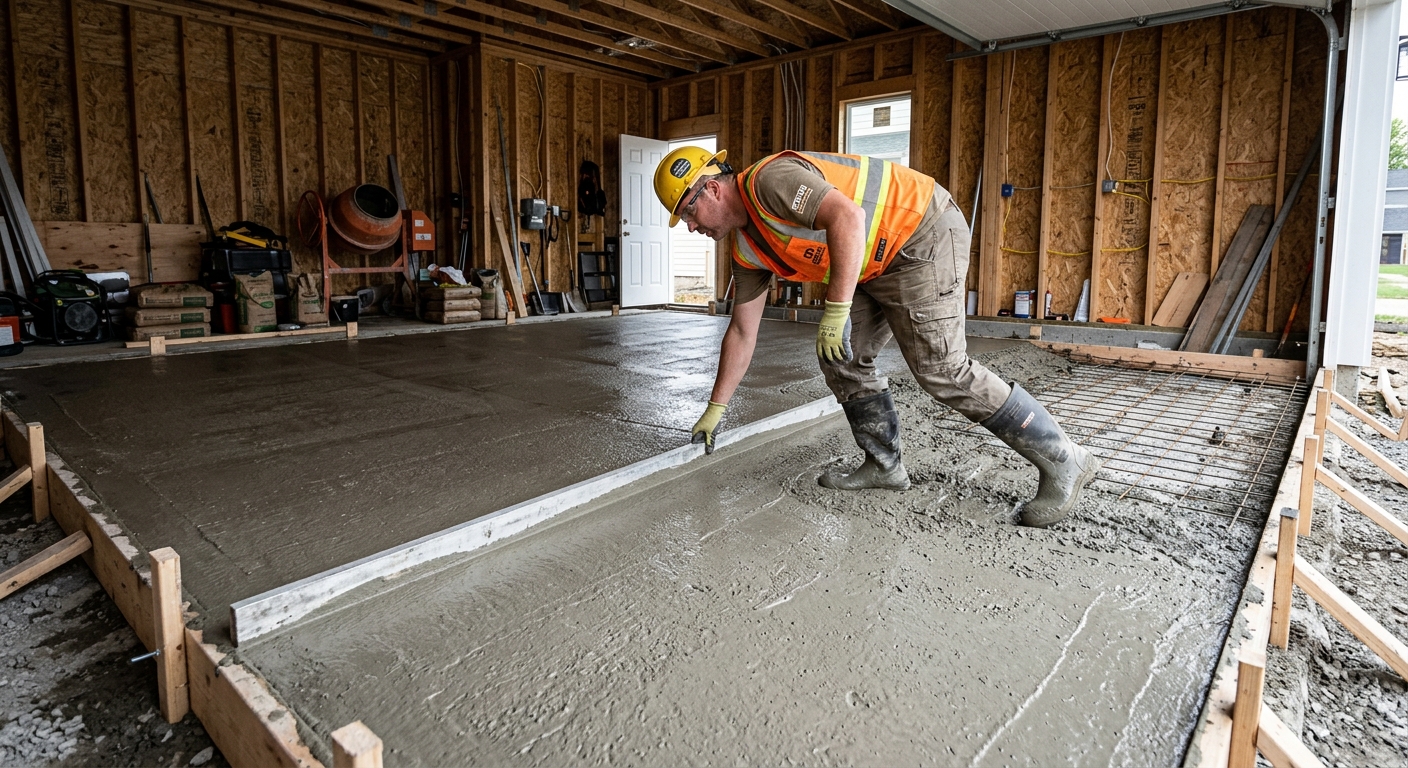
Concrete work options and costs in Marmora
Marmora, Ontario has a lot of homeowners relying on solid concrete for driveways, patios and walkways—especially in established areas where properties have mature landscaping and limited room to stage materials. With a population of 1,499 in the 2021 Census (Statistics Canada, 2021 Census), the town and surrounding road network are small, so local crews and delivery capacity can be more limited than you’d see in bigger GTA pockets. That matters for scheduling and for how efficiently a contractor can mobilize a crew and concrete trucks.
In practice, the most common concrete work here is exterior flatwork attached to older homes and single-family properties. Even though Marmora is rural, the broader Toronto economic region influences expectations and pricing: contractors still build to Ontario frost and durability standards, and that typically means deeper, better-prepped bases and air-entrained concrete for exterior pours. Ontario’s freeze–thaw swings drive costs because contractors need control joints, proper drainage, and surface protection—otherwise you see cracking, uneven settlement, or premature scaling. Crews also concentrate exterior work into the warmer months to manage curing when temperatures trend toward the low teens and below.
In Marmora, we often see especially strong demand near the town core and along main routes (where driveways connect directly to busier streets and access is tight). If you’re planning new flatwork or upgrading existing slabs, use the comparison below as a budgeting baseline—then we’ll narrow it based on your soil, drainage and finish choice.
| Application |
Typical Size |
Key Spec |
Finish Option |
Price Range |
| Concrete driveway (standard broom finish) |
480–600 sq. ft. |
Air-entrained mix, compacted granular base, control joints, drainage |
Broom finish |
$18,000–$28,000 |
| Exposed aggregate driveway |
480–600 sq. ft. |
Air-entrained mix, proper mix design for clean wash, base prep and joints |
Exposed aggregate |
$22,000–$34,000 |
| Stamped concrete driveway or patio |
320–500 sq. ft. |
Air-entrained mix, hardened surface timing, joint layout for crack control |
Stamped (pattern + release) |
$24,000–$40,000 |
| Plain concrete patio or walkway |
200–350 sq. ft. |
Sloped for drainage, air-entrained mix, proper base and saw-cut control joints |
Float + broom (or smooth) |
$3,200–$9,000 |
| Garage floor (interior slab) |
400–650 sq. ft. |
Vapour barrier where needed, fibre or mesh, proper thickness for vehicle loads |
Plain broom or steel-trowel finish |
$7,000–$16,000 |
| Foundation footings (structural, below frost) |
Varies by house footprint |
Concrete to structural spec; excavate to design depth; typical below frost requirement |
Structural concrete |
$180–$300 |
Prices are estimates only and vary by project scope, site access and material selection.
What affects the price of concrete work in Marmora
In Marmora, two quotes for what looks like the same concrete job can easily vary by 30–50% across Ontario. The main reason isn’t just the “concrete cost”—it’s the total build-up: excavation, hauling away unsuitable soil, compacted granular base, reinforcement detailing, and how the contractor manages curing and finishing in real field conditions. In the Toronto economic region, builders also plan for Ontario frost depth and the freeze–thaw cycle, which forces certain specs whether your driveway is “simple” or not.
Here’s the chain: frost depth and freeze–thaw cycles dictate every exterior spec. Exterior footings must extend below the design frost depth to reduce frost heave and differential movement. All exterior slabs are generally built with air-entrained concrete to survive repeated freezing and thawing, and to reduce surface scaling and spalling. When temperatures drop toward about 10 °C or below, cold-weather curing precautions (insulation blankets, heating, longer scheduling) may be needed to protect early-age strength gain. Finally, de-icing salt in winter accelerates surface wear—so sealing and a correctly finished surface become part of long-term performance.
In Marmora, cost can rise when you have wet, silty soils that need over-excavation and a thicker granular base, or when access limits truck placement and increases labour for moving materials. Costs may be lower on level sites with good drainage and straightforward access. For example, upgrading from standard broom finish to exposed aggregate can be worth the money when you want better surface texture and durability; in many budgets, stamped options typically start higher than plain patio work, aligning with the $18–$28 driveway band and the $16–$26 patio/walkway band depending on size and prep.
| Price Factor |
Why It Matters |
Cost Impact |
| Frost line depth — determines footing depth and form height |
Deeper excavation and more concrete increase volume and labour for structural stability |
Can add significant labour/earthwork time, especially on uneven lots |
| Site preparation — excavation, grading, compacted granular base |
Proper base prevents settlement and reduces freeze–thaw movement against the slab |
Higher costs when poor soils require extra base and hauling |
| Reinforcement — rebar or wire mesh requirement |
Controls cracking and supports loads where required by design and thickness |
Material + labour cost increase; spacing and chairs must be correct |
| Mix design — air-entrainment and compressive strength spec |
Air-entrainment and strength rating drive freeze–thaw durability |
Small per-cubic-yard change that protects the surface over years |
| Finish type — broom vs. stamped vs. exposed aggregate |
Finishes require different materials, timing, and extra labour on site |
Stamped/exposed usually move you toward the higher end of the band |
| Pour size and concrete truck access to site |
Longer carries, smaller trucks, and multiple deliveries increase labour |
Can raise cost quickly on narrow or awkward driveways |
| Cold-weather curing precautions — heating and blankets |
Protects early-age strength when temperatures drop and slows curing issues |
Adds equipment, labour, and scheduling buffer |
| Control joint pattern and sealing cost |
Joints manage cracking; sealing repels salt and helps reduce surface breakdown |
Often overlooked; a good system costs modestly but reduces callbacks |
Permits & regulations in Ontario
In Ontario, structural concrete work generally requires a building permit—especially when the foundation system is involved. That includes tasks such as footings, foundation walls, and grade beams/structural elements supporting the house. Many municipalities also expect engineered drawings for structural components, and they may review plans before construction starts. By contrast, concrete flatwork like typical patios, walkways and driveways often does not require a permit unless the work affects lot grading, impervious surface coverage limits, or interferes with municipal right-of-way requirements (for example, changes near the roadside ditch or driveway culvert).
Before breaking ground in Marmora, confirm the exact permit triggers with the local authority having jurisdiction. Also verify the contractor carries liability insurance and appropriate worker coverage for the job (WSIB/WCB, as applicable). Ask for references tied to similar-scale projects in Ontario, and make sure the contractor can clearly explain how they’ll handle base prep, drainage, and frost considerations.
How a homeowner can verify coverage and legitimacy (step-by-step):
- Ask for a certificate of insurance and confirm it lists you as a certificate holder where possible.
- Request proof of WSIB/WCB clearance/coverage for the trades performing the work.
- Check the contractor’s business details and licensing/registration status through Ontario’s available online resources (use the company name exactly as shown on the quote and invoices).
- Compare the scope: confirm whether permits (if needed), disposal, and protection/curing materials are included.
- Review references: ask for photos of exterior freeze–thaw concrete from other Ontario projects, not just showroom images.
Getting concrete right in Marmora's freeze-thaw climate
Marmora’s concrete challenges are the classic Ontario freeze–thaw realities: water in the soil or slab surface expands when it freezes, and that movement can lead to cracks that widen, then spall (surface flaking) when de-icing salts and wetting repeat every winter. The right way to spec your job is to build a “system,” not just pour concrete and hope.
1) Base preparation: plan a compacted granular sub-base to the right depth for your soil and to suit frost protection. If the base isn’t compacted and level (and if drainage isn’t handled), your slab can settle unevenly and fail early, even with a strong finish. 2) Mix design: use air-entrained concrete for exterior flatwork. A typical target is about 5–7% air content, plus a minimum 32 MPa compressive strength. This is what helps reduce spalling during freeze–thaw cycles. 3) Control joints: specify joint spacing that limits random cracking, and ensure saw cuts happen at the right time so the slab cracks where you want. 4) Curing: minimum 7 days of proper curing under suitable conditions is critical; cold weather protection (blankets/heating) can be needed when temperatures fall. 5) Sealing: apply a penetrating sealer about 28 days after the pour to repel de-icing salt.
When people try to cut costs by skipping sealing or using the wrong mix, the savings are usually short-lived. For instance, a plain broom-finished patio in the $16–$26 band may look economical, but if it’s not air-entrained and properly jointed, you may be paying again in a few winters. If you want decorative looks, stamped concrete can justify the higher finish price only when the base, air content, and curing are done to match—otherwise the pattern won’t save the slab.
| Spec |
Why It Matters in Marmora |
What to Ask For |
Impact if Skipped |
| Compacted granular base (depth?) |
Marmora freeze–thaw movement is controlled by how well water is managed and how stable the support layer is |
Base depth and compaction test standard; specify drainage slope away from house |
Settlement and uneven cracking, leading to early spalling |
| Air-entrained concrete mix (target air %?) |
Air bubbles provide freeze–thaw resistance so water expansion doesn’t destroy the surface |
Air content target (commonly 5–7% for exterior flatwork) on the ticket/spec |
Higher risk of scaling/spalling within a few winters |
| Compressive strength (MPa rating) |
Strength gain supports durability and load resistance as the slab cycles through seasons |
Minimum 32 MPa compressive strength and proper curing schedule |
Surface wear, poor performance, and increased cracking risk |
| Control joints (spacing per ACI guidelines) |
Limits random cracking by creating planned weak points that open evenly |
Joint spacing and timing for saw cutting; confirm sealant type if applicable |
Random cracks, water infiltration, and accelerated deterioration |
| Minimum 7-day curing period |
Concrete needs time to reach early-age strength before it’s exposed to cold nights and moisture |
How curing is maintained; what happens if temperatures drop mid-job |
Weakened concrete and higher likelihood of surface breakdown |
| Penetrating sealer (when applied after cure) |
Sealer helps reduce salt/water penetration that drives surface spalling in winter |
Penetrating sealer applied after cure (about 28 days post-pour) with prep steps |
Faster wear and salt damage, especially on exterior walkways/driveways |
How to choose a concrete work contractor in Marmora
Choosing the right concrete contractor in Marmora is mostly about verifying the basics and matching the contractor’s process to Ontario’s freeze–thaw durability requirements. Start by confirming the contractor carries liability insurance and has appropriate worker coverage for the job. In Ontario, the practical homeowner approach is to request (1) a certificate of insurance, (2) WSIB/WCB clearance or proof of coverage for the workers tied to the job, and (3) references for comparable exterior flatwork that’s actually been through winters. Then compare the quote details: you want an itemized breakdown showing labour and materials—not a vague lump sum that hides how they’ll build the base, finish, joints and curing.
Get 2–3 written quotes and ask for the schedule in writing: estimated start date, pouring date window, and completion date. A well-run concrete job is sequencing—excavation, base prep, reinforcement (if required), forms, pour, finishing, and curing/protection—so delays and cold-weather precautions should be discussed early. Payment should protect you: never pay more than about 10–15% upfront, and hold back a meaningful portion until the work is fully completed, cleaned up, and any finishing/sealing steps are done as promised. Also ask whether disposal is included, whether any permits (if required for structural work) are handled, and how protection of landscaping and neighbouring surfaces will be managed.
- Ask for proof of liability insurance and confirm effective coverage dates.
- Request WSIB/WCB clearance/proof for the specific trades doing the work.
- Get 2–3 itemised quotes with labour + materials (not a single “all-in” number).
- Confirm the concrete spec: air-entrainment and minimum strength rating (for exterior).
- Ask for base depth and compaction approach (especially if soil is wet or silty).
- Review joint plan: locations, spacing, and saw-cut timing.
- Confirm curing method and what happens if night temperatures drop.
- Ask when sealing will be applied (about 28 days post-pour) and who supplies it.
- Clarify reinforcement: where mesh/rebar is required and how it’s supported (chairs/spacers).
- Check exclusions: is disposal, site protection, and equipment rental included?
- Verify warranty length for workmanship and whether it covers freeze–thaw related surface issues.
- Get a written timeline and weather plan for cold spells and rain.
Concrete red flags we see in Marmora include: promises that “we never need air-entrainment” for exterior slabs, skipping base compaction details, no joint plan or saw-cut schedule, asking for large upfront payments (over 15%), and avoiding answers about curing/blankets when temperatures drop.
Frequently asked questions — concrete work in Marmora
Can concrete be poured in cold weather in Marmora?
Yes, it can be poured in cold weather in Marmora, but it depends on the conditions and the contractor’s cold-weather curing plan. Pouring isn’t simply about temperature—it’s about how early-age concrete protects against freezing while it gains strength. In the Toronto area, exterior work is often scheduled to avoid prolonged cold snaps; when temperatures approach about 10 °C and below, contractors may need insulation blankets and/or temporary heating to keep the concrete warm enough for proper curing. If that protection isn’t in place, the slab can lose strength and become more prone to surface damage. Always ask what curing method they’ll use, for how long, and how they’ll cover and monitor the slab. If you’re budgeting, know that cold-weather precautions can move the project cost toward the higher end of the typical ranges (for example, patio/walkway budgets often land closer to the top end when curing protection is required).
How do I maintain concrete in Marmora's freeze-thaw climate?
Maintenance in Marmora is about limiting water and de-icing salt penetration, and catching small issues before they turn into spalling. Start with sealing: for most exterior flatwork, a penetrating sealer is typically applied about 28 days after the pour to help repel de-icing chemicals. Keep drainage working—clear any edges/weep paths so water doesn’t pool against the slab. During winter, use de-icing products carefully and avoid heavy salt dumping; excessive salt accelerates surface wear. Visually inspect annually for hairline cracks or areas that sound hollow—those can indicate freeze–thaw deterioration. If you have joints, keep them clean so they don’t fill with debris and allow water to sit. For budgeting, plain patio work may land in the $16–$26 band, but skipping sealing often increases repair risk in a few seasons, especially where winter cycling is harsh.
What causes concrete to spall in Marmora winters?
Spalling usually happens when water gets into the concrete and freezes, then repeats across seasons—this “freeze–thaw cycling” lifts the surface and breaks down the paste. In Ontario, the biggest preventable cause is inadequate air-entrainment for exterior exposure. If the mix doesn’t have the right air content, water expansion during freezing can damage the surface and lead to scaling and spalling. Other contributors include poor base prep (so the slab moves or settles), insufficient control joint planning (so cracks open randomly), and weak curing protection in early days. De-icing salt worsens the process by accelerating chemical attack on the weakened surface. If your driveway or walkway looks rough early on, that’s a sign the mix, curing, or finishing timing may have been compromised. A properly spec’d exterior pour should be closer to the durability level that protects you through Ontario winters rather than only looking good the first season.
What is rebar and when is it required in Ontario?
Rebar is steel reinforcing bar placed within a concrete slab or foundation to help the concrete handle tension and control cracking. It’s used when the design requires reinforcement based on loads, slab thickness, and soil conditions—not just because “more steel is better.” In Ontario, structural concrete items like footings and foundation walls are typically engineered and reinforced according to design. For typical driveway slabs, mesh or rebar may be required depending on thickness, vehicle loads, and the local engineer/permit requirements; some contractors use welded wire mesh and chairs, while others use rebar for heavier loading or more challenging subgrade. The key homeowner takeaway for Marmora is to ask for the spec and placement method: reinforcement must be supported at the correct cover depth (not floating on the base) so it actually performs. If you’re quoting a foundation/footing scope, the foundation band in your market often starts around the structural range, typically $180–$300 per unit depending on engineered design and excavation.
How long does a concrete project take in Marmora?
Timelines depend on size, access and weather, but a typical residential exterior concrete job in Marmora is often a short site-duration process with a curing-dependent finish. Excavation and base prep can take 1–3 days depending on soil conditions and disposal needs. Forms and reinforcement (if used) often add another 1 day. The pour itself is usually a 1-day event, but finishing, edge work and curing start immediately after. While concrete continues to gain strength after placement, contractors commonly plan for a minimum 7-day curing period before stressing the slab heavily, with full performance developing over longer time. Decorative and stamped work sometimes requires extra labour and attention to surface timing. Cold snaps can add time if the contractor needs blankets/heating for curing protection, which is why exterior work is commonly concentrated in warmer periods in the Toronto region. If you’re planning for budgeting, factor these schedule realities into the total cost band—delays and extra curing protection usually push toward the higher end.
What is a concrete overlay and is it suited to Marmora?
A concrete overlay is a new layer placed over an existing concrete surface after preparation. It’s used to improve appearance and restore surface function without fully removing and replacing the original slab, which can be attractive when you want a quicker turnaround. In Marmora, overlay suitability depends heavily on the condition of the existing concrete: if the old slab is moving due to subgrade issues, overlays tend to crack and fail because the movement transfers through. Overlays also require proper cleaning/profiling and correct bonding methods so the new layer adheres. For freeze–thaw areas, the overlay mix, thickness and joint strategy matter a lot; otherwise, water can infiltrate and cause accelerated deterioration. If your current driveway has widespread settlement or major structural cracking, full replacement is often the more durable path. If the surface is mostly sound and only worn or stained, an overlay can be a reasonable compromise—just ensure the contractor addresses drainage, joint alignment, and exterior durability specifications.