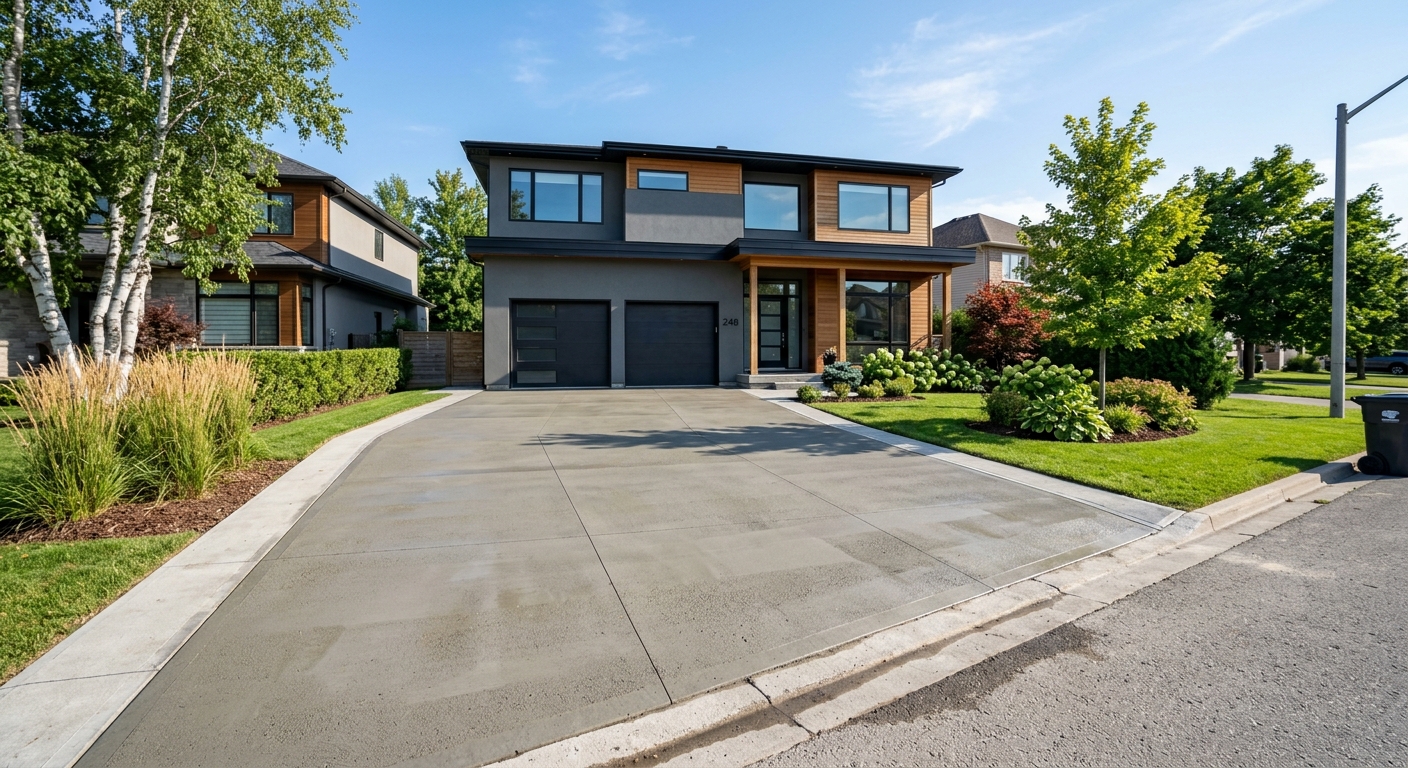
Concrete work options and costs in New Toronto
Concrete work in New Toronto, Ontario is typically busiest for homeowners improving driveways, patios and walkways, especially in older residential pockets where many properties were built decades ago and now need fresh, level flatwork. In a community with a population of 11,463 (Statistics Canada, 2021 Census), concrete contractors still get steady demand year-round, but the highest volume is concentrated when the ground is workable and temperatures support proper curing. Much of the local market is made up of single-detached and semi-detached homes, which commonly means longer exterior runs—perfect conditions for air-entrained mixes, proper drainage, and well-planned control joints to manage the region’s freeze–thaw cycles.
In the Toronto economic region, frost depth and repeated freezing and thawing strongly influence every specification: structural footings must extend below design frost depth to prevent frost heave and differential movement, and exterior slabs need a strong granular base so saturated soils don’t expand and contract against the concrete every winter. Costs also move with weather—Toronto pours are usually concentrated in the warmer months, and once temperatures drop toward about 10 °C, contractors may need extra curing protection (blankets/heating) to hit durability targets. Neighbourhoods around Lakeview/Long Branch and the waterfront access corridors often see higher demand because homeowners refresh entrances and patios before/after seasonal flooding concerns and salt exposure periods.
Below are common concrete options and realistic cost bands to help you compare proposals before site measurements.
| Application |
Typical Size |
Key Spec |
Finish Option |
Price Range |
| Concrete driveway (standard broom finish) |
320 sq. ft. (about 20' x 16') |
Air-entrained mix, compacted base, control joints |
Broom finish, light edging |
$6,000 – $8,900 |
| Exposed aggregate driveway |
320 sq. ft. (about 20' x 16') |
Air-entrained mix, aggregates exposed via wash/surface retarder |
Exposed aggregate finish |
$7,200 – $10,500 |
| Stamped concrete driveway or patio |
280 sq. ft. (about 20' x 14') |
Stamped work, base prep, joints to match pattern |
Slate/stone stamp with release & sealer |
$7,000 – $11,200 |
| Plain concrete patio or walkway |
200 sq. ft. (about 10' x 20') |
Slab with proper drainage slope, air-entrained mix |
Steel-trowel or broom finish |
$3,200 – $5,200 |
| Garage floor (interior slab) |
440 sq. ft. (about 22' x 20') |
Vapour barrier (as required), reinforcement where needed |
Broom or light trowel finish |
$5,900 – $9,900 |
| Foundation footings (structural, below frost) |
Varies by home; example 1 run per foundation wall line |
Engineered depth/width, rebar, excavate & form |
Structural concrete, no decorative finish |
$180 – $300 |
Prices are estimates only and vary by project scope, site access and material selection.
What affects the price of concrete work in New Toronto
In New Toronto, two quotes for the “same” concrete driveway can differ by 30–50% because contractors price risk: ground conditions, excavation depth, reinforcement needs, and how winter weather impacts curing. Even when the finished size is identical, Toronto-area jobs often require deeper frost-protected design, heavier drainage prep, and air-entrained mixes to handle freeze–thaw cycles—especially for exterior flatwork exposed to de-icing salts and wet spring/fall shoulders. That means labour isn’t just pouring; it’s also base build-up, grading, and cure management.
Frost depth and freeze–thaw cycles dictate every spec in Ontario. Structural footings must extend below the design frost depth (commonly 1.2 m to 1.5 m and more in many Ontario designs) to reduce frost heave and differential movement. For exterior slabs—driveways, patios and walkways—contractors generally specify air-entrained concrete mixes so the material can survive repeated freezing without scaling/spalling. In colder periods, contractors also need cold-weather curing precautions (insulating blankets/heating setups) and a longer protected window to reach strength targets; that adds cost compared with warm-month pours.
In practical terms, a property with soft, saturated topsoil will cost more because contractors must excavate deeper and replace with properly compacted granular base. A driveway that ties into an existing slope or requires retaining backfill can also drive up formwork and disposal charges. Conversely, a straightforward patio on stable, well-drained soil with easy truck access may land closer to the lower bands—like the typical $18–$28 per sq. ft. range for driveways or $16–$26 per sq. ft. for simpler exterior slabs.
| Price Factor |
Why It Matters |
Cost Impact |
| Frost line depth — determines footing depth and form height |
Deeper, frost-safe footings prevent heave and uneven settlement. |
Raises excavation and forming time; can move pricing significantly on foundations/footings. |
| Site preparation — excavation, grading, compacted granular base |
Concrete fails when the base is unstable or waterlogged. |
Additional haul-off/replace and compaction checks increase labour and material costs. |
| Reinforcement — rebar or wire mesh requirement |
Controls cracking and improves load capacity for driveways and garage floors. |
Higher material and tying time, especially for larger slabs. |
| Mix design — air-entrainment and compressive strength spec |
Air-entrainment helps manage freeze–thaw durability on exterior flatwork. |
Premium mix and tighter spec; usually essential for outdoor work. |
| Finish type — broom vs. stamped vs. exposed aggregate |
Finish affects labour hours and tooling/material handling. |
Stamped/exposed work typically costs more than plain broom finish. |
| Pour size and concrete truck access to site |
Access controls how efficiently concrete can be placed and finished. |
Long wheelbarrow distances, lane closures, or crane/extra hoses can add cost. |
| Cold-weather curing precautions — heating and blankets |
Proper curing reduces surface scaling and ensures strength development. |
More equipment, labour monitoring, and protection time when temperatures drop. |
| Control joint pattern and sealing cost |
Joints limit random cracking and sealing helps repel de-icing salt intrusion. |
More saw-cut labour and sealer product/crew time. |
Permits & regulations in Ontario
In Ontario, the rule of thumb is that structural concrete needs a building permit and is often tied to engineered drawings reviewed by the municipality, while many concrete flatwork projects do not—unless they change grades, affect drainage, or trigger impervious-surface/lot-grading rules. For New Toronto homeowners, this matters because the excavation and depth for footings, grade beams and foundation walls can impact how the home sits, how water is managed, and how loads are transferred.
Typically requires a permit: foundation footings, foundation walls, grade beams, retaining wall footings, and any concrete work that supports structural loads. These projects often involve inspections at critical stages (e.g., before concrete is placed).
Typically does not require a permit: patios, walkways and driveway slabs on grade, and garage slabs—provided they don’t require re-grading that affects lot drainage or right-of-way conditions. Even then, you should still confirm with the local authority before breaking ground.
To verify a contractor in Ontario step-by-step, start by requesting (1) their proof of liability insurance and (2) their proof of WSIB/WCB coverage (if applicable to your contractor’s work). Next, confirm licensing/eligibility using provincial/online registries where contractors are listed (your contractor should tell you what category they fall under). Finally, ask for a certificate of insurance showing your address as certificate holder (or an endorsement), and request references for similar-scale GTA work so you can match what you see to the quote’s scope.
Getting concrete right in New Toronto's freeze-thaw climate
Concrete failures in New Toronto usually trace back to water and freeze–thaw: water gets under or into the slab, the base expands and contracts, and the surface begins to scale or spall—especially where de-icing salt is used. The fix isn’t “more cement” or thicker by guesswork; it’s a correct system: base build-up, durable air-entrained mix, reinforcement where needed, planned control joints, proper curing, and sealing. In the GTA, humid conditions in wet shoulder seasons can also leave contractors fighting moisture at the jobsite—another reason correct grading and drainage are non-negotiable.
Spec the job with five essentials. (1) Base preparation: compacted granular sub-base at the required depth for local soil and the slab thickness, with slope away from the house. (2) Mix design: air-entrainment for exterior flatwork (commonly 5–7% air content) and a minimum 32 MPa compressive strength target, ensuring freeze resistance. (3) Control joints: spacing that limits random cracking so joints—not edges—open first. (4) Curing: keep the slab protected for at least 7 days under suitable conditions; if temperatures drop toward/under about 10 °C, plan cold-weather protection. (5) Sealing: apply a penetrating sealer after the cure window (often around 28 days) to reduce salt and moisture intrusion.
Here’s a cost example: a plain broom-finish patio might target the $16–$26 per sq. ft. band, while a stamped option often lands closer to $24–$40 per sq. ft. That premium is justified when the contractor also keeps proper joints and uses the right air-entrained mix—otherwise the decorative finish won’t last any longer than plain concrete. If air-entrainment is skipped, spalling risk rises quickly in Toronto winters.
| Spec |
Why It Matters in New Toronto |
What to Ask For |
Impact if Skipped |
| Compacted granular base (depth?) |
Stable support prevents settlement and reduces freeze–thaw movement. |
Written base depth and compaction method; confirm drainage slope. |
Cracking, rocking slabs, and premature edge spalling from moving soils. |
| Air-entrained concrete mix (target air %?) |
Helps concrete resist freeze–thaw scaling in salted, wet Toronto conditions. |
Target air content for exterior flatwork (commonly 5–7%). |
Higher chance of surface scaling and spalling after winter cycles. |
| Compressive strength (MPa rating) |
Strength development supports long-term durability and load performance. |
Minimum 32 MPa specified in the mix and pour plan. |
Soft/weak concrete that wears quickly and cracks under everyday loads. |
| Control joints (spacing per ACI guidelines) |
Joints “steer” cracking, limiting random fractures from temperature movement. |
Joint spacing and saw-cut timing for exterior flatwork. |
Uncontrolled cracking across the slab and more water entry. |
| Minimum 7-day curing period |
Proper curing reduces shrinkage cracking and improves durability before winter. |
Curing protection plan and confirmation of when temperatures drop. |
Surface defects, reduced strength, and early scaling/spalling risk. |
| Penetrating sealer (when applied after cure) |
Repels moisture and reduces salt penetration during freeze–thaw. |
Specify a penetrating sealer and schedule (often around 28 days post-pour). |
Faster surface breakdown and more maintenance sooner. |
How to choose a concrete work contractor in New Toronto
Choosing the right concrete contractor in New Toronto is mostly about verifying accountability and making sure the quote matches the durability specs your climate requires. In Ontario, start by confirming the contractor carries liability insurance and WSIB (and/or the applicable workers’ compensation clearance where required). To check this, request a current certificate of insurance and review expiry dates and jobsite coverage. Then ask for WSIB/WCB clearance documentation and keep copies with your contract.
Next, collect 2–3 itemised written quotes so you can compare like-for-like—labour, concrete supply, base prep, reinforcement, forms, saw cutting, sealing, and disposal should be shown separately rather than hidden inside one lump sum. Carefully read exclusions: Are permits included? Is traffic control or right-of-way restoration included? Is demo and haul-away part of the price, or billed separately? For Ontario flatwork, contractors often treat grading/drainage as “scope risk”—so you want clarity on who is responsible if the contractor finds unsuitable soil.
For warranty, look for a written workmanship warranty length (and what it covers), and ask whether any product/manufacturer warranty is included and whether it’s transferable to the homeowner. Keep payment terms sensible: never pay more than 10–15% upfront; use a holdback until the job is complete and the finish quality is confirmed. Finally, ask for a timeline with a start date and a completion estimate in writing—this helps prevent mid-season delays that can compromise curing.
- Request proof of liability insurance and confirm it covers your property address.
- Ask for WSIB/WCB clearance/coverage documentation before work begins.
- Get a written scope that lists excavation depth, base depth, and compaction plan.
- Confirm the mix is air-entrained for exterior slabs and includes the required strength.
- Ask how they handle frost protection and whether footings extend below design frost depth.
- Require joint spacing details and saw-cut timing (don’t accept “we’ll do it later”).
- Get a line item for reinforcement (rebar/wire mesh) and where it’s placed.
- Clarify sealing—product type and when the sealer is applied after curing.
- Ensure demo, disposal, and site restoration are itemised (not assumed).
- Confirm truck access, hose/wheelbarrow plan, and how they protect landscaping.
- Ask for crew experience with your chosen finish (broom vs stamped vs exposed).
- Use milestone payments with a holdback until final cleanup and checks are complete.
Concrete red flags in New Toronto include: quoting a driveway without discussing air-entrainment for exterior work, promising “no joints” or vague joint spacing, skipping or downplaying base compaction and drainage, providing only a lump-sum price without itemised materials/labour, and asking for most of the money upfront without a holdback tied to completion and curing protections.
Frequently asked questions — concrete work in New Toronto
Concrete vs pavers for a patio in New Toronto?
For patios in New Toronto, both concrete and pavers can last a long time, but concrete generally wins on cost predictability and smooth drainage when the base is done correctly. Pavers allow easier spot repairs if a section settles, while concrete relies on a good granular base, air-entrainment, and correct control joint planning to prevent random cracking in freeze–thaw. Price-wise, plain concrete patios often land in the $16–$26 per sq. ft. range, while pavers commonly come with higher material and install labour once you factor edging and base depth. If your property has frequent wet spots, pavers can be more forgiving during maintenance, but you’ll still need proper slope away from the house. For either option, ask contractors to describe drainage and the compaction steps—not just the finish.
How long does a concrete driveway last?
A well-built concrete driveway in Ontario typically aims for 25–30 years of service life, and longer when it’s designed for freeze–thaw and salt exposure. The big drivers are base preparation, air-entrained concrete for exterior durability, correct thickness, reinforcement where needed, and a reasonable control joint pattern. If the driveway is poured over poorly compacted soil or water is allowed to sit under the slab, you’ll see cracking and edge deterioration much sooner. In New Toronto specifically, curbside salt and winter moisture make sealing and surface protection important. If you’re comparing prices, a standard broom driveway often follows the $18–$28 per sq. ft. band; the “cheap” end usually reflects less site work. Make sure that cost difference isn’t coming from skipping base depth or joint/sealing details.
What is air-entrained concrete and why does it matter here?
Air-entrained concrete is a mix engineered with tiny air bubbles that provide room for water to expand when it freezes. In Ontario’s Toronto area, freeze–thaw cycling and de-icing salts can pull moisture into the surface. Without air-entrainment, water expansion creates stress and can lead to scaling and spalling—those rough, flaking patches you often see on older flatwork. For exterior slabs like driveways, patios and walkways in New Toronto, contractors commonly target about 5–7% air content and specify a minimum compressive strength (often 32 MPa) to support durability. When quotes differ, ask what mix they’re using and whether it’s air-entrained for exterior exposure. This is one of the most important questions you can ask because it directly affects whether the concrete survives winters, not just how it looks on day one.
How do I prepare the base for a concrete slab?
Base prep is where strong driveways and patios are won or lost. For New Toronto, you want excavation to the specified depth, followed by placement of well-graded granular material and thorough compaction. The base should be graded with a slope that directs water away from the house and into proper drainage paths. If the contractor finds soft or waterlogged soil, it often needs removal and replacement; otherwise, the slab can “float” and crack as freeze–thaw moves moisture in and out. Ask your contractor for the base depth, compaction method (and whether they’ll confirm it with test steps), and whether they’re using a vapour barrier where relevant for interior slabs. A patio poured on the wrong base might still fit budget—often near the $16–$26 per sq. ft. band—but it can become a repair job sooner than expected.
How do I compare concrete quotes?
Comparing concrete quotes is easiest when you insist on itemised scope and identical specifications. For a New Toronto driveway or patio, ask each contractor to break out labour and materials for excavation, granular base, reinforcement, concrete supply (including air-entrainment and strength), forming, finishing, saw-cut control joints, curing protection, and sealing. Confirm disposal/haul-away is included if demo is required. Also check whether the contractor is allowing for Ontario permits and inspections when structural work is involved (footings/foundation walls/grade beams usually need permits). In quotes, a stamped project may look more expensive, but compare whether they’ve included correct jointing and sealing—stamped & decorative typically follows the $24–$40 per sq. ft. range. If one quote is dramatically lower, look for missing base depth, reduced reinforcement, or a non-air-entrained exterior mix.
Can concrete be poured in cold weather in New Toronto?
Concrete can be poured in cold weather in Ontario, but it must be managed carefully. In New Toronto, the risk is that curing slows down when temperatures drop, which can weaken the surface and increase cracking or scaling. Many contractors avoid marginal conditions unless they’re set up for cold-weather curing—typically including heating, insulated blankets, and careful protection around the pour and early curing window. If the forecast suggests temperatures near or below about 10 °C, a reputable contractor should explain their cold-weather plan and how long protection will be provided. The practical impact is cost and schedule: cold-weather precautions add labour and materials, so pricing can land toward the higher end of bands like $18–$28 per sq. ft. for driveways when protection is required. Your best move is to ask for the plan in writing before booking a pour date.