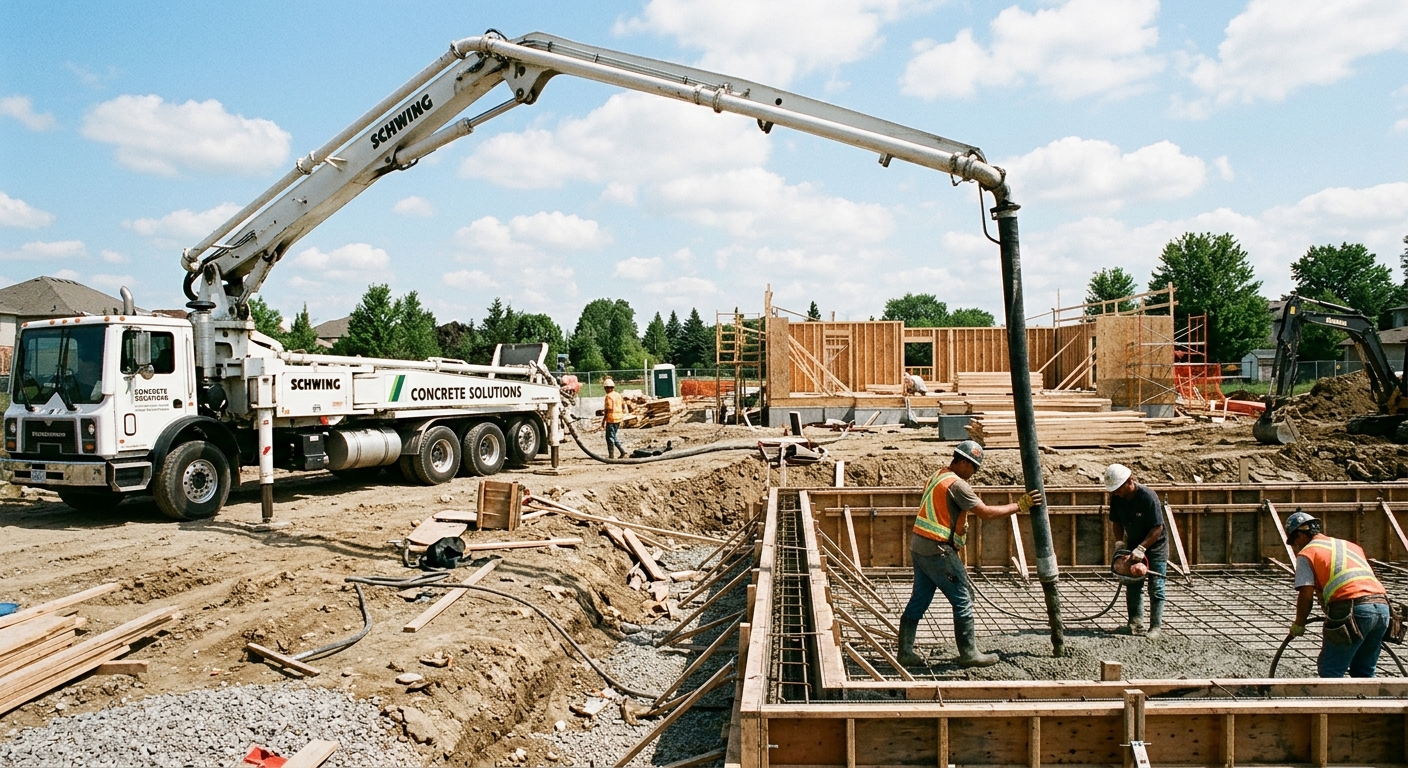
Concrete work options and costs in Centreville Chicopee
Concrete work in Centreville Chicopee is shaped by both the local housing market and Ontario’s harsh freeze–thaw winters. With a population of 10,434 (Statistics Canada, 2021 Census), the area is dominated by owner-occupied homes, and that typically means steady demand for exterior concrete flatwork—driveways, walkways, and patios—especially in established residential pockets like the Chicopee–Centreville corridor where homes often sit on older, well-treed lots and get regular upgrades.
Toronto-region concrete pricing is rarely “one-size-fits-all.” In the GTA, deeper frost protection and more robust exterior mix designs are the norm, because saturated soils can expand and contract against slabs every winter. Contractors also concentrate most exterior pours into the warmer months to protect curing quality when temperatures drift toward 10 °C or below. If a job is delayed by spring rain, limited site access, or truck scheduling, costs can jump due to extra protection and rework risk.
As a result, you’ll typically see quote differences on the same “type” of concrete work—sometimes 30–50%—driven by base prep, reinforcement, finish detailing, and whether sealing and jointing are included. If you’re budgeting, it helps to anchor to current local price bands: concrete driveways commonly land in the $18,000 – $28,000 range, while patios and walkways are often in the $16,000 – $26,000 range depending on thickness, prep, and finish. Use the table below to compare options side-by-side and pinpoint what you’re actually paying for.
| Application |
Typical Size |
Key Spec |
Finish Option |
Price Range |
| Concrete driveway (standard broom finish) |
10 m x 3 m (30 m²) |
Air-entrained exterior slab, granular base, control joints |
Broom finish |
$18,000 – $28,000 |
| Exposed aggregate driveway |
10 m x 3 m (30 m²) |
Air-entrained mix, exposed surface seeding/retarder, proper jointing |
Exposed aggregate |
$22,000 – $34,000 |
| Stamped concrete driveway or patio |
9 m x 3 m driveway (27 m²) or 6 m x 6 m patio (36 m²) |
Air-entrained slab, release agent, thicker wear surface where needed |
Stamp + texture pattern |
$24,000 – $40,000 |
| Plain concrete patio or walkway |
3 m x 6 m (18 m²) |
Air-entrained, compacted base, edge forms, joints |
Float/steel trowel or light broom |
$16,000 – $26,000 |
| Garage floor (interior slab) |
6 m x 6 m (36 m²) |
Vapour barrier (as required), base prep, optional integral colour |
Broom or lightly troweled |
$8,000 – $16,000 |
| Foundation footings (structural, below frost) |
Per linear metre depends on design |
Below-grade concrete per engineered/approved drawings |
Standard formwork finish |
$180 – $300 |
Prices are estimates only and vary by project scope, site access and material selection.
What affects the price of concrete work in Centreville Chicopee
In Toronto and across Ontario, two homeowners can receive quotes for the “same” concrete job and still see a 30–50% swing once you break down the details. The biggest drivers are below the surface: frost-depth requirements, how much excavation and base preparation is needed, reinforcement choices, and the finish system (broom vs. stamped vs. exposed aggregate). Labour rates and concrete-truck scheduling in the GTA also influence pricing—longer waits, fewer access routes, or re-pours due to weather protection can add cost quickly.
Every exterior spec in the Toronto region starts with frost protection and freeze–thaw durability. Footings must extend below the design frost depth (in Ontario typically 1.2 m or deeper, and many designs push deeper based on soil and local conditions) to prevent frost heave and differential movement. Exterior slabs should use air-entrained concrete so the freeze–thaw cycle doesn’t break down the surface over time. When temperatures drop toward 10 °C or below, contractors often add cold-weather curing precautions—insulating blankets and careful curing management—so the concrete actually achieves strength rather than just looking “set.” And because GTA winters involve de-icing salt, sealing becomes a durability line item; without it, spalling risk rises.
In Centreville Chicopee specifically, local conditions can move your budget. For example: (1) a driveway on heavy, moisture-retentive soil often needs deeper granular base and more undercut to stabilize—pushing driveway pricing toward the $18,000 – $28,000 end; (2) a stamped or exposed aggregate option adds forming and finishing labour, so budgets often align with $24,000 – $40,000 when patterns, colours, and thicker wear requirements are included; and (3) older lots with established trees may limit truck access, increasing labour time for wheelbarrowing and materials handling.
| Price Factor |
Why It Matters |
Cost Impact |
| Frost line depth — determines footing depth and form height |
Deeper footings increase excavation, formwork, and concrete volume |
Higher excavation can add hundreds to thousands depending on linear metres |
| Site preparation — excavation, grading, compacted granular base |
Proper base controls settlement and helps prevent slab movement |
Can move exterior flatwork by 10–25% when soil is poor or wet |
| Reinforcement — rebar or wire mesh requirement |
Controls cracking and improves performance under loads |
Adds material and labour; mesh vs rebar spec changes total cost |
| Mix design — air-entrainment and compressive strength spec |
Air content and strength affect freeze–thaw durability |
Small material premium, but essential for exterior longevity |
| Finish type — broom vs. stamped vs. exposed aggregate |
Complex finishes require more labour and precise workmanship |
Stamped/exposed typically increases price versus broom finish |
| Pour size and concrete truck access to site |
Long distances and restricted access increase handling time |
Risk of extra labour or shorter load capacity can raise costs |
| Cold-weather curing precautions — heating and blankets |
Ensures strength development when temperatures drop |
Often adds cost during shoulder-season scheduling |
| Control joint pattern and sealing cost |
Joints manage cracking; sealing helps repel salt and water |
Skimping leads to earlier spalling; doing it properly adds value |
Permits & regulations in Ontario
In Ontario, structural concrete work—such as foundation walls, footings, grade beams, and other load-bearing structural elements—typically requires a building permit, and municipalities commonly expect engineered drawings to support the design. For concrete flatwork (driveways, patios, and walkways), permits are often not required as stand-alone work, but your plan can still trigger review if it affects lot grading, drainage, or impervious surface coverage limits, or if the work impacts the municipal right-of-way (for example, in some driveway tie-ins or within regulated frontage areas). Before breaking ground in Centreville Chicopee, confirm the requirements with the local building office or permit portal.
For contractor verification, start with insurance and coverage before you talk about finish options:
Step-by-step for homeowners:
- Confirm the contractor has liability insurance (ask for a current Certificate of Insurance showing your project as an additional insured where offered).
- Verify workplace coverage (WSIB/WCB as applicable) so you’re not exposed if a worker is injured on your property.
- Check their standing and business details through provincial/company registration sources and their own documentation package.
- Ask for references on similar-scale Ontario projects (exterior slabs and winter-ready curing practices are a good benchmark).
- Ask who pulls any required permits and whether permit fees and drawings are included or excluded in the quote.
This approach keeps you compliant, reduces risk, and helps ensure the concrete is built to the right standard for Ontario’s climate and load expectations.
Getting concrete right in Centreville Chicopee's freeze-thaw climate
Concrete failure in Centreville Chicopee usually starts with water management and freeze–thaw exposure. If the base isn’t compacted granular material to the right depth, water can sit under the slab. Each winter freeze expands that moisture, stressing the concrete and soil bond. On the surface, inadequate air-entrainment is a common cause of spalling: the freeze–thaw cycle damages the paste, then salt and moisture accelerate the breakdown. That’s why your specifications matter as much as your finish.
To “spec it right” for the Toronto region:
- Base preparation: require a compacted granular sub-base sized to the local frost/soil condition and designed to drain. Proper grading and drainage control reduce saturation.
- Mix design: ask for air-entrainment (for exterior flatwork, a typical target is 5–7% air) and minimum 32 MPa compressive strength so the slab performs through winter.
- Control joints: include a joint layout and spacing strategy that limits random cracking and keeps cracks tight.
- Curing: plan for at least 7 days of proper curing conditions. If you pour during colder snaps, ask how they’ll insulate/heated-protect to achieve strength.
- Sealing: request a penetrating sealer applied after cure (commonly around 28 days post-pour) to repel water and de-icing salt.
Here’s a practical dollar example: if one contractor quotes a basic broom driveway toward the low end of the $18,000 – $28,000 range but skips proper air-entrainment, a weak base, or sealing, you might save today and pay later for patching and early surface breakdown. A more complete spec that includes air-entrainment, correct base prep, and sealing support can justify the higher end of the band because it’s directly tied to freeze–thaw longevity in Ontario.
| Spec |
Why It Matters in Centreville Chicopee |
What to Ask For |
Impact if Skipped |
| Compacted granular base (depth?) |
Stabilizes soil, controls drainage, reduces movement under freeze–thaw |
State the base depth and compaction plan; confirm drainage/grading details |
Settlement, cracking, and faster deterioration |
| Air-entrained concrete mix (target air %?) |
Gives room for freeze expansion; helps prevent paste damage and spalling |
Ask for 5–7% air for exterior flatwork and confirm mix design |
Higher spalling risk during winters with salt and moisture |
| Compressive strength (MPa rating) |
Ensures strength development for long-term durability |
Minimum 32 MPa (or project-specific requirement) |
Surface wear, reduced impact resistance, early scaling |
| Control joints (spacing per ACI guidelines) |
Manages where cracks occur so they’re predictable and easier to maintain |
Joint pattern and approximate spacing (and whether joints will be sealed) |
Random cracking and wider cracks that let water in |
| Minimum 7-day curing period |
Cold/wet shoulder-season conditions can slow strength gain |
Confirm curing method and protection if temperatures fall |
Weaker slab, increased surface defects and scaling |
| Penetrating sealer (when applied after cure) |
Helps repel water and salt during freeze–thaw seasons |
Penetrating sealer applied after cure (commonly after ~28 days) |
Higher water/salt absorption and faster spalling |
How to choose a concrete work contractor in Centreville Chicopee
Choosing the right concrete contractor in Centreville Chicopee starts with verifying three basics: Ontario licensing/qualification (where applicable for the work they perform), liability insurance, and WSIB/WCB coverage. Here’s the practical way to check:
- Ontario licensing/standing: ask for their business details and trade qualification information, then confirm through available provincial registries or their documentation package.
- Liability insurance: request a current Certificate of Insurance before scheduling the pour; verify limits are appropriate for concrete work on residential sites.
- WSIB/WCB: ask for proof of coverage for their workers; coverage matters for your protection if someone is injured.
- Clear scope: ensure the quote clearly lists excavation, base prep, reinforcement, concrete type (air-entrained for exterior), joints, curing protection, and sealing (if included).
Next, get 2–3 itemised written quotes. Don’t accept a vague lump sum without a breakdown of labour + materials. Compare like-for-like: same thickness, same base depth, same reinforcement, same mix requirements, and the same finish scope. Pay attention to exclusions (permit pull, disposal, sawcutting, driveway approaches, removal of existing concrete, and protection/clean-up).
For payment, a safe approach is to never pay more than 10–15% upfront. Use a holdback until the job is complete and properly cured/finished. Finally, request a timeline in writing: a start date, pouring window, and completion estimate that account for Ontario’s shoulder-season weather.
- Request the air-entrained mix spec for exterior work.
- Ask for the planned base depth and compaction method.
- Confirm joint spacing and whether joints will be sealed.
- Ask how they protect curing during cooler nights.
- Verify disposal/replacement of spoils is included.
- Confirm concrete truck access plans and waste handling.
- Get finish details in writing (broom direction, stamp pattern, exposed aggregate finish method).
- Ask for warranty length for workmanship and what it covers.
- Clarify whether any manufacturer warranties are included and if transferable.
- Check that the quote includes edge forms, proper slope, and drainage tie-ins.
- Confirm curing timeline and when you can use the driveway/patio.
Concrete red flags: contractors who won’t discuss air-entrainment for exterior slabs, quotes that omit base preparation and compaction details, payment schedules demanding large upfront sums, no written timeline for curing/protection, or crews who skip/underspec reinforcement and control joints for winter-prone Toronto-area conditions.
Frequently asked questions — concrete work in Centreville Chicopee
How long does a concrete driveway last?
In Centreville Chicopee and across the Toronto economic region, a properly built concrete driveway often lasts decades, but the service life depends on the details that survive freeze–thaw. The big quality factors are an air-entrained exterior mix, a well-compacted granular base, correct jointing, and curing done long enough for strength gain. Sealing also plays a role because de-icing salt plus winter moisture can accelerate surface scaling if the slab is porous. If your driveway includes good drainage and joints that are maintained, you’re far more likely to avoid early spalling and random cracking.
What is air-entrained concrete and why does it matter here?
Air-entrained concrete is mixed with tiny, uniformly distributed air bubbles that give the cement paste space to expand during freezing. In Ontario’s freeze–thaw climate—where moisture gets into concrete and then freezes—this is one of the best defences against spalling and scaling. For exterior flatwork around Centreville Chicopee, you should ask your contractor to specify an air-entrained mix with a typical exterior target of about 5–7% air content and to confirm the concrete meets the needed strength. Cutting corners here can make a driveway look fine at first, then break down faster once winters hit. It’s one reason reputable GTA quotes may cluster toward the $18,000 – $28,000 driveway range when the full durability package is included.
How do I prepare the base for a concrete slab?
Base preparation is where long-term performance starts. For a slab in Centreville Chicopee, you want the subgrade excavated to the design grade, then a compacted granular sub-base placed in lifts to achieve the right density. The contractor should also address drainage and slope so water doesn’t pool under the slab. If the site has wet or unstable soil, they may need deeper undercut and more engineered base material before placing concrete. Ask for the base depth and compaction approach in the quote and confirm the slab has edge support. Even a great finish won’t compensate for a weak base, especially with Toronto-area freeze–thaw cycles.
How do I compare concrete quotes?
Comparing quotes in Centreville Chicopee is easiest when you insist on itemised, like-for-like details. Ask each contractor for thickness, base depth, reinforcement (rebar or mesh), the concrete mix type (air-entrained for exterior), control joint layout, and whether curing protection is included if temperatures drop. Also check what’s excluded: removal of existing concrete, disposal, permit pull, and sealing. For pricing, use the local bands as a sanity check: a standard broom-finished driveway often falls in the $18,000 – $28,000 band, while stamped work is commonly higher and can align with $24,000 – $40,000 once labour and finishing steps are included. If one quote is far below the band, ask what durability steps were reduced or left out.
Can concrete be poured in cold weather in Centreville Chicopee?
Yes, concrete can be poured in colder weather in Centreville Chicopee, but it’s not “set and forget.” When temperatures near or below 10 °C, curing slows and concrete may not reach adequate strength without protection. A competent Ontario contractor will plan cold-weather precautions such as insulating blankets, temperature monitoring, and sometimes controlled heating of the slab area to support proper curing. You should also confirm that they account for protection time, not just the day of the pour. Even with good cold-weather procedures, scheduling is often tighter in the GTA because reliable curing conditions are best in the warmer months.
How do I maintain concrete in Centreville Chicopee's freeze-thaw climate?
Maintenance in Ontario is mostly about keeping water and salt from attacking the surface. After your driveway or patio cures, use a penetrating sealer (often around 28 days post-pour, depending on product instructions and conditions) to help repel moisture and de-icing salts. Use de-icers carefully—avoid products that are excessively harsh for concrete if alternatives are available, and clear snow promptly to reduce salt sitting time. Inspect annually for hairline cracks, spalling spots, and joint failure; address small issues early so water doesn’t migrate beneath the slab. With Centreville Chicopee’s winters, the combo of sealing, sensible de-icing, and keeping joints in good condition is what most consistently protects concrete long term.