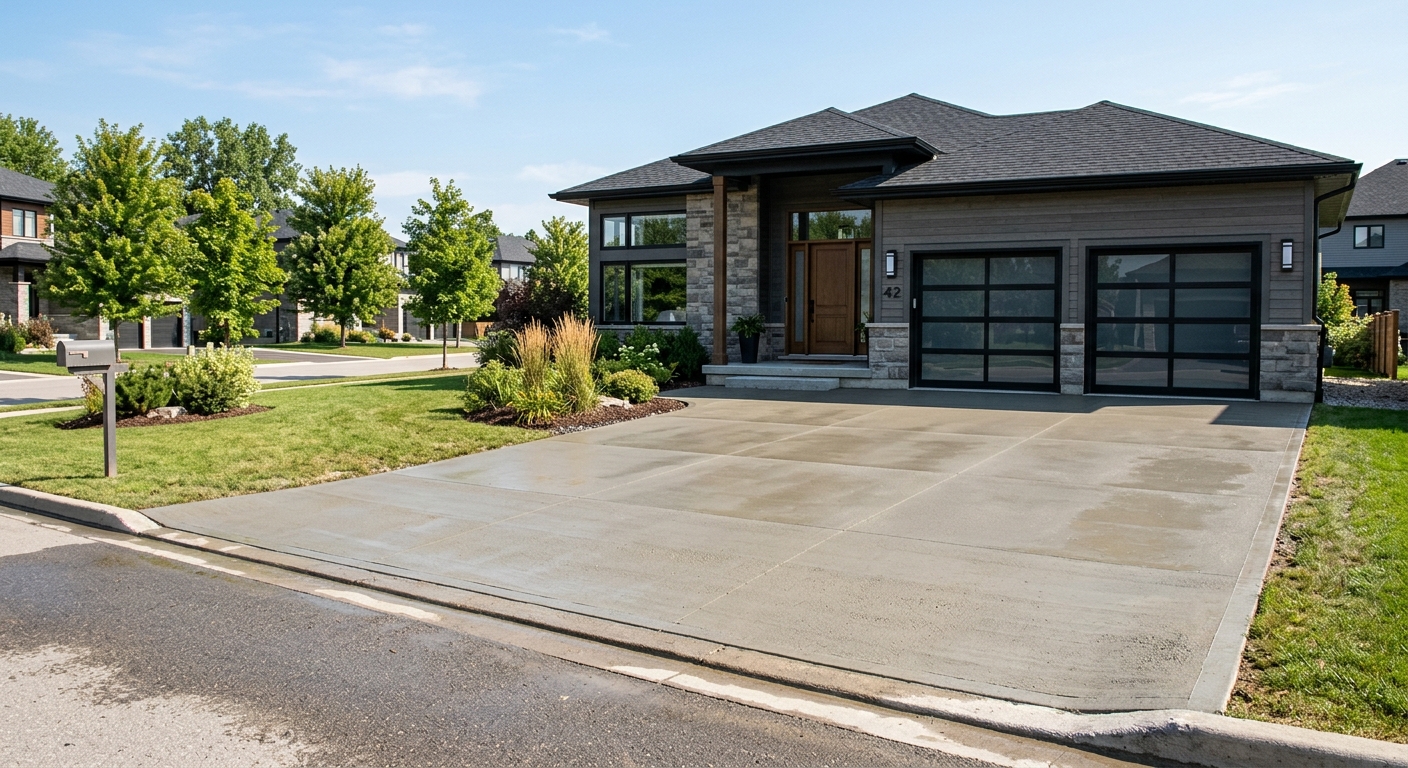
Concrete work options and costs in Henry Farm
Concrete work is a common home upgrade in Henry Farm, where driveways, patios, walkways and basement foundations are built to handle Toronto’s real-world freeze–thaw swings. With a local population of 15,723 (Statistics Canada, 2021 Census), the area has a steady mix of established homes and ongoing infill activity—so concrete contractors stay busy, especially around the commercial strip at McCowan Rd and Steeles Ave E. In many Toronto neighbourhoods like yours, concrete flatwork is most often used on the front approach and backyard transitions for single-detached and townhouse properties, which make up a large portion of demand for long-lasting exterior slabs.
In the Toronto economic region, pricing reflects more than “square footage.” Local building practice typically pushes most structural footings to extend at least 1.2 m (about 4 ft) below grade to reduce frost heave risk, and exterior slabs are commonly specified with air-entrained concrete and well-planned control joints. Contractors also concentrate outdoor pours during the warmer months so curing stays reliable; when temperatures drop toward 10 °C or below, protection (insulating blankets and careful curing practices) becomes part of the job cost. That’s why two homeowners can receive quotes that differ noticeably for the same driveway style: the depth of base prep, reinforcement, and the logistics of a concrete truck reaching your lot all affect labour and materials.
Below are typical cost ranges you’ll see in Henry Farm, starting with common flatwork and moving down to structural footings.
| Application |
Typical Size |
Key Spec |
Finish Option |
Price Range |
| Concrete driveway (standard broom finish) |
400–500 sq ft |
4 in slab, compacted base, control joints |
Broom finished top, sealed (optional) |
$7,200–$13,500 |
| Exposed aggregate driveway |
400–500 sq ft |
Air-entrained mix, proper finishing timing |
Exposed aggregate (stone wash) |
$10,000–$17,500 |
| Stamped concrete driveway or patio |
300–450 sq ft |
Reinforcement plan, air-entrained mix |
Stamped pattern with release and sealer |
$9,000–$18,500 |
| Plain concrete patio or walkway |
150–300 sq ft |
5 in patio (typical), compacted base |
Broom finish |
$2,400–$7,800 |
| Garage floor (interior slab) |
240–480 sq ft |
Vapour barrier (if required), reinforcement as specified |
Steel-trowel or broom (light texture) |
$4,800–$14,000 |
| Foundation footings (structural, below frost) |
Varies (linear footage + excavation) |
Engineered footing size, rebar, waterproofing coordination |
Structural concrete |
$180–$300 |
Prices are estimates only and vary by project scope, site access and material selection.
What affects the price of concrete work in Henry Farm
In Toronto and across Ontario, quotes for the same “type” of concrete job can vary by 30–50% because the real drivers aren’t just the finish—they’re the foundation preparation, reinforcement, and how the contractor protects concrete during curing. In Henry Farm, the freeze–thaw cycle is a constant cost variable: exterior slabs and approaches need air-entrained concrete, correct thickness, and control joints to manage seasonal movement. Structural work also follows Ontario building practice, where footings are typically built to extend at least 1.2 m below grade to reduce frost heave and differential settlement.
Those requirements affect labour time and material usage. A driveway that’s cheaper on paper may have a thinner or poorly compacted granular base, less reinforcement, or a finish plan that doesn’t match the exposure level—each can show up as early spalling or cracking. Weather also matters here: because the GTA has a shorter, more sensitive reliable pour season, contractors often schedule exterior flatwork to keep curing steady. When concrete needs cold-weather curing precautions—insulating blankets, temporary heat, and longer protection—the cost rises. Sealing is another practical variable: de-icing salt accelerates surface deterioration, so a quality penetrating sealer (typically applied after the cure) can extend service life.
In Henry Farm specifically, driveway replacement costs tend to jump when there’s limited truck access off Steeles or McCowan (extra labour for placing materials and managing forms), or when drainage work is needed to stop saturated soils from swelling and contracting. Conversely, simpler projects with clear access and straightforward drainage can land near the lower end of the region’s driveway band (about $18–$28 per sq ft). Decorative work like stamped concrete usually sits higher within the $24–$40 per sq ft range because it adds labour steps and higher material handling.
| Price Factor |
Why It Matters |
Cost Impact |
| Frost line depth — determines footing depth and form height |
Footings must sit below the design frost zone to prevent heave |
Higher excavation and taller forms can add 10–25% on structural scopes |
| Site preparation — excavation, grading, compacted granular base |
Strong base reduces settlement and stops moisture-driven expansion/contraction |
Can shift exterior slab pricing by 15–30% depending on removal/haul |
| Reinforcement — rebar or wire mesh requirement |
Controls cracking and helps slabs perform under vehicle loads |
Typically adds 5–15% but can prevent expensive rework |
| Mix design — air-entrainment and compressive strength spec |
Air-entrainment helps resist freeze–thaw damage |
Often small per-yard cost, but essential for durability; skipping it saves little and risks failure |
| Finish type — broom vs. stamped vs. exposed aggregate |
Decorative finishes take more labour and careful timing |
Stamped/exposed can add roughly 20–40% versus standard broom |
| Pour size and concrete truck access to site |
Short access roads can increase labour and placement time |
Can add 5–20% for mobilization and extra handling |
| Cold-weather curing precautions — heating and blankets |
Maintains early strength development when nights are near or below 10 °C |
May add 10–25% on exterior work scheduled late in the season |
| Control joint pattern and sealing cost |
Joints manage shrinkage cracks; sealing reduces salt/water damage |
Usually a modest line item, but can extend service life significantly |
Permits & regulations in Ontario
In Ontario, structural concrete work generally requires a permit. That includes footings, foundation walls, and grade beams for a new foundation, structural underpinning, or foundation repairs that affect load paths. Most of these structural scopes also rely on engineered drawings reviewed by the municipality as part of the permit process. For concrete flatwork—patios, walkways, driveways, and slabs—permits are often not required, unless the work affects lot grading, drainage, or impervious surface coverage rules, or it ties into a municipal right-of-way. Because local details vary by site and drainage layout, it’s smart to confirm with the local authority before excavation.
For your Henry Farm project, verify the contractor is properly set up before anyone starts: ask for their liability insurance and evidence they can cover workers under the required workplace coverage program. Then ask for references on similar-scale jobs in your area (driveways and exterior flatwork are the best match, since Toronto freeze–thaw failures are often installation-related).
Step-by-step: (1) check Ontario’s online licensing/registry for the contractor’s credentials (and subcontractors they plan to use); (2) request a current certificate of insurance and verify coverage limits are appropriate for concrete removal, excavation, and site access risks; (3) ask for clearance/coverage proof related to the required workplace insurance program and confirm it matches the company name; (4) request a written scope and schedule so you can verify what’s included—base prep depth, reinforcement, drainage, and curing/protection.
Getting concrete right in Henry Farm's freeze-thaw climate
Concrete failures in Henry Farm usually come down to two things: water and timing. When water gets trapped under or within a slab, freeze–thaw cycles can expand it and break the surface—leading to spalling, scaling, and early cracking. The fix is spec-driven: start with the right base prep and drainage, use an air-entrained mix suited to exterior exposure, install control joints to “predict” where cracks occur, and cure and seal correctly. In Toronto’s humid seasons—wet falls, cool spring swings, and evenings that slip toward 10 °C—curing management is just as important as the mix.
For base preparation, specify a compacted granular sub-base to the required thickness for your soil and frost conditions; don’t rely on “existing fill.” For the mix, ask for air-entrainment (typically 5–7% air content for exterior flatwork) and a minimum 32 MPa compressive strength so the concrete develops durability and early strength. Control joints should be planned by spacing, depth, and saw timing to limit random cracking. After placement, curing should last at least 7 days under suitable conditions, and sealer should be applied about 28 days after the pour once the slab has fully cured.
Why pay for the “right” option? If you’re deciding between a standard broom finish driveway and a premium stamped look, the stamped job may cost more (often in the $24–$40 per sq ft decorative band). That price is justified when the contractor also builds the job correctly—good base, air-entrained mix, and proper jointing—because decorative stamping doesn’t prevent freeze–thaw damage by itself. If those essentials are missing, even the most expensive finish won’t hold up.
| Spec |
Why It Matters in Henry Farm |
What to Ask For |
Impact if Skipped |
| Compacted granular base (depth?) |
Prevents settlement and water-driven movement through freeze–thaw cycles |
Base depth tied to your soil conditions; engineered compaction verification |
Premature cracking, dips, and joint failure |
| Air-entrained concrete mix (target air %?) |
Air voids provide space for freeze expansion and reduce surface scaling/spalling |
Exterior mix with 5–7% air content for flatwork (as specified by the engineer/contractor) |
Spalling and flaking within a few winters |
| Compressive strength (MPa rating) |
Ensures concrete reaches required durability and load performance |
Minimum 32 MPa compressive strength (typical expectation for exterior slabs) |
Weak concrete, scaling, and faster wear |
| Control joints (spacing per ACI guidelines) |
Controls where cracks form as the slab shrinks and expands |
Joint spacing based on slab thickness and reinforcement plan; saw timing specified |
Random cracking that can admit water and worsen deterioration |
| Minimum 7-day curing period |
Early curing affects strength gain and surface durability through the season |
At least 7 days of proper curing; cold-weather protection if needed |
Surface weakness and higher crack/spall risk |
| Penetrating sealer (when applied after cure) |
Repels water and reduces damage from de-icing salt |
Penetrating sealer applied after cure—commonly around 28 days post-pour |
More water/salt intrusion and faster surface deterioration |
How to choose a concrete work contractor in Henry Farm
Choosing the right concrete contractor in Henry Farm starts with proof, not promises. In Ontario, structural concrete and exterior work that disrupts your property should be done by a contractor who carries liability insurance and has proper workplace coverage for their workers. To check: (1) verify the contractor’s Ontario licence/registration details using the appropriate government online registry; (2) request a certificate of insurance showing current coverage and confirm it’s in the company’s name you’re hiring; (3) obtain proof of workplace coverage/clearance related to the required program and make sure it matches the workforce used on your project.
Next, get 2–3 itemised written quotes. Ask for a breakdown that separates labour, excavation, granular base, reinforcement, concrete supply, finish, curing/protection, and sealing. A real quote will state what thickness the slab is, what the base depth is, and what’s included in disposal and cleanup—especially for driveways where concrete removal can be a significant part of cost. Also ask whether permits are included where they apply (structural work often needs them).
For warranty, look for two layers: a workmanship warranty (how long they stand behind crack/spall performance caused by installation) and any product/manufacturer warranty on specific systems (like sealer or waterproofing coordination, if used). Confirm whether warranties are transferable if you sell your home. Payment should be staged: never pay more than about 10–15% upfront, and hold back a portion until you’ve confirmed completion items (final grade, joint sealing, cleanup, and sealer schedule).
Finally, ask for a start date and an estimated completion window in writing—Toronto’s pour season affects scheduling, and a clear timeline helps you plan around curing and protection needs.
- Verify licence/registration details online before signing.
- Request certificate of insurance and confirm coverage limits and jobsite address are correct.
- Ask for proof of workplace coverage/clearance that matches the hiring contractor.
- Get 2–3 itemised quotes (labour, materials, disposal, base prep, reinforcement, finishing, sealing).
- Require slab thickness and granular base depth in writing (not “as needed”).
- Ask for the mix design approach: air-entrainment for exterior and minimum compressive strength target.
- Confirm reinforcement plan (mesh vs rebar) and jointing pattern.
- Ask about curing and protection if rain or cold nights are forecast (blankets/heating if needed).
- Clarify joint sealing: when it’s done and what product is used.
- Confirm whether sealing is included or optional, and the expected sealer type and timing.
- Set payment milestones: keep 10–15% back until punch list is complete.
- Ensure the scope includes excavation, haul/disposal, edge finishing, and final cleanup.
Concrete contractor red flags in Henry Farm: vague proposals with no slab/base thickness; skipping air-entrainment “to save money”; promising a quick pour and early traffic before adequate curing; no written jointing plan (especially for exterior flatwork); and refusing to provide proof of insurance or workplace coverage when you ask.
Frequently asked questions — concrete work in Henry Farm
What is a concrete overlay and is it suited to Henry Farm?
A concrete overlay is a bonded layer of new concrete (often with a bonding agent) placed over an existing concrete slab to restore surface condition without full removal. In Henry Farm, overlays can be suited when the existing slab is still sound—meaning there’s no major base failure, heavy settlement, or widespread structural cracking that indicates the sub-base has shifted. If the old slab is pumping water, has significant heaving, or has lost support under certain sections, an overlay can fail because the movement will “telegraph” through the new layer. Cost-wise, overlays may be attractive versus replacement (driveways in the region commonly run about $18–$28 per sq ft for full pours), but you only win if the substrate is stable. A good contractor will inspect for voids, thickness changes, and drainage issues before recommending overlay versus removal.
How do I seal concrete to protect it in Henry Farm?
Sealing is especially useful in Ontario because de-icing salt and repeated freeze–thaw cycles can drive water and salts into the slab surface. For best results, ask for a penetrating sealer applied after the concrete has cured—commonly around 28 days post-pour—so you don’t trap excess moisture under the coating. Preparation matters: the slab should be clean, dry, and free of dust or curing residue. Many problems attributed to “bad sealing” are really surface prep failures. If you choose a decorative finish like stamped concrete (often in the $24–$40 per sq ft band), sealing is also important for colour protection and easier cleaning. Use a contractor that specifies the sealer product type (penetrating vs film-forming) and includes sealing timing in the written scope.
What is the difference between concrete and cement?
Cement is one ingredient—typically Portland cement—that acts as the binder in concrete. Concrete is the full engineered material: cement plus water plus aggregates (crushed stone and sand), and often additives like air-entrainment for durability. When you hire a contractor in Ontario, you’re really paying for the full concrete system: the mix design, how it’s produced, how it’s placed, finished, cured, and protected. That’s why “cement vs concrete” confusion matters for warranties and performance. For exterior flatwork in Henry Farm, the air-entrainment in the concrete mix is key for surviving freeze–thaw; the correct concrete recipe helps resist spalling and scaling, whereas cement alone doesn’t address freeze durability. Always ask for the mix spec (air content and strength target) and how it will be maintained during cold or wet conditions.
How much does concrete work cost in Henry Farm?
Costs in Henry Farm typically align with the Toronto economic region pricing drivers—especially frost-depth excavation, base prep, reinforcement, and curing conditions. For quick orientation: concrete driveways commonly fall around $18–$28 per sq ft, while stamped/decorative concrete often lands in the $24–$40 per sq ft range due to added labour steps. For patios and walkways, you’ll commonly see about $16–$26 per sq ft. If your project includes structural footings, budgeting often references work around $180–$300 per linear-foot-equivalent pricing in many contractor estimates (varies with engineered sizes and excavation scope). Final pricing can swing based on access (truck placement near your lot), drainage corrections, and whether cold-weather curing protection is needed. Get an itemised quote so you can compare like-for-like thickness, base depth, and reinforcement rather than just the total number.
How deep must footings be for Henry Farm's frost line?
For Henry Farm and Ontario generally, structural footings are typically installed below the design frost depth to reduce frost heave risk and differential movement. In local contractor practice for the Toronto region, most structural footings extend at least about 1.2 m (roughly 4 ft) below grade, which is below the design frost line requirements used for frost protection. Exact depth, however, depends on the engineering and soil conditions on your lot, including whether there are variable soils or if drainage is poor. This is one reason you should always get an engineered footing plan for structural work. A contractor should be able to explain how the footing depth ties into the frost protection requirement and match the excavation to what’s on the drawings. If someone proposes shallow footings “to save money,” you should treat that as a major risk for the long-term performance of your foundation.
Why does concrete crack in Henry Farm and how is it prevented?
Concrete cracks for predictable reasons: shrinkage as it cures, temperature movement, and moisture variation through seasons. In Henry Farm, the freeze–thaw cycle and seasonal wetting can worsen the issue if water can get to the slab edges or if the base isn’t compacted properly. The prevention plan has three core parts. First, use the right base preparation so the slab doesn’t settle. Second, for exterior flatwork, specify an air-entrained concrete mix and correct thickness so freeze–thaw doesn’t cause spalling that expands into cracks. Third, control joints must be placed and timed so the concrete cracks where you want it. Proper curing for at least 7 days also supports strength development. Finally, sealing after cure helps limit salt/water intrusion. A good contractor will propose a joint layout and curing/protection plan—those details matter as much as the finish.