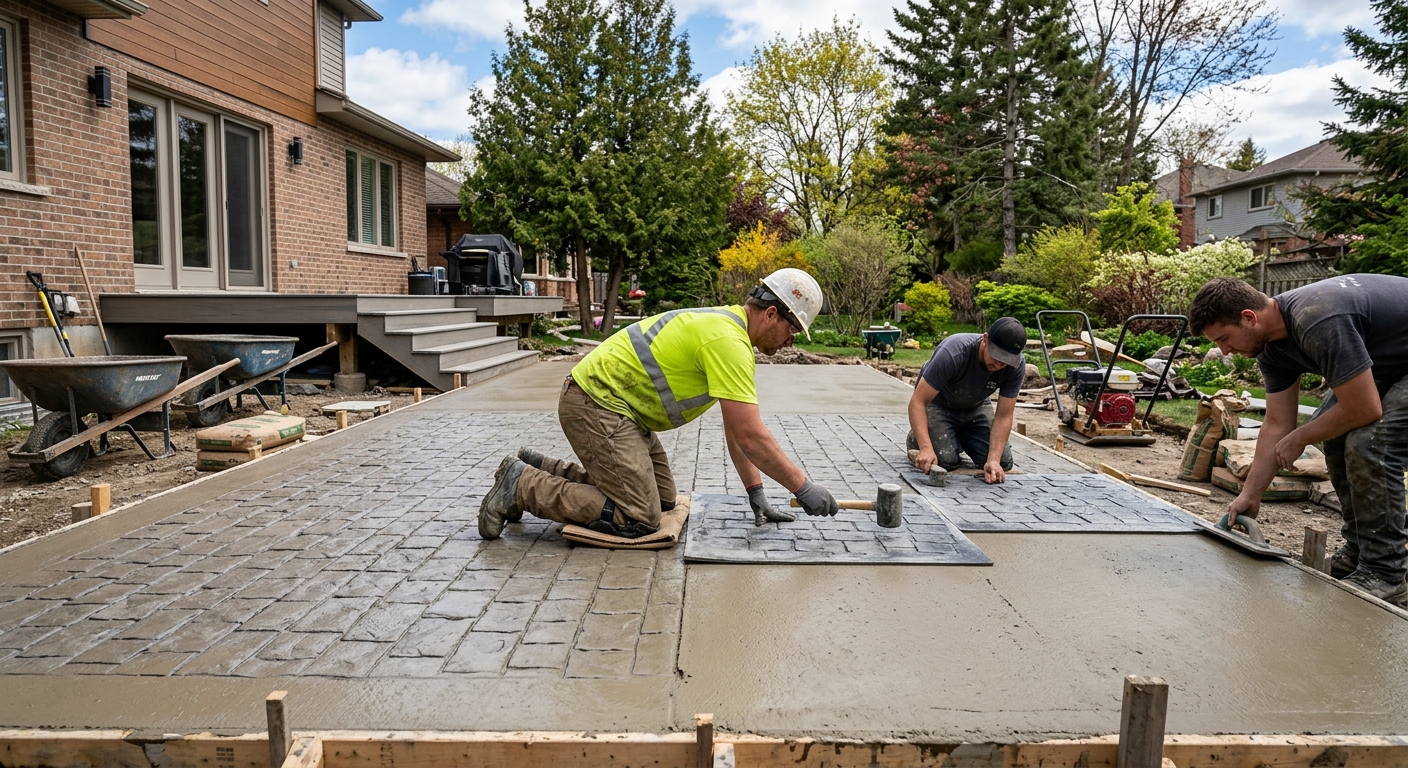
Concrete work options and costs in Georgetown
Georgetown, Ontario has a busy mix of older homes and newer subdivisions, and that means homeowners are constantly planning concrete updates—driveways, patios, walkways, and occasionally foundation work. With a population of 44,058 (Statistics Canada, 2021 Census), there’s enough local demand that you’ll typically see multiple crews competing for exterior flatwork schedules, especially around the warmer pour window. Most properties here are detached or semi-detached family homes, which drives consistent need for driveways and front-step paths that handle salt, damp weather, and freeze–thaw cycles.
In the Toronto economic region, concrete pricing is heavily influenced by frost depth and freeze–thaw. Municipal expectations commonly require structural footings to extend about 1.2 m (roughly 4 ft) below grade to reduce frost heave and differential movement. For slabs and driveways, contractors usually specify air-entrained mixes and enough thickness, plus control joints to manage cracking. The GTA’s humid, often-wet fall and spring also makes curing and surface protection more critical—especially when temperatures slide toward 10 °C or lower. That’s why two quotes for “the same driveway” can differ noticeably: one may include better base prep and an air-entrained mix, while another may shortcut on curing protection or joint planning.
Where demand is especially steady in Georgetown, you’ll see frequent requests around the established residential pockets near Queen Street and the surrounding neighbourhoods where people are expanding parking pads or rebuilding deteriorating walkways. If you’re comparing options before contacting contractors, the table below gives typical ranges for common concrete projects in the area.
| Application |
Typical Size |
Key Spec |
Finish Option |
Price Range |
| Concrete driveway (standard broom finish) |
400–500 sq. ft. (approx. 20 ft x 22–25 ft) |
Air-entrained exterior mix, compacted base, joints |
Broom finish |
$7,200 – $12,500 |
| Exposed aggregate driveway |
400–500 sq. ft. (approx. 20 ft x 22–25 ft) |
Air-entrained mix, proper curing, sealer recommended |
Exposed aggregate |
$9,000 – $15,500 |
| Stamped concrete driveway or patio |
350–450 sq. ft. (approx. 18 ft x 20–25 ft) |
Air-entrained mix, colour hardener/antiquing, release |
Stamped (pattern + colour) |
$10,500 – $18,000 |
| Plain concrete patio or walkway |
200–300 sq. ft. (approx. 10 ft x 20–30 ft) |
Compacted granular base, joints where needed |
Plain / smooth or light broom |
$3,200 – $7,800 |
| Garage floor (interior slab) |
400–480 sq. ft. (approx. 20 ft x 20–24 ft) |
Vapour barrier, reinforcement as required, proper cure |
Float finish (option for broom) |
$7,000 – $13,000 |
| Foundation footings (structural, below frost) |
Varies (often per linear foot for estimator purposes) |
Engineered/inspected placement below frost depth |
Structural concrete |
$180 – $300 |
Prices are estimates only and vary by project scope, site access and material selection.
What affects the price of concrete work in Georgetown
In Georgetown and the broader Toronto region, it’s common to see quotes for the same concrete scope swing by 30–50%. The reason is that “concrete” isn’t just pouring—cost is driven by what’s underneath and around it: excavation, granular base, reinforcement, mix design (including air-entrainment), curing protection, and finishing complexity. In the GTA, labour and scheduling also matter because exterior work is concentrated into the warmer months when concrete will cure reliably. When crews are booked, you may pay more for earlier scheduling or more crew time for tight access sites.
Frost depth and freeze–thaw cycles dictate nearly every structural and exterior spec. Footings must extend below design frost depth to prevent frost heave and movement—often about 1.2 m (roughly 4 ft) for typical Ontario footing requirements—so formwork height and excavation volume can change the cost fast. Exterior slabs and driveways are typically air-entrained to survive repeated freeze–thaw, and contractors plan control joints and proper drainage so saturated soils don’t expand and contract against the slab.
Concrete work can also rise in cost when colder weather protection is needed. If you’re late in the season, contractors may use curing blankets and heating, and they need longer protection to reach proper strength gain. De-icing salt accelerates surface spalling on poorly specified mixes, which is why sealing and surface protection are frequently included—sometimes as an add-on.
Two Georgetown examples: (1) a driveway replacement on a sloped lot often costs more because grading and base build-up are larger; (2) a basic broom-finish patio usually lands closer to the plain patio band, while stamped work can justify its premium—using Toronto-region pricing where stamped & decorative concrete commonly ranges around $24–$40 per square foot—because labour time and materials (colour, release, finishing) are higher.
| Price Factor |
Why It Matters |
Cost Impact |
| Frost line depth — determines footing depth and form height |
Deeper excavation increases labour, materials, and inspection |
Higher excavation/formwork can add 10–30% |
| Site preparation — excavation, grading, compacted granular base |
Good base reduces settlement and prevents water pumping |
Can swing costs by 15–25% depending on soil and access |
| Reinforcement — rebar or wire mesh requirement |
Helps control cracking and improves load capacity |
Typically adds 5–15% for extra materials and placement labour |
| Mix design — air-entrainment and compressive strength spec |
Exterior durability depends on air content for freeze–thaw |
May add a few dollars per yard, but prevents costly failures |
| Finish type — broom vs. stamped vs. exposed aggregate |
Finishing complexity changes labour hours and materials |
Stamped/exposed often increases total by 20–60% over broom |
| Pour size and concrete truck access to site |
Smaller pours or difficult access require more handling/time |
Hauling, waiting time, and labour can add 10–25% |
| Cold-weather curing precautions — heating and blankets |
Early cold can slow strength gain and risk surface defects |
Can add 5–20% if protection is needed |
| Control joint pattern and sealing cost |
Joints manage shrinkage cracking; sealing helps resist salt damage |
Often modest individually, but added scope can shift pricing 5–15% |
Permits & regulations in Ontario
In Ontario, structural concrete work generally needs a building permit. That typically includes footings, foundation walls, grade beams, and any engineered structural concrete elements. In many cases, the municipality will also expect engineered drawings or that the work follows an engineer’s foundation plan, particularly when soil conditions, bearing capacity, or groundwater considerations are involved. For exterior flatwork—patios, walkways, driveways—permits are often not required, unless the work affects lot grading, stormwater flow, impervious surface coverage rules, or the work touches municipal right-of-way/sidewalk areas. Even when a permit isn’t expected, always confirm with the local authority before breaking ground so you don’t run into compliance issues mid-project.
Step-by-step, Georgetown homeowners can verify a contractor the right way:
- Confirm they carry liability insurance (ask for a current Certificate of Insurance) naming the right parties as required by your contract.
- Ask for WSIB coverage confirmation (or WCB clearance where applicable) and verify it matches the company you’re hiring.
- Use the Ontario contractor/licensing registry or the contractor’s stated business information to confirm their standing for the work they’re proposing.
- Check references for similar-scale projects—driveways and stamped patios in freezing climates—and request photos from at least one job with the same finish type.
- Make sure the quote clearly separates structural scope (permitted work) from flatwork scope so expectations are clear.
Getting concrete right in Georgetown's freeze-thaw climate
Concrete failure in Georgetown is usually a freeze–thaw story, not a “bad batch” story. The most common issues you’ll see are spalling (surface flaking), scaling, and premature cracking caused by water getting in and expanding as it freezes. To spec correctly for Georgetown’s climate, focus on five areas: (1) base preparation with a compacted granular sub-base to the right depth for local soils and frost protection; (2) mix design with air-entrainment and adequate strength so the paste can tolerate expansion; (3) control joints placed to limit random cracking; (4) curing long enough to achieve strength—especially when temperatures drop during shoulder season; and (5) sealing after the concrete cures to repel de-icing salts and reduce water penetration.
For exterior flatwork, a practical spec is air-entrained concrete with about 5–7% air content and a minimum 32 MPa compressive strength, plus proper jointing and drainage. When crews in the Toronto market skip steps—like under-compacting the base or not protecting the slab during cold nights—cracks form where they shouldn’t and the surface can scale once salts and moisture start cycling through winter. That’s why contractors often recommend sealing applied after full cure, typically at the 28-day mark.
Here’s a dollar example to help you judge value: if a broom-finish driveway quote lands near the $18–$28 per square foot band, adding proper base thickness, air-entrained mix confirmation, and correct joint spacing may cost more modestly—but opting for a cheaper “no-air” approach can lead to repairs that quickly exceed the original difference. Stamped options (often around $24–$40 per square foot) are typically worth it only when the contractor also nails the underlying durability specs.
| Spec |
Why It Matters in Georgetown |
What to Ask For |
Impact if Skipped |
| Compacted granular base (depth?) |
Stable support reduces settlement and keeps water from pumping |
Ask for base thickness and compaction method (plate compactor/roller) and confirmation of drainage |
More cracking and uneven slab movement during freeze–thaw |
| Air-entrained concrete mix (target air %?) |
Air voids give freeze–thaw protection against scaling and spalling |
Request air content around 5–7% for exterior flatwork |
Higher risk of surface scaling from winter salt and moisture |
| Compressive strength (MPa rating) |
Strength gain supports long-term durability and load performance |
Confirm minimum 32 MPa for exterior applications |
Premature wear, faster deterioration, and weaker edges |
| Control joints (spacing per ACI guidelines) |
Joints manage shrinkage cracking and restrict random failure lines |
Ask for joint spacing and sawcut/timing plan |
Random cracks reduce appearance and may allow water intrusion |
| Minimum 7-day curing period |
Curing is critical in Georgetown’s cool fall/spring temperature swings |
Ask how they maintain temperature/moisture during curing |
Lower surface strength and increased vulnerability to early damage |
| Penetrating sealer (when applied after cure) |
Sealer helps repel de-icing salts and reduces water absorption |
Ask for application timing—commonly after full cure (often 28 days) |
Faster scaling and deeper staining/spalling over multiple winters |
How to choose a concrete work contractor in Georgetown
Start with verification. For Ontario jobs in Georgetown, ask the contractor for (1) liability insurance—request a current Certificate of Insurance and confirm it covers the work they’ll do on your property; and (2) WSIB clearance for the company and workers who will be on-site. If they subcontract, you still want proof those parties are covered. Next, check Ontario licensing or registration status where applicable for the type of work they’re quoting—don’t rely on verbal assurances.
Then get 2–3 itemised written quotes. The best quotes break down labour and materials (excavation/grading, granular base, reinforcement, concrete supply, forming, finishing, and sealing), rather than using only a single lump-sum number. Read the exclusions carefully: is removal/disposal of old concrete included? Are forms and excavation depth assumed? Is the driveway or patio properly drained and protected during curing? Make sure any permit pull (for structural concrete like footings/foundation walls) is included where it’s required, or clearly listed if it’s your responsibility.
Warranty matters too: ask for the workmanship warranty length and what it covers (cracking vs. spalling vs. surface defects), and whether manufacturer product warranties apply for the concrete mix, sealer, or admixtures. Clarify whether the warranty is transferable if you sell the home.
Payment schedule should be controlled: never pay more than about 10–15% upfront. Use a holdback until completion and final cleanup, and confirm in writing the start date and estimated completion date.
- Request insurance and WSIB clearance documents before signing.
- Ask for photos of similar Georgetown freeze–thaw projects (driveways and patios).
- Insist on itemised pricing (no “mystery allowances”).
- Confirm base thickness, granular type, and compaction method.
- Ask whether the mix is air-entrained and what air content target is used.
- Verify reinforcement plan: rebar/wire mesh and placement height/distance from edges.
- Confirm control joint spacing and sawcut timing.
- Ask how they handle curing if nighttime temps drop—blankets/heating details.
- Clarify sealing: product type (penetrating), application timing, and coverage area.
- Confirm disposal/removal of existing concrete and any haul-away fees.
- Review schedule commitments and weather protections in the contract.
- Get the warranty in writing, including what’s excluded and how to file a claim.
Concrete contractor red flags in Georgetown: (1) they won’t discuss air-entrainment or joint spacing; (2) they quote a flat rate without a site-measurement visit; (3) they minimize base preparation or skip compaction details; (4) they ask for large upfront payments; and (5) they can’t provide proof of insurance/WSIB coverage or recent local references.
Frequently asked questions — concrete work in Georgetown
How do I seal concrete to protect it in Georgetown?
In Georgetown (Ontario), sealing helps protect exterior concrete from water absorption and the salt used during winter, which can drive spalling if moisture cycles through freeze–thaw. The usual approach is to allow the slab to fully cure—often around 28 days—then apply a penetrating sealer designed for concrete. Before sealing, ensure the surface is clean, dry, and free of dust, paint overspray, or curing compounds. For driveways and walkways, ask the contractor to confirm coverage rate and whether they’ll seal only the concrete surface (not landscaping/edges) with proper masking.
If your project is in the same general pricing zone as a plain patio ($16–$26 per square foot), sealing is often a cost-effective “durability add” compared with repairs. Make sure you get the sealer product name, application date, and a written recommendation for recoat timing (commonly every few years depending on traffic and salt exposure). (Statistics Canada, 2021 Census)
What is the difference between concrete and cement?
In plain terms, cement is one ingredient inside concrete. Concrete is the finished product made by combining Portland cement (the binder), water, sand, and stone (aggregate), plus sometimes admixtures like air-entrainment for freeze–thaw durability. This matters in Georgetown because exterior concrete is exposed to wet fall/spring conditions and repeated winter freezing; contractors specify air-entrained mixes to reduce surface scaling and improve performance over multiple seasons.
When you ask for a quote, don’t just compare “cement content” or assume all concrete is the same. Instead, ask about the engineered mix properties: target air content for exterior flatwork (often about 5–7%), minimum compressive strength (commonly 32 MPa for many residential exterior applications), and curing/protection practices if temperatures drop toward 10 °C or lower. A driveway priced near the $18–$28 per square foot band can still vary widely if the mix design and curing plan differ.
How much does concrete work cost in Georgetown?
Concrete costs in Georgetown typically depend on size, access, and how much prep work the job needs, but there are useful price bands you can use to sanity-check quotes. For example, concrete driveway work commonly falls around $18–$28 per square foot, while patios and walkways are often in the $16–$26 per square foot range. If you’re considering decorative work, stamped & decorative concrete usually runs higher—commonly about $24–$40 per square foot—because it requires labour-intensive forming, stamping, and colouring.
Foundation footings are priced differently from flatwork because they’re structural and typically priced per linear foot in estimating: around $180–$300 is a common band for structural below-frost footing work. In this GTA context, freeze–thaw and frost depth expectations influence excavation and formwork depth, which can change costs even when concrete quantities look similar. If your project scope includes removal of old slabs, drainage upgrades, or cold-weather curing protection, those line items will also move the final number.
How deep must footings be for Georgetown's frost line?
For Georgetown and much of Ontario, structural footings are commonly specified to extend to at least about 1.2 m (roughly 4 ft) below grade to reduce frost heave and differential movement. That depth is tied to the design frost depth used in the local building practice and Ontario Building Code expectations for typical residential foundation conditions. The exact depth can still vary based on your site conditions, soil, and engineering/design requirements—especially if there are abnormal soils or drainage concerns.
When contractors price foundation footings, the depth drives excavation volume, form height, and inspection steps. That’s one reason foundation pricing can look very different from driveway pricing even when both involve “concrete.” If you’re comparing quotes, ask whether they’re meeting the required below-grade depth and whether the plan reflects any engineer’s foundation recommendations. Also ensure the contractor clarifies how they’ll protect excavations from water during construction so you don’t end up with soft bearing.
Why does concrete crack in Georgetown and how is it prevented?
Concrete cracking in Georgetown is usually caused by shrinkage, temperature movement, and—most importantly—water movement during freeze–thaw cycles. Exterior slabs experience wetting, drying, and winter freezing, and if water gets under or into the slab, repeated expansion can widen existing micro-cracks into visible lines. Poor base preparation, insufficient compaction, and weak drainage are frequent contributors.
Prevention starts with the specs: a properly compacted granular base to the right depth, air-entrained concrete for exterior freeze–thaw durability, control joints placed at appropriate spacing (and sawcut timing that matches the mix and weather), and correct curing so the slab gains strength before it’s stressed. Sealing after cure helps limit water and salt penetration. If you’re selecting between finishes, remember that stamped and exposed work still needs the same durability fundamentals—decorative texture doesn’t prevent freeze–thaw damage on its own.
Stamped vs broom-finish concrete — cost difference?
Stamped and decorative concrete typically costs more than broom-finish because it’s labour- and material-intensive. Broom-finish driveways and walkways focus on utility and durability: a broom texture for traction, air-entrained exterior mix, proper base prep, and control joints. Stamped concrete adds forms/templates, stamp texture work, and usually colour hardener and antiquing/release materials, plus extra labour time to achieve a consistent pattern and curing schedule.
In Georgetown, it’s common to see driveway pricing around $18–$28 per square foot for standard broom finish, while stamped & decorative concrete often lands around $24–$40 per square foot. That difference can be justified when the contractor also installs the right base thickness, correct jointing plan, and protects curing—especially because Toronto-area freeze–thaw can expose weak specs quickly. Ask for an itemised quote so you can see what portion of the premium is finishing labour and materials versus any additional durability scope.