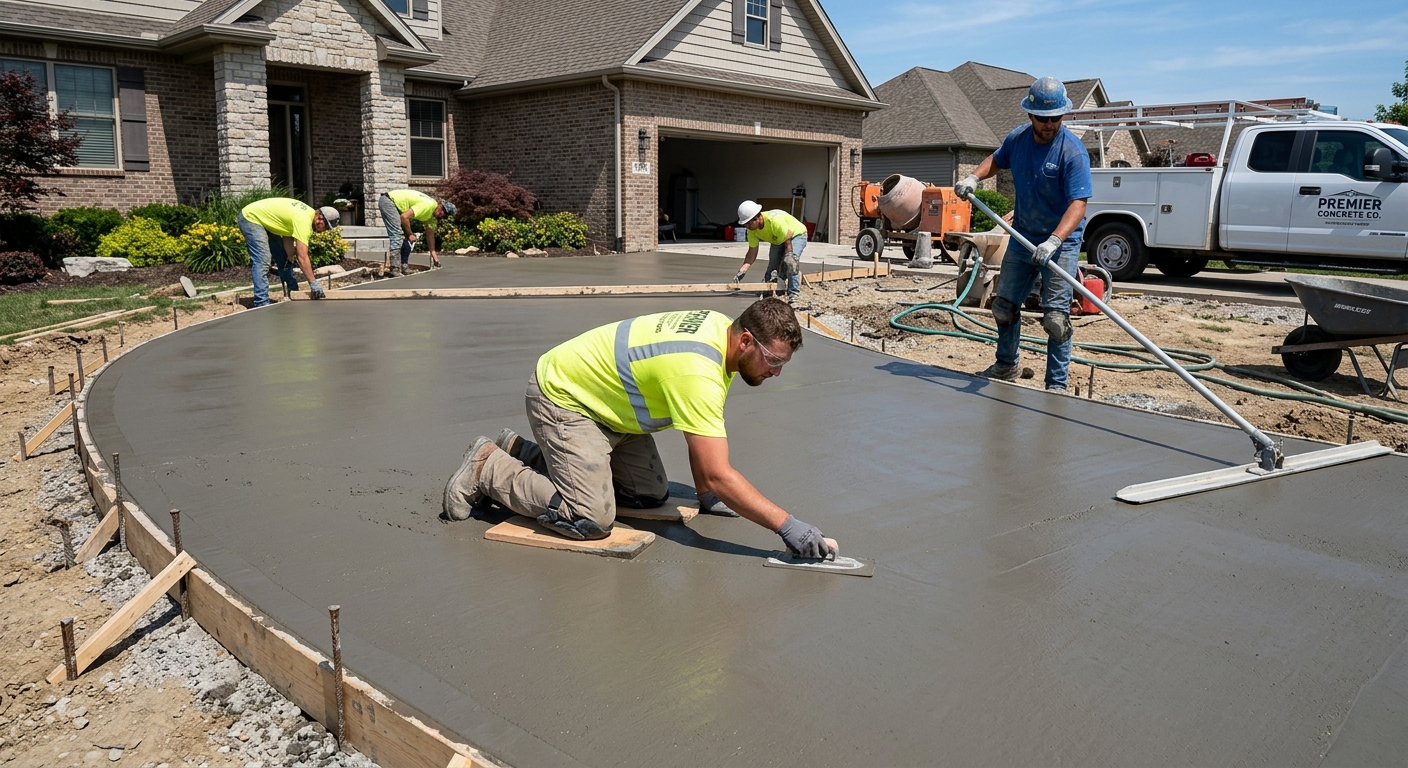
Concrete work options and costs in Taylor-Massey
Taylor-Massey, Ontario is a busy, family-focused neighbourhood where concrete flatwork is a major part of the home-renovation landscape—especially driveways, patios and walkways that see year-round wear. In the Toronto economic region, Taylor-Massey’s population was 15,683 in the 2021 Census (Statistics Canada, 2021 Census). That steady mix of older and newer housing stock drives constant demand for concrete repairs and upgrades. The biggest concrete customers are homeowners with typical residential lots—many of whom are improving curb appeal before selling, or replacing sunken slabs after a few freeze–thaw seasons.
In the GTA, pricing is strongly shaped by frost depth and freeze–thaw cycles. Ontario requirements generally push structural footings to extend at least 1.2 m below grade to reduce frost heave and differential movement, and exterior slabs need properly prepared granular base and air-entrained concrete. Contractors also concentrate most exterior pours in the warmer months, when curing conditions are reliable and the surface can reach strength without expensive cold-weather protection. When temperatures trend toward 10 °C or below, crews may need insulating blankets, internal heating, or scheduling changes, which can add cost and affect availability.
Concrete trade demand is often especially high around the commercial and residential corridors near Danforth Avenue and Coxwell area, where homeowners frequently replace aging walkways and upgrade driveway surfaces. With that local reality in mind, here’s a clear comparison of common options and realistic Toronto pricing ranges to help you budget before you request quotes.
| Application |
Typical Size |
Key Spec |
Finish Option |
Price Range |
| Concrete driveway (standard broom finish) |
16 ft x 10 ft (160 sq. ft.) |
Air-entrained mix, compacted granular base, control joints |
Broomed surface |
$3,000–$4,500 |
| Exposed aggregate driveway |
16 ft x 10 ft (160 sq. ft.) |
Air-entrained mix, proper curing, exposed stone reveal |
Exposed aggregate (washed texture) |
$3,700–$5,600 |
| Stamped concrete driveway or patio |
12 ft x 16 ft (192 sq. ft.) |
Reinforcement as needed, air-entrained mix for exterior |
Stamp pattern + release + sealer |
$4,700–$7,600 |
| Plain concrete patio or walkway |
10 ft x 12 ft (120 sq. ft.) |
Compacted base, adequate thickness, joints |
Float/trowel then light broom |
$2,000–$3,400 |
| Garage floor (interior slab) |
20 ft x 20 ft (400 sq. ft.) |
Vapour barrier (as applicable), fibre or mesh, joints as required |
Standard trowel-finish |
$7,200–$12,000 |
| Foundation footings (structural, below frost) |
Varies by house size |
Below-grade structural concrete, engineered sizing, rebar per design |
Formed concrete with inspection |
$180–$300 |
Prices are estimates only and vary by project scope, site access and material selection.
What affects the price of concrete work in Taylor-Massey
In Taylor-Massey and across the Toronto economic region, it’s common to see quote differences of 30–50% for what looks like the “same” concrete job. The gap usually comes from how contractors handle freeze–thaw risk: deeper/appropriate footing specs, base excavation and compaction, and the quality of the mix and finishing plan. Labour availability also shifts with the short, reliable pour season—when temperatures fall toward 10 °C, crews can’t just keep pouring without protection, and that affects both pricing and scheduling.
Ontario frost requirements matter in every exterior structural element. Footings must extend below the design frost depth to prevent frost heave and differential movement, and exterior slabs need air-entrained concrete mixes to survive repeated freeze–thaw cycles. The colder the period and the closer you are to early spring or late fall, the more contractors spend on cold-weather curing precautions (heating setups, insulating blankets, longer scheduling buffers). De-icing salts in winter add another pressure point: if the surface isn’t protected with sealing after cure, spalling and surface scaling can show up sooner, which often triggers costly rework.
Local examples in Taylor-Massey: a driveway replacement on a compacted base that’s already failing may require extra excavation and re-grading before new concrete goes down—raising the job near the top end of the $18–$28/sq. ft. band. By contrast, a straight patio pour over an already-draining, well-prepped area may come in closer to $16–$26/sq. ft. for patios and walkways, particularly if truck access is easy. For structural foundation work, per-footing pricing often lands in the $180–$300 band depending on rebar density, excavation depth, and form complexity—meaning a minor change in footing dimensions can translate into meaningful dollar shifts.
| Price Factor |
Why It Matters |
Cost Impact |
| Frost line depth — determines footing depth and form height |
Footings must sit below frost to prevent heave |
Deeper excavation and taller forms can add significant labour and disposal cost |
| Site preparation — excavation, grading, compacted granular base |
Bad base leads to settlement and cracking |
Removing soft soils or replacing granular fill pushes quotes toward the upper range |
| Reinforcement — rebar or wire mesh requirement |
Controls cracking from loads and temperature movement |
More steel and proper placement adds material and labour |
| Mix design — air-entrainment and compressive strength spec |
Air-entrainment helps survive freeze–thaw |
Specified mix can cost more but reduces premature spalling and rework |
| Finish type — broom vs. stamped vs. exposed aggregate |
Surface system affects labour time and materials |
Stamped/exposed finishes commonly add cost versus broom-finish |
| Pour size and concrete truck access to site |
Access affects pumping, staging, and labour efficiency |
Tight yards, long carry distances, or need for pumping can increase labour |
| Cold-weather curing precautions — heating and blankets |
Curing depends on temperature and protected conditions |
Heating/blankets and schedule changes can raise the price notably in shoulder season |
| Control joint pattern and sealing cost |
Joints manage shrinkage cracking; sealing protects against salts |
Proper joints and sealing add line items that improve long-term performance |
Permits & regulations in Ontario
In Ontario, structural concrete work typically requires a building permit because it’s part of the load-bearing system. That includes concrete footings, foundation walls, grade beams, and other structural foundation elements. Municipal review may also require engineered drawings before inspections can proceed. Concrete flatwork such as patios, walkways and most driveways usually does not require a permit on its own, unless the work changes lot grading, impacts stormwater drainage, triggers impervious surface coverage limits, or affects the municipal right-of-way. Because Taylor-Massey projects often tie into municipal drainage patterns and existing service connections, it’s smart to confirm with the local authority before breaking ground.
For contractor compliance, ask for three things every time: (1) the contractor’s Ontario licence/registration details (as applicable for their business type), (2) liability insurance, and (3) WSIB/WCB coverage for workers. Here’s how to verify step-by-step: first, request a recent certificate of insurance that lists your address as an additional insured (when offered). Next, ask for their WSIB/WCB clearance information (or the equivalent proof they use in Ontario). Finally, confirm the contractor’s business and trade credentials using their official listing and any public registry information they provide. Also ask for references on similar-scale GTA projects so you can match their past exterior results to your freeze–thaw expectations.
Getting concrete right in Taylor-Massey's freeze-thaw climate
The biggest concrete failures in Taylor-Massey come from a predictable set of problems: inadequate base preparation, the wrong mix for freeze–thaw, weak or rushed curing, and poor joint planning. In this Toronto climate, snowmelt and rain in spring saturate soils, then winter freezes expand and contract the ground. If the slab is underlain by a poorly compacted granular base or if water can collect at the edge, the slab can heave slightly and crack. If the concrete lacks proper air-entrainment, the paste can deteriorate faster and you’ll see spalling over time, especially around edges and near de-icing salt paths.
To spec the job correctly, start with base preparation: excavate to the required depth for your soil and frost considerations and compact the granular sub-base so it’s stable under load. Then lock in mix design: air-entrained concrete with a typical exterior target of 5–7% air content and a minimum 32 MPa compressive strength for durable exterior performance. Control joints should be cut or tooled on a planned pattern to limit random cracking—usually with spacing that follows accepted industry practice for flatwork. Curing matters: plan for at least 7 days of proper curing conditions before expecting full outdoor exposure. Finally, seal: apply a penetrating sealer about 28 days after the pour to repel de-icing salts and reduce moisture intrusion.
As a dollar example, switching from a plain broom finish to stamped concrete can be justified if you value the surface appearance and you’re prepared for higher labour and finishing time—commonly pushing pricing from the $16–$26/sq. ft. patio/walkway band toward the $24–$40/sq. ft. stamped range. But don’t “save” by skimping on air-entrainment or base—those cuts often cost more later due to early repairs.
| Spec |
Why It Matters in Taylor-Massey |
What to Ask For |
Impact if Skipped |
| Compacted granular base (depth?) |
Stable support reduces settlement and edge movement during freeze–thaw |
Granular base depth based on soil/site conditions; compaction testing if available |
Settlement, rocking slabs and early cracking |
| Air-entrained concrete mix (target air %?) |
Resists freeze–thaw damage from water in the concrete |
5–7% air content for exterior flatwork |
Premature spalling and surface scaling |
| Compressive strength (MPa rating) |
Strength and durability depend on proper mix and curing |
Minimum 32 MPa compressive strength at required design testing |
Weak surface, durability loss and faster wear |
| Control joints (spacing per ACI guidelines) |
Controls where shrinkage cracks occur |
Planned joint layout with spacing consistent with accepted ACI practice |
Random cracking and more frequent repairs |
| Minimum 7-day curing period |
Cold/wet conditions slow strength gain and weaken early-age concrete |
7+ days of protected curing plan, especially if temps dip |
Reduced strength and higher risk of early damage |
| Penetrating sealer (when applied after cure) |
Repels salt and moisture that drive freeze–thaw deterioration |
Penetrating sealer applied after cure (about 28 days post-pour) |
Faster moisture ingress and spalling risk |
How to choose a concrete work contractor in Taylor-Massey
Choosing the right contractor in Taylor-Massey is mostly about proof: proof they design for Ontario freeze–thaw conditions, proof they’re insured to operate safely, and proof they can deliver the finish quality you’re paying for. Start by verifying Ontario licensing/registration for their business type (where applicable), then request liability insurance documentation and proof of WSIB/WCB coverage for their workers. If you can’t get clear paperwork before work starts, that’s a red flag—concrete jobs can involve rebar handling, saw cutting, and equipment that makes coverage essential.
For pricing, avoid a single lump-sum with vague scope. Ask for 2–3 itemised written quotes that separate labour and materials, and that list inclusions such as excavation, granular base, reinforcement, concrete supply, finishing, joints, sealing, and disposal. Confirm whether a permit pull is included for structural work (footings/foundation elements) and whether any grading or right-of-way constraints are handled. Review warranty details carefully: look for a workmanship warranty length, what it covers (e.g., minor surface cracking vs. structural issues), whether a product/manufacturer warranty applies, and if it can be transferred to future owners.
On payment, protect yourself: never pay more than 10–15% upfront, and use a holdback until the job is complete and inspected. Finally, insist on a written timeline with start date and completion estimate—concrete crews in the GTA often schedule around weather, curing windows and truck access, so written dates help you manage expectations.
- Provide insurance certificate and WSIB/WCB proof before signing
- Use a written contract with the exact scope and finish specified
- Ask for proof of similar driveway/patio work in Toronto weather conditions
- Confirm granular base depth and compaction method (not just “topsoil removed”)
- Require air-entrained mix for exterior flatwork
- Insist on a control joint plan (layout and spacing)
- Ask how curing will be protected if temperatures drop
- Clarify sealing: product type and approximate application timing after cure
- Confirm reinforcement placement (rebar vs. mesh and where it sits)
- Check site access: truck placement, pumping (if needed), and disposal inclusions
- Review payment schedule: 10–15% max upfront, holdback until completion
- Get start date, pour date target, and completion estimate in writing
Concrete contractor red flags in Taylor-Massey: refusing to provide insurance/WSIB proof, quoting without base prep details, promising “no joints needed,” skipping air-entrainment for exterior slabs, and offering low prices based on vague exclusions like “concrete only” or no disposal/grading allowance.
Frequently asked questions — concrete work in Taylor-Massey
How do I seal concrete to protect it in Taylor-Massey?
In Taylor-Massey, sealing is one of the best defences against moisture and de-icing salt that drive freeze–thaw deterioration. The usual approach is to wait for proper cure first—commonly about 28 days after the pour—then apply a penetrating sealer designed for exterior concrete. Penetrating products soak in and help reduce water absorption rather than forming a surface film that can wear unevenly. Before sealing, clean the surface thoroughly and let it fully dry (humidity can be high in the GTA, especially in shoulder seasons). If your plan is a patio or walkway, sealing complements the right mix and joint plan; it won’t fix missing air-entrainment. For budgeting context, a plain patio/walkway might land around $2,000–$3,400 for typical sizes, and sealing is often a separate line item—worth it when winter salt is common on your street.
What is the difference between concrete and cement?
In everyday language, people say “cement” to mean the whole concrete material, but they’re not the same. Cement is one ingredient—typically Portland cement—inside the concrete mix. Concrete is the full system: cement plus aggregates (sand and stone), water, and often admixtures such as air-entrainment for freeze–thaw durability in Ontario. That air-entrainment is especially important for Taylor-Massey’s winter conditions where repeated freezing and thawing can cause spalling if the mix isn’t right. When you get a quote, the key is what mix they’re specifying (air-entrained exterior mix, compressive strength target, and curing plan), not just whether they’re using “cement.” A driveway or patio priced in the $16–$28 per square foot band usually reflects the full concrete mix and finishing process—not just the cement component.
How much does concrete work cost in Taylor-Massey?
Concrete pricing in Taylor-Massey depends on scope, site access, thickness, base preparation, reinforcement, and finish type. For basic budgeting: driveways and slabs often fall within the $18–$28 per square foot band, while patios and walkways commonly land around $16–$26 per square foot for plain work. Stamped and decorative systems cost more—frequently aligned with the $24–$40 per square foot range because of additional labour for stamping and finishing. For a practical example, a standard broom-finish driveway might be in the $3,000–$4,500 range for a typical mid-sized replacement, while a stamped driveway or patio can climb into the $4,700–$7,600 range depending on square footage and complexity. Foundation footings are priced differently—structural work often lands in the $180–$300 band per relevant unit and is driven by engineered design, excavation depth, rebar, and inspection requirements.
How deep must footings be for Taylor-Massey’s frost line?
Ontario typically requires structural footings to extend below the design frost depth to reduce frost heave and differential movement. In the Toronto region context, most structural footings are commonly set to at least about 1.2 m below grade (around 4 ft) in line with local expectations and the way projects are designed for frost protection. Exact depth can still vary based on engineered drawings, soil conditions, and the specific foundation system. That’s why your contractor should reference the plan for your particular lot rather than guessing. If the footing depth is too shallow, freeze–thaw cycles can move the supporting soil and translate that movement into cracks or settlement issues. When budgeting, footing work falls into the $180–$300 band for structural elements, but your final cost changes with excavation conditions, rebar placement complexity, and access for concrete trucks and forming.
Why does concrete crack in Taylor-Massey and how is it prevented?
Concrete cracks in Taylor-Massey for several reasons, and most are manageable when the job is designed correctly. The big drivers are shrinkage as concrete cures, temperature movement, and freeze–thaw cycles that expand and contract water-saturated soils under and at slab edges. If the base isn’t well-compacted or if water can pool, the slab can settle or heave slightly each winter. Also, exterior flatwork must use air-entrained concrete so freeze–thaw doesn’t destroy the surface paste. Prevention is about the whole system: proper granular base prep, air-entrained mix for exterior durability, correct thickness, planned control joint spacing to control where cracks occur, and adequate curing (including cold-weather protection if needed). Sealing after cure helps limit moisture and salt intrusion. If you’re quoted “no joints” or a basic mix without air-entrainment, push back—cracking risk rises quickly in Ontario’s winter conditions.
Stamped vs broom-finish concrete — cost difference?
Stamped concrete costs more than broom-finish because it adds labour and materials. A broom-finish driveway or patio is usually a simpler surface process: smooth, float, and broom texture with control joints and sealing as needed. Stamped concrete requires form-and-colour workflows—release agents, stamps, careful timing, and more detailed finishing—plus typically more crew time to maintain consistent patterning. In the Toronto area, that difference commonly lands you from the plain bands toward the decorative bands: plain patios/walkways are often around $16–$26 per square foot, while stamped work more often aligns with the $24–$40 per square foot range. For homeowners, that can be a good trade-off if you want a higher-end look, but it should never come at the expense of exterior durability specs (air-entrainment, correct base, joint planning, and curing). If the contractor can’t clearly explain those specs, the lower price of broom-finish isn’t your only savings—durability is the real priority in Ontario’s freeze–thaw climate.