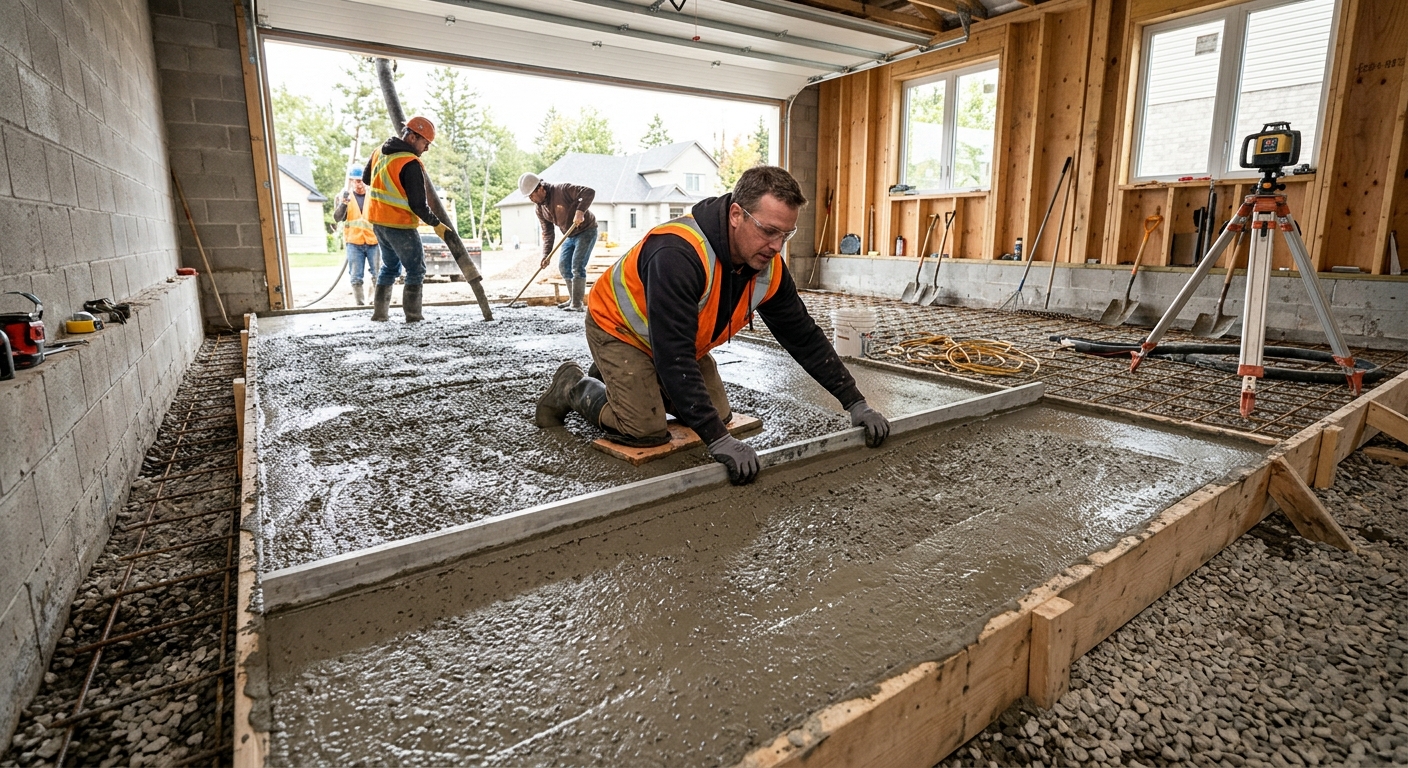
Concrete work options and costs in Powassan
Powassan is a small community in Ontario (population 3,346 in 2021), where most homes are single-detached (90.9% of dwellings) and many were built before 1981 (60.2%). That matters because older neighbourhoods often need driveway widening, porch/step repairs, and re-pouring sections where freeze–thaw cycles have already pushed water into weak spots. With about 1,130 homeowner households (85.0% of households own), there’s steady demand for concrete flatwork—especially driveways, patios, and walkways—plus occasional foundation upgrades.
Even though Powassan is in Ontario, homeowners feel the same performance problems that contractors plan for across cold regions: frost heave, surface scaling, and cracking from repeated freezing and thawing. In practice, that means more attention to granular base prep, air-entrained mixes for exterior concrete, and tighter control joint layouts. It also affects scheduling—concrete can only be poured when ground conditions are workable, and cold snaps require protected curing (blankets/insulation and sometimes heating), which adds labour and materials.
In Powassan, concrete work is especially in demand around the busier residential pockets where driveways and sidewalks see heavy seasonal wear—older streets near local amenities and school routes tend to have the highest “trip-and-spall” callouts. If you’re comparing options, use the ranges below as a backbone for planning: broom-finished driveways are typically the most cost-predictable, while decorative finishes cost more because prep, forming, and surface treatments are more labour-intensive.
Here’s a practical comparison of common applications and what you can expect to pay in Powassan.
| Application |
Typical Size |
Key Spec |
Finish Option |
Price Range |
| Concrete driveway (standard broom finish) |
400–550 sq. ft. |
Air-entrained exterior mix, compacted base, control joints |
Broom finish, saw-cut joints |
$18,000–$28,000 |
| Exposed aggregate driveway |
400–550 sq. ft. |
Air-entrained mix, proper retarder and curing control |
Aggregate reveal, often sealed after cure |
$22,000–$34,000 |
| Stamped concrete driveway or patio |
250–450 sq. ft. |
Air-entrained exterior mix, colour hardener/integral colour |
Stamp pattern + release + sealer |
$15,000–$36,000 |
| Plain concrete patio or walkway |
150–300 sq. ft. |
Compact base, air-entrained mix, joints as needed |
Smooth or broom finish |
$6,000–$18,000 |
| Garage floor (interior slab) |
400–600 sq. ft. |
Vapour barrier (as site requires), proper base, mix for interior exposure |
Trowel/float finish (non-decorative) |
$10,000–$22,000 |
| Foundation footings (structural, below frost) |
Per linear foot (typ. 60–120 ft.) |
Below frost depth, engineered rebar per drawings, concrete spec to structure |
Structural concrete (no decorative finish) |
$55–$90 |
Prices are estimates only and vary by project scope, site access and material selection.
What affects the price of concrete work in Powassan
Homeowners in Powassan often see quote swings of 30–50% for what looks like the same “slab replacement” or “new driveway.” The biggest reason isn’t the concrete itself—it’s what has to happen before the pour, and what specs are required to make the concrete survive Ontario’s freeze–thaw season. In colder climates, crews must plan for frost-related design and cold-weather curing, and that drives deeper foundation work and higher labour/equipment costs.
In Ontario, the frost line depth governs every structural detail: footings must extend below the design frost depth to prevent frost heave and slab cracking. Exterior slabs also need air-entrained concrete so the freeze–thaw cycle doesn’t break down the surface. Powassan is also subject to a shorter usable outdoor pour window when soils are workable, so contractors may spend more time setting up, protecting pours, and scheduling ready-mix deliveries. If early freezing is possible, protected curing (insulation blankets, temperature control, sometimes admixtures) is essential and adds cost—especially for larger driveway pours.
De-icing salts accelerate scaling/spalling when concrete isn’t properly designed and sealed, so sealing becomes more than “nice to have.” For example, a basic broom-finished driveway can align closer to the driveway/slab backbone range of $18–$28 per sq. ft., while stamped or exposed aggregate usually moves up because of colour/texture materials and extra labour. Similarly, foundation/footings commonly land in the $55–$90 band per linear foot depending on excavation difficulty and reinforcement density. In Powassan, many homes were built before 1981, and older grading or drainage problems often mean extra excavation and backfill—sometimes turning a “simple patch” into a full base rebuild.
| Price Factor |
Why It Matters |
Cost Impact |
| Frost line depth — determines footing depth and form height |
Deeper excavation and taller formwork increase materials, labour and disposal |
Can add tens of thousands on structural jobs if access is tight; drives foundation/footings pricing |
| Site preparation — excavation, grading, compacted granular base |
Concrete fails from the bottom up if the base isn’t properly compacted and drained |
Major swing factor; poor drainage often forces additional base depth and regrading |
| Reinforcement — rebar or wire mesh requirement |
Cracking control and structural capacity depend on reinforcement per spec |
Increases material and labour; required rebar can be a step-change in cost |
| Mix design — air-entrainment and compressive strength spec |
Freeze–thaw durability relies on air content; strength supports long-term performance |
Small material delta, but required spec can increase concrete unit costs |
| Finish type — broom vs. stamped vs. exposed aggregate |
Decorative finishes require added prep, tools, and timing control |
Stamped/exposed often move projects from the lower driveway band toward higher totals |
| Pour size and concrete truck access to site |
More concrete means more deliveries and bigger crew; access limits can add pumping/short pours |
Limited access can add equipment and labour even if the slab area is unchanged |
| Cold-weather curing precautions — heating and blankets |
Early freezing can weaken concrete; curing protection prevents surface defects |
Adds materials and labour; most noticeable in shoulder-season work |
| Control joint pattern and sealing cost |
Joints manage cracking; sealing helps protect against salt scaling |
Often modest compared to structure, but skipped steps can create expensive repairs |
Permits & regulations in Ontario
In Powassan and across Ontario, structural concrete work typically requires a building permit because it affects the building’s structural system. That includes foundation footings, foundation walls, grade beams, and other below-grade or load-bearing elements that transfer loads to the ground. In many cases, engineered drawings or design documents are reviewed as part of the permit process.
Concrete flatwork—like patios, walkways, and most driveways—often does not require a permit when it’s strictly non-structural and doesn’t change lot grading or drainage. However, permits or approvals may be required if your project affects lot grading, changes impervious surface coverage limits, impacts municipal right-of-way areas, or alters stormwater patterns. Before anyone breaks ground, confirm with the local authority so you don’t get stopped mid-project.
Contractor checks are just as important. Ask the contractor to provide proof of liability insurance and current WSIB/WCB coverage (coverage requirements can vary depending on whether the contractor is incorporated and their work type). To verify credentials step-by-step: (1) check their business licence/registration status through Ontario’s public business resources, (2) request a certificate of insurance and confirm it’s current and lists your property/address as applicable where required, and (3) ask for a WSIB/WCB clearance letter or equivalent coverage documentation, then cross-check that the status is active. Finally, request references on similar-scale concrete flatwork or footing projects so you can judge workmanship, jointing, and curing practices.
Getting concrete right in Powassan's freeze-thaw climate
Concrete fails in Powassan when water and frost get a chance to move. The most common problems homeowners see—spalling edges, scaling surfaces, and random cracking—usually trace back to inadequate base preparation, a mix that isn’t properly air-entrained for exterior exposure, or curing that wasn’t protected during cool conditions. Because Powassan sits in a cold, freeze–thaw-prone climate, the job spec must assume repeated cycles and de-icing salt exposure on driveways and steps.
To spec the work correctly, start with (1) base preparation: excavate to the required depth for your soil and frost conditions, then place and compact granular base in lifts. Good drainage behind and under the slab prevents trapped water. Next (2) mix design: exterior flatwork should use air-entrained concrete (commonly 5–7% air) and a minimum 32 MPa compressive strength spec for durability. (3) control joints: plan saw-cut joints to limit random cracking—especially on wider driveways and long runs. (4) curing: allow proper curing; in Ontario, you should plan for at least 7 days under suitable conditions, using curing blankets/insulation if pouring when temperatures drop. (5) sealing: apply a penetrating sealer after the concrete has cured (often at about 28 days) to help resist salt and surface degradation.
If you’re choosing between broom and stamped, the cost difference is justified when your goal is appearance and you’re funding the added labour and controlled timing for colour/stamp work. But if your base and drainage are wrong, spending more on decoration won’t prevent failure. For example, moving from a standard broom driveway within the $18–$28 driveway/slab band to a stamped finish can add significant dollars, yet those dollars are wasted if joints, air content, and curing protection aren’t right.
Ask contractors to explain their base depth, air content target, joint layout, and curing plan—not just “what kind of finish.” That’s where durability is won or lost in Powassan.
| Spec |
Why It Matters in Powassan |
What to Ask For |
Impact if Skipped |
| Compacted granular base (depth?) |
Proper base prevents settlement and reduces water pumping under freeze–thaw |
Exact base thickness, lift/compaction method, and drainage plan |
Settlement, joint failure, pumping/cracking and faster deterioration |
| Air-entrained concrete mix (target air %?) |
Air voids help concrete resist freeze–thaw scaling |
Documented target air content (commonly 5–7% for exterior flatwork) |
Spalling and surface scaling within a few seasons under salt and cycles |
| Compressive strength (MPa rating) |
Adequate strength supports long-term load capacity and durability |
Minimum 32 MPa (or higher if required by design) |
Reduced performance, increased risk of cracking and wear |
| Control joints (spacing per ACI guidelines) |
Joints manage shrinkage and limit random cracking |
Proposed joint spacing and timing of saw cutting |
Random cracks, uneven movements, and moisture intrusion |
| Minimum 7-day curing period |
Cold/early freezing can weaken concrete and worsen surface durability |
Curing timeline, curing conditions, and cold-weather protection plan |
Surface defects, reduced strength gain, and early spalling |
| Penetrating sealer (when applied after cure) |
Helps repel de-icing salts and reduces water absorption |
Type of sealer and application timing after cure (often ~28 days) |
Faster scaling, staining, and increased maintenance costs |
How to choose a concrete work contractor in Powassan
Choosing a concrete contractor in Powassan is mostly about verifying they’ll build to spec, not just pour quickly. First, confirm Ontario coverage. Ask for proof of liability insurance (current certificate) so you’re protected if there’s property damage. Then request WSIB/WCB documentation—either a clearance letter or current status information—so you know the crew is properly covered for workplace injuries. Also ensure their business information and registration are up to date.
Next, get 2–3 itemised written quotes. For flatwork, insist on a breakdown that separates excavation/site prep, granular base, rebar or mesh (if required), concrete supply, finishing, saw-cutting/joints, sealing, and disposal. Avoid “lump sum only” quotes; they make it harder to compare a broom driveway that includes proper base and curing versus one that doesn’t. For structural footing work, make sure the quote references engineered requirements and includes excavation, formwork, reinforcement install, concrete placement, and backfill where applicable. Also ask whether permits (if needed) and inspections are included.
Warranty matters: ask for workmanship warranty length, and whether the manufacturer warranty for concrete-related products (like sealers/admixtures) is provided to you in writing. Confirm if any warranty is transferable if you sell the home. For payment schedule, don’t pay more than about 10–15% upfront; hold back enough to ensure completion. Finally, put the start date, weather contingencies, and estimated completion date in writing—cold snaps can shift timelines in Ontario.
- Verify liability insurance certificate is current and clearly provided before contract signing.
- Confirm WSIB/WCB coverage status (clearance letter or equivalent documentation).
- Require itemised quotes (materials vs labour vs disposal vs sealing).
- Ask for base prep details: excavation depth and compacted granular base lifts.
- Ask whether the mix is air-entrained for exterior exposure.
- Confirm joint layout: spacing and saw-cut timing.
- Ask about cold-weather curing plan (blankets/heating if needed).
- Check whether sealing is included and when it will be applied (after cure).
- Review how they handle drainage (sump ties, slopes, water management).
- Confirm disposal/haul-away is included (or explicitly excluded).
- Get a written schedule with weather hold points and resequencing plan.
- Ask for 2–3 references from similar Powassan projects (driveways/patios or footings).
Concrete red flags in Powassan: quotes that don’t mention air-entrainment or joint spacing, “one price fits all” promises with no site prep description, crews that skip saw-cut timing, vague curing language (especially for shoulder-season pours), and requests for large upfront payments without a detailed scope.
Frequently asked questions — concrete work in Powassan
How do I prepare the base for a concrete slab?
In Powassan, base preparation is where long-term performance is won. A good slab starts with excavation to the designed depth, then placement of compacted granular base in lifts so it achieves the required density. The goal is to keep water out and prevent settlement that later shows up as cracking or uneven surfaces. For exterior flatwork, drainage and frost performance are tied together: contractors should confirm how water will move away from the slab and whether you need additional sub-base or drainage improvements. If you’re comparing bids, ask what base depth they’re using, what compaction method they’ll use, and whether they’re accounting for the fact that concrete in Ontario faces repeated freeze–thaw cycles. For driveways, costs often align with the $18–$28 per sq. ft. band when base prep is properly included, while “cheap” bids frequently cut corners there.
How do I compare concrete quotes?
When you compare quotes in Powassan, don’t look only at the total. Break the scope into line items so you can see whether the contractor is including the specs that matter in a freeze–thaw climate: air-entrained mix, compacted granular base, reinforcement, control joint layout, curing protection, and sealing. Two quotes that both mention “driveway concrete” can differ by 30–50% because one includes proper base depth and cold-weather curing blankets while the other leaves them out. Ask what finish is included (broom vs stamped vs exposed aggregate) and whether sealer is included after cure. Use a sanity check: a standard broom driveway commonly falls within the $18–$28 backbone, while stamped finishes are typically higher because of additional materials and labour (often referenced in the $25–$40 decorative band for the finish portion). Make sure disposal and access/pumping assumptions are clearly stated.
Can concrete be poured in cold weather in Powassan?
Yes, concrete can be poured in Powassan during cold weather, but only when the contractor has a proper cold-weather plan. Ontario’s risk is early freezing and inadequate strength gain during curing, which can lead to weak, scaling-prone concrete surfaces. A qualified crew will protect the slab with insulation/curing blankets, may use approved cold-weather admixtures, and will monitor temperature so concrete reaches adequate strength before it’s exposed to freezing conditions. Don’t accept “we’ll just pour and hope” language—ask for their protection method and curing timeline in writing. If the weather is in the shoulder season, cold-weather measures can add material and labour cost, which can shift your project toward the higher end of typical ranges (for example, driveways that start near $18–$28 can cost more if heating/blanketing is required). The right answer is about controlling curing, not skipping it.
How do I maintain concrete in Powassan's freeze-thaw climate?
Maintenance in Powassan is mostly about keeping water and salt off the surface. Start with sealing: a penetrating sealer applied after the concrete has cured (often around 28 days) helps reduce water absorption and helps protect against de-icing salt impacts. Use de-icing practices that don’t aggressively scour the surface—avoid over-salting, and sweep off loose debris so salt doesn’t sit and concentrate. In winter, remove snow carefully using plastic shovels or non-metal blades to reduce surface abrasion. Inspect seasonally for small cracks or edge spalling; early repairs are far cheaper than waiting until the slab base has been undermined. If you have joints, keep them clean and properly maintained so water doesn’t migrate beneath. If you’ve got an older home (many in Powassan are pre-1981), it’s especially important to watch drainage and low spots because older grading can trap water around driveways and walkways.
What causes concrete to spall in Powassan winters?
Spalling in Powassan winters is usually caused by a combination of moisture intrusion, freeze–thaw action, and salt exposure—then amplified when concrete isn’t correctly designed. The most common root cause homeowners can’t see is inadequate air-entrainment (not enough air voids to accommodate freezing water). If the base isn’t well-drained or compacted, water gets under or into the concrete surface, and repeated cycles expand that pressure until the surface flakes. Poor curing—especially if the concrete is exposed to freezing before it reaches sufficient strength—also makes spalling more likely. De-icing salt accelerates scaling once the surface is compromised. When contractors spec properly, exterior work is built to withstand cycles; when they don’t, repairs can become routine. If you’re planning a driveway, ask specifically for air content targets and whether sealing is included after cure—those are practical, spec-level questions that prevent the “salt-and-spall” cycle.
What is rebar and when is it required in Ontario?
Rebar is short for reinforcing steel bars used to strengthen concrete and help control cracking in structural applications. In Ontario, when rebar is required depends on the project’s engineering and exposure conditions—not every slab gets the same reinforcement. For many exterior slabs and driveways, contractors may use mesh or rebar if the design calls for it based on thickness, soil conditions, load expectations, and whether the slab is treated as structural. For foundation footings, grade beams, and other load-bearing elements, reinforcement is typically required and specified on engineered drawings. If you’re replacing footings or doing structural foundation work, you should expect reinforcement requirements to be part of the permit/engineering scope. For flatwork, ask the contractor what reinforcement they’re using (mesh vs rebar), what the slab thickness is, and whether joints are planned for shrinkage and cracking control. This is also where Ontario’s regulatory process matters for structural concrete—flatwork may not need permits, but it still needs the right design for freeze–thaw durability.