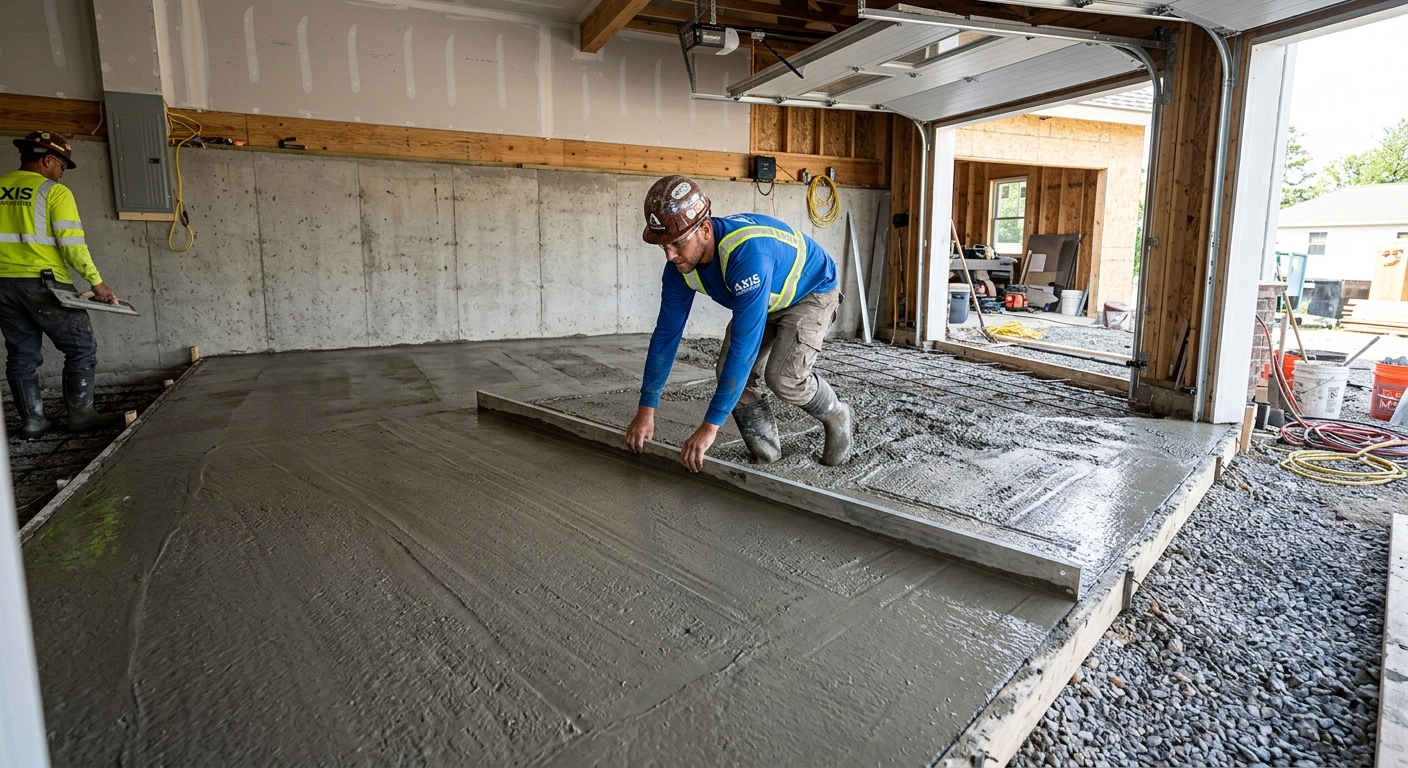
Concrete work options and costs in Keswick
Keswick, Ontario is a busy residential market, and concrete flatwork is one of the most common upgrades homeowners make—especially around driveways, walkways and patios. With a population of about 21,000 (Statistics Canada, 2021 Census), Keswick sees steady demand from the growing families moving into established neighbourhood pockets and from long-time residents refreshing older surfaces. You’ll often hear about concrete because many homes are single-family, which means a lot of the region’s projects are sized to typical driveway and patio footprints rather than large commercial pours.
In the Toronto economic region, concrete pricing is tightly linked to frost depth and freeze–thaw cycles. Local specifications generally require structural footings to extend at least 1.2 m (about 4 ft) below grade to reduce frost heave and differential movement. Exterior slabs also need air-entrained concrete mixes, plus well-compacted granular base and drainage—because saturated soils can expand and contract against the slab every winter. Contractors around the GTA concentrate exterior work into the warmer months to manage curing, and costs rise when weather forces shorter windows or adds cold-weather protection.
If you drive through areas near the downtown Keswick corridor, you’ll notice how often contractors are in and out for replacement driveways and patio upgrades—those locations tend to be especially busy because access is straightforward and homeowners want faster turnaround. Below is a practical comparison of common options and the typical ranges Keswick homeowners see for planning purposes—then you can dial in the specs for your soil, thickness and finish.
| Application |
Typical Size |
Key Spec |
Finish Option |
Price Range |
| Concrete driveway (standard broom finish) |
16 ft x 24 ft (384 sq ft) |
Air-entrained exterior mix; proper granular base + drainage |
Broom finish with control joints |
$18,000–$28,000 |
| Exposed aggregate driveway |
16 ft x 24 ft (384 sq ft) |
Air-entrained exterior mix; higher cement/aggregate quality |
Exposed aggregate with sealed surface |
$21,000–$34,000 |
| Stamped concrete driveway or patio |
12 ft x 20 ft (240 sq ft) |
Air-entrained mix; adequate thickness; joints planned to pattern |
Stamp + colour hardener (or integrally coloured) |
$24,000–$40,000 |
| Plain concrete patio or walkway |
10 ft x 14 ft (140 sq ft) |
Well-compacted base; slope for drainage |
Float + broom finish, control joints |
$2,200–$3,600 |
| Garage floor (interior slab) |
20 ft x 22 ft (440 sq ft) |
Vapour barrier/insulation depending on use; standard structural thickness |
Plain trowel finish or broom prep for grip |
$7,900–$13,900 |
| Foundation footings (structural, below frost) |
Typical house perimeter |
Footings extend below design frost; engineered rebar placement |
Structural concrete formwork + reinforcement |
$8,500–$15,000 |
Prices are estimates only and vary by project scope, site access and material selection.
What affects the price of concrete work in Keswick
If you’re comparing quotes in Keswick and the broader Toronto area, it’s not unusual to see the same driveway or patio come back 30–50% apart. The spread usually isn’t the concrete itself—it’s what’s underneath and around it. Two contractors can both propose “a 4-inch slab,” but one may include better granular base, better drainage, correct air-entrainment, and engineered reinforcement; the other may value engineer those items out, and you only notice later when the slab heaves, cracks, or spalls.
In Ontario, frost depth and freeze–thaw cycles dictate the entire build-up. Footings and frost-sensitive elements must extend below design frost depth (often in the 1.5–2.4 m range for Ontario structural work), and exterior slabs rely on air-entrained concrete mixes to survive repeated freeze–thaw. When late fall or early spring weather drops toward 10 °C or below, contractors may need longer protection and cold-weather curing precautions (like insulating blankets or temporary heating). That adds labour time and material handling, especially in the GTA where crews are booked and limited-window pours are common.
Salt from winter road treatments accelerates surface wear and can contribute to spalling if the mix and sealing aren’t right—so sealing and a durable finish matter. For Keswick homeowners, a few real cost drivers show up fast: (1) clay or poorly drained soils often require deeper excavation and more granular fill; (2) tight access near mature trees can slow truck placement and formwork; (3) larger driveway removals with old asphalt base can add disposal and base rebuild work. That’s why a standard broom driveway might land in the mid $20s per sq ft range, while stamped work tends to sit closer to the high-end of the $24–$40 band because of labour-intensive form-and-finish processes.
| Price Factor |
Why It Matters |
Cost Impact |
| Frost line depth — determines footing depth and form height |
Deeper frost exposure means deeper excavation and taller formwork |
Can add significant labour + equipment time; often pushes structural work toward the top of the range |
| Site preparation — excavation, grading, compacted granular base |
Base quality controls settlement and slab cracking |
Improves durability but increases excavation and granular material costs |
| Reinforcement — rebar or wire mesh requirement |
Reinforcement supports loads and reduces crack propagation |
Higher material and tie-in labour; usually necessary for driveways |
| Mix design — air-entrainment and compressive strength spec |
Air-entrainment helps resist freeze–thaw damage |
More robust mix can cost more but lowers spalling risk |
| Finish type — broom vs. stamped vs. exposed aggregate |
Finishes require different labour rates and material additions |
Stamped/exposed typically adds cost toward the upper ends of flatwork bands |
| Pour size and concrete truck access to site |
Smaller pours or difficult access can increase labour for placement |
Access constraints can raise costs even if square footage stays the same |
| Cold-weather curing precautions — heating and blankets |
Concrete must cure properly to develop strength in cool temps |
Can add direct costs for protection and increase crew time |
| Control joint pattern and sealing cost |
Joints manage cracking; sealing improves salt/impact resistance |
Small line item on paper, but often large value for exterior longevity |
Permits & regulations in Ontario
In Ontario, the permitting line is mainly about whether your project is considered structural or affects lot drainage/servicing. Structural concrete work—such as footings, foundation walls and grade beams—typically requires a building permit, and municipalities often expect engineered drawings and inspections as the work is completed. For concrete flatwork like driveways, patios, and walkways, permits are usually not required on their own unless the work affects lot grading, impervious surface limits, drainage patterns, or municipal right-of-way considerations. Because policies can vary based on how the project ties into the rest of your site plan, always confirm with the local authority before anyone breaks ground.
For contractor readiness in Keswick, verify insurance and worker coverage before you sign. Step-by-step: first, ask for a Certificate of Insurance showing liability coverage that matches the project size. Second, request proof of WSIB/WCB coverage for workers (or the contractor’s coverage arrangement where applicable). Third, check the contractor’s business details and any required Ontario registrations through appropriate online government resources. Then, request references from similar-scale jobs—especially exterior flatwork in freeze–thaw conditions—so you can see how they handle base prep, joints and sealing.
Finally, require the contractor to state clearly whether they will pull permits (when needed), include inspection coordination, and handle any required documentation before the pour.
Getting concrete right in Keswick's freeze-thaw climate
In Keswick, concrete failure is usually a freeze–thaw story—either the slab is sitting on the wrong base, the mix can’t handle repeated freezing, or the job didn’t cure long enough in cold snaps. The most common homeowner-visible problems are random cracking and surface spalling, which often trace back to inadequate air-entrainment, poor drainage, or skipping proper curing protection. The fix is to spec the system correctly from the bottom up.
Start with base preparation: compacted granular sub-base to the right depth for your soil and frost exposure, with proper slope and drainage so water doesn’t pool under the slab. Next is the mix design: for exterior flatwork, use air-entrained concrete with target air content of about 5–7% and a minimum compressive strength around 32 MPa. Third, control joints should be planned so the slab cracks where you want it—at predictable locations—rather than letting it split randomly across the field. Fourth, curing matters: plan for at least 7 days of proper curing under workable site conditions, and add protection when temperatures drop and curing slows. Finally, sealing: apply a penetrating sealer after curing (typically around 28 days post-pour) to help repel de-icing salts.
Ask your contractor hard questions about the air content and base build-up, not just the finish. For example, paying a bit more for air-entrained mix and the correct granular base under a driveway often costs less than redoing the entire slab later—especially if you’re trying to stay within common driveway ranges like the $18–$28 band for standard work versus the higher $24–$40 band for stamped finishes. Stamped looks great, but in Ontario the durability details protect that appearance for years.
| Spec |
Why It Matters in Keswick |
What to Ask For |
Impact if Skipped |
| Compacted granular base (depth?) |
Prevents settlement and reduces water retention under the slab |
Confirm excavation depth, granular type, moisture-compaction method and final grade/slope |
Early cracking, uneven slab movement, and failure at joints |
| Air-entrained concrete mix (target air %?) |
Air bubbles help concrete resist freeze–thaw pressure |
Ask for target air content (typically 5–7% for exterior flatwork) and delivery tickets showing the spec |
Spalling and flaking—often within a few winters if underspecified |
| Compressive strength (MPa rating) |
Ensures adequate strength development and performance in load-bearing use |
Confirm minimum strength around 32 MPa (and thickness design) for the application |
Surface wear, cracking, and reduced structural performance |
| Control joints (spacing per ACI guidelines) |
Controls where shrinkage cracking occurs |
Request the joint layout (spacing and saw-cut timing) aligned with slab dimensions and patterns |
Random cracks through the middle of the driveway or walkway |
| Minimum 7-day curing period |
Curing time supports strength gain before traffic and seasonal temperature swings |
Ask how they protect the pour in cool or wet weather and when you can use the area |
Weaker surface, higher risk of cracking and scaling |
| Penetrating sealer (when applied after cure) |
Helps repel de-icing salts and reduces moisture intrusion |
Confirm product type and application timing (commonly around 28 days post-pour) |
Faster surface deterioration and more staining |
How to choose a concrete work contractor in Keswick
Choosing the right concrete contractor in Keswick comes down to proof and process—not just a good-looking quote. First, verify Ontario-related readiness. Ask for their liability insurance certificate (make sure it lists the correct legal business name), and request proof of WSIB/WCB coverage for workers. Then confirm the contractor can legally do the type of work they’re bidding and is properly set up for your project scope. You can also ask for a clearance letter where applicable and check that the certificate of insurance doesn’t look expired.
Next, get 2–3 itemised written quotes. You want labour and materials separated: demo/removal, excavation, granular base, reinforcement, formwork, concrete supply, finishing, curing/protection, and sealing (if included). Avoid quotes that are “lump sum” without stating thickness, reinforcement, joint layout, or whether drainage is addressed. Carefully read what’s excluded: disposal, arborist work for tree roots, permits (for structural concrete), traffic control, and surface restoration around edges.
Warranty matters too. Ask for a clear workmanship warranty length and what it covers (for example, cracking due to curing/base issues) and whether the product/manufacturer warranty is included for sealer or specialty admixtures. For payment schedule, never agree to paying more than about 10–15% upfront. Hold back enough to keep accountability until the final grading, cleanup, and any sealing are completed. Finally, insist on a written start date and estimated completion window—Toronto-region weather can change timelines, but the schedule should still be documented.
- Request delivery ticket specs: air content, strength, and additives for exterior work.
- Confirm slab thickness and base thickness in writing (not just “standard”).
- Ask whether they include compaction testing or at least describe compaction method.
- Get the joint spacing plan (and when saw-cuts will occur).
- Verify reinforcement type and placement (rebar chairs/tie-ins, mesh support).
- Ensure cold-weather protection procedures are stated for temperatures near 10 °C or below.
- Confirm sealing type and timing (commonly around 28 days post-pour).
- Clarify whether disposal of old material is included.
- Check scope of grading and drainage away from the house foundation.
- Require insurance certificate and WSIB/WCB proof before any work starts.
- Ask for at least two recent Keswick-area references with similar finish types.
- Confirm warranty terms in writing and whether they’re transferable on resale.
Concrete contractor red flags in Keswick: they won’t discuss air-entrainment or joint layout; they quote without specifying thickness and base depth; they ask for large upfront payments; they refuse to show insurance/WSIB/WCB documentation; or they promise “one-week cure and done” without addressing curing, protection, and sealing for winter durability.
Frequently asked questions — concrete work in Keswick
What is the difference between concrete and cement?
Concrete is the finished building material you see on site—it’s made of cement, water, and aggregates (sand and stone), plus possibly air-entraining admixtures for durability in Ontario freeze–thaw conditions. Cement is only one ingredient inside concrete (often Portland cement) that binds everything together when it hydrates. For Keswick homeowners, the practical takeaway is that a contractor can’t just say “we’ll use concrete.” You should ask for the concrete mix spec: air content for exterior flatwork, minimum compressive strength, and whether the mix is designed for cold-season curing. That’s what protects your driveway or patio from spalling and helps manage cracking risk when winters return.
How much does concrete work cost in Keswick?
In Keswick, pricing depends on whether you’re doing basic flatwork, a premium finish, or structural work. For typical concrete driveway and slab projects, many Toronto-region bids land within the $18–$28 band for standard broom-finished concrete, while stamped or decorative options commonly push into the $24–$40 range because of extra labour and materials. For smaller exterior work like a plain patio or walkway, homeowners often see per-job totals that reflect the $16–$26 band for that category when base prep and drainage are included. If you’re planning foundation footings (structural, below frost), budgeting against the $180–$300 foundation/footings band is realistic due to excavation depth, formwork and reinforcement. Exact numbers still depend on access, thickness, and how much base has to be rebuilt.
How deep must footings be for Keswick's frost line?
For Keswick and much of Ontario, structural footings generally extend below the design frost depth to reduce frost heave and differential movement. In practice, local work is commonly specified to extend at least 1.2 m (about 4 ft) below grade for typical structural footings, with exact depth determined by the design and site conditions. That depth requirement is one reason foundation and footing work is more expensive than flatwork—it’s not just concrete volume; it’s excavation, formwork height, and reinforcement placement. The key is that the footing depth should come from engineered requirements for your foundation system (and your soil conditions), not a guess. A good contractor will also talk about drainage and subgrade preparation, since water management is part of the frost performance.
Why does concrete crack in Keswick and how is it prevented?
Concrete cracks in Keswick mainly due to shrinkage, curing conditions, and—critically—movement from freeze–thaw when water is allowed to sit under or within the assembly. In Ontario’s climate, if the slab doesn’t have proper air-entrainment, the freeze–thaw cycle can cause spalling and surface deterioration that makes cracking look worse. Prevention starts with base preparation (compacted granular base and drainage), correct mix design (including air-entrainment for exterior flatwork), and a control joint pattern that limits random cracking. Joints should be cut at the right timing so cracks form where you want them. Finally, proper curing matters: exterior pours need adequate curing time and protection when temperatures drop. Sealing after curing also helps reduce salt-driven surface stress.
Stamped vs broom-finish concrete — cost difference?
Stamped concrete costs more than a broom finish because it requires additional steps: form-and-stamp work, colour application (integral or via colour hardener/release), more detailed finishing and careful joint planning so the pattern looks consistent. In Keswick, that difference often shows up in the Toronto-region bands: standard driveway concrete typically sits around the $18–$28 range, while stamped & decorative concrete usually pushes into the $24–$40 band depending on complexity and size. Stamped can be worth it if you want curb appeal and a specific look, but durability should still be the priority—air-entrained mix, proper base thickness, and joint spacing come first. If a quote is close in price to broom-finish work but doesn’t mention air content, base build-up, or sealing, it’s a warning sign.
When is the best time to pour concrete in Keswick?
For Keswick and the Toronto economic region, the best time to pour exterior concrete is during the warmer months when curing is predictable. Contractors commonly schedule driveways, patios and walkways in late spring through summer so the concrete reaches strength development without expensive cold-weather protection. When temperatures drop toward 10 °C or below, the curing process slows, and contractors may need insulation blankets, heating methods, and longer wait times before finishing and return-to-use. Wet fall and early spring conditions can also complicate base preparation and moisture control. If you’re planning a pour near the shoulder seasons, ask the contractor what cold-weather curing precautions they will use, what the protection plan is, and how long curing will be before you can use the surface.