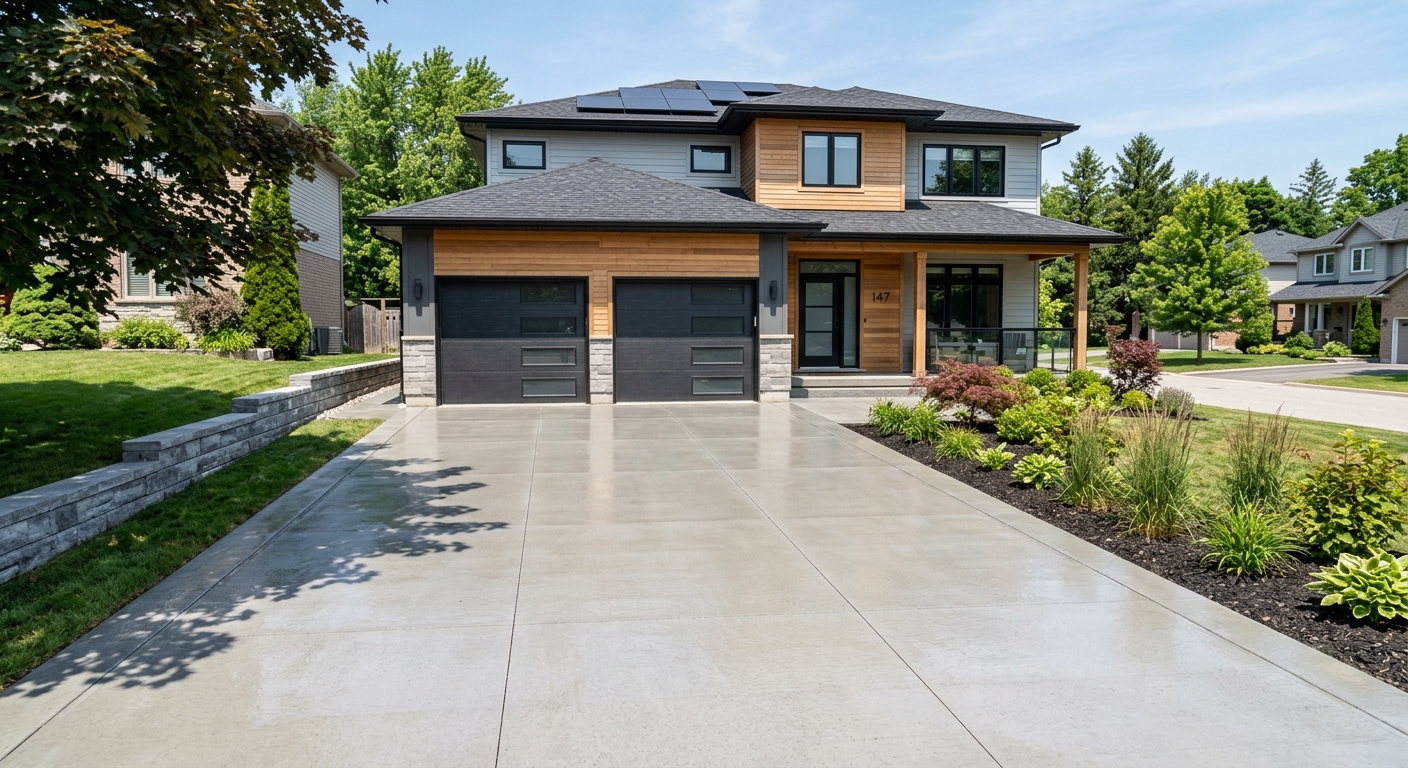
Concrete work options and costs in Munster
Concrete work in Munster usually starts with one of three needs: a new driveway, an exterior flatwork upgrade, or structural concrete for a foundation. If you’re comparing options, it helps to know Munster’s housing profile—while the community is small (population 1,145, Statistics Canada, 2021 Census), the surrounding Toronto economic region drives strong demand for practical, durable concrete in established residential pockets. Many homes rely on concrete for everyday access and snow/ice management, especially where driveways and walkways connect directly to doorways and garages.
In the GTA area, contractors price concrete with Toronto’s freeze–thaw reality built in. Frost depth requirements and winter temperature swings mean footings typically need to extend at least 1.2 m below grade, and exterior slabs are commonly designed with air-entrained mixes plus adequate thickness. That’s why you’ll see driveway and patio pricing clustered around the local bands: for a concrete driveway, many quotes land in the $18–$28 range, while patios and walkways often fall in the $16–$26 range. Availability also matters—most exterior pours are scheduled for the warmer months to protect curing, so late-season work often costs more because of heaters, blankets, and tighter scheduling.
In Munster, trades are especially in demand around Munster Road and nearby residential lanes where longer access runs and older lots create more excavation and base prep. Next, here’s a comparison table to help you benchmark typical scope and finish choices before you request itemised quotes.
| Application |
Typical Size |
Key Spec |
Finish Option |
Price Range |
| Concrete driveway (standard broom finish) |
16 m x 4 m (about 64 m²) |
Air-entrained mix for exterior, proper granular base, control joints |
Broom finish, edging |
$18,000 – $28,000 |
| Exposed aggregate driveway |
16 m x 4 m (about 64 m²) |
Air-entrained mix, correct curing and surface wash timing |
Exposed aggregate, slip-resistant texture |
$24,000 – $35,000 |
| Stamped concrete driveway or patio |
12 m x 4 m (about 48 m²) |
Air-entrained mix, colour hardeners, joint pattern planning |
Stamped patterns with integral colour |
$24,000 – $40,000 |
| Plain concrete patio or walkway |
10 m x 3 m (about 30 m²) |
Well-compacted base, drainage slope, joints |
Broom or trowel-lite finish, light broom texture |
$16,000 – $26,000 |
| Garage floor (interior slab) |
7 m x 6 m (about 42 m²) |
Vapour control layer (where required), proper thickness, saw-cut joints |
Float and seal (optional) |
$2,400 – $6,000 |
| Foundation footings (structural, below frost) |
Varies by house size |
Structural concrete and rebar, footing depth below design frost |
Formed finish as required by foundation system |
$180,000 – $300,000 |
Prices are estimates only and vary by project scope, site access and material selection.
What affects the price of concrete work in Munster
It’s normal to see quotes for the “same” concrete job vary by 30–50% across the Toronto economic region, even when the finish looks identical. The biggest reason is that concrete pricing isn’t just about pouring a slab—it’s about excavation, base preparation, frost-safe design, reinforcement, and the time required to protect curing through freeze–thaw cycles. In Munster, those climate-driven requirements translate directly into labour hours, equipment needs, and material choices like air-entrained mixes.
For exterior work, frost depth and freeze–thaw cycles dictate footing and slab specs. Footings must extend below the design frost depth (commonly 1.5–2.4 m in Ontario, depending on site conditions and engineering) to prevent frost heave and differential movement. For slabs on grade—driveways, patios, and walkways—air-entrained concrete helps the mix survive repeated freeze–thaw. When temperatures drop toward 10 °C or below, contractors often need cold-weather curing precautions (insulating blankets, heaters, and longer protection periods), which increases cost and can reduce contractor availability. De-icing salt can also accelerate surface spalling over time, so sealing and a correctly finished surface are important.
Two common Munster cost swings: (1) older or poorly drained lots often need deeper granular base and more grading to manage water, pushing a simple patio toward the $16–$26 band; (2) longer haul distances, narrow access, or removing existing asphalt and concrete can quickly add labour and disposal, making driveway work closer to the $18–$28 range. Foundation scope is even more sensitive because footing depth and reinforcement quantity scale with the structure—small changes can move a project by tens of thousands of dollars.
| Price Factor |
Why It Matters |
Cost Impact |
| Frost line depth — determines footing depth and form height |
Deeper footings require more excavation and concrete volume to resist frost heave |
High; can add major formwork and trucking costs |
| Site preparation — excavation, grading, compacted granular base |
Proper drainage and compaction reduce settling and cracking |
Medium to high; poor subgrade increases base thickness |
| Reinforcement — rebar or wire mesh requirement |
Controls cracking and supports load paths in slabs and structural elements |
Medium; depends on engineering and slab thickness |
| Mix design — air-entrainment and compressive strength spec |
Air content and strength help concrete survive freeze–thaw and loading |
Medium; specialty mix costs more than basic mix |
| Finish type — broom vs. stamped vs. exposed aggregate |
Labour intensity and materials (forms, colours, surface processing) |
High for stamped/exposed; shifts the job into higher bands |
| Pour size and concrete truck access to site |
Narrow or distant access can add hoses, pumping, and labour time |
Medium; access issues can swing costs quickly |
| Cold-weather curing precautions — heating and blankets |
Protects strength gain when temperatures drop and curing slows |
Medium to high; especially near the end of pour season |
| Control joint pattern and sealing cost |
Joints manage shrinkage cracking; sealing reduces de-icing salt damage |
Low to medium per cost line, but big impact on longevity |
Permits & regulations in Ontario
In Ontario, structural concrete work typically needs municipal permitting because it relates directly to the building’s stability. That includes footings, foundation walls, grade beams, and other engineered load-bearing concrete elements. For these items, municipalities often expect engineered drawings and inspections at key stages (for example, after excavation and before the pour). In contrast, concrete flatwork such as driveways, patios, and walkways usually does not require a permit on its own—unless it changes lot grading, impacts drainage requirements, affects impervious surface limits, or touches municipal right-of-way considerations. Because rules can differ based on how your project ties into site drainage, always confirm with the local authority before breaking ground.
Before a contractor starts in Munster, verify three things in a practical order. First, ask for a clear certificate of insurance and confirm it covers general liability (and any trade-specific operations). Second, confirm WSIB/WCB coverage for the crew working on your site. Third, check that the contractor carries the correct Ontario licensing for the work they’re doing (and that the licence matches the legal business entity on the quote).
How to check: (1) look up the contractor in Ontario’s public business/licensing registry if applicable; (2) request the insurance certificate and review the insured name and expiry date; (3) ask for proof of WSIB/WCB coverage number and status; (4) confirm references for similar-scale jobs in the GTA area so you know they’ve built in freeze–thaw conditions before.
Getting concrete right in Munster's freeze-thaw climate
Concrete fails in Munster mainly when the slab can’t move safely with the seasons or when water and salt get into the surface. The most common problems you’ll see after winter are cracking from shrinkage or restraint, and surface spalling from freeze–thaw when the mix isn’t properly air-entrained. Specifying the job correctly comes down to five steps.
(1) Base preparation: start with a compacted granular sub-base to the right depth for your soil and frost design, with drainage slopes that don’t trap water. In the Toronto area’s wet shoulder seasons, saturated base increases pumping and settlement against the concrete. (2) Mix design: for exterior flatwork, ask for air-entrained concrete with 5–7% air content and at least 32 MPa compressive strength. (3) Control joints: plan a joint layout that limits random cracking; joints should be cut or formed on schedule so shrinkage happens where it’s intended. (4) Curing: protect the pour for at least 7 days under proper conditions; in cold snaps, contractors may need blankets or heat to keep strength gain on track. (5) Sealing: apply a penetrating sealer about 28 days after the pour to repel de-icing salts and reduce surface deterioration.
When you’re comparing prices, it can be worth paying more for the right durability details. For example, moving from a basic broom-finish driveway toward a higher-spec option within the $18–$28 band is often justified if the contractor demonstrates proper base thickness, correct air entrainment, and a correct joint plan—because those items prevent costly rework later. Stamped work can also be a good value when the foundation of the job is sound; just don’t let the appearance distract from the freeze–thaw specs.
| Spec |
Why It Matters in Munster |
What to Ask For |
Impact if Skipped |
| Compacted granular base (depth?) |
Reduces settlement and prevents water from pumping at the slab edges in wet springs and falls |
Confirm excavation depth, granular type, compaction method, and final base grade/slope |
Early cracking, uneven surfaces, and edge failure |
| Air-entrained concrete mix (target air %?) |
Improves freeze–thaw resistance in Munster’s winter cycles |
Ask for 5–7% air for exterior flatwork and documented mix design |
Higher risk of freeze–thaw spalling and scaling |
| Compressive strength (MPa rating) |
Strength gain supports the slab under traffic and seasonal movement |
Confirm minimum 32 MPa and curing approach to reach strength |
Surface weakness, increased wear, and cracking |
| Control joints (spacing per ACI guidelines) |
Controls where shrinkage cracks develop so they don’t randomize |
Ask for the joint layout plan and cutting schedule |
Random cracking and water ingress into cracks |
| Minimum 7-day curing period |
Cold nights and fluctuating temps slow curing and can compromise early strength |
Confirm curing method, protection period, and what happens if temps drop |
Lower durability and increased cracking risk |
| Penetrating sealer (when applied after cure) |
Helps protect against de-icing salt and moisture-driven surface deterioration |
Confirm product type and application timing about 28 days post-pour |
Faster surface breakdown and spalling over winters |
How to choose a concrete work contractor in Munster
Choosing the right concrete contractor in Munster is mostly about verifying capacity and durability details—not just getting a low number. Start by confirming Ontario licensing where required for the work they’re performing, then ask for liability insurance and proof of WSIB/WCB coverage for their workers. How to check: (1) request a current certificate of insurance and ensure it names the correct legal business and is not expired; (2) ask for the WSIB/WCB status proof and verify the number belongs to the contractor on your quote; (3) confirm the contractor’s licence details match the company performing the work (not a sub-trade “shell”).
Next, get two or three itemised written quotes. You want labour and materials separated—especially base preparation, concrete mix details (air entrainment and strength), reinforcement, saw-cutting/joint work, and any sealing. Watch scope exclusions: disposal of removed concrete, protection of landscaping, permit handling (if needed for structural work), and whether cold-weather measures are included. A quality contractor will tell you exactly what they’re doing and when.
Warranty matters too. Ask for the workmanship warranty length, the product/manufacturer warranty (if applicable for sealers or admixtures), and whether warranties are transferable if you sell the home. For payment, avoid large deposits—never pay more than 10–15% upfront; hold back the remainder until completion and cleanup. Also request a start date and completion estimate in writing, particularly for exterior pours that depend on temperature and curing time.
- Itemised quote with labour/material breakdown (not just one lump sum).
- Specific mix details: air-entrainment target and minimum compressive strength.
- Base preparation scope: excavation depth, granular type, compaction method.
- Reinforcement requirements stated clearly (mesh/rebar and spacing).
- Joint plan: where joints go and when they’ll be cut/formed.
- Curing plan: protection method and minimum protection period.
- Sealing plan: product type and whether sealing is included (often 28 days post-pour).
- Cold-weather precautions listed if temperatures fall during your pour window.
- Permit responsibility clarified (structural vs flatwork scope).
- Disposal included for removed concrete/asphalt and excavation debris.
- Equipment and access plan (pumping, hoses, or truck positioning) for your lot.
- Written warranty and a clear remedy process if problems appear.
Concrete red flags in Munster: vague mix specs (no air content/strength mentioned), ignoring drainage and base thickness, cutting corners on joints or curing time, offering only a low price without itemisation, and asking for a large upfront payment before any site work begins.
Frequently asked questions — concrete work in Munster
What is the difference between concrete and cement?
In everyday conversation, people say “cement” when they mean “concrete,” but they’re not the same. Cement is a powder (the binder) made from processed materials that reacts with water. Concrete is the full mixture: cement plus water, sand, gravel (or other aggregates), and often admixtures like air-entraining agents for durability. In Munster and across Ontario, exterior flatwork needs the right admixtures because freeze–thaw cycles can damage low-durability mixes. That’s why reputable contractors specify air-entrained concrete for driveways, patios, and walkways—often with a target of 5–7% air content—rather than leaving the mix unspecified. If you’re comparing quotes, ask what’s in the mix, not just the surface finish.
How much does concrete work cost in Munster?
Concrete costs in Munster depend on the scope (removal, excavation, base prep), the finish, and how much protection is needed for curing in the Toronto climate. For typical homeowners, driveway and flatwork projects often land in the local price bands: a concrete driveway usually falls around $18–$28 per project cost band depending on size and site conditions, while patios and walkways commonly price in the $16–$26 range. Stamped concrete is higher because of additional materials and labour, typically $24–$40 for stamped/decorative work. Interior garage slabs are usually less complicated than exterior pours because you’re not fighting de-icing salt exposure and harsh freeze–thaw. For accurate budgeting, request an itemised quote that breaks out excavation/base, concrete mix, reinforcement, joints, finishing, and sealing—so you can see what’s driving the difference.
How deep must footings be for Munster's frost line?
For structural concrete like footings, Ontario practice is to extend below the design frost depth to prevent frost heave and differential movement. In the Toronto economic region, building departments commonly require footings at least 1.2 m below grade (about 4 ft), based on the design frost considerations and site conditions. Your exact footing depth should be confirmed with your engineered drawings or the foundation design for your home, because soil type, drainage, and local design assumptions can change the requirement. If someone quotes structural footings without discussing frost depth and the structural design basis, that’s a concern. Even in a small community like Munster (population 1,145, Statistics Canada, 2021 Census), the freeze–thaw cycle impacts the specifications the same way it does across the GTA: depth, reinforcement, and proper subgrade preparation aren’t optional if you want long-term performance.
Why does concrete crack in Munster and how is it prevented?
Concrete can crack due to shrinkage (as it cures), thermal movement, and restraint from the base. In Munster’s freeze–thaw climate, water in or under the slab can worsen freeze damage and accelerate deterioration. The best prevention is planning: a properly prepared and compacted granular base with correct drainage, an air-entrained mix for exterior exposure, and a control joint pattern designed to “tell” the concrete where to crack. Joints are typically spaced to limit random cracking, then sealed or protected where appropriate. Curing also matters—contractors should protect the slab for at least 7 days and use cold-weather precautions if temperatures drop. If air entrainment or curing is skipped, freeze–thaw can cause spalling and make the surface fail sooner, even if the slab doesn’t look badly cracked right away.
Stamped vs broom-finish concrete — cost difference?
Stamped concrete costs more than broom-finish because it requires additional materials and more labour time. For broom-finished driveways or walkways, contractors focus on proper base preparation, air-entrained exterior mix, finishing texture, and joint layout—typical pricing often sits in the $18–$28 band depending on project size and access. Stamped or decorative work adds form/stamp labour, colour hardeners or integral colour, and additional finishing steps; that’s why stamped concrete commonly prices around $24–$40 for decorative projects. The key point for Munster homeowners: don’t treat stamped concrete as “only cosmetic.” If the base prep, air-entrainment, curing, and joint plan aren’t correct, the stamped surface can still deteriorate faster during Toronto-region winters. A good contractor will explain how the durability specs stay the same while the finish changes.
When is the best time to pour concrete in Munster?
The best time to pour in Munster is during the warmer months when temperatures support consistent curing and finishing. In the Toronto economic region, contractors typically schedule exterior pours in the warmer season because cold snaps can slow strength gain and increase the risk of surface defects. When temperatures approach or drop toward 10 °C and below, curing management becomes more involved—heating, insulated blankets, and longer protection periods may be required. If you’re doing a driveway, patio, or walkway, plan around reliable curing conditions rather than just picking a date. If scheduling forces a late-season pour, ask the contractor exactly what cold-weather curing measures they’ll use and how long the slab will be protected. For structural work with engineered drawings, timing still matters, but the design and inspection sequence is usually the bigger driver.