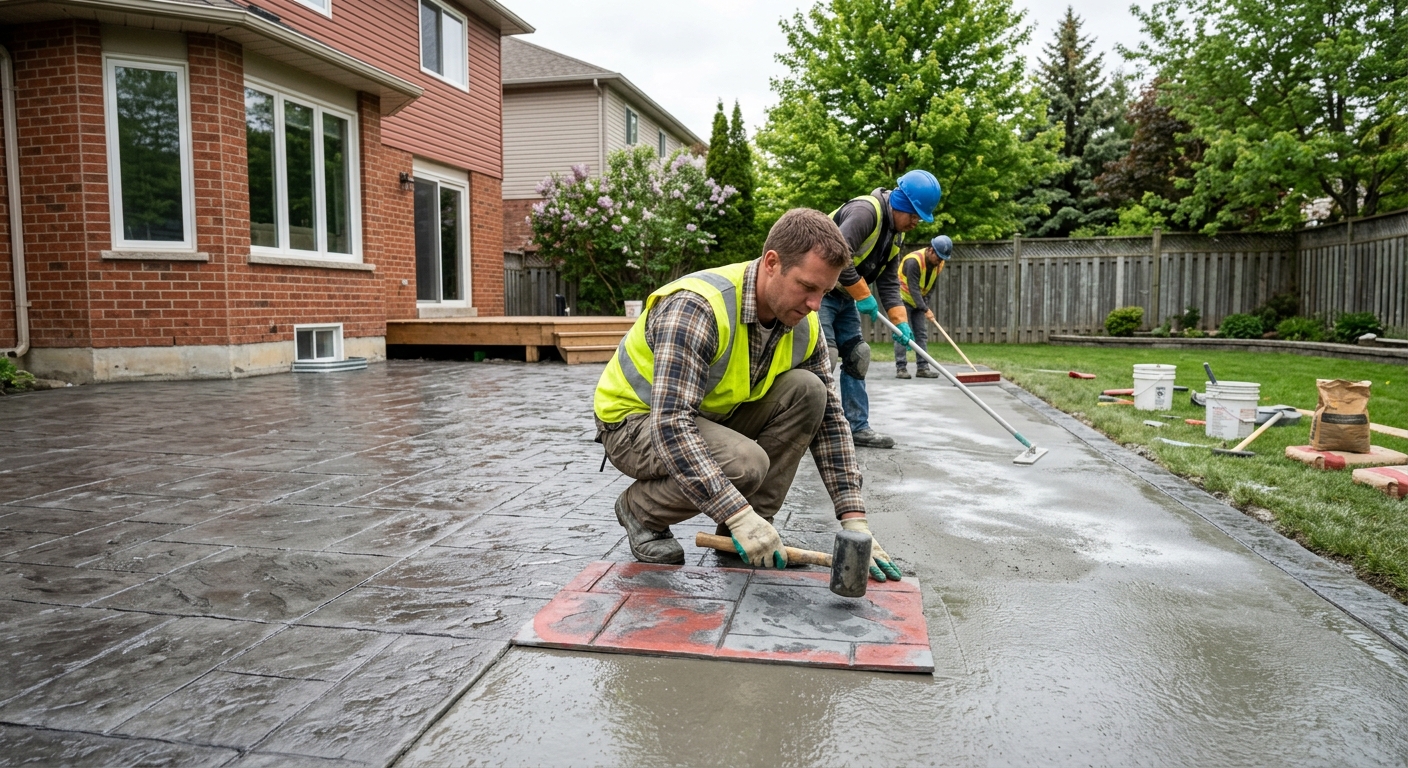
Concrete work options and costs in Huntsville
In Huntsville, concrete work is a common upgrade because the town is dominated by single-detached homes—79.9% of dwellings—so driveways, patios, and walkways see heavy wear in year-round freeze–thaw weather. With 45.3% of homes built before 1981, many properties also have aging flatwork and older drainage patterns that need improvement before new concrete will last. Our region, Muskoka–Kawarthas, experiences repeated winter cooling and spring thaw, and frost lines typically run around the 4 ft range. That means foundations and footings must be placed below frost to prevent heave, and exterior slabs need air‑entrained concrete and properly prepared granular base.
Costs also reflect the short practical pour season (often April–November). Scheduling crews around lake-effect cold snaps, plus cold-weather curing precautions (blankets/heating when required), can add labour and equipment time. That’s especially noticeable in neighbourhoods with more challenging access—like Algonquin Heights and parts of Huntsville’s south end—where longer material haul distances or narrower approaches can increase forming and prep effort.
Below are realistic price bands for common projects so you can compare quotes apples-to-apples before you talk design details like stamping or exposed aggregate.
| Application |
Typical Size |
Key Spec |
Finish Option |
Price Range |
| Concrete driveway (standard broom finish) |
16 ft x 24 ft (384 sq. ft.) |
Air‑entrained mix, compacted granular base, edge forms, fibres optional |
Broom finished, standard joints |
$12,500–$22,000 |
| Exposed aggregate driveway |
16 ft x 24 ft (384 sq. ft.) |
Air‑entrained mix, proper finishing timing, dense base and edging |
Exposed aggregate with sealer |
$18,000–$28,000 |
| Stamped concrete driveway or patio |
12 ft x 20 ft (240 sq. ft.) |
Air‑entrained mix, reinforced where required, integral colour or stain |
Stamped pattern with release + sealing |
$15,000–$32,000 |
| Plain concrete patio or walkway |
10 ft x 16 ft (160 sq. ft.) |
Air‑entrained mix, compacted base, control joints |
Broom or light trowel finish |
$4,500–$10,500 |
| Garage floor (interior slab) |
20 ft x 20 ft (400 sq. ft.) |
Vapour barrier + base prep, 32 MPa class, saw-cut joints |
Steel trowel or broom finish |
$10,000–$18,000 |
| Foundation footings (structural, below frost) |
Approx. 24 lin. ft of footing wall |
Excavation to below frost, rebar cage, waterproofing prep |
Structural concrete + formwork |
$20,000–$45,000 |
Prices are estimates only and vary by project scope, site access and material selection.
What affects the price of concrete work in Huntsville
In Muskoka–Kawarthas, it’s not unusual to see the “same” concrete job come in 30–50% apart between quotes, even when the finished look looks identical. The biggest reason is that scope details—how deep we excavate, what mix we specify, whether drainage is included, and what finish system is used—are often not comparable. Labour and equipment scheduling also tighten during the April–November window, and cold snaps can force additional curing precautions. Huntsville’s housing profile matters too: with many properties built before 1981 (45.3% of homes), you may be dealing with older grading, soft spots, or buried services that require extra prep before any slab can be guaranteed.
Frost line depth and freeze–thaw cycles dictate every key spec in Ontario. Footings must extend below design frost depth to prevent heave, and all exterior slabs require air‑entrained concrete to survive repeated freezing and thawing. When pours happen near the cold threshold, contractors may need insulated blankets and controlled curing time; that can push an otherwise straightforward concrete patio from the lower $4,000–$12,000 band toward the upper end if extra protection is required. Driveways can similarly move within the $12,000–$25,000 band when excavation and base prep expand due to poor soils or longer truck access routes.
Two examples from Huntsville that reliably change pricing: (1) If the existing base is pumping or has spring mud, the job can require deeper granular removal and re-compaction, adding material and machine time. (2) If you’re adding stamped or coloured concrete, expect premium mix systems, extra forming and detailing, and specialized finishing crews—often a justified increase when you want a decorative finish rather than “just durable.”
| Price Factor |
Why It Matters |
Cost Impact |
| Frost line depth — determines footing depth and form height |
Below-frost placement prevents heave and long-term movement |
Excavation + formwork can raise foundation/footing budgets significantly (often the main driver) |
| Site preparation — excavation, grading, compacted granular base |
Stable base reduces cracking and uneven settlement |
Soft soils or poor drainage can push costs up due to extra granular, compaction, and hauling |
| Reinforcement — rebar or wire mesh requirement |
Controls cracking and improves load resistance |
Material and labour add cost, especially for driveways near garages and thicker slabs |
| Mix design — air‑entrainment and compressive strength spec |
Air‑entrainment improves freeze–thaw durability |
Higher-performance mixes raise materials cost, but reduce spalling and surface scaling |
| Finish type — broom vs. stamped vs. exposed aggregate |
Finish complexity affects labour, timing, and material system |
Stamped/exposed work typically increases cost versus plain broom finish |
| Pour size and concrete truck access to site |
Access controls placement method and schedule reliability |
Narrow lots, long carry, or multiple short pours can increase labour and equipment time |
| Cold-weather curing precautions — heating and blankets |
Maintains hydration and strength development |
Blankets/heaters and extended protection add cost when temperatures are borderline |
| Control joint pattern and sealing cost |
Joints manage shrinkage cracking; sealing helps repel de‑icing salts |
Correct joint cutting and later sealing add line-item cost, but protect longevity |
Permits & regulations in Ontario
In Ontario, structural concrete work is typically tied to a building permit and, in many cases, engineered drawings that the municipality reviews before you pour. That includes footings, foundation walls, grade beams, and any foundation elements that support a dwelling or accessory structure. For homeowners in Huntsville, this is where “small concrete job” assumptions can get expensive if the permit path isn’t followed—because structural elements can’t be treated like simple flatwork.
Concrete flatwork—driveways, patios, and walkways—usually does not require a building permit unless it changes lot grading, affects impervious surface coverage limits, or impacts municipal right‑of‑way requirements. Even when a permit isn’t required, you still need to avoid creating drainage problems on your lot or directing water into a way that contradicts property drainage expectations.
Before you sign a contract, verify contractor compliance step-by-step: (1) confirm they carry liability insurance (request the certificate of insurance); (2) confirm coverage for workers via WSIB/WCB as applicable (ask for a clearance letter or proof of account); and (3) verify they’re authorized to do the type of work they’re quoting, typically through Ontario’s public-facing contractor registry sources and company details shown in your proposal. Then ask for references on similar Huntsville-scale projects—especially those involving frost depth excavation and exterior drainage upgrades.
Getting concrete right in Huntsville's freeze-thaw climate
Concrete fails in Huntsville most often due to freeze–thaw damage and poor base preparation, not because “concrete is weak.” In our Muskoka–Kawarthas climate, the ground repeatedly freezes and thaws, and moisture gets trapped under or within the slab. If the base isn’t compacted to the right depth, or if the concrete isn’t air‑entrained, you’ll see early surface deterioration: spalling, scaling, and cracking that worsens every winter. This matters more on exterior slabs because Ontario exterior work must be built to endure repeated freezing cycles and de‑icing salt exposure.
To spec the job correctly, start with base prep: we excavate to achieve a stable, compacted granular sub-base sized for frost protection and proper drainage. Next is mix design: for exterior flatwork we target 5–7% air content with at least 32 MPa class compressive strength, so the concrete has the durability to handle freeze–thaw cycles. Then lock in crack control with a control joint plan—spacing needs to limit random cracking, especially on driveways and wider walkways. Curing is the silent make-or-break step: allow a minimum 7-day cure under proper conditions, and if weather is cold, use blankets/heating so strength develops before the slab is exposed. Finally, seal: apply a penetrating sealer after the cure window (commonly 28 days) to repel de‑icing salts and reduce water absorption.
Where does price show up? Take a 240 sq. ft. stamped patio: you might be looking at the $15,000–$32,000 range, but if the contractor “saves” by skipping air content or rushing cure, the cheaper short-term option can cost you repairs next season. A well-built broom-finish patio in the $4,000–$12,000 band can still last many years—if the specs match Huntsville’s climate reality.
| Spec |
Why It Matters in Huntsville |
What to Ask For |
Impact if Skipped |
| Compacted granular base (depth?) |
Stable frost-protected base reduces settlement and pumping |
Base depth details, compaction method, and granular type |
Uneven settlement, early cracking, and reduced slab lifespan |
| Air-entrained concrete mix (target air %?) |
Air voids protect concrete from freeze–thaw deterioration |
Concrete air content target (typically 5–7% for exterior) |
Spalling and scaling during cold seasons |
| Compressive strength (MPa rating) |
Strength development supports durability and load resistance |
Minimum 32 MPa class spec and mix confirmation |
Surface wear, increased cracking, and premature deterioration |
| Control joints (spacing per ACI guidelines) |
Manages shrinkage cracking from drying and temperature change |
Joint layout plan and timing of saw cutting |
Random cracking and wider repair scope later |
| Minimum 7-day curing period |
Correct curing enables strength gain before exposure |
Protection plan for cold nights and curing duration |
Reduced strength and higher risk of surface scaling |
| Penetrating sealer (when applied after cure) |
Helps resist water and de‑icing salt penetration |
Sealer type and application timing (often after 28 days) |
Faster moisture uptake and worse winter damage |
How to choose a concrete work contractor in Huntsville
Choosing a concrete contractor in Huntsville comes down to proving two things: (1) they spec correctly for frost and freeze–thaw conditions, and (2) they’re legitimately insured to work on your property. Start by verifying Ontario compliance: ask for their business information and proof of liability insurance (certificate of insurance) and proof of WSIB/WCB coverage. If they can’t provide clear documentation, that’s a major red flag—especially for excavation and foundation work where jobsite risk is higher. Then request 2–3 quotes written with itemized line items, not just a lump sum. You want a breakdown that shows labour, concrete supply, reinforcement, excavation/grading, disposal, forming, finishing, and sealing (if applicable).
Read the scope carefully for exclusions: is permit pulling included where required for structural concrete? Is topsoil removal and disposal included, or is it “by others”? Are drainage improvements part of the plan? Confirm who is responsible for surface restoration in case trucks and equipment need temporary access. Ask about warranties—workmanship duration matters, and you should also understand whether any product warranty applies and whether it’s transferable to you as the homeowner.
On payment terms, avoid large upfront deposits. A good rule of thumb is no more than 10–15% upfront, with a holdback until the work is complete and you’ve confirmed final grading and finish quality. Finally, get the start date and completion timeline in writing, especially because Muskoka–Kawarthas weather can shift the practical pour window.
- Ask which concrete air content and strength class they’ll place for your exterior work.
- Confirm footing/foundation work will be below frost and specify expected excavation depth.
- Request joint spacing and saw-cut timing for driveways and slabs.
- Get a written curing plan for cold nights (blankets/heating if needed).
- Confirm base preparation depth and compaction standards (not vague “proper base”).
- Verify rebar placement and whether dowels/mesh are used where required.
- Ensure site drainage and slope to the correct direction are addressed.
- Confirm whether disposal/haul-away is included for removed material.
- Ask about truck access and placement method (avoid unapproved “mud dumping”).
- Review finish specs: broom vs exposed aggregate vs stamped, including sealer.
- Verify liability insurance and WSIB/WCB coverage before work begins.
- Use a written schedule: start date, concrete pour day, and curing/sealer dates.
Concrete red flags we see in Huntsville include quotes that don’t mention air-entrainment, vague curing promises (“we’ll just pour and hope”), missing joint layout or no mention of saw cutting, unclear disposal and grading responsibilities, and contractors who ask for a large deposit before verifying insurance and site conditions.
Frequently asked questions — concrete work in Huntsville
What is rebar and when is it required in Ontario?
Rebar (reinforcing steel) is used to help control cracking and add tensile capacity in concrete members. In Ontario, rebar requirements depend on what you’re building and the structural design—typically determined by engineered drawings for structural components. For example, foundation footings, foundation walls, and grade beams usually require reinforcement based on loads and soil/frost conditions. For exterior flatwork like driveways and patios, rebar or wire mesh may be included depending on slab thickness, soil stability, and whether the slab is intended for vehicle loads. Since Huntsville sits in a freeze–thaw zone with frost depth concerns, properly detailed reinforcement can be part of a durability spec, not just an “extra.” Always ask your contractor to name the reinforcement type, placement position (cover), and spacing, and confirm the design is compliant for Ontario structural work.
How long does a concrete project take in Huntsville?
Project length in Huntsville depends on whether you’re doing exterior flatwork or structural work, and on weather that can affect curing. For a driveway or patio, the excavation and base prep can take several days, then the pour day itself is usually fast (often one working day). After placement, curing is what makes the difference: even if the concrete is “walkable” sooner, proper curing typically requires protection for at least 7 days, and sealing is commonly done after a full cure window (often around 28 days). During the April–November pour season, crews can coordinate trucks and finishing crews efficiently, but colder mornings or rain can delay scheduling. For a driveway in the $12,000–$25,000 band, you should still plan for cleanup and final grading, and possibly a short wait for the right conditions. Structural foundation work is longer due to inspections, forming, and cure/protection needs.
What is a concrete overlay and is it suited to Huntsville?
A concrete overlay is a new layer placed over an existing concrete slab to restore appearance and add thickness without full removal. In Huntsville, overlays can be suitable when the existing slab is structurally sound—meaning it isn’t actively heaving, severely spalled, or heavily cracked with differential movement. If your slab has freeze–thaw damage but is still well-bonded and relatively level, an overlay may be cost-effective compared with full replacement. However, if the original base failed or the slab is moving due to frost-related soil issues, an overlay can simply transfer the underlying problem upward and shorten lifespan. That’s why we evaluate the cause first: drainage, base compaction, and whether de‑icing salt has led to surface breakdown. If replacement puts you in the $12,000–$25,000 driveway range, an overlay might reduce cost, but only when the prep and bonding method are correctly specified for Ontario freeze–thaw exposure.
How do I seal concrete to protect it in Huntsville?
Sealing is especially important in Huntsville because de‑icing salts and freeze–thaw cycles can drive moisture into the surface, worsening spalling and scaling over time. The typical approach is to wait until the concrete has cured sufficiently—often around 28 days for many penetrating sealers—then apply a penetrating sealer that helps repel water and reduce salt intrusion. Before sealing, the slab needs to be clean and dry; any dust, oils, or curing compounds can block the sealer from penetrating properly. Ask your contractor which sealer system they recommend and whether they apply it uniformly around edges and joints. If you’re planning a driveway in the $12,000–$25,000 band or a decorative project, include sealing in the scope so it’s done on schedule, not as an afterthought months later. Proper joint sealing and drainage away from the slab also matter as much as the sealer itself.
What is the difference between concrete and cement?
Concrete is the finished construction material—cement combined with water, sand, gravel (or other aggregate), and often additives such as air‑entrainment for durability. Cement is one ingredient inside concrete (typically Portland cement). In everyday talk people use “cement” and “concrete” interchangeably, but in construction the difference matters because you’ll hear specs for the overall concrete mix, not just the cement content. For Huntsville’s freeze–thaw climate, the important performance details are the concrete’s air-entrainment and strength class, plus how it’s cured and sealed—not simply “more cement.” Contractors should specify the mix design (including target air content for exterior work) and the curing plan. When you compare quotes in Ontario, ask what concrete mix they are placing and what durability steps they’re taking, especially for exterior slabs exposed to salt and repeated freezing cycles.
How much does concrete work cost in Huntsville?
Pricing varies by size, access, excavation needs, and the level of finish—especially in Huntsville where frost depth and freeze–thaw cycles drive deeper base and structural specs. For planning purposes, a concrete driveway typically falls in the $12,000–$25,000 range depending on whether you’re doing plain broom finish versus something more decorative. A plain patio or walkway often lands in the $4,000–$12,000 range for typical homeowner-sized projects, while stamped or decorative work usually starts higher due to premium materials and specialized finishing crews (often $15,000–$35,000). Foundation footings (below frost) are higher per the excavation, rebar, waterproofing prep, and formwork—often $18,000–$45,000 depending on wall length and site conditions. When you request quotes, make sure the scope matches: base depth, air‑entrainment, reinforcement, joints, curing, disposal, and sealing should all be clearly stated.