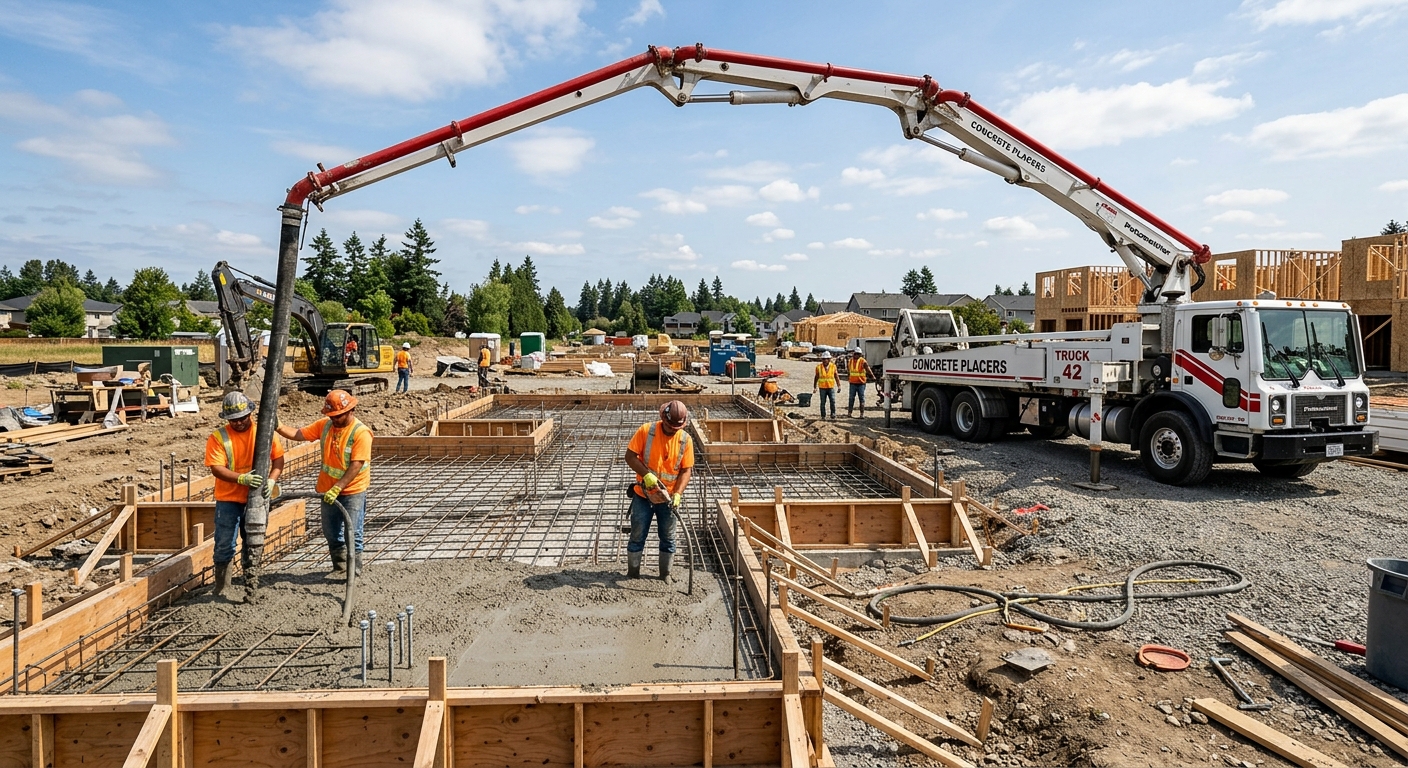
Concrete work options and costs in Preston Heights
In Preston Heights, concrete work is a big part of how homeowners handle driveways, patios, walkways, and foundation-related needs—especially in a market with a lot of established homes. With a population of 2,869 (Statistics Canada, 2021 Census), the local pool of trades is smaller than larger GTA cores, so scheduling can tighten when crews are booked for the spring and early-summer pour season. Many properties here are in stable neighbourhood pockets where curb appeal upgrades are common, such as around the main arterials and everyday commuter corridors.
Toronto-area pricing is driven by freeze–thaw cycles and the way frost depth controls how deep contractors must build structural elements. In practical terms, exterior work requires air-entrained mixes, well-compacted granular base, and control joints to manage cracking during Ontario winters. The Ontario Building Code also pushes most structural footings to extend at least about 1.2 m below grade in many typical applications, which affects excavation and forming labour. When temperatures drop toward 10 °C or below, curing management becomes more important, so crews may schedule pours earlier and use protection methods in shoulder-season weather to protect the concrete’s early strength development.
Because of these climate-linked requirements, two “similar” driveways can land in meaningfully different price tiers—especially when reinforcement, thickness, or finish type changes. That’s why the table below compares common options and the typical price bands homeowners in Preston Heights usually see, so you can discuss scope with confidence before you request quotes.
| Application |
Typical Size |
Key Spec |
Finish Option |
Price Range |
| Concrete driveway (standard broom finish) |
20 m² (approx. 10 m x 2 m) |
Air-entrained exterior mix; compacted granular base; control joints |
Broom finish |
$18,000–$28,000 |
| Exposed aggregate driveway |
20 m² (approx. 10 m x 2 m) |
Air-entrained exterior mix; proper curing and surface wash timing |
Exposed aggregate |
$22,000–$34,000 |
| Stamped concrete driveway or patio |
18 m² (approx. 9 m x 2 m) |
Air-entrained exterior mix; thicker section for stamping; release agent |
Stamped pattern with sealer |
$24,000–$40,000 |
| Plain concrete patio or walkway |
15 m² (approx. 5 m x 3 m) |
Compacted base; joints to control cracking |
Float and broom / light trowel |
$16,000–$26,000 |
| Garage floor (interior slab) |
24 m² (approx. 12 m x 2 m) |
Vapour barrier (as applicable); fibre or mesh; proper thickness |
Broom finish / light trowel |
$20,000–$32,000 |
| Foundation footings (structural, below frost) |
Typical footing package for a small addition |
Engineered design; excavation to design depth; rebar & concrete |
Not finished (structural concrete) |
$180,000–$300,000 |
Prices are estimates only and vary by project scope, site access and material selection.
What affects the price of concrete work in Preston Heights
In Preston Heights and across the broader Toronto economic region, homeowners often see quotes that swing by 30–50% for “the same” concrete project because concrete pricing bundles several variable factors: site conditions, how much prep is required, structural requirements, and the finish system. With smaller local demand pockets, scheduling also matters—crews may prioritize certain dates to hit the best curing window, which can change labour costs depending on timing.
Climate is the big driver. Frost depth and freeze–thaw cycles dictate every exterior spec. Footings and structural elements must extend below the design frost depth to reduce frost heave and differential movement (and contractors must follow Ontario Building Code requirements). For exterior flatwork like driveways, air-entrained mixes are standard to survive repeated freezing and thawing. When the forecast turns cooler and temperatures hover around 10 °C or below, contractors often add curing protection (insulating blankets, wind protection, and longer planning for strength gain), which raises costs and tightens the pour schedule.
In the GTA, GTA contractors commonly plan exterior work for late spring through early fall to avoid cold-weather curing headaches. De-icing salt is another Ontario reality: it can accelerate surface spalling if the concrete is not properly air-entrained or if the surface is not sealed. For example, a broom-finished patio in the $16,000–$26,000 band may stay close to that range if your base is already well-drained. A stamped driveway in the $24,000–$40,000 band is usually justified when you want improved curb appeal and higher labour (forms, texture mats, and sealing), not just “pretty finishing.”
Local housing stock also matters: older properties around Preston Heights can have questionable drainage patterns, older subgrades, or previous replacements that require extra excavation—meaning more disposal and base rework—before any concrete is poured.
| Price Factor |
Why It Matters |
Cost Impact |
| Frost line depth — determines footing depth and form height |
Deeper excavation and more forming to meet Ontario requirements |
Higher labour and equipment time; can move a foundation job to the top of its band |
| Site preparation — excavation, grading, compacted granular base |
Proper base reduces settlement and cracking under freeze–thaw |
Often the largest swing factor on flatwork quotes (especially if drainage is poor) |
| Reinforcement — rebar or wire mesh requirement |
Controls cracking and adds strength for heavier loads |
Adds material and labour; critical for driveways and garage floors |
| Mix design — air-entrainment and compressive strength spec |
Air entrainment helps resist freeze–thaw damage; strength supports durability |
Higher mix cost, but usually cheaper than repairs later |
| Finish type — broom vs. stamped vs. exposed aggregate |
Finish complexity affects labour time and curing/finishing steps |
Stamped/exposed can push flatwork into higher tiers versus basic broom finishes |
| Pour size and concrete truck access to site |
Hard access increases labour for wheelbarrowing/pumping and can limit pour planning |
Can add mobilization and handling charges quickly |
| Cold-weather curing precautions — heating and blankets |
Protects early strength when conditions cool below reliable curing thresholds |
Extra labour/materials; often moves the schedule-dependent cost up |
| Control joint pattern and sealing cost |
Joints limit random cracking; sealing helps reduce salt-driven surface damage |
Small line item, but skipping it can reduce service life |
Permits & regulations in Ontario
In Ontario, structural concrete work typically requires a building permit and, in many cases, engineered drawings reviewed by the municipality. That includes concrete footings, foundation walls, and grade beams—anything that is part of the building’s structural system. Concrete flatwork like driveways, patios, and walkways often does not require a permit by default, but it can if the project affects lot grading, increases impervious surface coverage beyond municipal limits, changes drainage patterns, or touches municipal right-of-way areas (for example, work near a curb or sidewalk). Always confirm with the local authority before breaking ground, because “it’s just a slab” is not always the whole story in established neighbourhoods.
Before you hire a Preston Heights contractor, verify three things: Ontario licensing (if applicable to their concrete/crane/contract scope), liability insurance, and WSIB coverage (or the equivalent coverage status for their firm). Step-by-step, here’s how homeowners typically check:
- Request the contractor’s certificate of insurance (ask for liability coverage and the policy’s effective dates).
- Ask for WSIB/WCB clearance status and documentation; don’t accept verbal confirmation.
- Look up the contractor online via provincial licensing/registry resources where listed (and match the legal name on their quote to the registry).
- Check references for similar-sized work (same exposure level: exterior, salt use, and freeze–thaw).
- Confirm whether permit pulling (if required) is included in the quote scope.
Doing these checks upfront protects you from delays, incomplete scope, and workmanship disputes later.
Getting concrete right in Preston Heights's freeze-thaw climate
Concrete failure in Preston Heights usually comes down to one of five issues: inadequate base preparation, insufficient frost-protection depth in structural work, poor mix design (especially air entrainment), uncontrolled cracking, and inadequate curing or surface protection. In our Toronto-region climate, freeze–thaw cycles pull moisture into the slab/edges; when the concrete can’t tolerate that expansion and contraction, you see scaling, spalling, and widening cracks.
To spec the job correctly, start with base prep: compacted granular sub-base to the right depth and slope so water drains away from the slab. For mix design, make sure exterior work uses air entrainment—commonly targeting 5–7% air for exterior flatwork—and a minimum 32 MPa compressive strength spec so the concrete reaches durability strength. Next, plan control joints. Joint spacing is where many “cheap” pours lose, because random cracking is the result of not managing where the slab wants to crack. Curing is equally important: plan for at least 7 days of proper curing under suitable conditions, and in cooler weather, the contractor should protect the pour so early strength development isn’t compromised.
Finally, sealing matters. A penetrating sealer applied after the cure period (commonly after 28 days for full curing) helps repel de-icing salts and reduces the likelihood of surface damage. If you want curb appeal, stamped concrete can be worth it, but don’t pay the premium without getting the base and air-entrainment right first. For example, moving from broom-finished concrete to stamped concrete often means paying in the $24,000–$40,000 band versus the $18,000–$28,000 band—justified for texture, colour, and finishing time, not as a substitute for proper freeze–thaw durability.
| Spec |
Why It Matters in Preston Heights |
What to Ask For |
Impact if Skipped |
| Compacted granular base (depth?) |
Moisture and settlement increase cracking and frost-related movement in Toronto area soils |
Base depth and compaction test/procedure; specify granular type and drainage slope |
Early cracking, uneven surface, and higher repair costs |
| Air-entrained concrete mix (target air %?) |
Air entrainment protects against freeze–thaw damage and scaling |
Confirm target air content (typically 5–7% for exterior flatwork) |
Spalling and scaling, especially at edges and where salt sits |
| Compressive strength (MPa rating) |
Strength supports durability and abrasion resistance in an exterior freeze–thaw environment |
Minimum 32 MPa compressive strength spec |
Surface wear and increased risk of failure under winter stress |
| Control joints (spacing per ACI guidelines) |
Manages where cracks form during seasonal movement |
Joint spacing plan and saw-cut timing; include crack control details in the quote |
Random cracking across the slab and a higher likelihood of water intrusion |
| Minimum 7-day curing period |
Proper curing is critical for early strength gain before cold snaps hit |
Protection plan if temperatures dip; confirm curing method and duration |
Lower strength, weaker surface, and durability problems |
| Penetrating sealer (when applied after cure) |
Helps repel de-icing salts and reduces surface deterioration during winters |
Penetrating sealer application after full cure (commonly after 28 days) |
More salt-related scaling and a shorter service life |
How to choose a concrete work contractor in Preston Heights
Choosing the right concrete contractor in Preston Heights starts with verification. In Ontario, you should require liability insurance (so you’re not exposed if damage occurs), and WSIB/WCB coverage confirmation (so workers are covered). Check each item the practical way: request a current certificate of insurance and a WSIB/WCB clearance status letter or documentation, and confirm the names match the legal entity on the quote. For licensing, rely on provincial registry lookups where applicable and confirm the contractor’s business details before signing.
Next, get 2–3 itemised written quotes rather than a single lump sum. You want labour and materials clearly separated so you can compare: excavation and haul-away, granular base depth and compaction expectations, reinforcement (mesh or rebar), mix requirements (air entrainment and strength spec), and finishing/sealer steps. Also ask what’s excluded—permit pulling, disposal, demolition of the old slab, site protection, and any extra charges for pump/wheelbarrow access.
Warranty should be specific. Ask for workmanship warranty length, whether materials have a separate manufacturer warranty, and whether warranties are transferable if you sell your home. For payment schedule, I recommend keeping your deposit to about 10–15% maximum, then holding back the remainder until the project is complete and cleaned up. Finally, insist on a timeline in writing: proposed start date, concrete pour day, and completion estimate, especially because Toronto-area pours are sensitive to weather and curing windows.
- Confirm liability insurance effective dates and coverage limits.
- Verify WSIB/WCB clearance status in writing.
- Ask for 3 similar references completed within the last 12–24 months.
- Demand itemised quotes (base prep, reinforcement, mix, finishing, sealer).
- Confirm disposal and demolition are included if old concrete exists.
- Clarify whether permit pulling is included if structural work triggers permits.
- Get the exact mix spec: air entrainment and minimum MPa.
- Ask for base depth and compaction approach; look for drainage notes.
- Review joint spacing plan and saw-cut timing.
- Confirm cold-weather curing protection plan if temperatures drop.
- Check warranty: workmanship duration and product warranty details.
- Agree on payment milestones tied to inspection points, not just “progress.”
Concrete red flags in Preston Heights include: contractors who won’t quote air content or strength, vague scope like “we’ll prep it properly,” no mention of control joints or sealing, rushing the schedule without curing protection in cool weather, and requests for large upfront payments (beyond about 10–15%) without a clear inspection plan.
Frequently asked questions — concrete work in Preston Heights
How long does concrete take to cure?
In Ontario and around Preston Heights, people often confuse “set time” with “cure time.” Concrete typically reaches initial set within hours, but that doesn’t mean it’s durable enough for real loads. For most exterior work, plan for at least 7 days of proper curing conditions for the slab to gain early strength, especially important when freeze–thaw cycles are approaching. Full strength development is commonly referenced at 28 days, which is also why penetrating sealer is often scheduled after the curing window. If a pour happens when temperatures are cooling toward 10 °C or below, the contractor should protect the surface with insulation and manage curing longer to prevent early-age damage.
Do I need a permit for concrete work in Ontario?
Often, concrete flatwork such as patios, walkways, and driveways does not require a permit in Ontario unless it affects grading, drainage, impervious surface limits, or touches municipal right-of-way areas (for example, near a curb/sidewalk). Structural concrete is different: footings, foundation walls, and grade beams typically need a building permit and frequently engineered drawings for municipal review. For homeowners in Preston Heights, the safest approach is to ask the contractor to confirm whether a permit is required for your exact scope, and to verify with the local authority before you start. Also confirm your contractor carries liability insurance and WSIB/WCB coverage, because permit status doesn’t replace basic site and worker protections.
Concrete vs pavers for a patio in Preston Heights?
Concrete and pavers both work well for patios, but Toronto-area freeze–thaw usually makes base preparation and drainage the deciding factors. Concrete is typically more straightforward: one monolithic slab with air entrained mix, joints, and a clear finishing plan. In your area, a plain concrete patio often lands around the $16,000–$26,000 band depending on size and prep. Pavers can look great and allow easier spot repairs, but they still depend on a properly compacted base and correct slope so water doesn’t sit. If your patio area has any history of poor drainage or standing water, the right answer may be the one that best controls moisture—whether that’s concrete with joints and sealer or pavers with a properly engineered base and joint bedding.
How long does a concrete driveway last?
A well-built driveway in Ontario can last decades, but life expectancy depends heavily on how it’s constructed for freeze–thaw. If the driveway has an air-entrained exterior mix, proper granular base, correct thickness, control joints, and a sealing plan to repel de-icing salts, it will usually perform far better in winter conditions. The most common early failures are scaling/spalling at the surface or edges (often linked to inadequate air entrainment or weak curing), and random cracking from missing or poorly planned joints. In Preston Heights, driveways are exposed to humid wet spells in fall/spring and the full winter freeze–thaw cycle, so durability specs matter more than people expect. Typical costs for standard broom-finished driveways are often within the $18,000–$28,000 band, and decorative options generally move higher.
What is air-entrained concrete and why does it matter here?
Air-entrained concrete is mixed with tiny, evenly distributed air bubbles designed to give freezing water somewhere to expand without destroying the paste structure. In Preston Heights and the Toronto region, freeze–thaw cycles are repeated every winter, and without proper air entrainment you’re more likely to see surface scaling and spalling—especially where de-icing salts sit. For exterior flatwork, contractors commonly target about 5–7% air (ask for the spec in writing) and use a minimum strength requirement such as 32 MPa to support durability. If a quote doesn’t mention air entrainment, it’s a major question to ask before work starts. Skipping it isn’t “just a materials choice”—it’s a main reason concrete can fail years earlier.
How do I prepare the base for a concrete slab?
Base preparation is where good driveways and patios are won or lost. In the Toronto freeze–thaw climate, the goal is to prevent water from sitting under and around the concrete, and to stop frost-related movement by creating a stable, well-compacted granular layer. A contractor should specify the granular material type, the depth appropriate to the design and soil conditions, and the compaction method. You should also expect attention to grading and drainage—slopes that shed water away from the slab. Ask your contractor how they’ll handle excavation, any subgrade issues, and whether reinforcement is needed. If the base isn’t properly built, even a driveway in the $18,000–$28,000 range can develop cracking sooner than it should, because the slab can’t “float” on a stable, dry foundation.