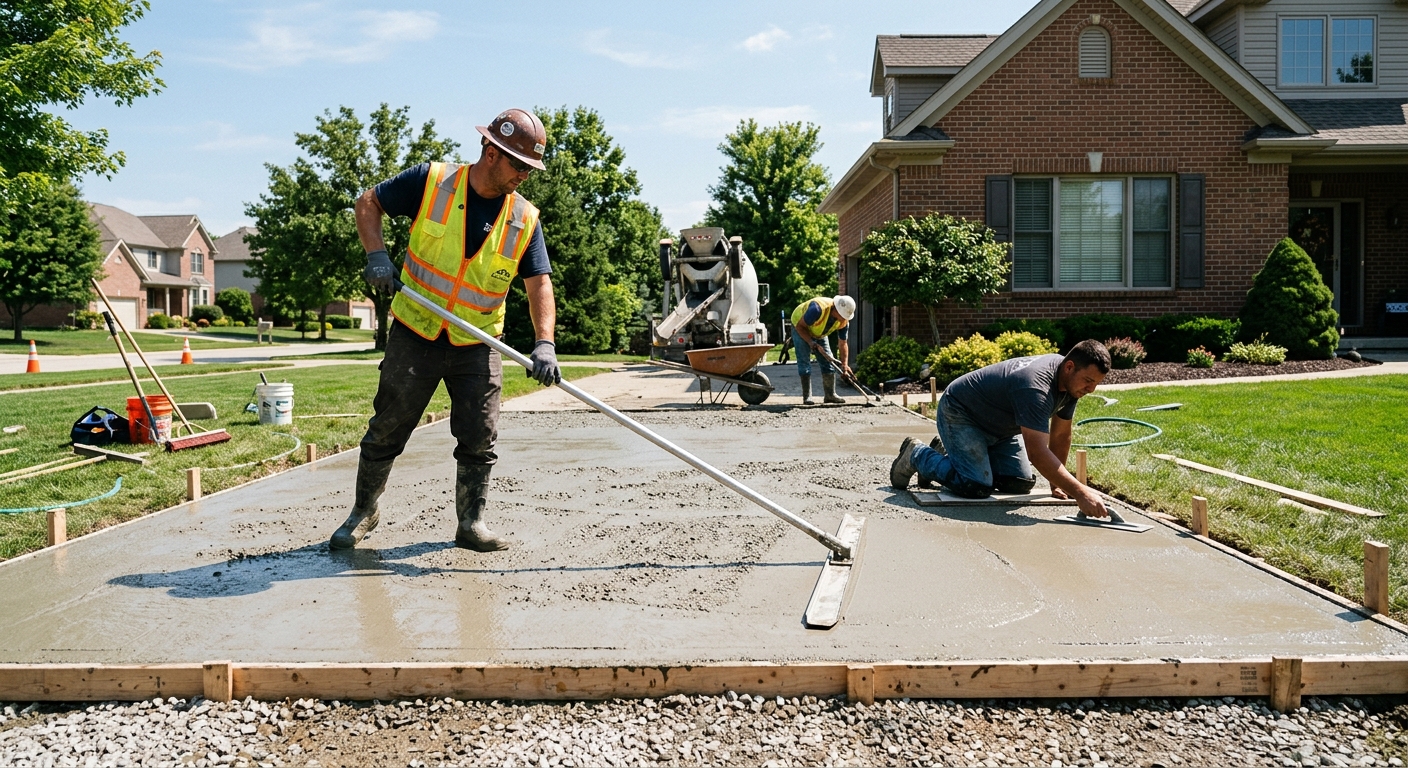
Concrete work options and costs in Bluewater
Concrete work is a big part of home maintenance in Bluewater, especially for homeowners with driveways, patios, and walkways. In this area, most houses are single-detached homes (82.5% of dwellings), and a strong majority of households own their homes (83.5%). That’s exactly the market that keeps crews busy on flatwork upgrades—reshaping entries, widening drive lanes, replacing cracked pads, and adding more durable finishes on high-traffic surfaces.
In the Stratford–Bruce Peninsula region, pricing is influenced by the freeze–thaw cycle and deep frost. We routinely plan excavations so structural footings sit below the design frost depth, and exterior slabs are built with air-entrained concrete and a properly compacted granular base. Cold-weather pours also compress the season—many pours happen late spring through early fall, and any work that runs into cooler weeks needs added labour for insulation/heating and longer curing control. Add coastal moisture exposure near Lake Huron and Georgian Bay, and you’ll often see thicker bases, stricter drainage grading, and better curing practices to reduce long-term moisture damage.
In Bluewater, contractor demand is especially steady around the residential areas that sit closer to main access roads and shoreline-adjacent neighbourhoods, where drainage and surface durability matter most. Below are typical cost bands homeowners compare when they’re getting quotes, before we talk about what can move the final number.
| Application |
Typical Size |
Key Spec |
Finish Option |
Price Range |
| Concrete driveway (standard broom finish) |
400–600 sq. ft. |
Air-entrained mix, compacted granular base, typical control joints |
Broom finish, sealed optional |
$6,400–$12,000 |
| Exposed aggregate driveway |
400–600 sq. ft. |
Air-entrained mix, higher cement paste control, curing discipline |
Exposed aggregate, non-slip finish texture |
$10,000–$15,500 |
| Stamped concrete driveway or patio |
300–500 sq. ft. |
Air-entrained mix, integral colour or release agent system |
Stamp + colour, often with sealer |
$9,000–$16,000 |
| Plain concrete patio or walkway |
200–350 sq. ft. |
Compacted base, air-entrained mix, edging and jointing |
Broom finish or trowel/light broom |
$3,000–$7,000 |
| Garage floor (interior slab) |
300–500 sq. ft. |
Vapour/ground prep as needed, base compaction, reinforcement if specified |
Broom or smooth finish |
$4,500–$10,500 |
| Foundation footings (structural, below frost) |
Per lineal ft. or home-sized scope |
Engineered dimensions, below-frost excavation, rebar cage per plan |
Structural concrete only (forming/pumping as required) |
$8,500–$16,000 |
Prices are estimates only and vary by project scope, site access and material selection.
What affects the price of concrete work in Bluewater
Even when homeowners describe the “same” job, concrete quotes in the Stratford–Bruce Peninsula region can vary by 30–50% because the hidden work is rarely identical: excavation depth, base thickness, drainage corrections, reinforcement decisions, and cold-weather curing controls. In Ontario, our frost expectations and freeze–thaw cycles dictate that structural elements and exterior slabs are built for movement and moisture. That means contractors price the full system—base, mix, joints, and cure—not just the concrete you see at the finish line.
Footings must extend below the design frost depth to prevent frost heave and cracking, which often means deeper excavation and more forming than in milder parts of Ontario. Exterior flatwork also needs air-entrained concrete to survive repeated freeze–thaw cycles; without it, you’re more likely to see surface scaling and spalling. The region’s shorter pour season means more work is stacked into late spring to early fall; if a pour drifts into cooler temperatures, cold-weather curing precautions (insulation blankets, heating, tighter temperature control) add labour and materials.
Coastal-wet exposure near Lake Huron and Georgian Bay can also increase base and drainage scope. For example, if your driveway area requires additional granular removal to fix poor drainage, that can push you toward higher-end driveway pricing in the $16,000–$22,000 band. Conversely, a straightforward patio replacement with minimal grading and a small access footprint may land closer to the $14,000–$20,000 patio/walkway range depending on finish choice.
Housing age matters too. With 60.5% of homes built before 1981, many sites have older drainage patterns and sometimes older subgrades that need correction before you pour. On a typical driveway, that “prep gap” can add several thousand dollars—often money well spent to avoid repeating the job after another winter.
| Price Factor |
Why It Matters |
Cost Impact |
| Frost line depth |
Determines footing depth and form height |
More excavation and forming can add several thousand dollars on structural scopes |
| Site preparation |
Excavation, grading, compacted granular base |
Poor subgrade or regrading can shift costs toward the upper driveway/patio band |
| Reinforcement |
Rebar or wire mesh requirement |
Material + labour; required for thicker slabs, garage floors, and some exterior designs |
| Mix design |
Air-entrainment and compressive strength spec |
Air-entrained mix is essential for exterior durability; spec upgrades add material cost |
| Finish type |
Broom vs. stamped vs. exposed aggregate |
Stamped/exposed systems increase labour and material handling |
| Pour size and concrete truck access to site |
Impacts crew time, pump needs, and lineal handling |
Limited access can mean additional equipment or smaller batch logistics |
| Cold-weather curing precautions |
Heating and blankets |
Common cost driver when scheduling moves into cooler weeks |
| Control joint pattern and sealing cost |
Manages shrinkage cracking; sealing helps with de-icing exposure |
Good jointing and sealing typically adds cost but reduces premature spalling |
Permits & regulations in Ontario
In Ontario, structural concrete work typically requires a building permit and often engineered drawings reviewed as part of the permit process. That means foundation walls, footings, grade beams, and any structural elements tied to the footing system are generally permit-driven. For a homeowner in Bluewater, that’s the work that needs the most documentation because it’s part of the building’s load path and must match the engineering and frost-resistant design requirements.
Concrete flatwork—such as driveways, patios, walkways and garage slabs—usually does not require a permit when it’s staying within typical lot grading and municipal compliance. It can require review or approval if the work changes lot drainage, affects impervious surface coverage limits, or interacts with municipal right-of-way/sidewalk conditions. Because rules can vary by site and how grading is handled, it’s best to confirm with the local authority before breaking ground.
To verify the contractor in Ontario, don’t rely on a verbal “we’re insured.” Step by step: (1) confirm the contractor’s business status and licence details using the applicable online registry they provide (ask them for their business number/contractor information); (2) request a certificate of insurance showing liability coverage and ensure it names you as an additional insured where applicable; (3) ask for proof of coverage for worker protection (WSIB/WCB paperwork, depending on their status) and expiry dates; and (4) request references from similar-scale projects done in your area’s freeze–thaw conditions. A reputable crew should provide documents quickly and without pressure.
Getting concrete right in Bluewater's freeze-thaw climate
Concrete fails in Bluewater mostly when the “invisible” layers aren’t designed for our freeze–thaw cycle and moisture exposure. The biggest issues I see are spalling and scaling from inadequate air-entrainment, uneven support from thin or poorly compacted granular base, and random cracking from weak joint planning. Ontario’s winter chemistry and de-icing habits also matter—once salts get into damaged surfaces, freeze expansion accelerates deterioration.
To spec the job correctly for Bluewater and the Stratford–Bruce Peninsula market, start with base preparation: use a compacted granular sub-base to the correct depth for local soil and frost considerations, and build drainage so water doesn’t sit under slabs. Next, require an exterior mix design with air-entrainment (commonly 5–7% air content for exterior flatwork) and specify a minimum 32 MPa compressive strength unless the engineer or designer calls higher. Control joints should be planned and cut early so shrinkage cracks occur where they belong, not randomly after the first couple winters. Curing is also critical: plan for proper curing conditions and don’t treat cold-weather pours like warm-season work—insulating blankets and heating can be necessary to maintain temperatures. Finally, apply a penetrating sealer after cure (typically after about 28 days) to help repel de-icing salts.
Here’s a cost example that helps explain value: if a standard driveway quote in Bluewater is around the $16,000–$22,000 band, adding proper air-entrainment, correct base depth, and early jointing might push it toward the upper end. That difference is usually justified compared to cheaper mixes that risk spalling—especially in a housing market where many homes are older and subgrades may need more correction.
| Spec |
Why It Matters in Bluewater |
What to Ask For |
Impact if Skipped |
| Compacted granular base (depth?) |
Supports the slab through frost movement and prevents settlement |
Base thickness by design, soil proofing/compaction method, drainage grade plan |
Settlement, cracking, and premature surface damage |
| Air-entrained concrete mix (target air %?) |
Protects against freeze–thaw scaling and spalling |
Specify air content target (commonly 5–7% for exterior flatwork) and mix source |
Spalling and scaling within a few winters |
| Compressive strength (MPa rating) |
Strength development supports durability and load capacity |
Minimum 32 MPa (or higher if specified), curing temperature approach |
Surface wear, reduced long-term performance |
| Control joints (spacing per ACI guidelines) |
Creates predictable crack locations during shrinkage |
Planned joint layout, saw-cut timing, and sealing plan |
Random cracking and water intrusion into joints |
| Minimum 7-day curing period |
Proper curing helps concrete resist early freeze stress |
How curing is maintained (blankets/heating in cold weather) |
Weak surface, increased scaling risk |
| Penetrating sealer (when applied after cure) |
Helps limit de-icing salt and moisture damage |
Penetrating sealer application after cure (about 28 days) and coverage rate |
Faster deterioration of surface paste and spalling |
How to choose a concrete work contractor in Bluewater
Choosing the right concrete contractor in Bluewater starts with verifying coverage and doing your paperwork checks. First, confirm Ontario licensing/business details. Next, request a certificate of liability insurance—make sure it covers the type of concrete work you’re hiring for and check that it won’t lapse during the project. Then ask for WSIB/WCB proof of coverage (or a documented exemption where applicable, if their business structure allows). You should also be able to see expiry dates and the policy limits. A crew that can’t produce insurance and coverage documentation quickly is a risk, especially in a region where frost and drainage errors can cost thousands to correct.
Get 2–3 itemised written quotes, not just a lump sum. The best quotes separate labour and materials, and they clearly list what’s included: excavation depth, granular base thickness, reinforcement (if required), concrete mix/method, saw-cut joints, curing plan, and whether disposal is included. Ask whether a permit pull is included (for structural work it usually is), and whether any engineering sign-off is part of the scope. In Ontario, structural elements like footings and foundation walls should be aligned with permit requirements.
Warranty matters too: look for a workmanship warranty length for installation, and ask whether there’s a separate manufacturer warranty for any coatings/sealers or systems. Clarify if the warranty is transferable to a future buyer. For payment, don’t approve large upfront amounts—keep deposits around 10–15% and use a holdback until complete, with a written completion checklist. Finally, get the start date and the completion estimate in writing so scheduling issues don’t turn into cold-weather pours without notice.
- Ask for proof of liability insurance and confirm coverage expiry dates
- Request WSIB/WCB documentation (or valid exemption paperwork)
- Confirm they’ve done similar Bluewater-area freeze–thaw projects
- Get a detailed, line-item quote (not a single number)
- Verify excavation depth and granular base thickness are stated
- Ensure air-entrainment is specified for all exterior concrete
- Confirm reinforcement plan (rebar/mesh) matches slab type
- Ask about joint layout and when saw cuts will occur
- Review curing and cold-weather procedures for late-season work
- Confirm sealing is included or offered (and when it will be applied)
- Check what’s included for drainage grading and disposal
- Use a contract schedule with milestones and a completion checklist
If you’re seeing excuses about air-entrainment, vague “we’ll do base” language without thickness, no mention of joints/cure/insulation plans, change orders that aren’t itemised, or contractors asking for most payment upfront before the pour—those are concrete red flags in Bluewater.
Frequently asked questions — concrete work in Bluewater
What causes concrete to spall in Bluewater winters?
Spalling in Bluewater usually comes from freeze–thaw damage where water enters the concrete and expands as temperatures drop. The most common trigger is inadequate air-entrainment for exterior slabs: without the right air void system (commonly 5–7% for exterior flatwork), the paste can’t resist expansion and the surface flakes or pops off. Moisture pathways matter too—thin granular base, poor drainage grading, or joints that weren’t cut and sealed properly let water sit near the surface. De-icing salts add another problem by speeding surface breakdown once the concrete is already micro-damaged. In a market with older housing stock (60.5% built before 1981), some driveways and walkways also start with subgrade conditions that increase water retention. If you’re quoted near the $16,000–$22,000 driveway band, make sure the quote explicitly includes air-entrained mix, correct base prep, proper jointing, and a curing plan.
What is rebar and when is it required in Ontario?
Rebar (reinforcing steel) is used to help concrete resist tensile stresses and control cracking. In Ontario, whether rebar is required depends on the type of structural element and what the drawings/engineer specify. For example, foundation footings and foundation walls are structural work and typically involve rebar cages or bars as designed for the load and frost conditions. For concrete flatwork like patios, driveways, and walkways, rebar or mesh is sometimes used but not always—many slabs rely on proper thickness, base preparation, and jointing. That said, thicker slabs, heavy loads (like certain driveway designs), garage floors, and slabs with settlement risk often call for reinforcement. The safest approach is: require the contractor to follow the plan/spec and state reinforcement placement in writing (size, spacing, and cover). If you’re adding reinforcement but they can’t explain it in relation to the slab design, ask for the design basis as part of the permit/quote package.
How long does a concrete project take in Bluewater?
For Bluewater, typical timelines depend on size, access, and whether you’re working in the late spring to early fall window. A straightforward concrete patio or walkway might take about 1–3 days on site—excavation and base prep day, pour day, then finishing and protection. A driveway with more excavation, base work, and edging can take about 2–5 days depending on truck access and whether forms and reinforcement are needed. Curing is what dictates usable time: concrete is usually kept protected and curing for at least 7 days before you allow full heavy use, and sealer schedules often follow later (commonly after about 28 days). If a pour happens in cooler weather, contractors may need heating/insulating blankets to maintain temperatures, which can add time and labour. Because the Stratford–Bruce Peninsula region has a short pour season, scheduling can also compress—book early and get the start/finish estimate in writing so your pour doesn’t shift into unsafe curing conditions.
What is a concrete overlay and is it suited to Bluewater?
A concrete overlay is an additional concrete layer placed over an existing slab—often used to refresh driveways or patios when the old concrete is mostly still structurally sound. In Bluewater, overlays can be suitable, but only after a careful assessment. If the existing slab has significant settlement, deep spalling, or extensive cracking that indicates movement, an overlay usually just locks in the problem and may fail faster under freeze–thaw cycles. Overlays need proper surface preparation: grinding, cleaning, and ensuring good bond, plus appropriate thickness and mix design. Joints and drainage also matter—if water is pooling, the overlay may deteriorate around the problem areas. If your goal is durability in a freeze–thaw climate, it’s worth comparing overlay pricing against full replacement. For reference, many exterior projects in this area are priced in bands like driveway work at $16,000–$22,000 and patios/walkways at $14,000–$20,000; your contractor should explain whether overlay saves money after accounting for prep and long-term risk.
How do I seal concrete to protect it in Bluewater?
To protect concrete in Bluewater, sealing is about limiting moisture and de-icing salt penetration—especially important in our freeze–thaw environment. The key is timing: for most penetrative sealers, you apply them after the slab is cured, commonly around 28 days post-pour. That means you shouldn’t seal too early, or the concrete can still be releasing moisture, reducing effectiveness. Before sealing, the surface should be clean and dry; contractors typically wash or allow proper drying after any curing steps. For exterior slabs, ask specifically for a penetrating sealer (not just a superficial film) and confirm expected coverage rate and drying conditions. Also understand maintenance: seals wear over time, and colder winters can shorten intervals depending on traffic and salt use. If your contractor is proposing sealing as an add-on, get it in writing as part of the timeline so you’re not left with an unsealed surface in the same winter it was poured.
What is the difference between concrete and cement?
Concrete and cement are closely related but not the same thing. Cement is the binder—essentially the fine powder that reacts chemically with water to “set” and gain strength. Concrete is the finished building material made by mixing cement with water, aggregates (sand and gravel), and sometimes admixtures like air-entrainment or plasticizers. In Bluewater’s exterior work, the concrete mix design matters more than the word “cement” because performance depends on the full recipe. For example, air-entrainment is a concrete admixture strategy that helps the finished concrete resist freeze–thaw scaling and spalling. When you compare quotes, don’t just ask “what cement are you using?” Ask for the concrete mix spec—air content target, compressive strength (often 32 MPa for many exterior applications), and curing approach. A well-built driveway or patio priced within local bands such as $16,000–$22,000 should include those performance specs, not just the presence of cement.