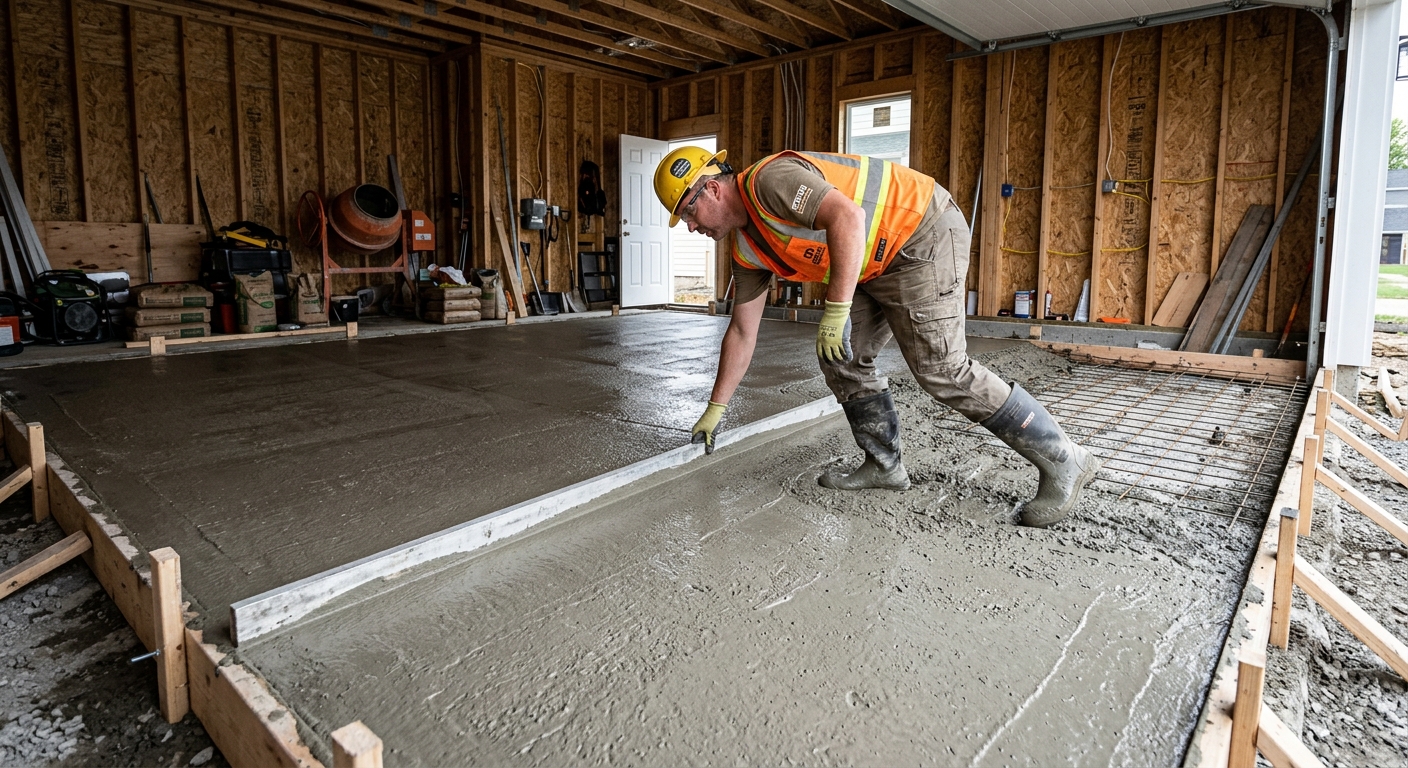
Concrete work options and costs in Brantford
Concrete work in Brantford ranges from straightforward broom-finished driveways to architectural stamped finishes, and the right option usually depends on your foundation needs, drainage control, and how long you want the surface to look sharp. In Brantford, concrete flatwork is especially common because single-detached homes make up 60.6% of local dwellings, and nearly two-thirds of households are owner-occupied (66.0%)—that typically means more homeowners reinvesting in driveways, patios, and entry walks. With a population of 104,688 (Statistics Canada, 2021 Census), there’s solid contractor capacity, but the busy season is concentrated. The Hamilton–Niagara Peninsula sits in a cold, wet Great Lakes corridor, so freeze-thaw stress and moisture exposure drive the specs: we design footings below frost and we specify air-entrained mixes and tighter control joint planning for exterior slabs. That’s also why pricing isn’t “one-size-fits-all” here—deeper excavations, more stone base, reinforcing steel, and seasonal labour premiums can raise installed costs, especially on projects that need rebar, proper drainage, or cold-weather protection.
If you’re in a neighbourhood with older housing stock—like parts of West Brant or around the older cores near downtown—many lots have post-1980 additions or retrofit drainage, and that increases site-prep time. For most homeowners, the fastest way to compare bids is to line up what’s being poured (driveway vs. patio vs. foundation), the finish level (broom vs. stamped vs. exposed aggregate), and whether the price includes base, reinforcement, and curing.
Use the table below as a practical cost map for Brantford so you can compare apples to apples.
| Application |
Typical Size |
Key Spec |
Finish Option |
Price Range |
| Concrete driveway (standard broom finish) |
400–600 sq ft |
Air-entrained, compacted granular base, control joints |
Broom finish |
$14,000–$22,000 |
| Exposed aggregate driveway |
400–600 sq ft |
Air-entrained, wash/expose surface plan, sealed exterior |
Exposed aggregate |
$18,000–$28,000 |
| Stamped concrete driveway or patio |
250–500 sq ft |
Air-entrained, release agent, colour hardener option, joints |
Stamped & textured pattern |
$22,000–$35,000 |
| Plain concrete patio or walkway |
150–300 sq ft |
Air-entrained, base prep, proper edge restraints |
Broom or lightly trowelled |
$12,000–$20,000 |
| Garage floor (interior slab) |
300–500 sq ft |
Vapour barrier where needed, reinforcement as specified |
Steel-trowelled or broom-ready finish |
$6,500–$12,500 |
| Foundation footings (structural, below frost) |
Varies by home size |
Engineered rebar, formwork, concrete placed below frost depth |
Structural concrete (no decorative finish) |
$10,000–$22,000 |
Prices are estimates only and vary by project scope, site access and material selection.
What affects the price of concrete work in Brantford
In Brantford and across the Hamilton–Niagara Peninsula, quotes for the “same” concrete job can vary by 30–50% because the hidden work drives most of the cost: excavation, base build-up, reinforcement, drainage, and winter or shoulder-season curing protection. Even small differences—like whether the contractor accounts for frost depth properly or whether the mix is truly air-entrained—can change both the amount of concrete and the labour time. In this region, frost depth typically pushes exterior footings to 4 ft or deeper, so the forms and granular base quantities climb quickly on sloped or poorly draining lots. We also expect more freeze-thaw cycles off Lake Ontario and Lake Erie, which is why exterior slabs need air-entrained concrete and good joint spacing, not shortcuts.
Seasonality is another price driver. Most exterior concrete work is scheduled roughly May–October, and if you pour during shoulder months, you’ll often pay for hoarding, insulating blankets, and careful cold-weather curing. De-icing salts later in winter also accelerate surface wear if the surface isn’t protected with the right curing and sealing plan. For example, a standard broom-finish driveway can land near the regional $14–$22 per sq ft range, but if your plan requires extra excavation, drainage improvements, and air-entrained spec compliance, you can realistically see pricing move toward the high end. Likewise, stamped & decorative work (often $22–$35 per sq ft equivalent pricing band, depending on size and detailing) costs more because colour hardeners, release agents, and finishing time are labour-intensive—yet it may be justified when you want curb appeal, reduced maintenance, and a more durable, sealed finish.
Local housing age matters too: with 62.8% of homes built before 1981 (Statistics Canada, 2021 Census), retrofit projects often encounter older services, settled base material, and drainage tie-ins. A site that needs extra stone and regrading can add thousands even if the final slab area looks similar on paper.
| Price Factor |
Why It Matters |
Cost Impact |
| Frost line depth — determines footing depth and form height |
Exterior support must extend below design frost to prevent heave |
Higher excavation and concrete volume can raise cost significantly |
| Site preparation — excavation, grading, compacted granular base |
Good sub-base reduces settlement and improves drainage stability |
Rock, hauling, and regrading add labour and disposal costs |
| Reinforcement — rebar or wire mesh requirement |
Rebar helps manage cracking in heavier loads and exterior exposure |
Material + tying/placement time adds cost |
| Mix design — air-entrainment and compressive strength spec |
Air-entrainment is critical for freeze-thaw survival outdoors |
Premium mix and tighter batching can move pricing upward |
| Finish type — broom vs. stamped vs. exposed aggregate |
Decorative finishes require more labour and specific processes |
Stamped/exposed typically increases total project price |
| Pour size and concrete truck access to site |
Access affects crew time, pump use, and wait times |
Long carries, pump charges, and truck positioning can add thousands |
| Cold-weather curing precautions — heating and blankets |
Protecting fresh concrete prevents damage during temperature swings |
Insulation blankets, heaters, and labour premiums increase cost |
| Control joint pattern and sealing cost |
Joints manage shrinkage/thermal movement; sealing reduces salt damage |
More joints and proper sealing add material and labour |
Permits & regulations in Ontario
In Ontario, structural concrete work generally needs a building permit, and in many cases engineered drawings reviewed by the municipality. That includes items like foundation footings, foundation walls, and grade beams—because these elements affect the building’s load path and safety. For those jobs, the inspector may want to see reinforcement placement, footing elevations below frost, and proper concrete placement documentation before the pour is covered.
Concrete flatwork—such as driveways, patios, and walkways—usually does not require a permit in Ontario, unless it affects lot grading, changes stormwater drainage patterns, or triggers municipal impervious surface coverage and right-of-way conditions. In Brantford, if you’re altering drainage, connecting to existing drainage infrastructure, or working close to municipal boundaries, you should confirm requirements before starting. The municipality’s expectations can affect the schedule, too.
How to verify your contractor (step-by-step) in Ontario:
- Ask for a copy of their liability insurance certificate (COI) showing current coverage.
- Confirm WSIB/WCB coverage—request clearance information or proof of registration/coverage status.
- Verify the contractor’s registration/licence as applicable for concrete work in Ontario through appropriate online resources or by asking for documentation they can provide.
- Get written references for similar-scale driveway/patio and any foundation-adjacent projects.
- Ensure they carry liability for site work, including excavation and protection of surrounding property.
Getting concrete right in Brantford's freeze-thaw climate
Brantford’s freeze-thaw climate is hard on concrete because water gets into pores and micro-cracks during thaw periods, then expands during freezes. Over repeated cycles, that leads to scaling (spalling), surface deterioration, and sometimes structural cracking if the base or reinforcement plan is wrong. To spec the job correctly in the Hamilton–Niagara Peninsula, you want five things nailed down: (1) base preparation, (2) an air-entrained exterior mix, (3) control joints sized and spaced to manage shrinkage and thermal movement, (4) curing protection long enough for strength gain, and (5) sealing after the concrete has properly cured to resist de-icing salt damage.
Base preparation: For exterior work, we build a compacted granular sub-base to the depth needed for local soil and frost conditions. (If the base is shallow or not compacted, the slab can settle and crack even with a good finish.)
Mix design: For exterior flatwork, I typically look for 5–7% air content and a minimum 32 MPa compressive strength. This combination supports durability under freeze-thaw exposure when done correctly.
Control joints: Proper spacing reduces random cracking and gives cracks a planned path.
Curing: Plan for at least a 7-day curing period under suitable conditions; in cooler shoulder months, curing blankets and temperature protection can be the difference between long life and early scaling.
Sealing: Apply penetrating sealer after cure (often at 28 days post-pour) to repel moisture and help reduce salt-driven surface loss.
Here’s where the price difference can be justified: if a quote for a driveway is much lower than the typical $14–$22 band, it’s often because it under-specced the granular base, used a less durable mix, skipped reinforcement where required, or didn’t include curing/sealing. In a freeze-thaw market like Brantford, those shortcuts tend to cost more later through repairs and rework.
| Spec |
Why It Matters in Brantford |
What to Ask For |
Impact if Skipped |
| Compacted granular base (depth?) |
Prevents settlement and frost-related movement in exterior slabs |
State granular base depth, compaction method, and drainage details |
Cracking, uneven slabs, and early failure around edges |
| Air-entrained concrete mix (target air %?) |
Improves durability during freeze-thaw cycles |
Request target air content (commonly 5–7% for exterior flatwork) |
Higher risk of spalling/scaling on the surface |
| Compressive strength (MPa rating) |
Ensures strength gain and better crack resistance |
Minimum 32 MPa specified for exterior work |
Weaker concrete leading to faster surface wear |
| Control joints (spacing per ACI guidelines) |
Controls where cracks occur as concrete shrinks/expands |
Joint layout drawing or written spacing plan |
Random cracking and wider, more noticeable distress |
| Minimum 7-day curing period |
Supports proper strength development in a changing-temperature climate |
Confirm curing plan; specify protection if temperatures drop |
Surface damage, reduced long-term performance |
| Penetrating sealer (when applied after cure) |
Repels moisture and helps reduce de-icing salt damage |
Apply after cure—typically around 28 days post-pour |
More salt staining, scaling, and faster deterioration |
How to choose a concrete work contractor in Brantford
Choosing the right concrete contractor in Brantford comes down to proof, clarity, and process—not just the lowest number. Start with compliance: in Ontario, verify the contractor carries liability insurance and WSIB/WCB coverage. To check, request a current certificate of insurance (COI) naming you as applicable certificate holder if their process allows it, and ask for WSIB/WCB proof or clearance documentation. Then ask how they handle crew safety and site protection (especially around excavation and concrete delivery).
Next, get 2–3 written, itemised quotes. For concrete, the best bids break costs down into labour and materials—base preparation, granular base, reinforcement, concrete mix design, finishing, saw cutting/control joints, curing protection, disposal, and sealing—rather than a single lump sum. Carefully read what’s included and excluded: permit pull included or not, disposal of excavated material, protection of landscaping and services, and any allowance for pump use or extended carries if truck access is tight.
Warranty matters. Ask for a workmanship warranty length and what it covers (for example, settlement-related issues vs. surface aesthetics). Also ask whether the product/manufacturer warranty (if used for specific sealers or repair products) is transferable.
On payment, I recommend you keep control of cash flow: never pay more than 10–15% upfront. Hold back a portion until the job is complete, inspected, and any deficiencies are corrected. Finally, insist on a start date and completion estimate in writing—Brantford’s seasonality means delays can affect curing, especially when temperatures swing.
- Ask for liability insurance COI and verify it’s current.
- Confirm WSIB/WCB coverage and request proof/clearance.
- Require itemised labour/materials pricing (no “mystery lump sum”).
- Confirm air-entrainment and minimum compressive strength on exterior pours.
- Ask about base depth, grading plan, and compaction method.
- Verify reinforcement requirements (rebar vs. mesh) for your slab type.
- Confirm control joint spacing plan and saw-cut timing.
- Ask about curing method and cold-weather contingency (blankets/heaters).
- Confirm sealing inclusion (penetrating sealer after cure) if exterior.
- Review disposal/haul-away costs for excavated material.
- Check whether traffic management and protection of neighbouring property is included.
- Put warranty terms in writing, including what triggers a warranty claim.
Concrete red flags I watch for in Brantford: contractors who won’t discuss frost-depth/base prep specifics, bids that ignore air-entrainment or control joints, “too-good-to-be-true” pricing below the typical $14–$22 driveway band without a detailed explanation, reluctance to provide COI/WSIB proof, and vague warranty language that doesn’t specify workmanship coverage or timelines.
Frequently asked questions — concrete work in Brantford
How much does concrete work cost in Brantford?
Concrete pricing in Brantford depends on finish level, site access, base preparation, and whether your project is exterior or structural. For exterior flatwork, many homeowners land in the regional driveway/slab band of about $14,000–$22,000 for a standard broom-finish driveway, with higher costs when decorative finishes are included. Plain patios and walkways commonly sit around $12,000–$20,000 depending on size and edge details. If you want stamped concrete, the decorative pricing band typically runs $22,000–$35,000 based on square footage and complexity. Foundation/footings are priced separately (structural, below frost). Because Brantford is in a cold, wet Great Lakes corridor, quotes also rise when extra excavation, drainage improvements, reinforcement, and cold-weather curing precautions are needed.
How deep must footings be for Brantford's frost line?
In Brantford, exterior structural footings must extend below the design frost depth to prevent frost heave and movement. In the Hamilton–Niagara Peninsula, frost depth typically pushes footings to around 4 ft or deeper in many cases, and the exact depth should follow the engineered foundation plan for your soil conditions and building loads. That’s why two foundation quotes can differ even when the house looks similar—depth, rebar density, form height, and the amount of excavation vary by site. For structural work in Ontario, you’ll generally need a building permit and often engineered drawings reviewed by the municipality, and your contractor should be able to show how their excavation elevations align with the frost requirement.
Why does concrete crack in Brantford and how is it prevented?
Concrete cracks for predictable reasons: shrinkage, thermal movement, settlement from inadequate base, and moisture-driven distress. Brantford’s freeze-thaw cycles make moisture management and durable materials especially important—water gets into pores during thaw and expands during freezes, which can worsen surface scaling if the mix and finishing weren’t right. Prevention starts with a properly compacted granular base to the correct depth, using an exterior air-entrained concrete mix, and planning control joints so cracks occur where you want them. Proper curing is also critical in Ontario’s cooler weather windows; curing blankets or heating can be required when temperatures fluctuate. Lastly, sealing after the concrete cures helps reduce de-icing salt impacts, which can otherwise accelerate spalling on driveways and steps.
Stamped vs broom-finish concrete — cost difference?
Stamped concrete costs more than a broom-finish driveway because it involves extra steps: colour hardeners or colour pigments, release agents, stamping labour, and careful finishing around the joint layout. In Brantford, a typical broom-finish driveway often falls near $14,000–$22,000 depending on size and access, while stamped concrete driveway or patios commonly fall in the decorative band of $22,000–$35,000. If your contractor is quoting stamped and broom at similar numbers, it’s worth asking whether the stamped scope includes proper base prep, air-entrainment, control joint work, and sealing. Those technical details affect durability and lifespan, not just appearance.
When is the best time to pour concrete in Brantford?
The best time to pour concrete in Brantford is typically during the May–October window when scheduling is more predictable and temperatures support proper curing without heavy temperature-protection measures. Brantford’s cold, wet Great Lakes weather can cause temperature swings that complicate finishing and curing if you pour too late in the season. In shoulder months, contractors may use hoarding, insulated curing blankets, and heaters to protect fresh concrete—those add cost and must be planned in advance to avoid early damage. If you’re considering a driveway or patio, aim for a period when daily temperatures stay consistently supportive and drainage work can be completed so water doesn’t sit under or beside the slab.
How long does concrete take to cure?
Concrete curing has two parts: early strength gain and longer-term strength development. For exterior work in Brantford, a good minimum baseline is a curing period of at least 7 days under proper conditions before you expect heavier tolerance or moving in a normal way around the surface. Full performance continues to develop beyond that, and if you plan to seal, penetrating sealers are typically applied around 28 days after the pour to ensure the slab is ready to receive it. In Ontario, cold nights, wind, and moisture can slow curing, so reputable contractors build a protection plan—especially if you pour close to cooler weather. If you’re comparing quotes, ask exactly what curing and protection they include during the first week.