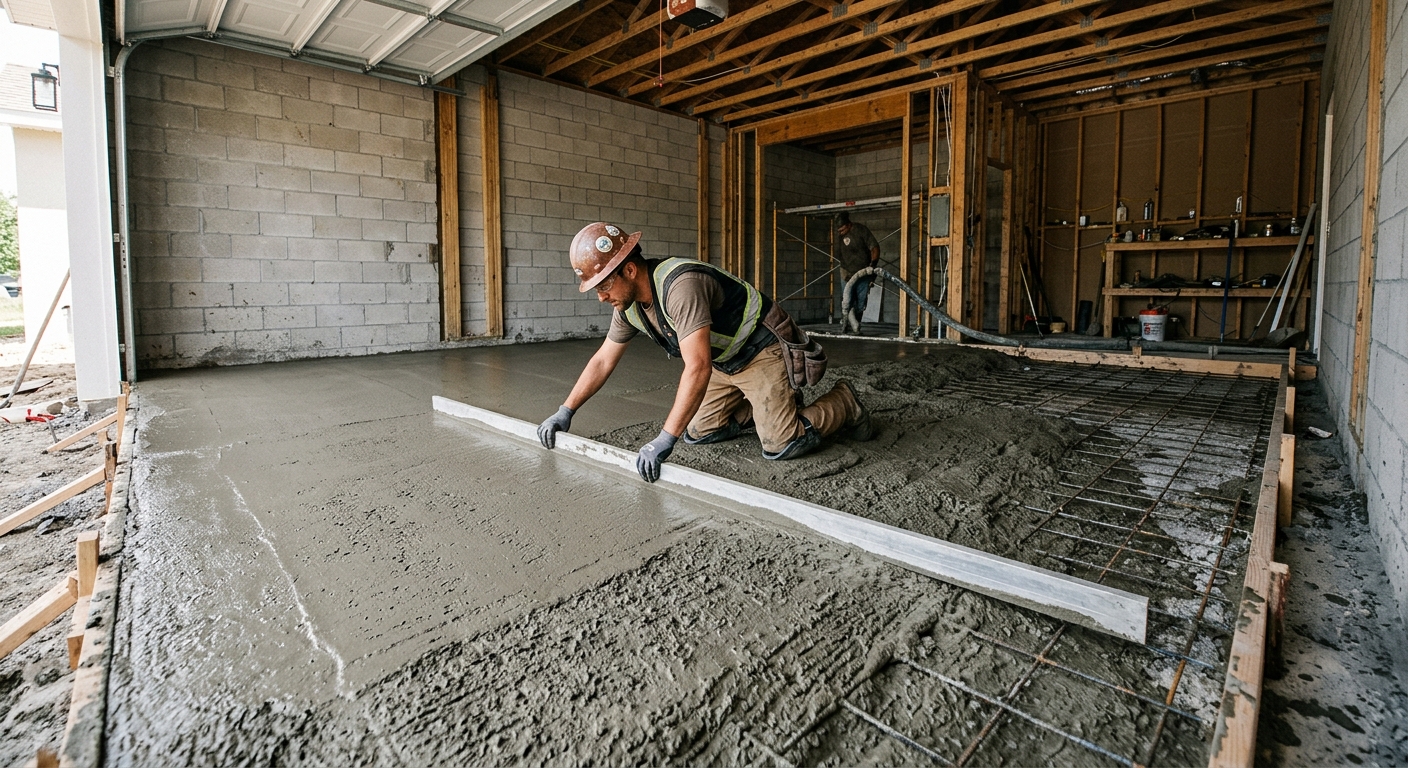
Concrete work options and costs in Belleville
Belleville homeowners typically have a clear mix of concrete needs—driveways, patios, walkways, garage slabs, and structural footings—because the area is dominated by single-detached homes (59.4% of dwellings). With 14,720 homeowner households across the census profile (62.5% of households own), it’s a steady market for exterior flatwork that takes foot traffic, snow removal, and de-icing salt. For older properties, that matters: 63.6% of homes in the local profile were built before 1981, so upgrades like new driveway aprons, replaced porch slabs, and repaired footing drainage come up often.
In the Kingston–Pembroke region, concrete pricing is influenced less by the slab size you see on paper and more by what’s happening under it—frost depth, repeat freeze-thaw cycles, drainage, and how well the crew can work within the short pour season. Cold shoulder-season weather around Belleville can delay strength gain, and Lake Ontario/Bay of Quinte moisture conditions make curing discipline more important. Because those constraints affect scheduling, the availability of experienced finishing crews can tighten in peak weeks, and that can show up in labour-related quotes.
In neighbourhoods like Bell Boulevard/Franklin Park and along the east end corridor, we see especially strong demand for resurfacing and widening driveways, as well as new patios for backyard entertaining.
Below is a practical starting point for comparing quotes, then we’ll break down the biggest cost drivers that swing bids in Belleville’s climate.
| Application |
Typical Size |
Key Spec |
Finish Option |
Price Range |
| Concrete driveway (standard broom finish) |
400–600 sq. ft. |
Air-entrained mix; compacted granular base; control joints |
Broom finish |
$5,000–$9,500 |
| Exposed aggregate driveway |
350–550 sq. ft. |
Air-entrained mix; exposed aggregate wash; base and drainage prep |
Exposed aggregate |
$7,500–$13,500 |
| Stamped concrete driveway or patio |
300–600 sq. ft. |
Air-entrained mix; colour hardeners/colour; integral sealer-ready plan |
Stamped |
$10,000–$18,500 |
| Plain concrete patio or walkway |
200–400 sq. ft. |
Air-entrained mix; compacted base; smooth hand-trowel/steel trowel |
Plain |
$3,000–$6,500 |
| Garage floor (interior slab) |
400–700 sq. ft. |
Slab-on-grade; vapour considerations; reinforcing as specified |
Broom/steel finish |
$5,000–$12,000 |
| Foundation footings (structural, below frost) |
Varies by home |
Engineered rebar; concrete to design; excavation and forming |
Structural finish only |
$8,500–$18,000 |
Prices are estimates only and vary by project scope, site access and material selection.
What affects the price of concrete work in Belleville
In Belleville and the wider Kingston–Pembroke region, two homeowners can get quotes for “the same” concrete work and still see a 30–50% swing. The reason is that the slab price is only part of the story—excavation, gravel base preparation, reinforcement, formwork, finishing complexity, and how the crew protects the pour during weather changes can dominate the total. Material pricing and delivery distance affect every bid, but in our market the biggest differences usually come from site conditions and whether the contractor is pricing correctly for freeze-thaw durability.
Frost line depth and freeze-thaw cycles dictate every exterior spec: in Ontario, footings typically need to extend below the design frost depth (often around 1.5–2.4 m in design practice), and that means deeper excavation and more concrete than many homeowners expect. Exterior slabs should be air-entrained to survive repeated freezing, and colder shoulder-season conditions shorten the practical pour window. When temps dip, crews often add cold-weather curing precautions—insulating blankets, heaters, and extra schedule time—which increases labour. Also, de-icing salt accelerates spalling if the mix and curing weren’t right; that’s why sealing and disciplined finishing matter. Even driveway costs that start in the $120–$180 per sq. ft. tier can move up when access is tight, base is weak, or rebar detailing changes.
Concrete work can also come in lower in Belleville when the site is straightforward: good drainage, easy truck access, and native soil that supports compaction can reduce gravel and excavation. Conversely, if you’re replacing an older driveway on a pre-1981 lot (63.6% built before 1981 in the local profile), you often uncover buried bases, poor compaction, or old drainage—those fixes can push a project from “plain patio” pricing closer to the higher flatwork bands, and stamped jobs naturally land in the decorative tiers (often supported by the $160–$280 stamped & decorative pricing band depending on scope).
| Price Factor |
Why It Matters |
Cost Impact |
| Frost line depth |
Determines how deep footings must be and how tall forms/excavation are |
Can add significant excavation and concrete; biggest driver on foundation work |
| Site preparation |
Excavation, grading, and compaction of granular base affect long-term settlement |
Extra hauling and re-grading can increase costs materially |
| Reinforcement |
Wire mesh, rebar, and correct spacing improve crack resistance and structural capacity |
Labour + material cost changes depending on design/loads |
| Mix design |
Air-entrainment and strength spec determine durability in freeze-thaw cycles |
Improves performance; if not included, contractors may underprice but risk failures |
| Finish type |
Broom finish is simpler; stamped/exposed aggregate requires tighter control and extra steps |
Stamped/exposed typically costs more than plain flatwork |
| Pour size and concrete truck access to site |
Smaller pours and difficult access increase labour time and handling |
Extra crew time, waiting, and equipment can raise the total |
| Cold-weather curing precautions |
Heating/insulation helps strength gain and protects surfaces during cool periods |
Adds labour and materials; may also shift the schedule |
| Control joint pattern and sealing cost |
Joints manage cracking; sealing improves resistance to salt-driven spalling |
Sealing is an added line item; joint layout affects finish time and material planning |
Permits & regulations in Ontario
In Ontario, structural concrete work is regulated through the municipal building permit process. Projects such as footings, foundation walls, grade beams, and other load-bearing concrete elements typically require a building permit and, in many cases, engineered drawings that the municipality reviews. In contrast, concrete flatwork—driveways, patios, and walkways—usually does not require a permit unless it affects lot grading, drainage, impervious surface coverage limits, or the municipal right-of-way. Because local requirements can differ based on site conditions and the scope of work, it’s smart to confirm with the City of Belleville or your building office before breaking ground.
For contractor credibility, verify three things: (1) the company is properly licensed/registered for the work they’re doing, (2) they carry liability insurance, and (3) they have WSIB coverage (or the relevant WCB coverage where applicable). Step-by-step for homeowners in Belleville: first, request a certificate of insurance and confirm the policy includes general liability for the project scope. Next, ask for proof of WSIB/WCB clearance and keep the documentation with your contract. Finally, check references: ask for photos of similar foundation and flatwork jobs and, ideally, completed projects within the last 12–24 months.
If a contractor can’t provide these documents upfront, treat it as a red flag—concrete failures are expensive, and the permit/coverage paper trail protects you when something goes wrong.
Getting concrete right in Belleville's freeze-thaw climate
Belleville’s freeze-thaw cycle punishes concrete mistakes. The most common failure we see locally is spalling: the surface pops or scales off because water enters small pores and freezes, expanding and breaking the matrix. To spec concrete that survives here, you need to get five things right—base, mix, joints, curing, and sealing—rather than simply choosing “more expensive concrete.”
1) Base preparation: start with compacted granular sub-base at the right depth for frost considerations and drainage. Poor base compaction leads to settlement, which turns shrinkage and thermal movement into cracking. 2) Mix design: use air-entrained concrete for exterior flatwork, with typical target air content around 5%–7%, plus a minimum 32 MPa compressive strength unless your engineered design calls for more. 3) Control joints: place joints to control where cracks happen, not whether they happen. 4) Curing: protect the slab and allow proper curing—plan for at least 7 days under suitable conditions, and use heating/blankets if the weather turns cool. 5) Sealing: apply a penetrating sealer after the concrete has cured—commonly around 28 days—to help repel de-icing salt and moisture.
Here’s a realistic cost example: upgrading from plain broom-finish to a properly specified stamped driveway may cost an additional amount consistent with the decorative band, but the spend can be justified because stamping is paired with careful timing, tighter finishing tolerances, and typically higher attention to curing and joint aesthetics. If a bid looks low on the mix (no air-entrainment) or skips proper base and joints, it’s not a bargain—repairs in Belleville often cost more than the difference between finish options.
| Spec |
Why It Matters in Belleville |
What to Ask For |
Impact if Skipped |
| Compacted granular base (depth?) |
Ensures drainage and limits movement during freeze-thaw |
State granular base depth and compaction method; confirm drainage plan |
Settlement cracks, uneven surface, faster deterioration |
| Air-entrained concrete mix (target air %?) |
Improves freeze-thaw resistance by allowing safe expansion |
Ask for target air content (typically 5%–7% for exterior flatwork) |
Higher risk of spalling and surface scaling |
| Compressive strength (MPa rating) |
Controls early and long-term performance in cold exposure |
Confirm minimum 32 MPa (or engineered requirement) |
Surface damage, reduced durability, premature wear |
| Control joints (spacing per ACI guidelines) |
Manages shrinkage and movement to reduce random cracking |
Request joint spacing plan, saw-cut timing, and layout details |
Random cracking, water intrusion, more freeze-thaw damage |
| Minimum 7-day curing period |
Lets concrete reach needed strength before traffic and temperature swings |
Ask how long you’ll keep it closed and what protection is used |
Scuffing, cracking, and weak surface layer |
| Penetrating sealer (when applied after cure) |
Helps reduce salt and moisture penetration on exterior slabs |
Confirm product type and application timing (often ~28 days) |
Faster salt scaling and higher maintenance cost |
How to choose a concrete work contractor in Belleville
Choosing the right concrete contractor in Belleville is mostly about verification and clarity. Start by confirming Ontario coverage basics: ask for their liability insurance certificate and ensure the project is included on the policy. Next, request proof of WSIB/WCB coverage (and a clearance/coverage letter where applicable) so you’re not exposed if a worker is hurt on your site. For licensing/registration, check the contractor’s credentials through the proper online registry channels for Ontario and confirm the company name on their insurance matches the name on the quote.
Then get 2–3 itemised written quotes—not just a lump sum. You want line items for excavation, granular base prep, reinforcement, formwork, concrete supply/delivery, finishing, sealing (if included), and concrete protection/cold-weather provisions. Read exclusions carefully: is disposal included? Who supplies/places any geotextile or sub-drain? Is a permit pull included (if required) or is it the homeowner’s responsibility? A good contract should also confirm joint cutting approach and curing time requirements.
Finally, check warranty and schedule. Ask for the workmanship warranty length, whether it covers cracking/spalling related to workmanship, and whether the product/manufacturer warranty is separate. For payment, never pay more than 10–15% upfront—hold back until substantial completion. Get a written start date and completion estimate so weather-driven delays are accounted for up front.
- Request proof of liability insurance and confirm policy dates and job listing
- Ask for WSIB/WCB clearance documentation before work begins
- Verify the quote includes excavation, hauling, and disposal (or note the exclusion)
- Confirm granular base depth and compaction method, not just “base included”
- Require a written mix spec (air-entrainment for exterior) and minimum strength
- Ask about reinforcement type and where it’s placed (under vs mid-slab)
- Confirm control joint layout and who is responsible for saw-cut timing
- Ask how curing is protected in cool or damp weather
- Clarify whether sealing is included, and if not, what date it can be applied
- Check if concrete delivery distance and truck access are addressed
- Review warranty terms in writing (what’s covered, timeline, exclusions)
- Keep the payment schedule conservative (10–15% upfront; holdback to completion)
Concrete contractor red flags in Belleville include: quotes that omit air-entrainment for exterior slabs, no plan for joint layout and saw-cut timing, cutting corners on base preparation/compaction, starting without insurance/WSIB documents, and offering “instant traffic” timelines that ignore curing and protection.
Frequently asked questions — concrete work in Belleville
How deep must footings be for Belleville's frost line?
In Belleville (Ontario), footing depth is driven by frost protection requirements and local soil conditions, so there isn’t one universal depth you can rely on without design. In Ontario practice, footings are commonly designed to extend below the design frost depth—often in the range of about 1.5–2.4 m—so frost heave doesn’t lift or crack the foundation. The exact depth depends on your building design, engineered drawings (when required), and whether there’s fill or poor drainage. If you’re getting foundation/footing quotes, ask the contractor to reference the footing depth shown on the engineering/permit documents and confirm excavation and forming are priced to reach that depth. For homeowners, this is where foundation costs can jump beyond a simple “materials” estimate.
Why does concrete crack in Belleville and how is it prevented?
Concrete cracks in Belleville mainly because shrinkage and temperature movement are unavoidable—freeze-thaw cycles then expose cracks to moisture and salt, which can worsen deterioration if the concrete wasn’t built for durability. Cracking is prevented by controlling where cracks form: proper base compaction, air-entrained exterior concrete, and a designed control joint pattern. Contractors should also specify correct saw-cut timing and include proper curing; if the slab is exposed too early to cool/damp weather or traffic, surface weakness can increase cracking. Sealing after cure helps reduce salt penetration. When comparing bids, don’t just look at the driveway line item—confirm the mix and joint plan are included, especially in Belleville’s older housing stock (63.6% built before 1981), where site conditions and drainage issues can be more common.
Stamped vs broom-finish concrete — cost difference?
Stamped concrete typically costs more than a broom-finished driveway or patio because it requires colour materials, stamping timing, additional finishing steps, and often extra attention to curing and joint aesthetics. In Belleville, you’ll usually see stamped options land in the decorative pricing tier, while standard broom-finish driveway work tracks closer to the base flatwork band. As a reference point, stamped concrete is often priced in the vicinity of $10,000–$18,500 for common driveway/patio sizes, while standard broom-finish driveway pricing commonly falls around $5,000–$9,500 depending on size and site access. The best value comes from pairing the finish with the correct durability specs—air-entrainment, base prep, and control joints—so you’re paying for performance, not just appearance.
When is the best time to pour concrete in Belleville?
The best time to pour concrete in Belleville is when temperatures stay within workable ranges for finishing and curing. You want a stable weather window because cool nights and damp conditions slow strength gain and increase the risk of surface damage if the concrete isn’t protected. That’s especially important for exterior flatwork on driveways and walkways, where freeze-thaw begins to punish weaknesses once winter sets in. Contractors in the Kingston–Pembroke region often manage scheduling around the shorter pour season, and if you’re pouring in a cooler shoulder-season period, they should price cold-weather curing precautions (insulating blankets/heating) where needed. As a homeowner, ask for a written pour plan: expected pour date, protection method, and how long you’ll keep the slab closed.
How long does concrete take to cure?
Concrete curing has two timelines: strength gain and surface readiness. Many concrete projects in Ontario are designed so you can keep the slab protected for at least 7 days, with better durability achieved with full curing discipline under suitable conditions. Even if it looks “hard” sooner, early exposure to cold or moisture can reduce quality and increase the chance of cracking or spalling later—particularly on exterior slabs in Belleville. For sealing, plan on applying penetrating sealer after the concrete has cured—commonly around 28 days—so it can perform as intended against salt and moisture. When you compare quotes, look for how the contractor handles curing protection and when they schedule sealing, not just when they promise the job will be “done.”
Do I need a permit for concrete work in Ontario?
In Ontario, many concrete projects do not require a building permit, but structural concrete work usually does. Footings, foundation walls, and grade beams typically require a building permit and often engineered drawings that the municipality reviews. Concrete flatwork such as patios, walkways, and driveways usually does not require a permit unless it impacts lot grading, impervious surface coverage limits, drainage, or the municipal right-of-way. For Belleville homeowners, the safest approach is to confirm with the local authority before you start—especially if you’re reworking drainage or changing elevations. Also verify the contractor has liability insurance and WSIB/WCB coverage; ask to see documentation before work begins. If a contractor says “no permit ever,” ask them to explain why for your exact scope.