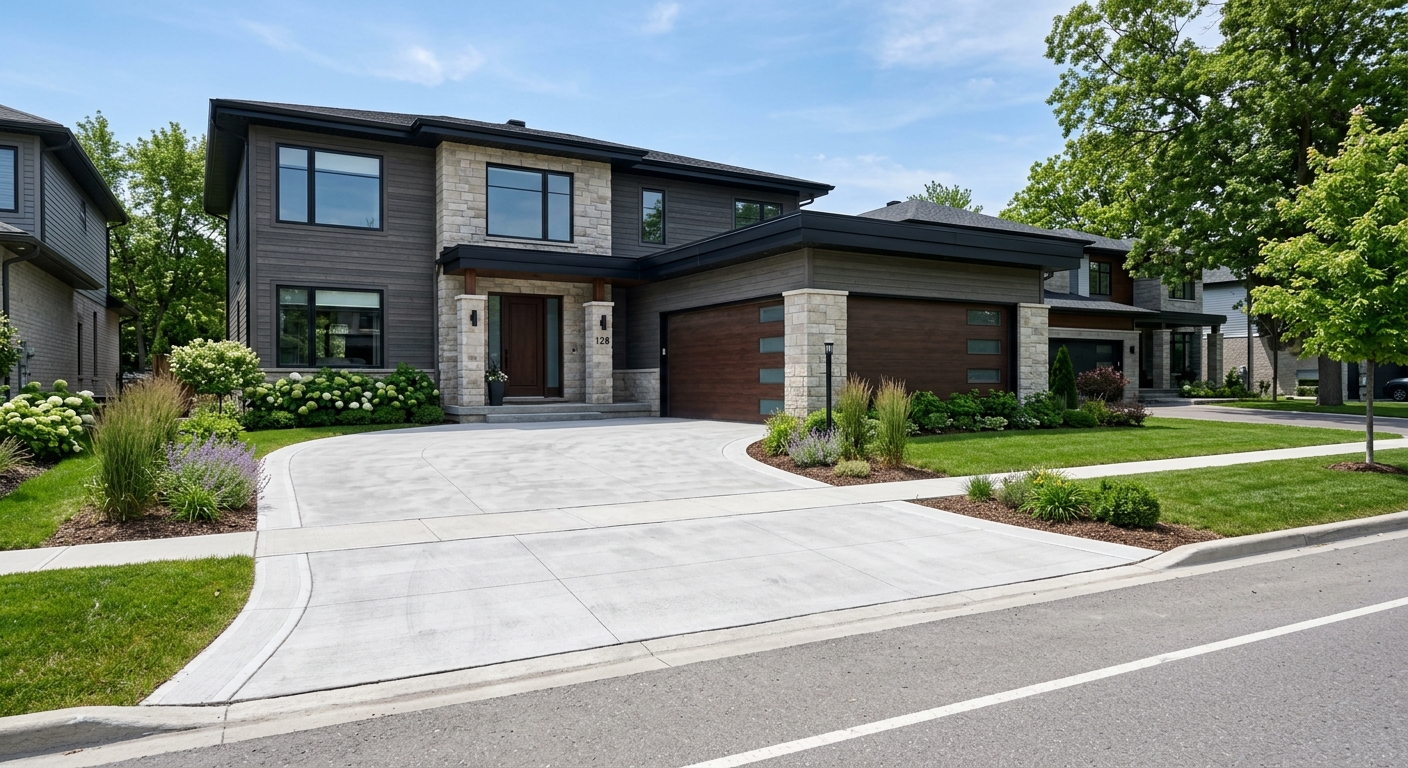
Concrete work options and costs in Wasaga Beach
Wasaga Beach is one of those Ontario communities where homeowners constantly weigh convenience (a clean, low-maintenance surface) against the realities of frost. With 82.7% of local dwellings being single-detached homes (Statistics Canada, 2021 Census), most concrete flatwork work here is driveway, patio, walkway and garage slab upgrades for families who want long service life. The local housing mix also includes a meaningful older segment—23.6% of homes were built before 1981 (Statistics Canada, 2021 Census)—which is important because many older properties have settlement, older drainage patterns, or thinner base layers that need more reconstruction before new concrete can be placed.
In the Kitchener–Waterloo–Barrie economic region, pricing is influenced by a cold, high freeze-thaw climate with frost depth commonly in the 1.0–1.2 m range. That means footings must be dug below frost line, and exterior slabs typically use air-entrained mixes to resist freeze-related damage. Contractors in the area also face a shorter effective pour season due to cold weather and winter protection requirements, which affects availability and labour rates.
Demand is especially steady around the Wasaga Beach core and along Highway 26 where many driveways and front walkways get resurfaced during spring and early summer. If you’re comparing options, the finish choice and whether your base needs rework usually drive the most noticeable differences, so use the table below as a quick budgeting guide before you request itemized quotes.
| Application |
Typical Size |
Key Spec |
Finish Option |
Price Range |
| Concrete driveway (standard broom finish) |
8 ft x 18 ft (144 sq. ft.) |
Air-entrained exterior mix; compacted granular base |
Broom finish + saw cut control joints |
$2,160 – $3,600 |
| Exposed aggregate driveway |
8 ft x 18 ft (144 sq. ft.) |
Air-entrained exterior mix; proper curing |
Exposed aggregate (surface wash) + joints |
$2,880 – $4,500 |
| Stamped concrete driveway or patio |
10 ft x 16 ft (160 sq. ft.) |
Air-entrained exterior mix; integral colour or hardener |
Stamp pattern + sealer |
$3,520 – $5,600 |
| Plain concrete patio or walkway |
10 ft x 12 ft (120 sq. ft.) |
Air-entrained exterior mix; compacted base |
Float + broom texture as required |
$1,680 – $2,640 |
| Garage floor (interior slab) |
20 ft x 20 ft (400 sq. ft.) |
Vapour barrier where appropriate; fibres or mesh if specified |
Steel-trowelled finish (smooth) + saw cuts |
$6,800 – $10,000 |
| Foundation footings (structural, below frost) |
Typical footing package |
Excavation below frost line; engineered rebar and concrete |
Formwork + reinforcement as per drawings |
$9,600 – $20,000 |
Prices are estimates only and vary by project scope, site access and material selection.
What affects the price of concrete work in Wasaga Beach
If you get two quotes for the same concrete footprint in the Kitchener–Waterloo–Barrie region, it’s not unusual to see differences that land around 30–50%. The range isn’t random—it comes from how each contractor handles frost requirements, drainage, and site conditions. In Ontario’s freeze-thaw climate, footings must be set below the design frost depth to prevent heave and cracking, and exterior flatwork is typically specified with air-entrained concrete mixes so the surface can survive repeated freezing cycles. Cold-weather curing precautions also matter here: insulating blankets or controlled heating may be needed to protect early-age strength gain, which adds labour and equipment cost. Finally, because de-icing salts accelerate surface spalling, sealing and correct curing timing become part of “durability budgeting,” not an optional upgrade.
In Wasaga Beach specifically, cost swings often come from whether the base needs rebuilding (common on older lots), how much excavation is required for frost-safe footing depth, and whether drainage improvements are included. For example, if you’re building a driveway from scratch, the concrete itself may fall in the typical $15–$25 per sq. ft. band, but if excavation and granular base replacement push the site prep higher, your total can move toward the top end. Stamped options, often in the $22–$35 per sq. ft. range, also cost more because of labour-intensive finishing and colouring steps—however, the added spend is usually justified when you want aesthetics plus a properly sealed exterior surface.
Concrete work on homes built before 1981 can cost more because you often find older grading that no longer drains properly. In dollars, even a modest increase in excavation and rebase can add hundreds to over a thousand dollars, before you account for reinforcement changes or longer truck access time on narrow driveways.
| Price Factor |
Why It Matters | Why It Matters | Why It Matters in Ontario |
Cost Impact |
| Frost line depth — determines footing depth and form height |
Deeper excavation increases time, spoil removal and formwork height |
Often +10% to +30% on foundation/footing scopes |
| Site preparation — excavation, grading, compacted granular base |
Weak or missing base leads to settlement and cracking during freeze-thaw cycles |
Can swing overall job cost by 20%+ on rework-heavy sites |
| Reinforcement — rebar or wire mesh requirement |
Proper reinforcement controls shrinkage and reduces cracking risk in slabs |
Moderate material cost, but labour adds up on dense reinforcement |
| Mix design — air-entrainment and compressive strength spec |
Air-entrainment improves freeze-thaw durability; strength supports service loads |
Small line-item increase, often +5% to +15% total depending on spec |
| Finish type — broom vs. stamped vs. exposed aggregate |
Decorative finishes require extra labour, materials and curing/sealing steps |
Stamped/exposed commonly push projects toward higher price bands |
| Pour size and concrete truck access to site |
Long carry distances and limited access slow production and increase crew time |
Can add significant labour; narrow lots often cost more |
| Cold-weather curing precautions — heating and blankets |
Protecting early-age concrete prevents surface scaling and strength loss |
May add hundreds to a few thousand dollars in shoulder seasons |
| Control joint pattern and sealing cost |
Joints manage movement; sealing helps resist de-icing salt scaling |
Small per-sq. ft. cost, but skipping it increases failure risk |
Permits & regulations in Ontario
In Ontario, structural concrete work generally needs a building permit and often requires engineered drawings reviewed by the municipality. That includes the concrete elements that support the building’s load path—such as footings, foundation walls, grade beams and similar structural components. For concrete flatwork—driveways, patios and walkways—the work often does not require a permit, unless it affects lot grading, drainage, or impervious surface coverage rules, or it involves work near municipal right-of-way conditions (for example, changing how stormwater is handled).
For a homeowner in Wasaga Beach, the practical approach is to confirm the permit requirement with the municipality before breaking ground, especially if you’re changing elevation, redirecting runoff, or building a new foundation element. Equally important, verify the contractor is properly insured and set up to work legally in Ontario: ask for a Certificate of Insurance showing liability coverage, and request proof of WSIB/WCB coverage (or the applicable clearance/coverage documentation). Then check licensing and standing through the appropriate Ontario online resources and by requesting references on similar-scale work.
Step-by-step check: (1) Ask the contractor for their liability insurance certificate and WSIB/WCB documentation; (2) request their clearance letter or status proof if applicable; (3) verify their licensing/registration through Ontario’s online registries; (4) confirm whether your scope needs a permit and who pulls it; and (5) keep a copy of all documents with your contract.
Getting concrete right in Wasaga Beach's freeze-thaw climate
Concrete fails in Wasaga Beach’s weather mostly because water finds its way into pores and joints, freezes, expands and then breaks down the surface—especially if the mix isn’t right or if the base isn’t compacted and drained properly. To spec the job correctly in the Kitchener–Waterloo–Barrie market, start with a compacted granular sub-base sized to the frost conditions for your lot, then keep the water moving away with good drainage and correct slopes. Next, require an air-entrained exterior mix; the target is typically around 5–7% air content for durable exterior flatwork, along with a minimum 32 MPa compressive strength spec. Air is what helps resist freeze-thaw scaling and spalling; if the air-entrainment is off, you can get flaking, pitting and early surface deterioration even when the slab “looks fine” at first.
Control joints are your friend. They’re placed to limit random cracking and to ensure cracks occur where they can be managed. Typical spacing should follow recognized ACI guidance for slab thickness and reinforcement conditions (your contractor should calculate and document it). Curing is also critical: plan for at least 7 days of proper curing under the right conditions, and in colder periods you may need blankets or controlled protection to avoid early-age damage. Finally, apply a penetrating sealer about 28 days post-pour to help repel de-icing salts and water intrusion.
As for money: choosing a broom-finish driveway (often closer to the lower end of the $15–$25 per sq. ft. band) might be $2,160 – $3,600 for a typical 144 sq. ft. pour, while stamped concrete can climb toward $22–$35 per sq. ft. In this climate, that price difference is justified when the contractor also includes correct air-entrainment, disciplined curing/protection and sealing—those details protect your investment, regardless of pattern.
| Spec |
Why It Matters in Wasaga Beach |
What to Ask For |
Impact if Skipped |
| Compacted granular base (depth?) |
A stable, drained base reduces settlement and limits movement during freeze-thaw cycles |
Base depth and granular type/compaction to match your soil conditions and slab thickness |
Uneven settling, cracking, and “hollow” sounding areas |
| Air-entrained concrete mix (target air %?) |
Air pockets relieve freeze pressure and reduce spalling risk |
Exterior air-entrainment target around 5–7% and air testing during placement |
Surface scaling, pitting, and early freeze-related deterioration |
| Compressive strength (MPa rating) |
A minimum strength helps the slab resist freeze-thaw stresses and service loads |
Minimum 32 MPa (or as engineered for your application) |
Soft surfaces, raveling, and reduced durability |
| Control joints (spacing per ACI guidelines) |
Joints control where cracks form as the slab shrinks and moves |
Joint layout drawing or written plan including spacing and sealant plan (if applicable) |
Random cracking and wider, harder-to-seal gaps |
| Minimum 7-day curing period |
Proper curing ensures strength gain and improves resistance to surface damage |
Curing method (blankets/membrane as required) and schedule confirmation |
Weak surfaces and increased risk of scaling in early winters |
| Penetrating sealer (when applied after cure) |
Helps limit water and de-icer salt penetration that drives spalling |
Apply penetrating sealer about 28 days after pour (after adequate cure) |
More moisture ingress, faster deterioration, and higher long-term maintenance |
How to choose a concrete work contractor in Wasaga Beach
Choosing a concrete contractor in Wasaga Beach is mostly about verifying paperwork and reading the scope like a checklist. In Ontario, you should confirm the contractor has appropriate liability coverage and WSIB/WCB coverage (or the relevant documentation showing status). Ask for the Certificate of Insurance up front and check that the policy is current and includes you as a certificate holder where applicable. For WSIB/WCB, request proof of clearance or current coverage documentation—don’t accept “it’s covered” without seeing the paperwork.
Get 2–3 itemised written quotes rather than one lump-sum number. Ideally, the quote breaks labour and materials separately: excavation/grading, granular base, reinforcement, concrete supply (including air-entrainment spec), forms, finishing, curing/blankets and sealing. Scope clarity matters because exclusions are where costs surprise homeowners. Ask whether a permit is included (when required), whether disposal/haul-away is included, and what happens if truck access is limited or if the base is worse than expected.
Warranty should be clear: workmanship warranty length, and whether product/manufacturer warranties apply to sealer or related materials. Also ask if warranties are transferable if you sell your home. On payment, a safe rule is never pay more than 10–15% upfront; hold back a portion until completion and final walk-through. For timing, insist on a start date and completion estimate in writing, including how cold weather protection will be handled if temperatures drop.
- Confirm liability insurance is current and request the certificate.
- Verify WSIB/WCB coverage documents before work begins.
- Ask for 2–3 recent references in Wasaga Beach or nearby Barrie/Collingwood area.
- Request an itemised quote (labour + materials), not just one total.
- Check that the quote specifies exterior air-entrained mix and curing/protection.
- Ask for base specs: thickness, granular type and compaction expectations.
- Review reinforcement details (mesh/rebar type, spacing, placement).
- Confirm control joint pattern and sealant/sealer plan.
- Clarify disposal/haul-away and who removes excess material.
- Ask about site access: hose/wheelbarrow distance, truck access plan.
- Verify warranty terms and what counts as a workmanship defect.
- Set a payment schedule with a holdback until final acceptance.
Concrete red flags in Wasaga Beach: contractors who won’t discuss air-entrainment targets; quotes that omit base thickness/compaction; no written joint layout; curing blankets/sealing mentioned vaguely or not at all; and schedules that ignore cold-weather protection when pours fall near shoulder months.
Frequently asked questions — concrete work in Wasaga Beach
Do I need a permit for concrete work in Ontario?
In Ontario, structural concrete work like footings, foundation walls, and grade beams generally requires a building permit and often engineered drawings that the municipality reviews. Concrete flatwork—driveways, patios and walkways—often doesn’t require a permit, but it can if the project changes lot grading, affects drainage, alters impervious surface coverage limits, or involves conditions near municipal right-of-way. For Wasaga Beach homeowners, the safest approach is to confirm requirements with the municipality before work begins, especially if you’re changing slopes or redirecting runoff.
Concrete vs pavers for a patio in Wasaga Beach?
Concrete and pavers both work well in Wasaga Beach, but they fail differently in freeze-thaw weather. Concrete, when built on a properly compacted granular base with air-entrained mix and well-planned control joints, typically offers excellent durability and a cleaner maintenance routine. Pavers can look great and allow easier individual repairs, but they depend heavily on base preparation and proper jointing; if drainage is off, you can get shifting during freeze cycles. Pricing is often comparable at the start, but stamped concrete can cost more due to labour and materials. A plain concrete patio commonly lands around the $14–$22 per sq. ft. range, while decorative choices move toward the higher end.
How long does a concrete driveway last?
A well-built concrete driveway in Ontario is often designed to last 25+ years, and sometimes longer, but the real answer depends on the details that fight Wasaga Beach’s freeze-thaw cycles: air-entrained concrete, correct base compaction, good drainage, proper curing, and sealing practices. Many failures aren’t “concrete quality” problems—they’re base and moisture problems, followed by de-icing salt exposure. If you’re comparing budgets, standard broom-finish driveways often price in the $15–$25 per sq. ft. band, and investing toward the upper end usually means better prep, reinforcement decisions, and protection/curing. Skipping sealing can accelerate surface deterioration even on otherwise solid slabs.
What is air-entrained concrete and why does it matter here?
Air-entrained concrete is made with microscopic air bubbles that act like pressure relief when water inside the concrete freezes and expands. In Wasaga Beach and the wider Kitchener–Waterloo–Barrie region, freeze-thaw cycling is a daily reality in winter months, so air-entrainment is a key spec for exterior slabs like driveways and walkways. Without it, water can push off the surface over time, causing spalling and scaling. Ask your contractor to specify exterior air-entrainment and confirm it’s included in the mix. Also ensure curing is protected for at least the first week. This is one of the most important ways homeowners prevent early failure.
How do I prepare the base for a concrete slab?
Base preparation is where quality shows up. For Wasaga Beach, the slab base needs to be excavated to the right depth, graded to eliminate ponding, and compacted granular material should be installed in lifts to achieve strong, stable support. The goal is drainage and reduced movement through freeze-thaw cycles. A contractor should explain granular depth, compaction method, and how they handle soft spots or organics (which must be removed). If your driveway or patio sits on older fill, plan for possible rebase—this is often a major driver of quote differences. Ask whether the quote includes excavation, disposal/haul-away and the granular base thickness before concrete is scheduled.
How do I compare concrete quotes?
To compare concrete quotes fairly in Ontario, make sure the scope and specifications match line by line. Look for: air-entrained exterior mix, base thickness and compaction, reinforcement type and placement, curing/blankets for cold conditions, control joint layout, and sealing timing. Don’t compare totals only—two quotes can differ by 30–50% because one includes more prep, drainage work, or better curing protection. Use price bands as a sanity check: for example, a standard broom-finish driveway often falls around $15–$25 per sq. ft., while stamped concrete tends to move toward the $22–$35 per sq. ft. range. Ask what’s excluded (permit pull, disposal, rebar/more base if conditions change) and require an itemised written quote.