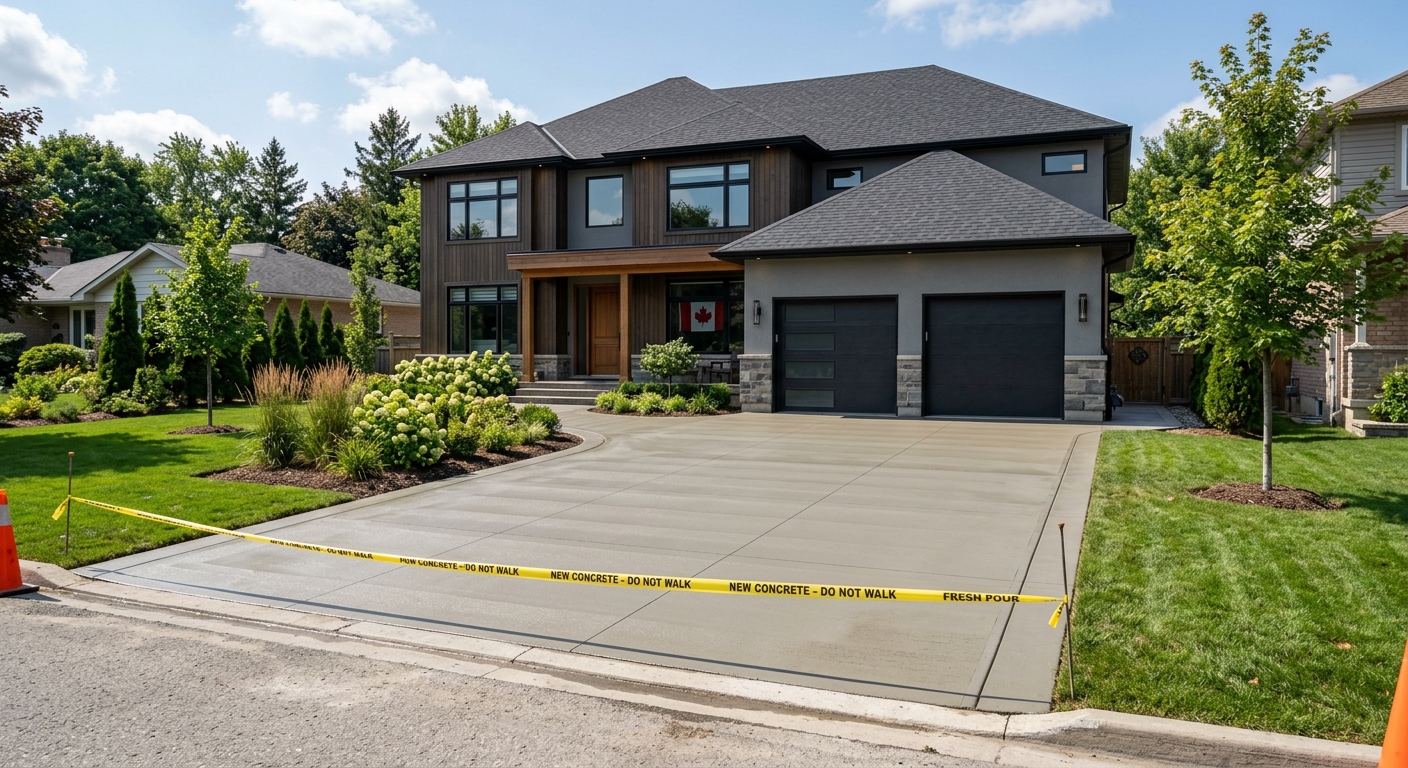
Concrete work options and costs in Ottawa South
Concrete work in Ottawa South is one of those home projects where the “same” driveway can price very differently, because the local climate punishes shortcuts. With a population of 125,090 (Statistics Canada, 2021 Census), the area is steady with new builds and renovations, and demand is especially strong around popular residential pockets near Heron Road and Strandherd area where many homeowners upgrade driveways and entry walkways. Ottawa South is also home to a large share of traditional family housing, which drives repeat demand for concrete flatwork: driveways, patios, and stair-adjacent walkways that need to stay stable through winter.
In this part of Ottawa, freeze–thaw cycles and a deep frost line mean contractors typically design below frost or isolate exterior slabs from frost movement. That affects everything from excavation and base prep to the concrete mix (air-entrained for exterior durability) and joint layout. It also influences scheduling: the exterior pour window is shorter, and cold-weather curing (heating/blanketing) can add labour even when the concrete “package” looks straightforward.
Below is a practical comparison of common Ottawa South options and what you can expect to pay for typical residential scopes. Use the ranges to sanity-check quotes before you talk details with contractors.
| Application |
Typical Size |
Key Spec |
Finish Option |
Price Range |
| Concrete driveway (standard broom finish) |
400–500 sq. ft. (typical single wide) |
Air-entrained mix for exterior; compacted granular base; control joints |
Broom finish |
$16,000–$25,000 |
| Exposed aggregate driveway |
400–500 sq. ft. |
Proper base drainage; air-entrained mix; controlled finishing to expose stones |
Exposed aggregate |
$19,000–$30,000 |
| Stamped concrete driveway or patio |
250–400 sq. ft. (driveway section or patio) |
Air-entrained mix; thicker placement for detail work; joint pattern planned for shrinkage |
Stamped (imprinted) finish |
$22,000–$35,000 |
| Plain concrete patio or walkway |
150–300 sq. ft. |
Exterior-rated mix; compacted granular base; edges formed; joints included |
Float/smooth or light broom |
$14,000–$22,000 |
| Garage floor (interior slab) |
300–520 sq. ft. |
Vapour barrier where needed; fibre or mesh depending on design; levelled base |
Plain trowel (sealed optional) |
$10,000–$18,000 |
| Foundation footings (structural, below frost) |
Per building footprint and perimeter length |
Engineered footing size and rebar per design; excavation to frost protection depth |
Structural concrete (no decorative finish) |
$120,000–$200,000 |
Prices are estimates only and vary by project scope, site access and material selection.
What affects the price of concrete work in Ottawa South
In Ottawa South (and across the Ottawa region), you can see the same driveway or patio quote swing by 30–50% because the real cost isn’t the concrete—it’s the prep, engineering choices, and weather protection that make exterior concrete last. In milder parts of Ontario, a contractor may get away with less excavation or less intensive curing. In Ottawa, freeze–thaw cycles and a deep frost line dictate the design: footings typically need to extend below design frost depth, and exterior flatwork needs air-entrained concrete mixes to manage repeated expansion and scaling.
Concrete pricing also changes with the pour season. Colder temperatures slow strength gain and create a narrower finishing window. That means heating/blanketing and a stricter curing plan when temperatures dip, especially on exposed or wind-swept sites. Finally, Ottawa-area winters involve de-icing salt; that accelerates surface spalling, so sealing is often recommended and sometimes included depending on scope. For perspective, a standard broom-finish driveway often lands in the $16,000–$25,000 band, while stamped/decorative work commonly moves into the $22,000–$35,000 range—partly because the material is different, but mostly because labour and finishing steps are.
Local examples: (1) a driveway requiring deeper base excavation for frost protection and drainage will cost more than one on already-stable, well-drained soil; (2) a site with limited truck access can increase labour time for moving materials; (3) if your home is older (common in long-established neighbourhoods), you may need more prep to remove old uneven slabs and tie into existing grades—more demo and hauling. With Ottawa’s steady population of 125,090 (Statistics Canada, 2021 Census), there’s capacity from multiple crews, but winter scheduling is still tight, so calling early matters.
| Price Factor |
Why It Matters |
Cost Impact |
| Frost line depth |
Determines footing depth and form height to prevent frost heave |
Higher excavation and concrete volume; can add significant labour and materials |
| Site preparation |
Excavation, grading, and well-compacted granular base set the long-term stability |
Poor prep can crack early; correct prep often increases cost up front |
| Reinforcement |
Rebar or mesh helps control cracking and supports loads |
Cost rises with heavier steel, chairs/ties, and more labour for installation |
| Mix design |
Air-entrainment and compressive strength targets are critical for freeze–thaw durability |
Exterior-rated mixes can cost more and require spec compliance |
| Finish type |
Broom vs. stamped vs. exposed aggregate changes labour, tooling and curing attention |
Stamped/exposed generally increases cost due to more finishing steps |
| Pour size and concrete truck access to site |
Large pours or limited access increase labour time and logistics |
May require smaller loads, extended staffing, or additional handling time |
| Cold-weather curing precautions |
Heating/blankets protect green concrete and help reach strength safely |
Can add day-by-day costs and lengthen the job timeline |
| Control joint pattern and sealing cost |
Joints manage shrinkage/thermal movement; sealing helps with salt exposure |
Proper jointing reduces random cracking; sealing is an added material line item |
Permits & regulations in Ontario
In Ontario, structural concrete work is typically regulated under the building permit process. That generally means concrete elements that support the structure—like footings, foundation walls, grade beams, and other load-bearing foundation components—require a building permit and often engineered drawings that the municipality reviews. For homeowners in Ottawa South, this is especially important when you’re adding an extension, underpinning, or doing anything that changes the structure’s load path.
Concrete flatwork such as driveways, patios, and walkways often does not require a permit by itself. However, permits can become relevant when the work affects lot grading, drainage away from the foundation, or when it impacts municipal rules around impervious surface coverage and stormwater management. Also, if you’re working near a curb/sidewalk, there may be additional requirements tied to the municipal right-of-way—confirm before you demo.
Before breaking ground, verify the contractor’s insurance and coverage in a practical order: (1) request their certificate of insurance showing liability limits that match the job size; (2) confirm WSIB/WCB coverage for workers; and (3) confirm they’re licensed/eligible as required for the scope (some concrete work is covered through general contracting structures rather than a trade-only licence, depending on who is providing the work). You can check credentials through provincial/official registries where applicable, and always ask for clearance letters where the contractor provides them. Then ask for references from similar Ottawa South projects (driveway and footing jobs) and inspect recent finished work in comparable freeze–thaw conditions.
Getting concrete right in Ottawa South's freeze-thaw climate
Concrete failures in Ottawa South usually come down to water and movement: freezing water expands, and repeated freeze–thaw cycles stress slab edges, joints, and surfaces exposed to salt. The goal is to build a system that survives both thermal movement and traffic loads. Start with base preparation: a compacted granular sub-base to the right depth so the slab doesn’t settle or heave. Next, use the right mix design: exterior flatwork should be air-entrained (commonly 5–7% air for durable exposure) and specified at minimum 32 MPa compressive strength for residential exterior work, depending on the engineer/spec. Then plan control joints early—close enough to limit random cracking—and commit to curing. In cold weather, curing protection matters; a minimum of 7 days under proper conditions is a practical standard, and crews may add heating/blanketing to keep temperatures safe during the first stages.
Finally, consider sealing after cure. Penetrating sealers applied around 28 days post-pour can help repel de-icing salt-driven moisture ingress.
Here’s the kind of decision where the extra cost is justified: if one quote offers “cheap concrete” without clear air content or a detailed joint plan, you may save on paper but pay later for spalling and patching. In Ottawa South, that difference is often reflected in decorative options too—stamped concrete typically carries higher labour and material setup, which can land closer to the $22,000–$35,000 band, whereas a plain patio/walkway is often in the $14,000–$22,000 range when prep and base are consistent.
Use these questions to avoid the most common failure: spalling from inadequate air-entrainment and poor freeze–thaw resistance.
| Spec |
Why It Matters in Ottawa South |
What to Ask For |
Impact if Skipped |
| Compacted granular base (depth?) |
Reduces settlement and helps prevent frost-driven heave under the slab |
Base depth requirement based on your soil and design; compaction test standard |
Cracks, uneven surfaces, and premature edge failure |
| Air-entrained concrete mix (target air %?) |
Protects against freeze–thaw scaling and spalling in Ottawa winters |
Concrete mix design showing target air content (commonly 5–7% for exterior) |
Surface scaling, flaking, and faster deterioration |
| Compressive strength (MPa rating) |
Supports strength development under cold-weather curing limits |
Minimum 32 MPa specification (or engineered requirement) |
Lower durability and higher cracking risk under load and temperature swings |
| Control joints (spacing per ACI guidelines) |
Controls shrinkage and thermal movement so cracks don’t wander randomly |
Planned joint spacing and sawing timing; edge/joint details |
Random cracking, wider joint failure, and water infiltration |
| Minimum 7-day curing period |
Cold weather slows strength gain; curing prevents early surface damage |
How curing is protected during cold snaps (blankets/heating as needed) |
Reduced strength, curling/weak surface, and early surface breakdown |
| Penetrating sealer (when applied after cure) |
Helps repel salt moisture and limits water ingress at the surface |
Product type and application timing (commonly ~28 days after pour) |
Faster spalling from de-icing salts and repeated wetting cycles |
How to choose a concrete work contractor in Ottawa South
Choosing the right contractor in Ottawa South is about verification and clarity. First, confirm insurance and coverage. Ask for a current certificate of insurance (liability) and confirm WSIB/WCB coverage if they employ workers. If they’re subcontracting, request the subcontractor’s proof as well—don’t assume it’s covered. For Ontario compliance, concrete construction tied to structural work should align with permit drawings and engineered specs; for flatwork, the contractor should still be able to explain frost-protection base and exterior mix design choices.
Next, get 2–3 itemised written quotes rather than one lump sum. A good quote breaks out labour and materials: excavation and haul-away, granular base and compaction, vapour barrier (if applicable), reinforcement, concrete supply, forming, finishing, curing protection, joints/sawing, and sealing (if included). Also ask what’s excluded: disposal fees, removal of old concrete, any required traffic control, protection of landscaping, and whether the contractor will manage drainage grading.
Warranty matters. Ask for a workmanship warranty length and what it covers (typically issues like settlement-related cracking or workmanship defects), plus manufacturer documentation for any specialty products. Confirm if the warranty is transferable if you sell your home.
Payment schedule: never let a contractor ask for the majority upfront. In practice, keep deposits around 10–15% and hold back the balance until the job is fully complete, final cleanup is done, and curing/sealing steps are confirmed. Get the start date and completion estimate in writing—especially important with Ottawa’s colder pour windows.
- Request their certificate of insurance and confirm WSIB/WCB clearance before work starts
- Ask if they include engineering/frost depth details for exterior slabs and footings
- Confirm air-entrainment and target mix specs for exterior work
- Ensure base depth and compaction method are written in the quote
- Get the rebar/mesh plan stated (if used) including placement and tie/chair method
- Ask for a joint layout diagram: location, spacing, and saw-cut timing
- Confirm cold-weather procedures (heating/blanketing) for pours near freezing
- Verify sealing is included or excluded; if included, ask for product and application timing
- Ask what happens if the weather changes mid-pour (how they protect green concrete)
- Require a written schedule: start date, pour date, curing time, and finish dates
- Clarify disposal and site restoration: haul-away, backfill, topsoil, and reinstatement
- Set payment milestones tied to completed phases, not just “progress”
Concrete red flags in Ottawa South: quotes that don’t mention air-entrainment for exterior work; vague joint spacing or “we’ll figure it out later”; no explanation of base depth/compaction; lowball pricing that excludes removal/disposal and then charges add-ons mid-project; and contractors who want large upfront payments without a clear contract, schedule, and holdback.
Frequently asked questions — concrete work in Ottawa South
What is rebar and when is it required in Ontario?
Rebar is reinforcing steel embedded in concrete to help control cracking and add strength under tension. In Ontario, whether rebar is “required” depends on the structural design and the building permit/engineering documents for the specific item. For example, foundation footings, foundation walls, and grade beams are structural components that typically need engineered reinforcement details before any pour. For exterior flatwork like driveways and patios, some jobs use wire mesh or fibre reinforcement, but the final call should follow the project design and site conditions (soil support, slab thickness, and loading). In Ottawa South, freeze–thaw and salt exposure make it even more important that reinforcement is installed correctly—using chairs/ties so it sits in the concrete zone, not on the ground. If your quote is silent on reinforcement and slab thickness, ask for the design or the rationale.
How long does a concrete project take in Ottawa South?
Typical residential concrete work in Ottawa South often looks quick on pour day, but the full project timeline depends on base prep, curing, and weather. For a driveway or patio, the prep and forms can take a few days, the pour is usually one day, and then curing continues before heavy use or sealing steps. In winter or shoulder-season weather, schedule can extend because crews may need heating/blanketing and must protect green concrete from temperature swings to reach strength safely. That curing sensitivity is higher in Ottawa’s freeze–thaw climate, especially on exposed or riverside-ish lots where moisture and wind can be harsher. If your scope includes demolition, disposal, and regrading, add time for excavation and reinstatement. Use the contract to confirm start date, pour date, and when you can drive/step on the new concrete, and don’t assume “we’ll pour and you’re done tomorrow.”
What is a concrete overlay and is it suited to Ottawa South?
A concrete overlay is a new concrete layer poured over an existing slab (after grinding/prep) or in some cases a resurfacing system. It can be a cost-effective option when the original slab is structurally sound (not moving, not badly heaved, and not extensively cracked through the slab). In Ottawa South, suitability depends heavily on why the original concrete failed. If the old slab’s issue is freeze–thaw damage, inadequate drainage, or frost-related movement at the base, an overlay can hide surface defects temporarily but may not stop the underlying movement. Ottawa’s de-icing salt exposure also means surface durability matters; you still need proper base preparation principles for the new layer. If you’re considering overlay to avoid costs, ask for a slab assessment and joint/edge condition review. If the contractor is recommending overlay without evaluating movement and base conditions, that’s a concern. For many homeowners, replacement—while higher upfront than a small resurfacing—may be more predictable in the $16,000–$25,000 driveway range when done with correct exterior specs.
How do I seal concrete to protect it in Ottawa South?
Sealing is mainly about reducing water and salt ingress at the surface. In Ottawa South, you’ll usually want to apply a penetrating sealer after the concrete has cured fully—commonly around 28 days post-pour—so the concrete can dry and the sealer can penetrate rather than trap excess moisture. Before sealing, the surface should be cleaned and dry; contaminants like mud, construction residue, and laitance can prevent proper absorption. Choose a sealer designed for exterior freeze–thaw and de-icing salt exposure. Ask your contractor whether sealing is included and what product they use, plus the application schedule relative to curing and weather. Also, follow winter safety expectations: avoid heavy salt immediately and don’t “test” the surface by loading early. Sealing doesn’t replace good base prep, air-entrainment, or proper joint spacing—but when those are correct, sealing helps extend service life and reduce spalling risk.
What is the difference between concrete and cement?
Cement is a component. Concrete is the finished building material made from cement plus water, sand, gravel (or other aggregates), and often admixtures. In other words, you don’t “pour cement” for driveways; you pour concrete with a specified cement type, water-cement ratio, and mix design. In Ottawa South, the mix design is critical for durability because freeze–thaw cycles and salt exposure can break down poorly designed mixes. That’s why reputable contractors specify an exterior-rated, air-entrained mix and minimum compressive strength (often 32 MPa for exterior residential work unless the design calls otherwise). If you hear a quote talk only about “cement quality” but doesn’t mention air content, curing plan, or joint layout, ask for the actual mix specs. Better questions lead to better outcomes—especially in a region with deep frost and repeated temperature swings.
How much does concrete work cost in Ottawa South?
Concrete cost in Ottawa South depends on scope, excavation, base prep, finish complexity, and whether cold-weather curing is needed. For common residential exterior projects, typical pricing often falls within regional bands: a concrete driveway with standard broom finish commonly lands around $16,000–$25,000, while plain patios and walkways tend to be around $14,000–$22,000 for typical sizes. Decorative stamped concrete frequently increases labour and finishing steps, commonly placing projects around $22,000–$35,000. Foundation footings are priced very differently from flatwork, with structural work often in the $120,000–$200,000 range depending on building size and engineered details. If your quote is unusually low, check whether it includes air-entrainment, adequate base depth/compaction, reinforcement details (where required), and proper curing protections for Ottawa’s freeze–thaw climate. In Ontario, structural jobs also need the right permitting/engineering, which can affect timelines and cost.