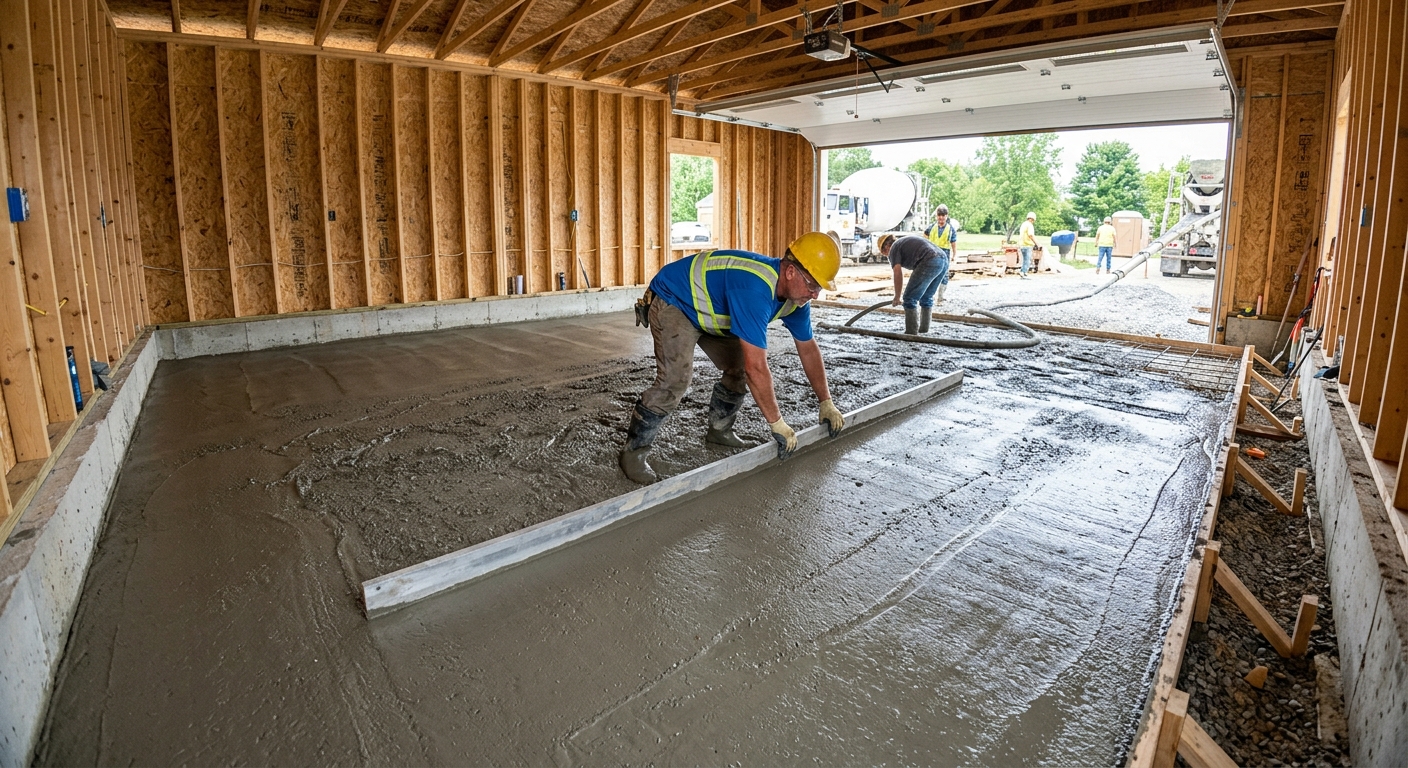
Concrete work options and costs in Mildmay
Concrete work is a common home upgrade in Mildmay, especially for families improving driveways, patios and walkways around the older housing stock and newer builds. Mildmay’s population is 1,219 (Statistics Canada, 2021 Census), so most trades—including concrete finishers and equipment operators—stay busy with a smaller local pool of crews. That matters for scheduling and pricing, because the Toronto economic region’s freeze–thaw cycles drive stricter specs and more labour time on exterior flatwork. In this market, concrete contractors also see steady demand from single-detached households, which are the typical sites for new driveway pours and backyard patios.
Toronto-area concrete costs are shaped by frost depth and repeated winter movement. In Ontario, structural footings generally need to extend at least 1.2 m (about 4 ft) below grade to reduce frost heave and differential settlement. For slabs, patios and walkways, contractors usually use air-entrained concrete, properly compacted granular base, and well-planned control joints. That’s why two quotes that “look similar” can still land far apart—one crew may include thicker base, proper drainage, and sealed finishes that the other treats as add-ons. Local access—like whether a skid steer can stage material, or whether a pump is needed—also changes labour and equipment costs. If you’re near main residential corridors such as the downtown Mildmay area, it’s especially important to plan timing, as crews often batch flatwork projects to make the short reliable pour season work.
Below are realistic cost ranges for common concrete options, so you can compare quotes before you call for site measurements.
| Application |
Typical Size |
Key Spec |
Finish Option |
Price Range |
| Concrete driveway (standard broom finish) |
400–600 sq ft (typical single-car to double-car) |
Air-entrained exterior mix; compacted granular base; control joints |
Broom finish; standard edging; optional sealer |
$3,800–$6,500 |
| Exposed aggregate driveway |
400–600 sq ft |
Air-entrained mix; proper curing; stone set for uniform wash |
Exposed aggregate (washed or retarder method) |
$5,000–$8,500 |
| Stamped concrete driveway or patio |
250–600 sq ft |
Air-entrained exterior mix; integral colour; joints planned for pattern |
Stamped pattern; release agent; optional border |
$6,000–$12,000 |
| Plain concrete patio or walkway |
100–300 sq ft |
Compacted base; air-entrained mix; drainage slope |
Broom finish or smooth-trowel (with texture) |
$1,600–$6,200 |
| Garage floor (interior slab) |
400–700 sq ft |
Typical 4 in thickness; vapour barrier; mesh/rebar as specified |
Broom finish; optional densifier or light stain |
$3,000–$7,000 |
| Foundation footings (structural, below frost) |
Per project scope (linear ft or partial replacement) |
Engineer/architect spec; excavation to frost depth; concrete placement |
Structural concrete only (forming/placement) |
$180–$300 |
Prices are estimates only and vary by project scope, site access and material selection.
What affects the price of concrete work in Mildmay
In Mildmay and across the Toronto economic region, the same “type” of concrete job can come in 30–50% different simply because the underlying specs aren’t identical. One quote may include the correct depth of excavation, compacted granular base, air-entrained concrete, and proper curing protection; another might treat those as extras. Labour rate differences and truck/equipment time also change the delivered cost—especially when crews must plan around frost depth requirements and the short stretch of reliable weather for exterior pours.
For exterior work, the frost depth and freeze–thaw cycles dictate the entire design. Ontario typically requires structural footings to extend to at least 1.2 m below grade to help prevent frost heave and differential movement. Driveways, slabs, patios and walkways then need an air-entrained mix designed to survive repeated winter expansion and contraction. When temperatures drop toward 10 °C or below, contractors may need cold-weather curing precautions—like insulating blankets or temporary heating—so concrete reaches the minimum cure before it’s exposed to damaging temperature swings. Finally, de-icing salt in winter can accelerate surface deterioration; sealing and good surface prep are often where long-term cost differences show up.
In Mildmay, a couple common local conditions push the price up or down. For example, a driveway that needs deeper base due to soft or saturated soils can add labour and granular material quickly, while a smaller patio on firm, well-drained ground is usually more straightforward. If you’re choosing between a standard broom-finished patio versus stamped work, the price jump is often justified by finish labour, integral colour/texture work, and extra time for clean joint planning—stamped & decorative concrete can land around $24–$40 per sq ft compared with more basic flatwork in the $16–$26 per sq ft band. Likewise, foundation and footing work carries its own risk and spec requirements, often priced around the $180–$300 per unit range depending on how much excavation and structural placement is included.
| Price Factor |
Why It Matters |
Cost Impact |
| Frost line depth |
Determines footing depth and form height to prevent frost heave |
Can add significant excavation and concrete; typically one of the biggest spec drivers for structural work |
| Site preparation |
Excavation, grading, and compacted granular base control settlement and cracking |
Poor prep increases failures; correct prep increases labour and materials but usually lowers long-term repair costs |
| Reinforcement |
Rebar or wire mesh affects crack control and slab strength |
Small material cost, but placement time can raise labour for larger slabs |
| Mix design |
Air-entrainment and compressive strength spec impacts freeze–thaw durability |
A higher-spec air-entrained mix costs more, but it’s cheaper than spalling repairs |
| Finish type |
Broom is simplest; stamped and exposed aggregate are labour intensive |
Stamps and exposed finishes typically add cost versus plain broom-finished flatwork |
| Pour size and concrete truck access to site |
Affects productivity; bottlenecks can slow placement and increase equipment time |
Tight access and long carry distances can raise overall labour and equipment charges |
| Cold-weather curing precautions |
Heating/blankets protect curing when temperatures fall near or below 10 °C |
Adds daily material and labour time; often only needed when scheduling pushes late-season |
| Control joint pattern and sealing cost |
Joints and sealing reduce random cracking and salt-driven surface wear |
Can be a low-cost line item with major durability impact; skipping it often increases callbacks |
Permits & regulations in Ontario
In Ontario, concrete work is split into what typically needs permitting versus what usually doesn’t. In most cases, structural concrete—including footings, foundation walls and grade beams—requires a building permit, and municipalities often expect engineered drawings reviewed as part of the permit process. Concrete that’s considered exterior flatwork (driveways, patios, sidewalks, walkways) often does not require a permit on its own, but it may be tied to a permit if it affects lot grading, stormwater flow, impervious surface coverage limits, or the work is near a municipal right-of-way. Because rules can vary by circumstance, you should confirm before excavation.
On the contractor side, verify they carry the right protections. Step-by-step for a Mildmay homeowner: (1) ask for a current certificate of liability insurance (and confirm the expiry date); (2) request proof of WSIB/WCB coverage for their workers; (3) check the contractor’s business details and standing through the appropriate Ontario business/contractor listings and any online registry pages they can reference; and (4) review their written scope and references for projects at a similar scale—driveways around the 400–600 sq ft range and patios around 100–300 sq ft are common comparables.
If a contractor tells you “permits aren’t needed” without asking about your grading, drainage, or foundation scope, that’s a red flag. Good crews will ask questions first, not later.
Getting concrete right in Mildmay's freeze-thaw climate
Mildmay’s freeze–thaw cycle is where concrete succeeds or fails. The two biggest failure paths are spalling (surface scaling from freeze–thaw plus de-icing salts) and cracking from settlement or uncontrolled shrinkage. To spec the job correctly, start below the surface: excavation should reach the proper depth for a compacted granular sub-base that supports the slab and controls drainage. In Ontario, footings are set below design frost depth (commonly at least 1.2 m), and for exterior flatwork you still want a base that prevents saturation. Wet soil expands against concrete every winter.
Next is the mix design. Exterior concrete should be air-entrained, typically targeting 5–7% air content for durability, and it should meet at least 32 MPa compressive strength (or higher if your engineer/spec requires it). Then control cracking with the right joint pattern—spacing is set to limit random cracking instead of hoping the concrete behaves. Finally, curing matters: plan for minimum 7 days of curing under proper conditions. When you pour in colder shoulder weather, crews should protect the surface and maintain curing conditions until the concrete gains enough strength. After the pour cures, apply a penetrating sealer—often around 28 days post-pour—to help repel de-icing salts and reduce freeze–thaw damage.
Here’s a practical dollar example. A stamped patio is commonly higher in cost (often in the $24–$40 per sq ft decorative range) than a plain broom-finished patio (often closer to $16–$26 per sq ft). The extra cost is usually justified when the base prep, air-entrainment, and joint plan are done correctly; if a contractor shortcuts those, even the best stamp still becomes an expensive surface to replace.
| Spec |
Why It Matters in Mildmay |
What to Ask For |
Impact if Skipped |
| Compacted granular base (depth?) |
Controls settlement and helps prevent saturation through freeze–thaw cycles |
Base depth for your slab thickness, compacted in lifts; drainage slope and granular type |
High risk of uneven settling, cracking, and early surface failure |
| Air-entrained concrete mix (target air %?) |
Improves resistance to freeze–thaw and salt scaling |
Air content target (commonly 5–7% for exterior flatwork) and documentation from the mix ticket |
Spalling and scaling become much more likely in winter |
| Compressive strength (MPa rating) |
Helps concrete reach durability and service strength before cycles repeat |
Minimum 32 MPa (or higher if specified) and curing plan |
Lower strength at early ages increases cracking and surface wear |
| Control joints (spacing per ACI guidelines) |
Directs shrinkage cracks to predictable lines |
Joint spacing and saw-cut timing; whether joints align with pattern work for stamps |
Random cracking through visible areas, especially on patios and driveways |
| Minimum 7-day curing period |
Concrete needs time and stable conditions to develop strength |
Curing method, protection plan, and what happens if temperatures drop |
Reduced strength gain; increased risk of early cracking and scaling |
| Penetrating sealer (when applied after cure) |
Repels water and helps manage salt exposure in Ontario winters |
Sealer type and timing (commonly ~28 days after pour) based on product instructions |
Faster salt-driven surface deterioration and higher maintenance |
How to choose a concrete work contractor in Mildmay
Choosing the right concrete contractor in Mildmay starts with verifying Ontario compliance and then matching scope, not just price. First, ask for liability insurance and check the certificate for limits and the coverage period. Next, verify WSIB/WCB coverage for their workers—request a clearance/coverage document or proof that your contractor is in good standing. Then confirm they operate as a legitimate business and can provide their registration details and a clear contract.
For concrete quotes, don’t accept “lump sum” without breakdown. Get 2–3 itemised written quotes that separate excavation/base preparation, concrete supply, reinforcement, forming, finishing, and protection/curing. Ask whether the price includes concrete saw-cutting and a joint plan, disposal of excess material, and any permit-related steps if structural work is involved. Confirm what’s excluded (for example, replacing damaged curbs, removing old interlock, or adding drainage improvements) so you can compare apples to apples. On warranty, ask for both a workmanship warranty length and whether there’s any product/manufacturer warranty—and whether it transfers to you if the home is sold.
Payment matters. In Ontario residential work, I recommend keeping upfront payments to around 10–15% and using holdback until key milestones are complete (especially finishing, curing/protection, and any sealer). Finally, get a timeline in writing: expected start date, curing weather contingency, and completion estimate.
- Ask for mix details: air-entrainment and compressive strength target.
- Confirm footing depth and base depth are included where applicable.
- Request a joint plan (spacing and timing of saw cuts).
- Verify sealing is included or clearly listed as an add-on.
- Check that disposal and grading restoration are in the scope.
- Look for how they handle poor drainage or saturated soil.
- Confirm reinforcement type and placement (wire mesh vs rebar as required).
- Ask about cold-weather curing: blankets/heating if temps drop.
- Ensure cleanup is included and the site is restored properly.
- Require a written contract with start/finish dates and change-order process.
- Confirm liability insurance and WSIB/WCB are current before scheduling.
- Ask for 2–3 photos or references from similar Mildmay projects.
Concrete red flags in Mildmay: skipping air-entrainment “to save money,” promising no control joints, refusing to put curing/sealing details in writing, quoting “same thickness” without specifying base preparation depth, or asking for most of the money upfront before forms and base are inspected.
Frequently asked questions — concrete work in Mildmay
Concrete vs pavers for a patio in Mildmay?
For Mildmay patios, concrete is often the better value when you want a clean, low-maintenance surface that’s designed for Toronto-region freeze–thaw. A plain concrete patio commonly lands around $16–$26 per sq ft, while stamped/decorative options typically run higher (often $24–$40 per sq ft). Pavers can be great if you’re prioritizing easy section-by-section repairs, but they’re more sensitive to base prep quality and drainage details. Either option needs a properly compacted granular base and correct slope. If you expect heavy de-icing use in winter, concrete with air-entrained mix and a penetrating sealer is designed to resist salt scaling, provided the contractor includes the right curing and joint plan. If your soil is prone to saturation, pay extra attention to drainage and base depth—this is where patios succeed or fail.
How long does a concrete driveway last?
A well-built concrete driveway in Ontario often lasts decades—commonly 20–30 years or more—when the contractor uses an air-entrained mix, correct base prep, proper thickness, and a control joint plan. In Mildmay, the freeze–thaw cycle and winter de-icing are the pressure points, so durability depends on resisting spalling and controlling shrinkage cracking. A broom-finished driveway is usually the most cost-predictable path (often in the $18–$28 per sq ft band for typical concrete driveway work), but longevity comes from including the durable specs, not just the finish. Sealing after curing (commonly around 28 days post-pour) can help protect the surface from salt exposure. If a driveway is poured late in cold shoulder weather without proper curing blankets or heating, lifespan can drop due to early-age strength problems.
What is air-entrained concrete and why does it matter here?
Air-entrained concrete is mixed with microscopic air bubbles that give freezing water somewhere to expand, reducing internal damage during freeze–thaw cycles. In Mildmay and the wider Toronto region, winters bring repeated freezing and thawing plus humid wet seasons, so exterior concrete without air entrainment is much more likely to develop surface scaling (spalling). That’s why reputable crews specify air-entrained exterior mix and can provide mix ticket information. For exterior flatwork, a typical target is about 5–7% air content, along with adequate curing time and thickness. The cost difference is often modest compared to the cost and disruption of repairs. If you’re comparing quotes and one sounds cheaper because it “doesn’t need air-entrainment,” you should treat that as a serious durability concern, especially where de-icing salts are used.
How do I prepare the base for a concrete slab?
Concrete base prep is mostly about two things: support and drainage. For your Mildmay slab, the contractor should excavate to the right depth, remove organic material, and build a properly graded, compacted granular sub-base in lifts. The granular base should be compacted to reduce settlement—cracking is often a base-prep problem first, not a concrete problem. The slab should also be sloped appropriately so water doesn’t pond at the edges. If soil is saturated or drains poorly, costs rise because additional granular depth and drainage corrections may be required. When you get quotes, ask the contractor to state the base depth, compaction approach, and drainage plan in writing. For exterior pours in the Toronto economic region, this base prep is essential alongside air-entrained concrete and a correct joint pattern.
How do I compare concrete quotes?
In Mildmay, the fastest way to compare quotes is to line them up by scope, not by the final number. Ask each contractor for an itemised breakdown covering excavation, granular base depth and compaction, reinforcement (wire mesh vs rebar as required), concrete mix details (air-entrainment and strength), finishing, control joints, curing/protection, and sealing. Confirm whether disposal is included and whether any permit work is included if structural elements are involved. It’s also smart to check for realistic concrete truck access and staging—tight access can change labour. If you’re comparing a stamped patio, note that decorative work often sits in the $24–$40 per sq ft band, while plain concrete patio/walkway work usually trends in the $16–$26 range. A “low” quote that doesn’t explain those spec differences is usually the wrong deal.
Can concrete be poured in cold weather in Mildmay?
Yes, concrete can be poured in colder weather in Ontario, but it needs a plan. In the Toronto region, crews typically increase curing protection as temperatures move toward about 10 °C or below because early-age freezing can damage strength development. For Mildmay, that usually means using cold-weather curing precautions such as insulating blankets, wind protection, and sometimes temporary heating, plus careful monitoring of concrete temperature. Even with protection, there are limits—concrete placement, finishing timing, and the curing window become tighter. A reputable contractor will tell you their temperature thresholds, curing method, and how they protect the surface during set and early curing. If you’re comparing quotes for pours scheduled late in the season, ask explicitly whether cold-weather curing precautions are included, not assumed.