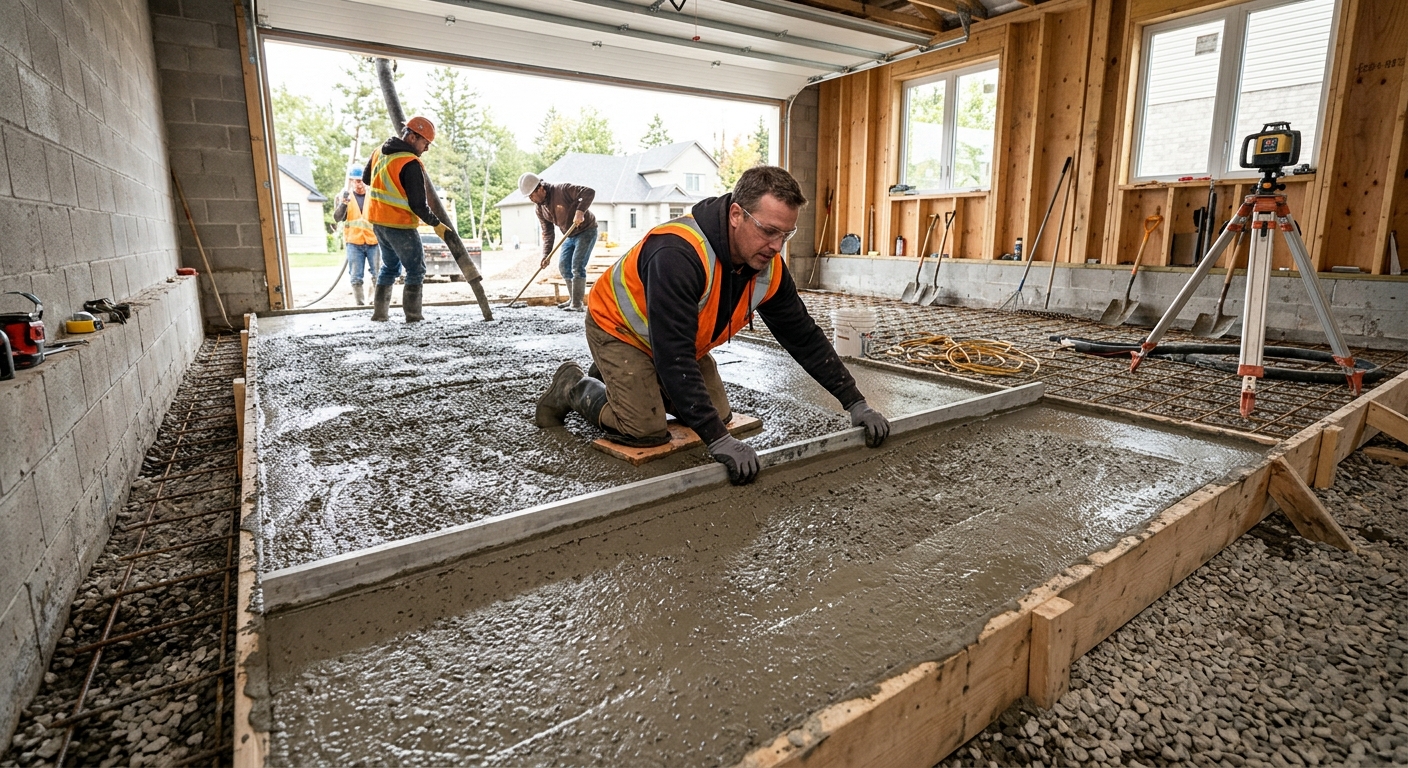
Concrete work options and costs in Stittsville
Stittsville homeowners often start with a simple question—what will the concrete cost?—and the answer usually depends on which part of your property you’re improving. With a 2021 population of 40,889 in the area (Statistics Canada, 2021 Census), there’s steady demand for driveways, patios, and garage slabs from growing family neighbourhoods around town. Stittsville’s housing stock is also heavily oriented toward single-detached homes, which is the typical buyer profile for exterior flatwork like driveway replacements and backyard patios (Statistics Canada, 2021 Census). That matters because larger lots and longer driveways mean more excavation, more base, and more joints to manage.
In Ottawa’s climate, pricing is higher than milder parts of Ontario because of deep frost protection requirements and repeat freeze–thaw cycles. Even when you choose a “standard” broom-finish driveway, the contractor still has to build a well-compacted granular base and plan for air-entrainment, proper drainage, and joint layout—especially at slab edges where heaving and cracking are most common. The pour season is shorter too; cold weather restricts finishing windows and slows strength gain, so many contractors budget more for weather monitoring, insulation/blanketing, and curing care.
Trade demand is especially strong in areas such as the Hunt Club Road corridor and the newer subdivisions along Abbott Street, where ongoing infill and new builds translate into frequent foundation and exterior flatwork work. If you’re comparing options, the best next step is to line up typical sizes and finish choices against realistic price bands.
| Application |
Typical Size |
Key Spec |
Finish Option |
Price Range |
| Concrete driveway (standard broom finish) |
400–600 sq. ft. |
Air-entrained mix; compacted granular base; control joints |
Broom finish, simple edge forms |
$6,500–$12,000 |
| Exposed aggregate driveway |
400–600 sq. ft. |
Air-entrained mix; base prep; proper curing before aggregate exposure |
Exposed aggregate (surface retarder/exposure) |
$9,000–$16,500 |
| Stamped concrete driveway or patio |
250–500 sq. ft. |
Air-entrained mix; higher workmanship; release agents and seal system |
Stamped patterns + sealer |
$7,500–$18,000 |
| Plain concrete patio or walkway |
150–350 sq. ft. |
Air-entrained mix; compacted base; slope and drainage |
Broom finish or smooth trowel (as specified) |
$2,200–$7,700 |
| Garage floor (interior slab) |
400–700 sq. ft. |
Vapour barrier (if required); reinforced slab design; curing |
Plain broom or smooth finish |
$6,000–$15,000 |
| Foundation footings (structural, below frost) |
Varies by house; typically multiple sections |
Engineered footing sizing and rebar; below-frost excavation |
Structural concrete, formwork |
$8,000–$25,000 |
Prices are estimates only and vary by project scope, site access and material selection.
What affects the price of concrete work in Stittsville
It’s not unusual to see the same concrete project priced 30–50% differently across Ottawa and other Ontario regions. In Stittsville, contractors price to the reality of a deep frost line, hard freeze–thaw cycling, and a shorter exterior pour season. Those conditions affect everything: how deep you must excavate, how much granular base you need, whether reinforcement is required, and how tightly the crew must control curing temperature and moisture.
Foundation and footing specs are the clearest example. Footings must be built below the design frost depth (Ontario commonly ranges about 1.5–2.4 m depending on location and design assumptions) to prevent frost heave. Exterior slabs also need air-entrained concrete to survive repeated freeze–thaw stress. That’s why an exterior driveway can fall inside a regional “backbone” range of about $16–$25 per sq. ft., while a stamped surface (with added labour and materials) often lands closer to $22–$35 per sq. ft. after you factor in finish complexity and sealing.
Two quick Stittsville examples show how site details move the needle. First, a driveway replacement where you have to remove and haul out old concrete and then rebuild base to the proper frost-protected depth will typically push cost toward the higher end of the $16–$25 band, even if the final slab is the same square footage. Second, a patio on a gently sloped backyard with easy truck access may land near the lower end of the $14–$22 patio/walkway band because fewer hours are spent on grading, edging, and placement logistics.
Labour availability can also matter: winter scheduling is tighter, so crews may price in heating/blanketing and longer on-site time to avoid early surface damage and ensure proper strength gain. Even a few extra days of cure protection can separate a job that lasts 20+ years from one that starts spalling early—especially where homeowners apply de-icing salt heavily near edges.
| Price Factor |
Why It Matters |
Cost Impact |
| Frost line depth — determines footing depth and form height |
Below-frost construction reduces heaving and cracking risk. |
Higher excavation and formwork; can add thousands on foundations. |
| Site preparation — excavation, grading, compacted granular base |
Base stability controls settlement and slab support. |
More trucking and labour; biggest swing factor for flatwork. |
| Reinforcement — rebar or wire mesh requirement |
Improves slab integrity where loads and movement occur. |
Materials + placement labour; modest for slabs, major for footings. |
| Mix design — air-entrainment and compressive strength spec |
Freeze–thaw survival depends on air content and strength. |
Usually a small materials premium; essential for durability. |
| Finish type — broom vs. stamped vs. exposed aggregate |
Complex finishes require extra steps and careful curing/sealing. |
Stamped/exposed typically move pricing toward the upper range. |
| Pour size and concrete truck access to site |
Placement time and method affect labour and waste. |
Limited access can require extra staging and rework. |
| Cold-weather curing precautions — heating and blankets |
Green concrete needs protection for proper strength gain. |
Heaters/blankets add labour and equipment charges. |
| Control joint pattern and sealing cost |
Joints manage shrinkage; sealing helps reduce salt damage. |
More layout time and sealing products; cost-effective long-term. |
Permits & regulations in Ontario
In Ontario, structural concrete work—like foundation footings, foundation walls, and grade beams—generally requires a building permit, and municipalities often expect engineered drawings as part of the plan review. Concrete flatwork (driveways, patios, and walkways) usually does not need a permit by itself, unless your scope affects lot grading, drainage, or impervious surface coverage limits, or it ties into municipal right-of-way requirements. Because rules can vary with the details of your site plan and municipality’s conditions, Stittsville homeowners should confirm with the local authority before breaking ground.
Step-by-step, a solid verification process helps you avoid surprises:
- Check the contractor’s business and licensing details through the Ontario government business registry resources (and any trade association listings they provide).
- Ask for a Certificate of Insurance (liability) showing current coverage and the correct job location; verify the coverage is active at the time of the pour.
- Confirm workplace coverage for their workers (WSIB/WCB clearance or account verification, as applicable) before work starts.
- For structural concrete, request documentation that the work will be executed to engineered drawings and permit requirements.
- Request references for similar-scale Ottawa-area jobs (driveways in freeze–thaw conditions, or footing work on below-frost excavation).
When in doubt, ask your contractor to provide a simple checklist: permit status (if required), insurance proof, and schedule for inspections. This is also where warranties and cure practices should be clearly stated in writing.
Getting concrete right in Stittsville's freeze-thaw climate
Concrete failures in Stittsville are usually about movement plus moisture plus chemistry—freezing water expands, and salt accelerates surface damage. The most common outcomes homeowners notice are random cracking, edge heaving, and spalling (flaking) near driveways and walkway borders. To prevent that, the job needs the full system: base prep, an exterior-grade mix, correct jointing, disciplined curing, and sealing after the cure window.
Start with base preparation: build a compacted granular sub-base to the frost-suitable depth for local soil and drainage conditions, and ensure the slab has proper slope away from structures. Next is mix design. For exterior flatwork in this region, specify air-entrainment (typically 5–7% air content for well-targeted freeze–thaw durability) and a minimum 32 MPa compressive strength so the concrete reaches reliable performance by the end of the cure period. Control joints then do their job: spacing should limit random cracking so cracks appear where you’ve planned for them, not across decorative corners.
Curing is non-negotiable. Plan for at least 7 days of appropriate curing protection; in cold or wind-exposed weather, crews may need blankets or heating to prevent surface damage while the concrete gains strength. Finally, apply a penetrating sealer after the concrete has cured (commonly after 28 days) to help repel de-icing salt intrusion.
A practical cost example: upgrading from a basic broom-finish driveway to stamped concrete is a real value-add, but you shouldn’t “save” by skipping air-entrainment or reducing base depth. Those cuts often show up later as spalling, and repairs can cost far more than the difference between finishes. In Stittsville, stamped work often falls around the $22–$35 per sq. ft. range, but durable broom-finish concrete with correct specs can be in the $16–$25 band and outlast it if the system is built correctly.
| Spec |
Why It Matters in Stittsville |
What to Ask For |
Impact if Skipped |
| Compacted granular base (depth?) |
Provides stable support and reduces frost-related movement. |
Base depth and gradation to match frost protection and drainage design. |
Settlement, edge lifting, and cracking show up sooner. |
| Air-entrained concrete mix (target air %?) |
Helps concrete survive freeze–thaw cycles by managing internal pressure. |
Target 5–7% air content for exterior flatwork and documented mix design. |
Higher risk of spalling and surface scaling in winter. |
| Compressive strength (MPa rating) |
Strength gain supports durability and weather resistance. |
Minimum 32 MPa (or the engineered design requirement). |
Weaker concrete wears/erodes faster under traffic and salt. |
| Control joints (spacing per ACI guidelines) |
Controls where shrinkage cracks occur. |
Joint spacing plan and sealant details at joints (where required). |
Random cracking across panels, leading to water entry and freeze damage. |
| Minimum 7-day curing period |
Ensures strength development before the slab is exposed to temperature swings. |
Cooling/wind plan and cold-weather curing method if needed. |
Premature damage, weaker surface, and early scaling/spalling. |
| Penetrating sealer (when applied after cure) |
Reduces moisture and salt intrusion at the surface. |
Apply after full cure window (commonly after 28 days) per product instructions. |
More salt-related deterioration, especially around edges and expansion areas. |
How to choose a concrete work contractor in Stittsville
Choosing the right concrete contractor in Stittsville is less about flashy photos and more about proof: licensing, insurance, and concrete-system discipline for Ottawa’s freeze–thaw winters. Start by verifying Ontario compliance. Ask for a current Certificate of Insurance (general liability) that includes your address or project description, and check the coverage is active during the work. Next, confirm WSIB/WCB coverage for their workers—get a clearance document or written confirmation before the first pour. For concrete contractors that do structural work, ensure they are comfortable coordinating engineered drawings and permit requirements where required.
Then request 2–3 itemised, written quotes—not just one lump sum. The best quotes break out labour, excavation/site prep, granular base, reinforcement, concrete supply, forming/finishing, joints, concrete curing protection (especially if temperatures are borderline), and sealing (if included). Make sure you understand what is excluded: removal/haul-away of existing concrete, disposal fees, temporary protection, saw-cutting timing, and whether permit pulling is included where needed.
Review warranty terms. Confirm the workmanship warranty length (and what it covers), whether the manufacturer warranty for products like sealers is provided, and whether it’s transferable if you sell your home. For payment, avoid large upfront deposits—generally no more than 10–15%—and use a holdback tied to completion and final curing/sealer steps.
Finally, protect your schedule: get a written start date and completion estimate, plus weather contingency language for cold snaps. In Ottawa-area winters, weather planning can be the difference between a good job and one that needs early patching.
- Confirm liability insurance is current (COI provided) and aligns with your project dates.
- Verify WSIB/WCB coverage before work begins.
- Ask whether they will provide engineered drawings/permit coordination for structural concrete.
- Request at least two project references in the Ottawa/Stittsville area with freeze–thaw performance.
- Get a quote that itemises excavation, granular base, reinforcement, concrete, and finish labour separately.
- Clarify disposal: is old concrete removal/haul-away included or extra?
- Confirm cold-weather curing plan: blankets/heaters, monitoring, and minimum curing approach.
- Ask for joint layout and how joints will be sealed (if required).
- Confirm mix design details: air-entrainment and minimum strength (MPa) for exterior exposure.
- Review warranty duration in writing and what triggers a warranty service call.
- Schedule the pour based on weather, not just calendar promises—get start/completion dates in writing.
- Use a payment schedule with 10–15% maximum upfront and a holdback until closeout items are done.
Red flags in Stittsville: contractors who refuse to provide insurance/WSIB proof, quotes that don’t specify air-entrainment or curing protection, unclear joint spacing plans, “cheap” pricing that assumes minimal base prep, and vague timelines that ignore cold-weather scheduling.
Frequently asked questions — concrete work in Stittsville
What is air-entrained concrete and why does it matter here?
Air-entrained concrete is mixed with tiny, evenly distributed air bubbles that help relieve internal pressure when water inside the concrete freezes. In Stittsville and across Ottawa’s region, freeze–thaw cycles and de-icing salt exposure make this especially important for exterior flatwork like driveways, walkways, and patios. Without the correct air content (commonly targeted around 5–7% for exterior work), concrete is more likely to spall and scale over time—often first at edges and near joints. When comparing quotes, ask the contractor to state the mix design for air-entrainment and minimum strength. If your driveway is priced near the $16–$25 per sq. ft. band, ensure that the “low” price isn’t achieved by skipping the exterior durability specs.
How do I prepare the base for a concrete slab?
Base preparation is what makes a slab stay level over Ottawa’s deep freeze conditions. In a proper Stittsville prep, the contractor excavates to the design depth, removes unsuitable soil, and rebuilds a compacted granular sub-base with proper gradation. The goal is stable, well-compacted support plus drainage that keeps water from pooling under or beside the slab. You should expect verification of compaction practices (often by equipment and process, not guesswork). For outdoor work, slope and drainage matter as much as depth. If you’re seeing a driveway quote on the higher end of the $16–$25 band, it’s frequently because base and grading scope is larger—haul-away, more granular material, and additional labour to meet frost protection and freeze–thaw durability needs.
How do I compare concrete quotes?
Start by comparing apples to apples. In Ontario, the simplest “lump sum” quote can hide major differences in base prep, mix design, reinforcement, jointing, and curing—areas that matter in Stittsville’s freeze–thaw climate. Ask each contractor for an itemised quote that includes: concrete mix details (air-entrainment and minimum MPa), granular base scope, reinforcement method, control joint layout, and whether cold-weather curing (blankets/heating) is included. Also confirm whether disposal of removed concrete and debris is included. Then match finish scope: a standard broom finish is different from exposed aggregate or stamped work (stamped often falls around the $22–$35 per sq. ft. band). If one quote is dramatically lower, ask what they’re excluding—because a “discount” often shows up later as cracking or spalling.
Can concrete be poured in cold weather in Stittsville?
Yes, concrete can be poured in cold weather in Stittsville, but it must be protected so it gains strength properly. Freeze–thaw risk is highest when the concrete is green (early-age) and exposed to temperature swings, wind, or moisture. The contractor should use cold-weather curing precautions—commonly insulation blankets, heating around the work area, and careful temperature monitoring—until the concrete reaches safe strength for exposure. You should also expect a weather-dependent schedule: crews may delay finishing steps or plan for additional curing time. This is one reason Ottawa-area pricing is often higher; the added equipment and labour are part of meeting durability specs. If a contractor offers a cold-weather pour but can’t clearly explain curing steps, that’s a major concern for exterior flatwork.
How do I maintain concrete in Stittsville's freeze-thaw climate?
Maintenance in Stittsville is mostly about controlling water and reducing salt-driven surface deterioration. After your slab cures (and if included, after sealer application—typically after about 28 days), keep the surface free of debris and ensure drainage paths remain clear. Use de-icing salts carefully; they speed up deterioration compared with less aggressive methods. Remove any standing water sources (downspout discharge, grading issues) because repeated wetting followed by freezing accelerates cracking and spalling. Inspect joints and edges each season and repair minor sealant issues early so water doesn’t enter and expand during winter. If you added sealing, re-apply per the product’s recommended schedule. Proper maintenance helps a driveway or patio hold up whether it’s priced near the $16–$25 band for standard broom finishes or higher for stamped surfaces.
What causes concrete to spall in Stittsville winters?
Spalling usually comes from a combination of inadequate air-entrainment, moisture entry, and repeated freeze–thaw. In Stittsville winters, water gets into tiny pores or at joints/edges; when temperatures drop, that water expands and stresses the surface. If the concrete isn’t properly air-entrained for exterior exposure, the surface has less internal “relief” and is more likely to flake. Salt worsens the problem by attacking the surface and increasing the rate of scaling and deterioration. Common contributors include poor base drainage (water pooling under/near edges), missing or improperly timed curing, and joint layouts that allow water infiltration. When comparing options, don’t select based only on price—ensure the quote includes exterior durability specs. A “cheap” driveway that ignores air content can fail much earlier than one built within the $16–$25 per sq. ft. range with proper freeze–thaw preparation.