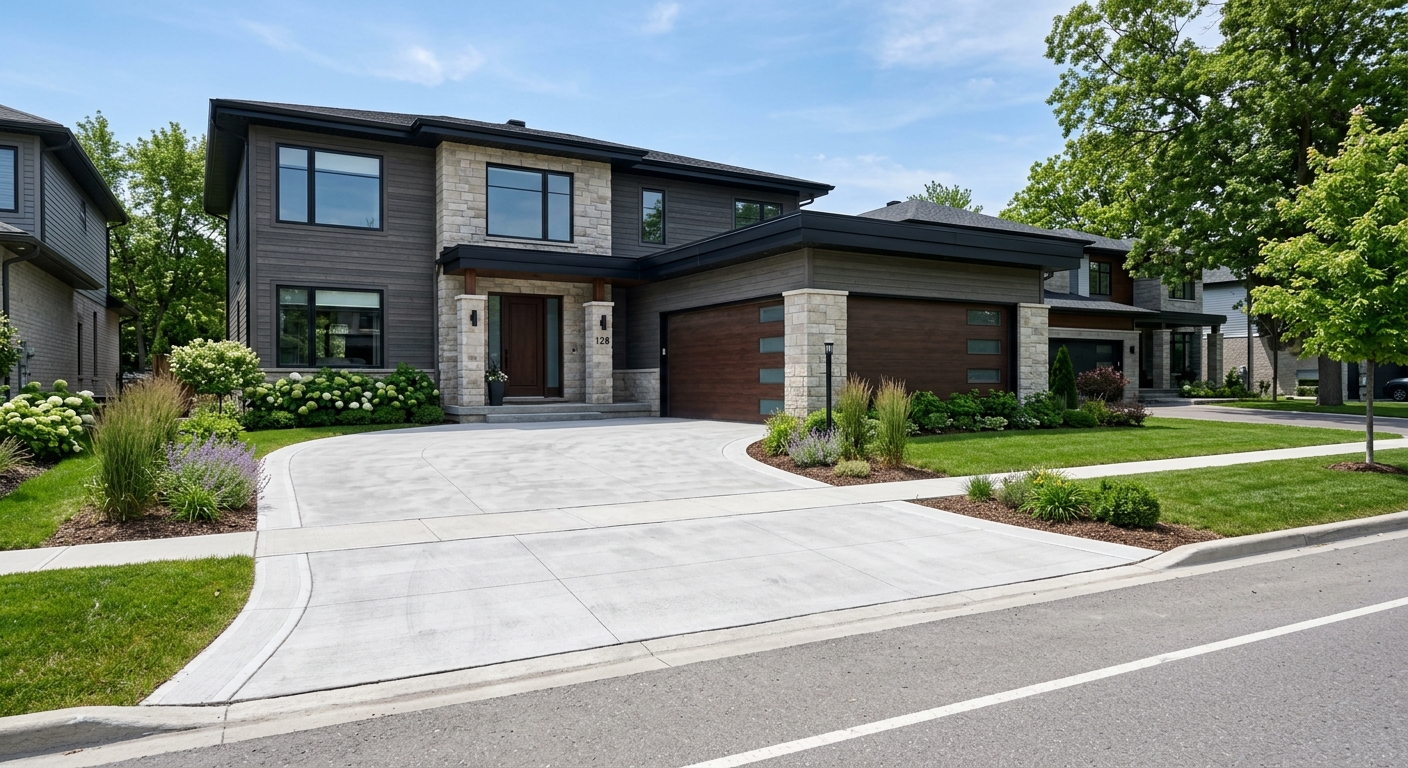
Concrete work options and costs in Corso Italia-Davenport
In Corso Italia-Davenport, concrete work is a year-round conversation because the neighbourhood’s homes and streets see a lot of freeze–thaw stress, especially on driveways, patios and walkways. With a population of 14,133 people (Statistics Canada, 2021 Census), the local market is active enough that homeowners can usually get competitive scheduling—though exterior pours are still concentrated in the warmer months for proper curing. The housing stock is dominated by single-detached and other family forms, which drives steady demand for slab-style upgrades like new driveway aprons, rear patio replacements and garage slab repairs.
Toronto-area concrete pricing tends to move more than you’d expect because the job details are tied to frost depth, drainage, and mix design. For most structural footings, Ontario specs generally require the foundation to extend at least 1.2 m (about 4 ft) below grade, helping reduce frost heave and differential movement. For flatwork, contractors typically use air-entrained mixes, build a well-compacted granular base, and plan control joints to manage cracking over repeated freeze–thaw cycles. Wet fall and spring weather also means more attention to curing protection—concrete that’s rushed in cool, damp conditions can cost less upfront but fail sooner (spalling, scaling, or surface breakdown).
If you’re comparing options in Corso Italia-Davenport—whether you want standard broom-finish durability or a decorative look—here are the typical cost bands to discuss with your contractor before you move into the pricing drivers.
| Application |
Typical Size |
Key Spec |
Finish Option |
Price Range |
| Concrete driveway (standard broom finish) |
300–400 sq. ft. |
Air-entrained mix, compacted granular base, control joints |
Broom finish |
$6,000 – $11,200 |
| Exposed aggregate driveway |
300–400 sq. ft. |
Air-entrained mix, proper base drainage, aggregate exposure |
Exposed aggregate |
$7,500 – $13,500 |
| Stamped concrete driveway or patio |
200–350 sq. ft. |
Air-entrained mix, thicker build for stamping texture, joints |
Stamped pattern + sealer |
$6,000 – $14,000 |
| Plain concrete patio or walkway |
120–240 sq. ft. |
Compacted base, proper slope, air-entrained mix |
Plain broom finish or smooth trowel |
$2,000 – $6,300 |
| Garage floor (interior slab) |
300–450 sq. ft. |
Vapour barrier (as required), proper thickness, fibre or rebar option |
Broom finish or smooth finish (limited by use) |
$5,400 – $12,600 |
| Foundation footings (structural, below frost) |
Varies by perimeter/house footprint |
Below-grade depth (Ontario practice ~1.2 m or per design), reinforced concrete |
Structural concrete (not a cosmetic finish) |
$3,600 – $12,000 |
Prices are estimates only and vary by project scope, site access and material selection.
What affects the price of concrete work in Corso Italia-Davenport
In Toronto and across Ontario, the same concrete job can land 30–50% apart because the “real” cost is usually in preparation and specifications, not just the concrete. Contractors protect themselves and your slab by building to frost-depth needs, using air-entrained mixes for exterior flatwork, and designing the base and drainage so saturated soils don’t pump and shrink against the concrete. In Corso Italia-Davenport, that means paying attention to freeze–thaw cycles: footings must be set below the design frost depth to limit heave and differential movement, and exterior slabs are commonly poured with air entrainment and well-spaced control joints to manage cracking.
Cold-weather curing also changes pricing. When temperatures drop toward 10 °C or below, contractors typically add concrete protection measures—insulating blankets, heat control, and longer timelines—because premature finishing or short cure periods can lead to weaker surface strength and scaling. De-icing salts in winter can further accelerate surface damage if you skip proper sealing after cure. That’s why a “simple” patio may come in near the $16 – $26 per sq. ft. band, while a decorative driveway that needs a tougher build-up and careful finishing can move into the $24 – $40 per sq. ft. range.
Two common Corso Italia-Davenport examples: (1) older lots with mature landscaping often require extra excavation and disposal for a proper granular base, which raises costs; (2) driveways that slope toward garages or streets need drainage planning, so contractors spend more on base thickness and grading to prevent pooling—less water contact means better long-term performance.
| Price Factor |
Why It Matters |
Cost Impact |
| Frost line depth — determines footing depth and form height |
Footings need to sit below design frost depth to prevent heave |
Higher depth increases excavation, shoring and concrete volume |
| Site preparation — excavation, grading, compacted granular base |
Base stability controls settlement and prevents slab movement |
Remove unsuitable soil and add granular fill can significantly raise labour hours |
| Reinforcement — rebar or wire mesh requirement |
Reinforcement helps control cracking and supports load transfer |
Material + placement time; may be required for thicker slabs |
| Mix design — air-entrainment and compressive strength spec |
Air-entrained mixes resist freeze–thaw scaling and spalling |
Specified mix can cost more but reduces early failure risk |
| Finish type — broom vs. stamped vs. exposed aggregate |
Complex finishes require extra steps and tighter tolerances |
Stamped and exposed surfaces typically add cost per sq. ft. |
| Pour size and concrete truck access to site |
Access affects pumping, hoisting, and labour coordination |
Limited access can add pumping fees or extended crew time |
| Cold-weather curing precautions — heating and blankets |
Concrete needs stable curing conditions for surface durability |
More labour, materials, and longer schedule before release |
| Control joint pattern and sealing cost |
Joints manage cracking; sealing repels moisture and salts |
Correct joint layout and later sealing add line-item cost |
Permits & regulations in Ontario
In Ontario, structural concrete work generally needs a building permit, and in many cases engineered drawings are reviewed as part of the municipal process. This includes foundation walls, grade beams, structural footings, and other load-bearing elements—essentially concrete that carries or redistributes structural loads. For these items in Corso Italia-Davenport, it’s common that the municipality expects drawings and inspections before, during and after the pour.
Concrete flatwork such as patios, walkways and most driveways typically does not require a permit by itself. However, you can still trigger requirements if the project affects lot grading, changes drainage patterns, adds impervious coverage beyond municipal allowances, or ties into municipal right-of-way or curb/surface alterations. The safest approach is to confirm before breaking ground, especially if you’re adjusting slopes or adding drainage.
Before you hire, verify your contractor carries liability insurance and WSIB/WCB coverage (for the trades they employ). A homeowner in Corso Italia-Davenport can typically check in this order: (1) request the contractor’s certificate of insurance and confirm it’s current and matches the job address; (2) look up their WSIB/WCB account information via the provider clearance method or documentation they provide; and (3) confirm they’re properly licensed for the scope they’re performing through Ontario’s online licensing registry for the relevant category. Then ask for references on similar structural or exterior flatwork projects—especially those done under tight access constraints.
Getting concrete right in Corso Italia-Davenport's freeze-thaw climate
Concrete failures in Corso Italia-Davenport are usually predictable: water gets into the slab and the pores, then freeze–thaw cycles expand moisture and break down the surface. The most common issue on exterior flatwork is spalling and scaling, which often points back to inadequate air-entrainment, poor base preparation, or missing/late sealing. To spec the job correctly, start with base preparation: build a compacted granular sub-base to the right depth for local soil conditions and frost susceptibility, and ensure the slab has proper slope and drainage so water doesn’t pool against the concrete.
Second, lock in the mix design. For exterior flatwork, air entrainment is critical—typically 5–7% air content—paired with a minimum 32 MPa compressive strength spec. Third, control joints should be installed to guide where cracking happens. Fourth, curing matters more than many homeowners realize: plan for at least 7 days of proper curing conditions, and use protection (blankets/heating) if temperatures are dropping toward 10 °C or below so the surface doesn’t weaken. Finally, sealing is the moisture barrier against de-icing salts and wet seasons; apply a penetrating sealer after full cure—commonly 28 days post-pour—then maintain it as recommended.
A quick cost example: a stamped driveway can run roughly $24 – $40 per sq. ft., which is a real jump from broom-finish durability. That difference is justified when the contractor also commits to correct joints, base thickness, and air-entrained mix—otherwise you’re paying for appearance while risking the same freeze–thaw damage. Ask for the spec details in writing so you’re paying for performance, not just the stamp.
| Spec |
Why It Matters in Corso Italia-Davenport |
What to Ask For |
Impact if Skipped |
| Compacted granular base (depth?) |
Prevents settlement and reduces pumping during wet/cold cycles |
Granular base thickness and compaction method; slope plan |
Uneven settlement, cracking, and early surface breakdown |
| Air-entrained concrete mix (target air %?) |
Resists freeze–thaw scaling and spalling in Ontario winters |
5–7% air content for exterior flatwork |
Higher risk of spalling and scaling within a few winters |
| Compressive strength (MPa rating) |
Stronger concrete holds up better under freeze–thaw and loads |
Minimum 32 MPa compressive strength spec |
Surface wear, deeper cracking and reduced durability |
| Control joints (spacing per ACI guidelines) |
Controls where cracks occur rather than random cracking |
Planned joint layout and spacing range for your slab size |
Random cracking that can invite water and freeze damage |
| Minimum 7-day curing period |
Builds strength and improves long-term freeze resistance |
Curing plan; protection if pouring near cooler temps |
Weaker surface, scaling risk and compromised finish |
| Penetrating sealer (when applied after cure) |
Repels moisture and reduces salt damage |
Penetrating sealer applied after full cure (commonly 28 days) |
Faster salt-related surface deterioration |
How to choose a concrete work contractor in Corso Italia-Davenport
Choosing the right contractor in Corso Italia-Davenport comes down to proof: proper Ontario coverage and a written plan that matches the freeze–thaw realities of exterior concrete. Start with licensing and compliance. Ask whether they’re performing work that requires a permit and whether they can coordinate it, and request documentation that they carry liability insurance. For work involving employees, confirm WSIB/WCB coverage and ask for clearance/active proof where applicable. If they can’t provide these items promptly, that’s a serious red flag.
Next, don’t accept vague estimates. Get 2–3 itemised written quotes showing labour and material breakdowns (excavation and disposal, granular base, reinforcement, concrete mix spec, joints, finishing, sealing, and any protection for curing). Make sure the quote states what’s included and what’s excluded—especially permit pull, traffic/surface protection, saw-cutting, and concrete truck or pump access. A quote can look similar while curing protection and base prep are missing, which is where the cheap jobs fail.
Warranty also matters. Ask for a workmanship warranty length and what it covers; clarify product/manufacturer warranty terms (and whether it’s transferable to you). For payments, never pay more than 10–15% upfront; hold back part of the amount until the job is complete and cleaned up. Finally, insist on a timeline with a start date and completion estimate in writing, since Ontario curing performance depends on temperature and scheduling.
- Request proof of liability insurance and ensure it’s current for your job address.
- Confirm WSIB/WCB coverage and ask how clearance is provided.
- Get an itemised quote (base prep, rebar/mesh, mix spec, finish, joints, sealing).
- Ask whether air-entrained concrete is specified for exterior flatwork and get the number.
- Confirm expected pour window and what curing blankets/heating are included (if needed).
- Review joint layout on the plan (where joints land and how they’re sealed, if included).
- Ask about excavation and disposal included in the price.
- Verify whether permit pulling is included when required for structural elements.
- Confirm reinforcement placement (chairs/spacers, cover, and tie-in details).
- Ask for references on similar-size driveways/patios in Toronto or nearby areas.
- Clarify warranty: workmanship term, conditions, and response timeline.
- Use a payment schedule with a holdback until final inspection/cleanup.
Red flags we see often in concrete projects around Corso Italia-Davenport: a quote that won’t specify air-entrainment or compressive strength, refusing to put curing protection and joint layout in writing, requiring a large upfront payment, “lump-sum” pricing with no breakdown of base prep or reinforcement, and no clear warranty terms or reference photos of comparable Ontario freeze–thaw exterior work.
Frequently asked questions — concrete work in Corso Italia-Davenport
How do I seal concrete to protect it in Corso Italia-Davenport?
In Corso Italia-Davenport and the broader Toronto area, sealing is mainly about reducing water and salt penetration during wet fall, freeze–thaw cycles, and de-icing season. For exterior flatwork, plan for a penetrating sealer after the concrete has fully cured—commonly about 28 days after the pour. The contractor should check surface dryness, then apply according to the sealer’s coverage rate to avoid glossy over-application or missed spots. If you’re comparing options, sealing is usually a relatively small line item compared with what you’d spend to redo a driveway—often keeping you closer to the $18 – $28 per sq. ft. broom-finish durability band instead of paying later for repairs. Ask for the product name, application date, and maintenance recommendation.
What is the difference between concrete and cement?
In everyday language, people say “concrete” and mean the whole material you see in the slab. Cement is only one component inside concrete. Cement is the binding material (powder) that hydrates and helps form the hardened matrix. Concrete is the full mix: cement plus water, aggregates (sand and stone), and sometimes additives like air-entrainment and plasticizers. In Ontario’s freeze–thaw climate, the exact concrete mix design matters more than the cement label—especially air-entrainment for exterior flatwork. That’s why a driveway quote should specify the air content and strength requirement, not just describe it as “concrete.”
How much does concrete work cost in Corso Italia-Davenport?
Costs in Corso Italia-Davenport typically track the Toronto economic region’s frost depth and labour demand. For a broom-finish driveway, a realistic budget often falls within the $18 – $28 per sq. ft. band, while patios and walkways are commonly in the $16 – $26 per sq. ft. range depending on base prep and drainage needs. If you’re considering decorative work, stamped concrete can shift into the $24 – $40 per sq. ft. band because it requires extra steps, careful joint planning, and finishing techniques that hold up in freeze–thaw conditions. Exact pricing depends on site access, excavation/disposal, thickness, reinforcement, and whether curing protection and sealing are included.
How deep must footings be for Corso Italia-Davenport's frost line?
Ontario’s design approach is based on frost depth to prevent frost heave and differential movement, so footing depth is typically set below the design frost depth. As a practical homeowner reference for the Toronto area, many structural footings are required to extend at least 1.2 m (about 4 ft) below grade, but the exact depth should follow the engineering/design requirements for your property. The key takeaway for Corso Italia-Davenport is that footing depth isn’t a guess—your plans and municipal requirements drive it. Contractors should be able to explain the footing depth in relation to your design documents and show how excavation and form height match that spec.
Why does concrete crack in Corso Italia-Davenport and how is it prevented?
Concrete cracks are often normal in flatwork—even when installed correctly—because concrete shrinks as it cures and the ground moves with moisture and freeze–thaw cycles. In Corso Italia-Davenport, prevention is about controlling where cracking occurs and reducing water entry. Contractors manage this with well-compacted granular base and drainage, air-entrained concrete for durability in freeze–thaw winters, and properly planned control joints to create “weak points” at predictable spacing. They also manage curing so the surface doesn’t weaken early, which can contribute to more rapid deterioration. Skipped or poorly located joints can lead to random cracking, then water gets in, freezes, and worsens the damage.
Stamped vs broom-finish concrete — cost difference?
Stamped concrete usually costs more than broom-finish because it requires additional labour and time: applying colour hardeners/release, using forms or stamping tools, creating a textured surface, then protecting it with sealers suitable for exterior freeze–thaw conditions. In the Toronto area bands, broom-finish driveways commonly land around $18 – $28 per sq. ft., while stamped concrete typically runs about $24 – $40 per sq. ft. The spread isn’t only cosmetic—good stamped work also includes correct base prep, air-entrained mix, and joint planning so the textured surface doesn’t become the weak point. If a quote for “stamped” doesn’t discuss joints, mix spec, and curing/curing protection, the low price is often coming from skipping the items that prevent freeze–thaw damage.