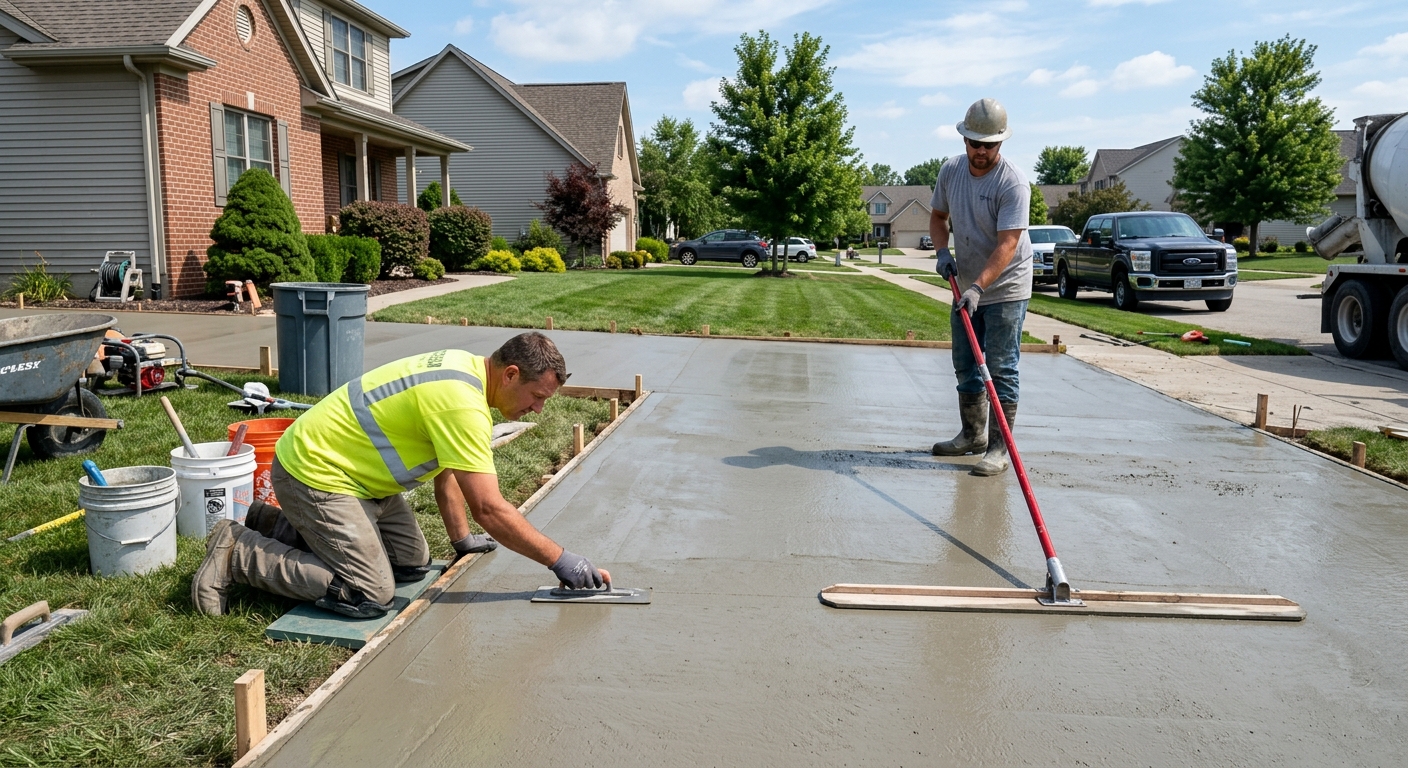
Concrete work options and costs in Greely
Greely, Ontario homeowners typically reach out for concrete when they’re planning driveways, walkways, patios, garage slabs and—on new builds or major renovations—foundation footings. With a population of 9,049 (Statistics Canada, 2021 Census), Greely has enough active housing demand that reliable crews can book out during the spring-to-fall window. In this area of Ottawa, concrete flatwork is especially in demand in and around neighborhoods like the Ogilvie Estates area, where new driveways and exterior upgrades are common.
Ottawa’s deep frost line and strong freeze–thaw cycles mean pricing is rarely “straight across” even for similar-looking slabs. Contractors design every exterior pour to resist heaving and cracking by using a well-compacted granular base, air-entrained concrete mixes, proper joint layout, and careful curing. Because exterior work has a shorter workable season, crews often need weather planning (blankets/heating on colder nights) and more time on site, which pushes labour and supervision costs up.
That’s why you’ll see some jobs land near the lower end of the local bands (for simpler, smaller-area pours), while others approach the higher end when there’s heavier excavation, tighter access, reinforcement, or decorative finishes. For example, a standard broom-finished driveway may be competitive within the $16–$25 range per square foot banded for Ottawa-area work, while stamped & decorative upgrades are commonly priced closer to the $22–$35 band because the finish requires extra labour and careful formwork and release timing.
Below is a practical comparison of common concrete options you’ll likely consider in Greely, along with realistic typical sizes and key specs.
| Application |
Typical Size |
Key Spec |
Finish Option |
Price Range |
| Concrete driveway (standard broom finish) |
10 ft x 20 ft (200 sq ft) |
Air-entrained exterior mix, compacted granular base, control joints |
Broom finish |
$4,200 – $5,600 |
| Exposed aggregate driveway |
10 ft x 22 ft (220 sq ft) |
Air-entrained exterior mix, proper cure timing, base with drainage |
Exposed aggregate (wash) |
$6,100 – $8,200 |
| Stamped concrete driveway or patio |
10 ft x 20 ft (200 sq ft) |
Reinforced slab as needed, air-entrained mix, color hardener |
Stamp + release + color |
$6,000 – $9,400 |
| Plain concrete patio or walkway |
12 ft x 12 ft (144 sq ft) |
Exterior air-entrained mix, slope away from house, compacted base |
Broom or light trowel |
$2,300 – $3,200 |
| Garage floor (interior slab) |
20 ft x 22 ft (440 sq ft) |
Vapour barrier as required, reinforcement, slab on prepared base |
Broom finish or smooth-trowel (sealed) |
$6,800 – $10,800 |
| Foundation footings (structural, below frost) |
Typical 1,200 sq ft footprint |
Engineered rebar cage, excavation to design frost depth, forming |
Reinforced structural concrete |
$18,000 – $30,000 |
Prices are estimates only and vary by project scope, site access and material selection.
What affects the price of concrete work in Greely
In Greely and the wider Ottawa region, quotes for the “same” concrete job can vary by 30–50% because concrete cost isn’t just material—it’s excavation, ground prep, protection from freeze–thaw damage, reinforcement, and how long the crew can work before cold weather affects finishing and curing. Even if the concrete thickness and footprint look similar on paper, a site that needs deeper digging, more base replacement, or added drainage will cost more than a comparable lot with good native soil and easier access.
Ottawa-area frost protection is a major driver. Footings must extend below the design frost depth to prevent frost heave, and in Ontario that typically means deeper excavation than you’d see in milder parts of the province. Exterior slabs are also built with air-entrained concrete mixes to survive freeze–thaw cycling, because poor air content is a common cause of surface spalling. Then there’s the short pour season: cold nights and temperature swings limit finishing windows, so contractors may add heating/blanketing and enforce longer protection and curing control—costs you feel even on “simple” driveways.
In Greely specifically, costs often rise when the driveway ties into an existing slope, when there’s rocky or poorly compacted fill that needs removal and re-grading, or when the site is exposed to wind off nearby open areas. Costs can be lower when access is straightforward, soil conditions are consistent, and the pour can be scheduled for a stable weather window. A plain patio may land toward the $14–$22 band when prep is simple, while stamped options often climb toward the $22–$35 range because labour-intensive finishing is less forgiving during cold, windy periods.
These same site realities show up on foundations too: on a foundation project, the cost difference between minimal excavation and design-depth excavation is often thousands of dollars, because every extra foot of digging affects trucking, granular base, forming, and crew time.
| Price Factor |
Why It Matters |
Cost Impact |
| Frost line depth |
Determines footing depth and how far forms must extend below grade |
Higher excavation and forming; can add thousands on foundation work |
| Site preparation |
Excavation, grading, and well-compacted granular base reduce voids and movement |
More base replacement typically increases labour and aggregate hauling |
| Reinforcement |
Rebar or wire mesh controls cracking, especially at edges and larger pours |
Material + placement labour; often needed for driveways and slabs |
| Mix design |
Air-entrainment and strength spec improve durability through freeze–thaw |
Exterior mix and QA testing add cost but reduce premature spalling |
| Finish type |
Broom vs. stamped vs. exposed aggregate affects labour time and timing |
Stamped/exposed typically move you toward the higher end of the bands |
| Pour size and concrete truck access to site |
Access affects pump needs, hose lengths, and crew efficiency |
Limited access can add truck/pump costs and extra labour hours |
| Cold-weather curing precautions |
Heating/blankets protect early-age strength gain and surface condition |
Added equipment and labour; especially common late season |
| Control joint pattern and sealing cost |
Joints control where cracks occur; sealing reduces water/saalt attack at surfaces |
Extra saw-cut time and sealer materials increase total price |
Permits & regulations in Ontario
In Ontario, the key split is between structural concrete (usually permit-required) and typical flatwork (often no permit, unless it changes site conditions). For Greely homeowners, concrete work that commonly requires a building permit includes: foundation footings, foundation walls, grade beams, and other structural elements tied to the building’s load path. In many cases, engineered drawings must be reviewed as part of the permitting process.
By contrast, concrete flatwork such as driveways, sidewalks, and patios often does not require a permit. The exception is when flatwork affects lot grading or stormwater drainage, triggers municipal rules about impervious surface coverage, or impacts the municipal right-of-way (for example, work near or over approved curb/sidewalk areas). If you’re unsure, ask the contractor to confirm requirements with the municipality before they excavate.
To verify a contractor in Ontario, start by asking for a recent Certificate of Insurance (general liability) and proof they carry WSIB coverage if they have workers. For licensing checks, use the relevant provincial/online trade listings where applicable, and ask for their business contact details and job references that match your type of work (driveways vs. foundations). Finally, request a written scope and have them clearly state who is pulling permits—when permits are required, you want that handled correctly before the pour.
Getting concrete right in Greely's freeze-thaw climate
Concrete fails in Greely most often when freeze–thaw exposure gets into the slab without adequate protection. The main culprits are poor base preparation, inadequate air-entrainment, weak curing practices, and joint layouts that don’t control cracking. If water can sit at slab edges and then freeze, the slab surface and edges are stressed repeatedly—leading to scaling and spalling. That’s why Greely concrete specs need to be “built for winter,” not just for the day of the pour.
Start with (1) base preparation: use a compacted granular sub-base to the right depth for local soil and frost conditions, then ensure good drainage so water doesn’t pump up under the slab. Next, (2) mix design: exterior flatwork should use air-entrained concrete (commonly 5–7% air content for exterior exposure) and a minimum compressive strength spec such as 32 MPa. For (3) control joints, spacing must limit random cracking; joints aren’t optional cosmetic cuts in Ottawa-area climate—they’re how you manage shrinkage and thermal movement. (4) curing matters even more here because the season can be short: minimum 7-day curing under proper conditions is a practical standard, and late pours may require insulating blankets or temporary heating. Lastly, (5) sealing: apply a penetrating sealer after the concrete has fully cured (typically around 28 days) so de-icing salts and moisture are less able to attack the surface.
When shoppers ask whether they can save money, I’ll usually say: pay for air-entrainment and proper base prep first. For example, if a stamped patio estimate is $1,500–$2,500 higher than a plain broom-finish patio because it includes reinforcement, better joint planning, and proper curing controls, that extra cost can be justified—because the durability benefits reduce callbacks in freeze–thaw conditions. What usually isn’t justified is skipping joints, using the wrong air content, or rushing curing to get back on schedule.
| Spec |
Why It Matters in Greely |
What to Ask For |
Impact if Skipped |
| Compacted granular base (depth?) |
Reduces voids and movement under freeze–thaw cycling |
State sub-base depth and compaction method (e.g., engineered granular layers) |
Settlement, edge lifting, cracking and pumping of fines |
| Air-entrained concrete mix (target air %?) |
Helps concrete survive repeated freezing and thawing |
Confirm air content target (commonly 5–7% for exterior exposure) |
Increased risk of scaling and spalling, especially at slab edges |
| Compressive strength (MPa rating) |
Affects durability and strength gain in cold-weather pours |
Confirm minimum 32 MPa (or higher if engineered) |
Surface damage, reduced performance and higher maintenance |
| Control joints (spacing per ACI guidelines) |
Controls where cracks form as concrete shrinks and moves with temperature |
Ask for planned joint spacing and layout on drawings/photos |
Random cracking, more water entry and faster deterioration |
| Minimum 7-day curing period |
Protects early strength development through Ottawa temperature swings |
Confirm curing approach and cold-weather curing plan if needed |
Weak surface, surface defects, and premature freeze damage |
| Penetrating sealer (when applied after cure) |
Reduces moisture and salt intrusion during winter de-icing |
Apply after cure (typically around 28 days) and specify product type |
Faster salt scaling and more frequent surface repairs |
How to choose a concrete work contractor in Greely
Choosing the right concrete contractor in Greely is mostly about verifying coverage and getting a complete scope. In Ontario, reputable contractors should carry general liability insurance and provide a recent Certificate of Insurance showing their coverage limits and your address on the project. If they have employees, they should also have WSIB coverage—ask for proof and verify it’s current. Don’t rely on verbal assurances; request documents before signing.
Next, get 2–3 itemised written quotes. The best quotes break costs into labour, concrete supply, reinforcement, excavation/granular base, forms, finishing, saw-cut joints, disposal, and—if applicable—sealing. Avoid quotes that are only a lump sum with vague language like “includes base” or “includes concrete”—in Ottawa-area freeze–thaw conditions, those details determine whether the slab lasts. Confirm whether the contractor is pulling permits (when required for structural concrete), and whether they include debris removal, grading adjustments, and any required tie-ins to existing drainage.
Warranty should be in writing. Ask for the length of the workmanship warranty, and whether product/manufacturer warranties apply to concrete materials like curing compounds or sealer products. Also ask whether the warranty is transferable if you sell the home.
For payment, I recommend never paying more than 10–15% upfront. Hold back a portion until the job is complete and you’ve inspected finishes, joints, and curing protection. Finally, insist on a start date and completion estimate in writing, because weather planning affects pour schedules here.
- Provide proof of general liability insurance (current certificate).
- Provide proof of WSIB coverage if they have workers.
- Include a detailed scope: excavation, granular base, and compaction steps.
- Confirm air-entrained exterior mix and minimum strength spec (e.g., 32 MPa).
- Explain joint layout: where and how they’ll cut and seal joints.
- State whether reinforcement is included (rebar or mesh) and why.
- List finishing details: broom, stamped, exposed aggregate timing and process.
- Clarify cold-weather plan: blankets/heating if temperatures drop.
- Include curing and what “proper curing” means for your pour dates.
- Specify sealing product and timing (typically ~28 days after cure for sealer).
- State disposal and haul-away for removed material (not “as needed”).
- Provide warranty terms in writing, including workmanship start date.
Concrete contractor red flags in Greely: they refuse to discuss air-entrainment or curing, they quote flatwork without any base depth or compaction details, they minimize the importance of control joints, they want large upfront payments, or they don’t provide insurance/WSIB documentation before work begins.
Frequently asked questions — concrete work in Greely
How long does a concrete project take in Greely?
In Greely, the timeline depends on whether you’re doing exterior flatwork or structural concrete. For a typical driveway or walkway, the active work is usually fast—often 1 to 3 days on site for excavation, base prep, forming, the pour, and finishing—while curing and weather protection dictate when you can use the surface safely. Because Ottawa-area freeze–thaw cycles can hit quickly, contractors may extend the protection period if nights get cold or if wind and moisture affect curing. If you’re comparing options, remember that stamped or exposed aggregate usually takes longer on finishing and timing, which is one reason stamped concrete commonly prices in the $22–$35 band versus broom-finish work closer to the $16–$25 band. For foundations/footings, schedule is longer due to excavation depth, reinforcement placement, and engineered requirements.
What is a concrete overlay and is it suited to Greely?
A concrete overlay is a new surface layer placed over an existing slab—often to restore appearance and improve wear without full demolition. In Greely, overlays can be a good solution when the base is structurally sound and the old slab isn’t significantly heaved, undermined, or failing badly at edges. The big issue with freeze–thaw is moisture movement: if water is getting under or through the old concrete, an overlay won’t “fix” the root problem. A proper overlay spec should include surface preparation (grinding/milling as needed), bonding requirements, and drainage planning so water can’t sit. Cost-wise, many homeowners find overlays can be priced competitively compared with new pour options, but if the existing driveway has widespread cracking or poor base support, replacement may be safer and more durable in Ottawa’s winter conditions.
How do I seal concrete to protect it in Greely?
In Greely, sealing matters because de-icing salts and repeated freeze–thaw cycles accelerate surface breakdown. The practical approach is: pour correctly with the right air-entrained mix and joints first, then seal after curing. For most exterior work, wait about 28 days after the pour so the concrete is sufficiently cured and dry enough for the sealer to bond properly. A penetrating sealer is commonly recommended because it helps repel moisture and reduces salt intrusion. Ask your contractor what type of sealer they use, coverage rate, and whether the surface is fully clean and ready before application. As a ballpark, sealing is usually minor compared with the overall driveway cost—however, it can help extend service life compared with an unsealed surface, especially on edges and traffic areas where water and salts concentrate.
What is the difference between concrete and cement?
Concrete is the full material system: cement plus water plus sand and gravel (aggregate), and often admixtures like air-entrainment for freeze–thaw durability. Cement is one component inside concrete—it’s the binder that reacts with water and helps the mixture harden. For Greely homeowners, the important takeaway is that the performance issues you feel in winter (spalling/scaling, cracking) are influenced by the concrete mix design—especially air content and strength—more than by the word “cement” in casual conversations. When contractors talk about “air-entrained concrete,” they mean the concrete mixture has been engineered for exterior exposure in freezing weather. If you’re comparing quotes, ask for the concrete mix spec (air-entrainment and minimum strength) rather than focusing only on finish type.
How much does concrete work cost in Greely?
Concrete pricing in Greely is driven by freeze–thaw requirements, the depth of excavation for frost protection, and how much site work is needed. As a reference for Ottawa-area bands, typical concrete driveway work often lands in the $4,200 – $5,600 range for standard broom-finished driveway sizes, while stamped concrete driveway/patio work commonly falls into a higher band such as $6,000 – $9,400 depending on size and finish complexity. For plain patios or walkways, smaller projects may fit roughly in the $14–$22 per square foot style band, while stamped and decorative work typically aligns more with the $22–$35 band. Foundation/footings are a different category because you’re digging below frost depth and placing reinforcement—those projects can be much higher. Your final number can swing significantly if you need more granular base, extra reinforcement, limited truck access, or cold-weather curing measures.
How deep must footings be for Greely's frost line?
For Greely, you can’t safely guess footing depth based on “what worked next door” because frost protection depends on design frost depth, site conditions, and engineering requirements. In Ontario, typical footing depths are often around 5–6 ft for structures, and contractors plan below frost depth to prevent frost heave. That’s why structural concrete work usually involves engineered drawings and a permit process. If the design calls for deeper excavation (for example, due to soil conditions or specific structural loads), the contractor must follow it even if it increases cost. When reviewing quotes for footings, ask for the engineered plan details: footing elevation, depth, reinforcement requirements, and how they’ll manage excavation and formwork below grade. Done correctly, this is what keeps your foundation stable through Ottawa’s freeze–thaw cycles.