Concrete work options and costs in Erin
In Erin, Ontario, most homeowners choose concrete because it performs well for driveways, patios and walkways—especially in a market where detached homes dominate (91.5% of dwellings) and many properties were built before 1981 (58.2% of homes). With 3,800 homeowner households and 90.0% ownership, there’s consistent demand for exterior flatwork and foundation-related repairs. The Kitchener–Waterloo–Barrie area’s cold, high freeze-thaw climate is a big reason concrete scopes are priced carefully: footings must be set below the frost line to reduce heave, exterior slabs need air-entrained concrete to handle winter cycling, and winter pours require extra protection (curing blankets, heating) that adds labour and equipment time. That weather reality also shortens the effective pour season, which can make scheduling tighter in spring and late fall—so contractors often build in logistics and standby costs. In Erin, the trade is especially busy in older, established pockets near Highway 109 corridors and the Erin Village area, where homeowners frequently upgrade driveways and replace aging walkways tied to existing landscaping and drainage patterns.
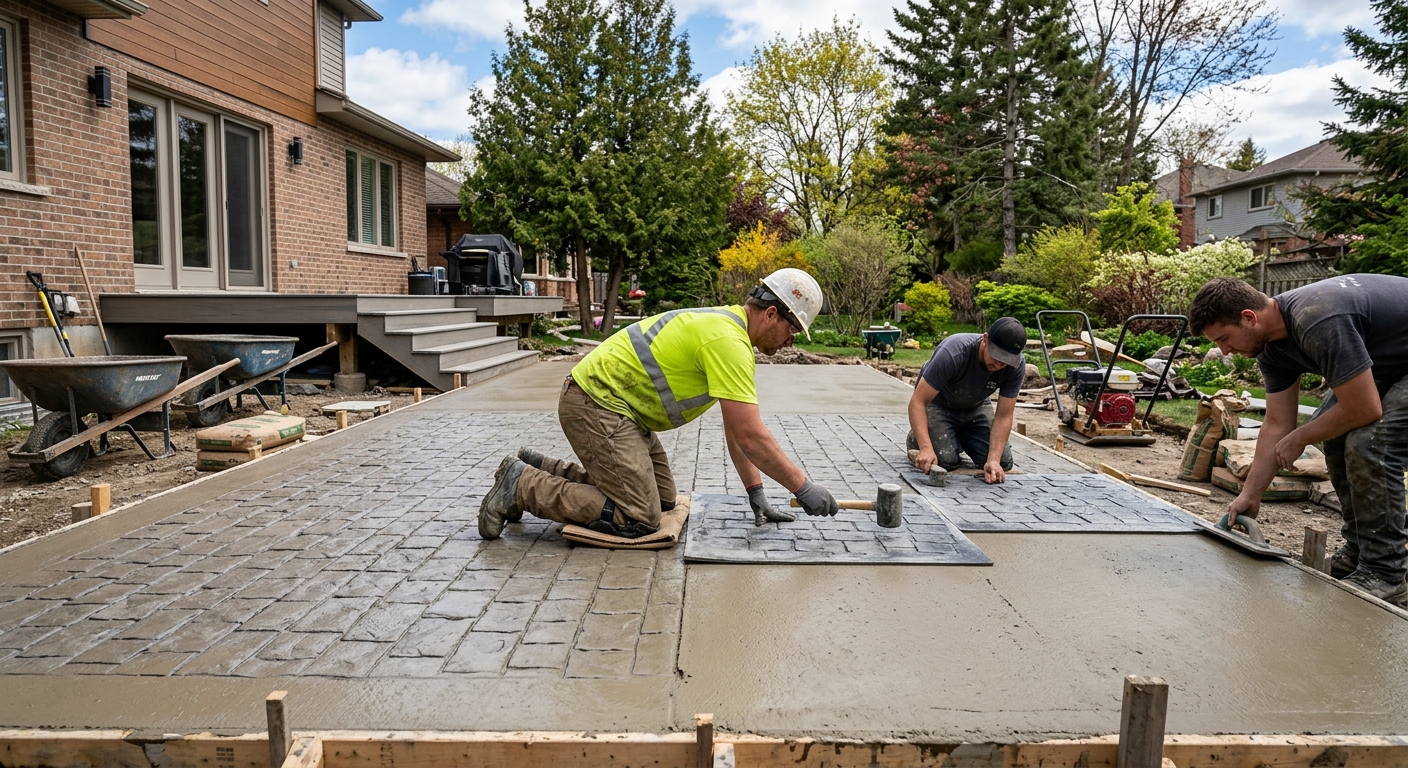
If you’re comparing proposals, it helps to look at typical configurations: standard broom-finished driveways are usually the most economical, while stamped or exposed aggregate add surface fabrication time and material markup. For context, the region’s concrete flatwork pricing generally aligns with the city’s tiered bands (driveways and slabs), and foundations/footings follow a separate structural pricing range. Use the table below to benchmark what “normal” looks like in Erin, then match the spec to your ground conditions, access, and finish preference.
| Application |
Typical Size |
Key Spec |
Finish Option |
Price Range |
| Concrete driveway (standard broom finish) |
12 m x 3.0 m (approx. 36 m²) |
Air-entrained exterior mix; compacted granular base; control joints |
Broom finish; saw-cut joints |
$6,000–$9,000 |
| Exposed aggregate driveway |
12 m x 3.0 m (approx. 36 m²) |
Air-entrained mix; proper curing and timing for wash-expose |
Exposed aggregate (wash finish) |
$8,000–$12,000 |
| Stamped concrete driveway or patio |
10 m x 3.0 m (approx. 30 m²) |
Air-entrained mix; base prep for a crack-controlled surface |
Stamped pattern (texture + release agent) |
$6,600–$10,500 |
| Plain concrete patio or walkway |
6 m x 4.0 m (approx. 24 m²) |
Air-entrained exterior mix; grading to drain away from house |
Plain broom or smooth trowel (as specified) |
$3,400–$5,300 |
| Garage floor (interior slab) |
6.1 m x 6.1 m (approx. 37 m²) |
Vapour barrier; proper sub-base; fibre or mesh as required |
Standard trowel finish |
$4,800–$8,000 |
| Foundation footings (structural, below frost) |
Per linear metre (varies by foundation design) |
Excavation to design depth; rebar per engineer; concrete below frost line |
Structural concrete (formwork + placement) |
$120–$220 |
Prices are estimates only and vary by project scope, site access and material selection.
What affects the price of concrete work in Erin
Even when two quotes describe the “same” concrete driveway, bids across the Kitchener–Waterloo–Barrie region and Southern Ontario can differ by 30–50% once you account for site conditions and cold-weather work. The main drivers are the design requirements that prevent failure in Erin’s freeze-thaw conditions: footings must extend below the design frost depth to reduce heave and random cracking, and exterior slabs typically need an air-entrained mix to improve durability when water freezes within the concrete. In Ontario, frost depth commonly pushes deeper excavation and higher formwork costs, and cold-weather curing precautions (insulating blankets and/or controlled heating) can add labour and equipment time when pours can’t happen in warm windows. On top of that, de-icing salt accelerates surface spalling—so sealing (and good drainage) can be a cost-effective part of a long-term plan rather than an afterthought.
In practice, costs rise or fall with very concrete examples: (1) A driveway over heavier clay or poor drainage often requires deeper or wider granular excavation and improved sub-base, which increases hauling and compacting time; (2) Restricted access off local streets near Erin Village can force smaller equipment or longer pump/set-up time, increasing labour hours; (3) If your home is older (and many are, given 58.2% built before 1981), you may run into buried services or misaligned grading tied to legacy drainage. Finish selection also matters: upgrading from a plain patio around $14–$22 per square foot-equivalent band into stamped concrete (often in the $22–$35 range) is only justified when the base prep and joint plan are correct, because those are what keep the surface looking good through winters—not just the pattern.
| Price Factor |
Why It Matters |
Cost Impact |
| Frost line depth |
Determines how deep footings and certain foundation elements must be to prevent frost heave. |
Higher excavation and formwork; can significantly increase foundation/footing pricing. |
| Site preparation |
Excavation, grading, and compacted granular base control settlement and reduce cracking. |
Often the largest swing factor for driveways and patios with variable soil conditions. |
| Reinforcement |
Rebar or wire mesh helps manage shrinkage and load-related cracking depending on design. |
Material + tying/placing time; costs rise if thicker slab or more steel is required. |
| Mix design |
Air-entrainment and specified compressive strength improve freeze-thaw durability and strength. |
Premium for correct exterior mix; typically small vs. the cost of repairs later. |
| Finish type |
Broom finishes are faster; stamped/exposed require additional steps and careful timing. |
Stamped typically adds the most; exposed aggregate costs more than plain broom. |
| Pour size and concrete truck access to site |
Smaller pours can cost more per square metre; limited access can increase pump/set-up time. |
Longer labour and equipment time can push prices upward noticeably. |
| Cold-weather curing precautions |
Heating blankets/membranes protect strength gain when temperatures drop early. |
Extra labour/equipment; commonly needed for spring/fall scheduling constraints. |
| Control joint pattern and sealing cost |
Proper joints limit random cracking; sealing helps reduce salt and moisture impacts. |
Cost is usually moderate, but it protects the finish and reduces surface deterioration. |
Permits & regulations in Ontario
In Ontario, concrete is a mix of “structural” work (usually permit-driven) and “flatwork” (often not). For Erin homeowners, structural concrete—footings, foundation walls, grade beams and other load-bearing elements—typically requires a building permit, and engineered drawings may be reviewed by the municipality as part of the approval process. Concrete flatwork like driveways, patios, and walkways usually does not require a building permit on its own, unless it affects lot grading, stormwater management, impervious surface coverage limits, or work near municipal right-of-way boundaries. Before excavation, confirm what applies to your address and scope with the local authority so you don’t get surprised after the fact.
Regardless of permits, verify your contractor is properly set up. Step-by-step, here’s how you can check: (1) Licensing: ask for the contractor’s business information and any required provincial/municipal registrations, then confirm their standing through publicly available business directories; (2) Liability insurance: request a Certificate of Insurance (COI) naming you/your property as additionally insured where applicable, and confirm coverage dates match the project; (3) WSIB/WCB coverage: request proof of workers’ compensation coverage and clearance documentation where offered; (4) References: ask for at least two recent jobs in Ontario with similar scope (driveway replacement, patio over clay, or foundation-related work) and confirm timelines. Getting this right before work starts protects you from delays, workmanship issues, and disputes.
Getting concrete right in Erin's freeze-thaw climate
Concrete failures in Erin are almost always tied to water and movement: inadequate drainage lets water saturate the slab, freeze-thaw cycling then expands trapped moisture, and that’s when you see spalling, scaling, and random cracking. The fix is not a “better finish”—it’s a correct specification from the base to the top surface. Start with base preparation: excavate to the design depth and build a compacted granular sub-base that matches local soil and frost considerations, not a “thin layer and hope” approach. Next, use a mix design that can survive Ontario’s winter: exterior flatwork should be air-entrained (commonly in the 5–7% air range for exterior exposure) and meet a minimum compressive strength target such as 32 MPa, so the concrete develops adequate durability and strength. Then control cracking with properly spaced control joints. In this climate, curing is critical—aim for a minimum 7-day curing period under conditions that protect early strength gain; in cold weather, that often means curing blankets and/or temporary heating to prevent temperature drop before the slab can lock in strength. Finally, seal the surface: apply a penetrating sealer after full cure (often around 28 days) to help repel de-icing salts and reduce moisture uptake.
When you ask questions, aim for specifics that prevent the most common issue: spalling from inadequate air-entrainment and poor curing. For example, if one quote for a plain patio is near the $14–$22 per square metre-equivalent band while another only “saves” by omitting proper air-entrainment or base compaction, that difference may look small—yet the repair cost is typically far higher than doing it right the first time in freeze-thaw weather.
| Spec |
Why It Matters in Erin |
What to Ask For |
Impact if Skipped |
| Compacted granular base (depth?) |
Provides support and reduces settlement/cracking under freeze-thaw movement. |
Confirm the excavation depth and granular type, and that it’s compacted in lifts to spec. |
Settlement, uneven cracking, and premature joint failure. |
| Air-entrained concrete mix (target air %?) |
Creates relief for freezing water so exterior slabs resist scaling and spalling. |
Ask for air-entrainment target (commonly 5–7% for exterior flatwork). |
Higher risk of spalling/scaling after winter cycles. |
| Compressive strength (MPa rating) |
Ensures durability and load capacity after curing in cold conditions. |
Confirm minimum 32 MPa (or design-specified strength) and curing plan. |
Weaker surface, faster wear, and brittle failure behavior. |
| Control joints (spacing per ACI guidelines) |
Controls where cracks form so they’re predictable and manageable. |
Ask for joint layout and spacing and whether joints align with slab geometry. |
Random cracking patterns and wider, unsightly defects. |
| Minimum 7-day curing period |
Early strength gain protects the slab against moisture/temperature stress. |
Confirm curing method (blankets/membrane as needed) and temperature protection. |
Surface damage, reduced durability, and increased shrinkage cracking. |
| Penetrating sealer (when applied after cure) |
Helps reduce moisture and salt penetration, slowing surface deterioration. |
Confirm application timing after cure (commonly around 28 days) and sealer type. |
More salt damage, accelerated scaling, and shorter finish lifespan. |
How to choose a concrete work contractor in Erin
Start with verification. In Ontario, confirm your contractor carries current liability insurance and workers’ compensation coverage (WSIB/WCB). Practical way to check: (1) Ask for a Certificate of Insurance (COI) and confirm the coverage dates overlap your proposed construction window; (2) Request proof of WSIB/WCB coverage directly from the contractor and verify the account is active; (3) Confirm the company can provide a written scope and doesn’t rely on verbal assurances only; and (4) check references for similar projects in Erin/area—especially driveway replacements where base prep and drainage are make-or-break.
Next, require 2–3 itemised written quotes. You want labour and material breakdowns—what’s included in excavation, disposal, granular supply, reinforcement, concrete type (air-entrained), finish, and sealing—not just a lump sum. Read exclusions carefully: Is permit support included if required? Is concrete removal/disposal included? Are protection measures for cold weather curing included (blankets/heaters), and who supplies them? For warranty, ask for a workmanship warranty length in writing, plus any manufacturer warranty details for products like sealers or admixtures, and whether the warranty is transferable to subsequent owners. Finally, insist on a sensible payment schedule: never pay more than 10–15% upfront; use progress payments tied to milestones, and hold back until the job is complete and cleaned up. Get a start date and completion estimate in writing—weather can affect timelines in Erin, but the plan should be specific.
- COI provided, active dates confirmed
- WSIB/WCB proof provided and active
- Written scope lists excavation, base depth, and disposal
- Concrete spec confirms air-entrainment for exterior work
- Control joint plan and sealing included/confirmed
- Cold-weather curing plan included (blankets/heating if needed)
- Reinforcement requirements stated (mesh/rebar) when applicable
- Itemised quote with line items (no “mystery allowance” pricing)
- Specific finish description (broom/exposed/stamped) and pattern options
- Timeline with dates and weather contingencies
- Workmanship warranty stated in writing
- Permit responsibility is clearly assigned (if required)
Concrete red flags in Erin: quotes that don’t mention air-entrainment for exterior slabs, “too-fast” schedules that skip cold-weather protection, vague base prep depths (“we’ll grade it”), refusal to provide COI/WSIB proof, and no written joint/sealing plan—those omissions are where winter cracking and spalling start.
Frequently asked questions — concrete work in Erin
How long does a concrete driveway last?
In Erin, a properly built exterior driveway often lasts 20 to 30 years, and sometimes longer, because good concrete isn’t just about pouring—it’s about freeze-thaw durability and water control. Air-entrained concrete and a compacted granular base reduce the risk of scaling and spalling during winter cycles. Equally important is drainage: if water ponds, the slab stays saturated and the freeze-thaw stress accelerates surface breakdown. If your driveway is in the typical Erin housing stock—many homes were built before 1981—older drainage patterns can make replacement more involved. A standard broom-finished driveway is often priced in the $15–$25 band, but the longevity depends on whether the contractor followed the spec (base depth, joint plan, curing, and sealing timing where recommended).
What is air-entrained concrete and why does it matter here?
Air-entrained concrete includes tiny microscopic air bubbles that give freezing water room to expand without destroying the cement paste. In Erin’s cold, high freeze-thaw climate, that matters because trapped moisture can expand during winter and cause spalling and scaling. For exterior driveways, patios and walkways, you should expect an air-entrained mix with a target commonly in the 5–7% air range, plus adequate curing. This is one of the biggest differences between a “lowest price” quote and a durable one. If a contractor can’t clearly state that the mix is air-entrained for exterior exposure, treat it as a serious gap. Sealing after full cure (often around 28 days) also helps protect the surface from de-icing salt, which is a common contributor to deterioration in Southern Ontario. (Statistics Canada, 2021 Census) shows Erin has a strong homeowner market, so durable work is especially valuable for repeat winters and long-term property value.
How do I prepare the base for a concrete slab?
For a concrete slab in Erin—whether it’s a driveway, patio or walkway—the “base prep” determines how stable the slab stays through frost movement. First, the contractor should excavate to the right depth for your soil and frost considerations, then grade to shed water away from your home. Next, they add compacted granular material in lifts and compact to the required density so you don’t get settlement. In a cold freeze-thaw area, insufficient granular depth or weak compaction can create uneven support, leading to cracking or joint failure. You can compare quotes by asking for the base section: granular type, base depth, compaction method, and confirmation that drainage is addressed. A plain patio in the $14–$22 band is only worth it when base prep is solid; otherwise, you’ll be paying for repairs sooner than you planned.
How do I compare concrete quotes?
Comparing concrete quotes in Erin comes down to like-for-like scope. Ask each contractor for an itemised breakdown: demolition/removal (if any), excavation, disposal, granular base materials, reinforcement, concrete mix type (confirm air-entrainment for exterior work), finish, control joints, curing/temperature protection, and sealing if included. Check whether permit support is included for structural work and whether disposal is priced. Also compare access and logistics—driveways with tight turns or limited truck placement can change labour and equipment needs. Price should match specification: for example, if one stamped patio quote lands near the higher $22–$35 range, confirm the steps behind it (proper prep, joint plan, stamp materials, and curing). If you’re seeing a large difference—often influenced by freeze-thaw scheduling and curing precautions—don’t pick only on the lowest number without verifying air-entrainment and curing details.
Can concrete be poured in cold weather in Erin?
Concrete can be poured in cold weather in Erin, but it requires a controlled plan to protect curing. The core risk is that early strength gain slows down when temperatures drop, and freezing during the early stages can damage the final durability. A competent contractor will discuss cold-weather curing precautions such as insulation blankets, wind protection, and sometimes heating to maintain safe temperatures until the concrete reaches adequate strength. You should also expect scheduling adjustments because the effective pour season in Southern Ontario is shorter than in milder regions. Ask the contractor what temperature thresholds they follow, how they’ll protect the slab edges and joints, and whether curing protection is included in the quote. If you’re being offered “regular pour” conditions with no curing protection in fall or spring, that’s a red flag. For exterior flatwork, ensure the mix is air-entrained and that the plan includes enough curing time before de-icing salt or heavy loads.
How do I maintain concrete in Erin's freeze-thaw climate?
Maintenance in Erin is mostly about keeping water off and protecting the surface from salt. Start with drainage: fix downspouts or grade issues that cause ponding, because saturated slabs suffer more freeze-thaw damage. Keep joints clear of debris so they can do their job. Use de-icing products cautiously; salt can accelerate surface wear and contribute to spalling on poorly protected concrete. If your slab is newly built, follow the recommended curing timeline and avoid heavy loads until the concrete is properly cured. Many homeowners also choose a penetrating sealer after full cure (commonly around 28 days) to reduce moisture and salt penetration. Budget-wise, repairs after winter can exceed the original finish cost—so maintaining a sealed, joint-controlled slab is often cheaper than waiting for scaling. With Erin’s housing stock and homeowner base, a well-maintained driveway or patio helps keep your property looking good year after year (Statistics Canada, 2021 Census).