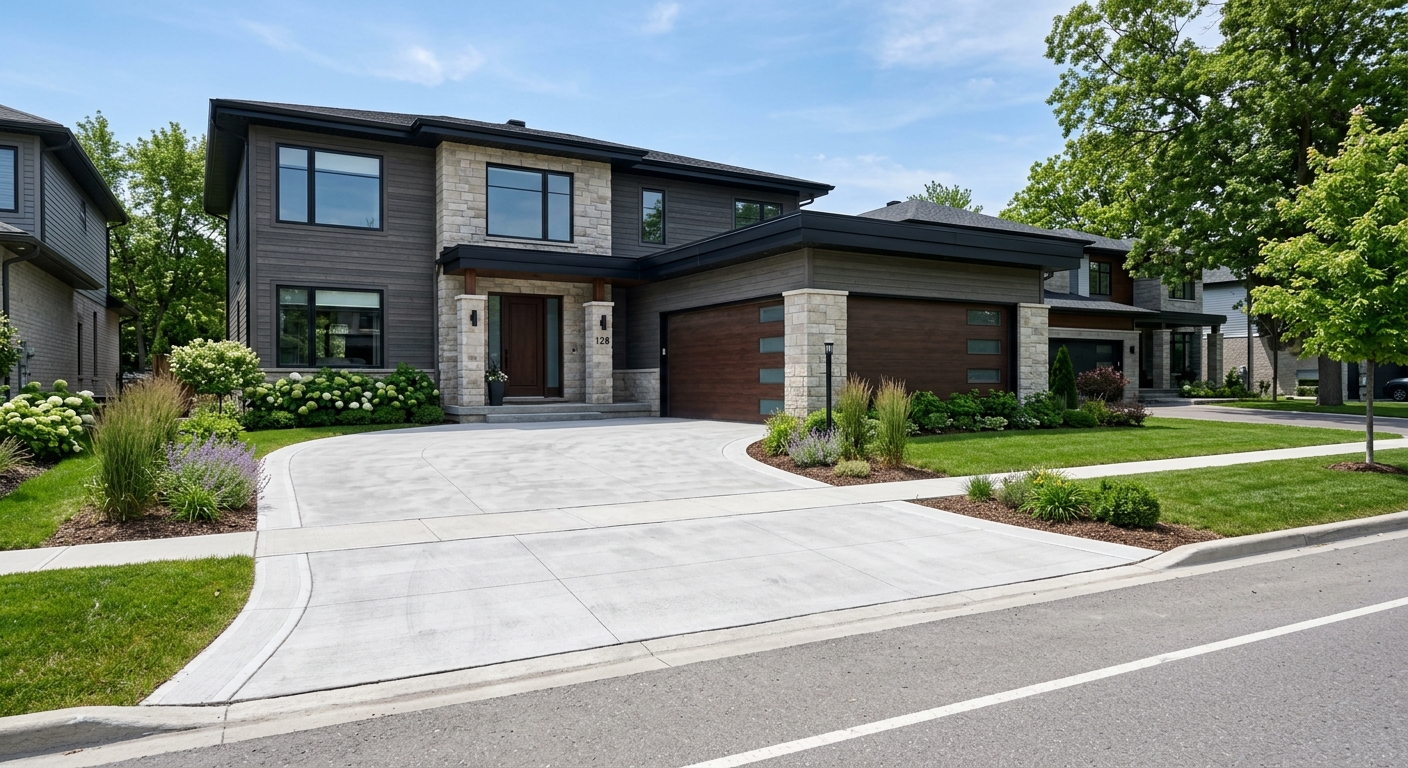
Concrete work options and costs in Greater Napanee
Concrete contractors in Greater Napanee, Ontario work in a market where most homes are built as single-detached properties—about 73.7% of the dwelling stock—so driveways, patios, walkways and garage slabs are constant demand items. With 4,940 homeowner households (Statistics Canada, 2021 Census), there’s steady repeat work as properties age; in fact, 64.2% of homes were built before 1981, which often means older flatwork and foundations need repairs, re-lifts, or full replacement rather than minor touch-ups.
In the Kingston–Pembroke region, your cost is driven less by the slab itself and more by site conditions and weather windows. Frost action and repeated freeze-thaw cycles in southern Ontario push contractors to set footings below frost and to use air-entrained concrete for exterior work. At the same time, the pour season can be shorter once shoulder-season temperatures swing, so scheduling and curing protection (blankets/heating) can add labour. Coastal-wet exposure around Lake Ontario and the Bay of Quinte also makes curing discipline important—opening concrete to traffic too early can lead to surface damage.
In Greater Napanee, trade activity is especially strong around established streets near the city core and along routes connecting to the harbour/Waterfront area, where lots often have mature trees, tighter access, and drainage challenges—factors that raise excavation and base prep time. With those realities in mind, the table below compares common options and realistic price bands you can use to benchmark your quote.
| Application |
Typical Size |
Key Spec |
Finish Option |
Price Range |
| Concrete driveway (standard broom finish) |
400–600 sq. ft. |
Air-entrained for exterior; compacted base |
Broom finish + control joints |
$8,000–$12,000 |
| Exposed aggregate driveway |
400–600 sq. ft. |
Air-entrained; proper surface retarder & finishing |
Exposed aggregate with sealer |
$10,000–$15,000 |
| Stamped concrete driveway or patio |
300–500 sq. ft. |
Coloured, air-entrained mix; tighter finishing tolerances |
Stamp + release + (typically) sealer |
$9,000–$17,000 |
| Plain concrete patio or walkway |
200–400 sq. ft. |
Air-entrained; sloped away from house |
Broom or smooth-trowel edges |
$3,500–$6,000 |
| Garage floor (interior slab) |
480–600 sq. ft. |
Vapour barrier (where required); proper thickening/mesh |
Power-trowel or light broom |
$7,500–$12,500 |
| Foundation footings (structural, below frost) |
Approx. 200–400 sq. ft. of footing area |
Below frost depth; reinforced concrete |
Structural finish (not decorative) |
$12,000–$25,000 |
Prices are estimates only and vary by project scope, site access and material selection.
What affects the price of concrete work in Greater Napanee
In Kingston–Pembroke, two quotes for the “same” concrete job can differ by 30–50% because the slab is only part of the cost. Excavation depth, the condition of the native soil, drainage needs, and concrete truck access often determine the real labour and material totals. That’s also why the same homeowner option can land in different Ontario price bands—an exterior driveway with better drainage and a clean, open access route can cost meaningfully less than a constrained site with wet subgrade that needs extra base, dewatering, or thicker reinforcement.
Climate is a big driver of spec—and spec drives cost. Frost line depth and freeze-thaw cycles mean footings must extend below the design frost depth (often around 1.2 m below grade in Ontario practice, depending on the engineered requirement and local conditions) to prevent frost heave. Exterior flatwork should use air-entrained concrete so it survives repeated freezing and thawing without scaling or spalling. In colder shoulder-season weather, cold-weather curing precautions—insulating blankets and, in some cases, temporary heating—protect strength gain. Finally, de-icing salts accelerate surface wear; sealing is commonly recommended to help extend service life.
Here are a few Greater Napanee examples of how conditions swing your budget: replacing a plain porch slab with proper air-entrainment and correct slope can be closer to the $90–$150 per sq. ft. patio band when access is easy; adding stamped work (stamps, colouring, and tighter finishing tolerances) often moves you into the higher decorative range of $160–$280 per sq. ft.-type budgeting. Older neighbourhoods with pre-1981 housing (Statistics Canada, 2021 Census) often have trees, uneven grades, and outdated drainage—those items raise excavation and base prep costs compared to new infill sites.
| Price Factor |
Why It Matters |
Cost Impact |
| Frost line depth — determines footing depth and form height |
Controls minimum excavation and rebar spacing for structural stability |
Higher depth/formwork increases concrete and labour; can add thousands |
| Site preparation — excavation, grading, compacted granular base |
Wet/soft subgrade or poor drainage needs thicker base and compaction |
Often the #1 swing factor; can move the job 30%+ on tight sites |
| Reinforcement — rebar or wire mesh requirement |
Improves crack control and load resistance |
Mesh is cheaper than heavier rebar cages; still material + labour |
| Mix design — air-entrainment and compressive strength spec |
Air voids reduce freeze-thaw damage; strength spec affects mix |
Typically adds a modest material premium but prevents failure costs |
| Finish type — broom vs. stamped vs. exposed aggregate |
Decorative work requires extra steps and tighter timing |
Stamped/exposed finishes usually cost substantially more |
| Pour size and concrete truck access to site |
Small access bottlenecks increase wheelbarrowing and time |
Limited access can add labour hours and require smaller pours |
| Cold-weather curing precautions — heating and blankets |
Maintains strength gain during cool shoulder-season nights |
Blankets/heaters add daily labour and rental/material costs |
| Control joint pattern and sealing cost |
Joints manage shrinkage cracking and sealing protects from salts |
Sealer is an added line item but can reduce early surface deterioration |
Permits & regulations in Ontario
In Ontario, structural concrete work typically requires a building permit. That includes foundation footings, foundation walls, and grade beams (anything part of the load-bearing structure). Often, you’ll also need engineered drawings that the municipality reviews. For most standard homeowners, the key point is that the permit path is tied to structural risk—not just the fact that concrete is involved.
In contrast, concrete flatwork like driveways, patios, and walkways usually does not require a permit unless it affects lot grading, drainage, or municipal coverage limits (such as rules around impervious surfaces). Even then, the municipality may require a compliance plan if your changes alter how water runs off your property.
For Greater Napanee homeowners, the practical verification steps are straightforward:
- Confirm the contractor’s Ontario business licence (if applicable) and trade credentials.
- Request a Certificate of Insurance (liability) that lists your address as additional information if offered.
- Ask for proof of WSIB coverage (and ensure it’s current).
- Request references for similar-scale projects (driveways/patios and/or foundations if applicable).
- Make sure the quote states whether permits/engineering coordination are included for structural work.
Before any digging or excavation, always confirm permit requirements with your local authority and ensure the contractor is insured and compliant for the scope you’re paying for.
Getting concrete right in Greater Napanee's freeze-thaw climate
Concrete failures in Greater Napanee almost always trace back to a few repeat causes: water management, freeze-thaw resistance, and timing. When the base isn’t compacted to the right depth or drainage isn’t handled, water sits under or at the slab edge, then expands during freezing. That contributes to voids, rocking, and eventual cracking. The second major culprit is the mix: exterior flatwork needs air-entrainment to resist freeze-thaw scaling and spalling caused by repeated freezing and thawing.
To “spec it right,” ask for five basics:
- Base preparation: compacted granular sub-base to a thickness that fits your soil and expected frost conditions, with proper slope away from the house.
- Mix design: air-entrained concrete (for exterior flatwork commonly in the 5–7% air range) and a minimum 32 MPa compressive strength for typical residential exposure.
- Control joints: spacing that limits random cracking so joints form where you expect them.
- Curing: minimum 7 days under suitable conditions; in cool weather, curing protection becomes critical.
- Sealing: penetrating sealer after cure (often around 28 days) to help repel de-icing salts.
A quick example of where money is justified: upgrading from a basic “any mix” approach to a correctly air-entrained exterior driveway spec can cost more up front, but it’s cheaper than repairing scaled surfaces after the first harsh winter. If your quote includes air-entrainment and proper base prep, you’ll typically see better value than spending extra on decorative stamping while skipping the freeze-thaw fundamentals.
| Spec |
Why It Matters in Greater Napanee |
What to Ask For |
Impact if Skipped |
| Compacted granular base (depth?) |
Reduces frost-driven movement and supports the slab during freeze-thaw cycles |
Base thickness plan based on soil conditions and proper compaction method |
Settling, cracking, and edge spalling from trapped moisture |
| Air-entrained concrete mix (target air %?) |
Protects against scaling/spalling in cold/wet winters |
Air content target (commonly 5–7% for exterior flatwork) |
Surface scaling, pop-outs and early deterioration with de-icing salts |
| Compressive strength (MPa rating) |
Ensures adequate strength gain in Ontario’s variable pour temperatures |
Minimum 32 MPa (and any exposure-based higher spec) |
Weaker surface and increased risk of damage if opened too early |
| Control joints (spacing per ACI guidelines) |
Directs shrinkage cracking to planned locations |
Planned joint layout and spacing schedule in the quote |
Random cracks that can widen and let water in |
| Minimum 7-day curing period |
Builds strength before traffic and reduces early surface damage |
Curing method and protection plan during cool/damp periods |
Surface weakness, scuffing marks, and scaling |
| Penetrating sealer (when applied after cure) |
Helps repel salt and moisture during the freeze-thaw season |
Confirm sealer type and timing (commonly after cure around 28 days) |
Faster salt-related deterioration and higher maintenance costs |
How to choose a concrete work contractor in Greater Napanee
Choosing the right concrete contractor in Greater Napanee is mostly about verifying coverage, scope, and construction discipline. Start with Ontario compliance: ask for a current Certificate of Liability Insurance (so you’re not exposed if there’s property damage or an injury on site) and proof the company participates with WSIB for the workers performing the work. Next, confirm they can provide an active Ontario business licence when required and that the crew is insured for the type of work quoted—decorative flatwork and structural concrete need different experience profiles.
Then require 2–3 written, itemised quotes instead of a single lump-sum. You want line items that separate labour and materials, including excavation, granular base prep, reinforcement, formwork, concrete delivery, finishing, joints, and sealing (if applicable). Make sure you understand what’s excluded: disposal/haul-away, eavestrough tie-ins, protection during curing, and whether the quote includes any permit coordination for structural work.
Payment should protect you. Never pay more than 10–15% upfront. Use a holdback until the job is complete and any punch-list items are finished. Confirm the schedule: a realistic start date and completion estimate in writing, especially since cool nights in the Kingston–Pembroke region can affect curing timelines.
- Ask for proof of WSIB and liability insurance, and confirm dates are current.
- Request a list of comparable projects in the Greater Napanee area.
- Get quotes that show base prep and thickness, not just “concrete supply and pour.”
- Confirm concrete is air-entrained for exterior flatwork.
- Require the joint layout (spacing and where joints land).
- Ask what reinforcement is used (mesh vs. rebar) and where it’s placed.
- Verify curing and protection plans for cool/damp weather.
- For stamped work, confirm steps: colouring, stamping, release, and sealing.
- Clarify truck access and whether pumping/wheelbarrowing is included.
- Check whether site drainage tie-ins are included or excluded.
- Review warranty length for workmanship and whether it’s transferable.
- Keep documentation: signed scope, spec sheet, and delivery/placement notes if available.
Concrete red flags in the Greater Napanee market: contractors who won’t specify air-entrainment or strength targets, who provide vague base prep descriptions, who start work without confirming drainage/frost considerations, who ask for large upfront deposits, or who treat control joints and sealing as optional “extras” even for exterior concrete exposed to Ontario winters.
Frequently asked questions — concrete work in Greater Napanee
How much does concrete work cost in Greater Napanee?
In Greater Napanee, concrete pricing usually tracks the scope and, most importantly, site conditions and weather-related scheduling. For example, a plain concrete patio or walkway often falls in the $90–$150 per sq. ft. range, while stamped driveway or patio work typically lands higher because of colouring, stamping, and tighter finishing tolerances. For driveways, standard broom-finish pours commonly align with the $120–$180 per sq. ft. band, but excavation, drainage fixes, and reinforcement can push your final total up or down. If you’re comparing quotes, ask each contractor to itemise excavation, base prep, rebar/mesh, and finishing—those lines explain most differences you’ll see across Ontario.
How deep must footings be for Greater Napanee's frost line?
Ontario practice generally requires footings to be placed below the design frost depth to prevent frost heave. In the Kingston–Pembroke region, a common rule-of-thumb used in residential detailing is around 1.2 m below grade, but the correct depth depends on engineered foundation design and site-specific conditions (soil type, building loads, drainage, and local assumptions). Since Greater Napanee has freeze-thaw cycles that can stress foundations during winter transitions, a contractor should not “guess” footing depth. For structural concrete (footings and foundation walls), the municipality typically expects permit and engineered drawings, so your depth requirement should be based on the design—not on a general estimate.
Why does concrete crack in Greater Napanee and how is it prevented?
Concrete cracks in Greater Napanee for two main reasons: shrinkage and movement from moisture/freeze-thaw cycles. Drying shrinkage is managed by control joints placed on a planned pattern. Movement from water and cold weather is managed with a properly compacted granular base, correct slopes/drainage, and an exterior-ready mix that’s air-entrained to resist freeze-thaw damage. De-icing salts can worsen surface wear, so sealing after the concrete has cured is often recommended. In practice, the best prevention is spec discipline: if your contractor can’t describe joint spacing, air-entrainment, and base preparation details, you’re taking on predictable risks—especially on driveways and patios.
Stamped vs broom-finish concrete — cost difference?
Stamped concrete costs more than broom-finish primarily because it involves additional materials and labour: integral colour and/or surface colour hardeners, stamp mats, release agents, and more careful timing and finishing tolerances, plus typically sealing. In Ontario, that’s why decorative projects usually sit above standard flatwork. As a benchmark for Greater Napanee, plain concrete driveway/flatwork is often priced around the $120–$180 per sq. ft. band, while stamped concrete projects commonly price in higher ranges (often tied to the $160–$280 decorative band depending on complexity and pattern). If the base and joints aren’t done correctly, stamping won’t prevent cracking—it just makes the surface more visually noticeable.
When is the best time to pour concrete in Greater Napanee?
The best time is when temperatures support reliable strength gain and curing. In Greater Napanee and the wider Kingston–Pembroke region, you generally want to pour during the main warm-weather window and avoid overnight freezes. If scheduling pushes into cooler shoulder-season conditions, contractors must use cold-weather curing precautions (insulating blankets and, in some cases, heating) to maintain adequate curing conditions. A concrete crew that schedules for weather windows typically protects the pour rather than rushing to meet a calendar date. This is where quotes can differ: one contractor may include blankets/heating (increasing cost) to ensure performance, while another may not treat those protections as essential.
How long does concrete take to cure?
Concrete strength gain is time-dependent. For homeowners in Ontario, the common guidance is that concrete should cure for at least 7 days before you allow traffic, and it takes about 28 days to reach typical design strength under normal conditions. Curing isn’t just “waiting”—it involves maintaining appropriate temperature and moisture conditions so the concrete develops strength rather than drying too quickly. In colder or damp weather near Greater Napanee, curing protection becomes more important, and crews may extend protection time and control exposure to wind/freezing temperatures. If you’re planning sealing (often a penetrating sealer), many systems are applied after the cure period (commonly around the 28-day mark) to repel salts and help the surface last through winter.