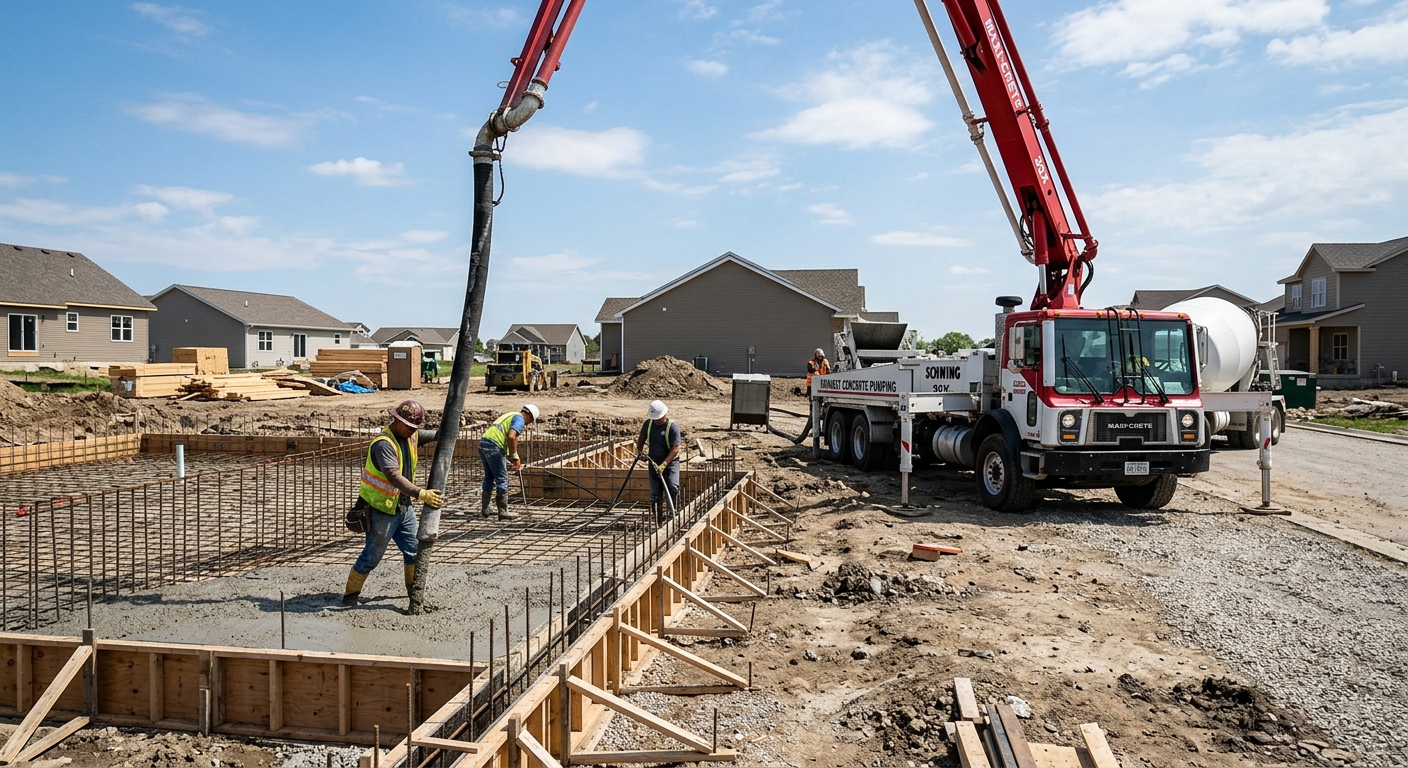
Concrete work options and costs in Wawa
Wawa concrete work typically starts with driveways, patios and walkways—especially because most homes here are single-detached (81.5% of dwellings) and the homeowner market is strong (78.5% of households own, Statistics Canada, 2021 Census). That ownership mix matters: homeowners are more likely to rework exterior flatwork for curb appeal, better drainage, and safer footing. In Wawa’s Northeast Ontario market, concrete contractors are also busier with older housing stock (86.8% of homes built before 1981), which often means we’re tying new pours into existing grades, footings, steps, and drainage patterns rather than building from scratch.
While the “freeze–thaw driver” is more extreme in Northeast BC, Wawa still sees repeated winter freezing that accelerates surface wear if concrete isn’t air-entrained, properly cured, and protected. In practice, that means footings and slab edges need disciplined prep: compacted granular base, correct mix design, and tighter control joint patterns. Shorter workable windows and the need for cold-weather protection can also tighten scheduling and raise labour costs when many jobs overlap.
In Wawa, demand is especially noticeable around the town core and established residential blocks where drive access and drainage improvements are common—folks often want a durable driveway that sheds meltwater, plus a safe walkway path to the front door. Below are current Wawa-tier cost bands to help you compare options before you request itemised quotes.
| Application |
Typical Size |
Key Spec |
Finish Option |
Price Range |
| Concrete driveway (standard broom finish) |
12 ft x 24 ft (288 sq ft) |
Air-entrained mix for exterior; compacted base |
Broom finish + control joints |
$4,800–$7,200 |
| Exposed aggregate driveway |
12 ft x 24 ft (288 sq ft) |
Air-entrained exterior mix; proper retarder timing |
Exposed aggregate (surface texture) |
$6,800–$10,800 |
| Stamped concrete driveway or patio |
12 ft x 20 ft (240 sq ft) |
Air-entrained mix; integral colour |
Stamp mats + border/colour options |
$6,000–$9,600 |
| Plain concrete patio or walkway |
10 ft x 12 ft (120 sq ft) |
Air-entrained mix; compacted granular base |
Broom or smooth trowel edge |
$1,800–$3,000 |
| Garage floor (interior slab) |
20 ft x 22 ft (440 sq ft) |
Slab thickness per design; vapour control if needed |
Plain finish with saw cuts |
$8,300–$13,200 |
| Foundation footings (structural, below frost) |
Typical 2-car home perimeter |
Reinforced, below frost; excavation + formwork |
Structural concrete (not decorative) |
$10,500–$18,000 |
Prices are estimates only and vary by project scope, site access and material selection.
What affects the price of concrete work in Wawa
In Wawa, it’s common to see quotes for the “same” concrete project vary by 30–50% when the scope details differ—especially around excavation, drainage prep, reinforcement, and curing protection. Two contractors can price a driveway at the same square footage, yet one includes a deeper granular base, proper air-entrainment, and sealing, while another treats it as a surface patch job. Those choices determine durability in freeze–thaw conditions, and they directly tie back to how we build for Ontario winters.
Frost and freeze–thaw cycles are the driver of every spec. In Ontario, exterior footings and foundation elements generally must extend below design frost depth (often in the 1.5–2.4 m range depending on location and engineered requirements). Exterior slabs also need air-entrained concrete to survive repeated freezing and thawing, and colder periods can shorten the effective pour season—meaning more scheduling pressure and cold-weather curing precautions like insulated blankets or heat tents. De-icing salt then becomes an additional concern: without a suitable sealer after cure, salts can accelerate spalling and surface scaling.
Here are a few realistic Wawa examples of what raises or lowers cost: (1) If your driveway sub-base is soft or has poor drainage, excavation and granular replacement can add meaningful labour and trucking; (2) Adding rebar or thicker slab sections for a heavier vehicle load can shift cost—often still cheaper long-term than frequent patching; (3) Switching from broom finish to stamped or exposed aggregate increases material and labour, which is reflected in Wawa’s higher decorative bands (for example, stamped work often lands closer to $6,000–$9,600 for a typical patio-sized area, while a broom driveway band is generally lower).
Finally, because many homes in Wawa were built before 1981 (86.8% of homes, Statistics Canada, 2021 Census), older lot grades and drainage patterns can require rework. That’s one reason driveway and patio quotes can swing even when the square footage looks identical.
| Price Factor |
Why It Matters |
Cost Impact |
| Frost line depth |
Determines footing depth, form height, and excavation volume |
Higher depth can add major excavation + rebar/formwork costs |
| Site preparation |
Excavation, grading, compacted granular base for a stable slab |
Soft soils or poor drainage increase trucking, granular supply, and labour |
| Reinforcement |
Rebar or wire mesh controls cracking and supports loads |
More steel and labour on placement raises total cost |
| Mix design |
Air-entrainment and compressive strength spec for freeze–thaw survival |
Premium mix costs more but improves durability and reduces failures |
| Finish type |
Broom vs. stamped vs. exposed aggregate affects labour and materials |
Stamped/exposed typically costs substantially more than broom |
| Pour size and concrete truck access |
Shorter pours and easier access reduce labour time |
Poor access can require pumping, extra handling, and more crew hours |
| Cold-weather curing precautions |
Protects strength gain and surface integrity in cold snaps |
Heating/blankets add material and time, especially near the pour window |
| Control joint pattern and sealing cost |
Manages cracking and protects the surface from salts and water |
Better jointing + sealing is a small add-on compared to repaint/patch cycles |
Permits & regulations in Ontario
In Ontario, structural concrete work typically needs a building permit, and it often comes with engineered drawings that the municipality reviews. That generally includes footings, foundation walls, grade beams, and other parts of a foundation or load-bearing structure. Concrete flatwork like patios, walkways, and driveways usually does not require a permit on its own—however, there are common exceptions. If the work changes lot grading, impacts drainage/overland flow, increases impervious surface beyond what’s allowed, or affects municipal right-of-way (for example, work near a curb or sidewalk), you may need approvals before you break ground.
For Wawa homeowners, the best approach is simple: confirm with the local authority before scheduling excavation. Next, verify your contractor carries liability insurance and has WSIB/WCB coverage (or the appropriate proof for their setup). Ask for certificates of insurance and clearance letters, not just verbal confirmation.
Step-by-step verification you can do before signing:
- Request the contractor’s insurance COI and ensure it lists you as additionally insured where applicable.
- Ask for WSIB/WCB clearance or account status proof (your contractor should provide it readily).
- Check that they’re properly registered/licensed for the type of work they’re performing (you can confirm through Ontario’s business and trade registration resources).
- Ask whether permit pulling is included if your job triggers it (structural or drainage-related changes).
- Request references for similar concrete scopes in comparable conditions.
Getting concrete right in Wawa's freeze-thaw climate
Concrete failures in Wawa are usually predictable: water gets into the surface or along cracks, freeze–thaw expands that moisture, and the surface breaks down. The most common culprit is inadequate air-entrainment, which leads to freeze–thaw damage and spalling—often showing up as flaking near edges, joints, and high-salt areas. The fix isn’t “stronger” concrete alone; it’s correct base prep, the right mix, disciplined jointing, and proper curing.
To spec the job correctly, focus on five areas. (1) Base preparation: compacted granular sub-base to the right depth for your soil and intended use. (2) Mix design: for exterior flatwork, use air-entrained concrete (commonly 5–7% target air content for exterior exposure) and a minimum 32 MPa compressive strength. (3) Control joints: plan saw cuts early so random cracking is reduced to predictable lines. (4) Curing: aim for at least 7 days of proper curing conditions; cold weather requires protection (insulation blankets/heating) to prevent early freezing. (5) Sealing: apply a penetrating sealer after the concrete has fully cured (commonly around 28 days) to improve resistance to de-icing salts and moisture intrusion.
Ask technical questions up front so your crew can’t “short-cut” the spec. For example, a basic broom driveway might land in the $4,800–$7,200 band, while a decorative stamped job can run closer to $6,000–$9,600. The price difference is justified when the contractor includes the same robust foundation prep and freeze–thaw spec beneath the decorative surface—otherwise you pay for style without solving the durability issue.
| Spec |
Why It Matters in Wawa |
What to Ask For |
Impact if Skipped |
| Compacted granular base (depth?) |
Stable support reduces settlement and cracking during spring melt |
Granular type and target compacted depth; proof of compaction method |
Uneven settling, joint failure, and accelerated cracking |
| Air-entrained concrete mix (target air %?) |
Air voids protect concrete from freeze–thaw moisture expansion |
Target air content (commonly 5–7% for exterior flatwork) and delivery records |
Spalling and flaking under de-icing and winter cycling |
| Compressive strength (MPa rating) |
Strength gain supports wear and load capacity |
Minimum 32 MPa rating and mix design sheet |
Surface wear, scaling, and premature deterioration |
| Control joints (spacing per ACI guidelines) |
Controls where cracks happen and helps limit random cracking |
Proposed joint layout and spacing, plus saw-cut timing |
Random cracking through the field and water infiltration |
| Minimum 7-day curing period |
Cold conditions can stall strength development |
How curing will be protected if temperatures drop; curing plan |
Reduced strength, surface defects, and curling |
| Penetrating sealer (when applied after cure) |
Improves resistance against salt and water in Wawa winters |
When it’s applied (commonly after 28 days) and product type |
Faster scaling/spalling and higher maintenance costs |
How to choose a concrete work contractor in Wawa
Choosing the right concrete contractor in Wawa is mostly about verifying paperwork, then verifying scope. Start with Ontario compliance basics: request proof of liability insurance (COI) for your project and confirm they carry WSIB/WCB coverage. How to check each: (1) Liability insurance—ask for the COI dated for the current policy term and confirm it names you where needed; (2) WSIB/WCB—request a clearance letter or account status proof; (3) Licence/registration—ask for their registration details for the trade/business type, and confirm it matches the work they’re quoting.
Next, get 2–3 written, itemised quotes. Not lump sums. You want a breakdown that shows labour, concrete supply, excavation/grading, reinforcement, finish work (broom vs stamped vs exposed), saw-cutting, and sealing if included. Scope matters a lot: clarify what’s excluded—disposal of concrete, removal of old slab/footings, permit handling (if structural/drainge-triggered), compaction verification, and any drainage corrections.
Warranty and payment schedule should be written. A workmanship warranty (length and what it covers) should be included in the contract, and you should understand if manufacturer warranty is tied to the product batch. Payment should be staged—never more than about 10–15% upfront for scheduling—then hold back until key completion items are done. Finally, demand a start date and completion estimate in writing.
- COI provided for your project’s dates and coverage amounts.
- WSIB/WCB clearance proof (not outdated paperwork).
- Itemised quote: excavation, base, reinforcement, concrete, finish, and sealing.
- 明确 specification: air-entrainment and minimum strength stated.
- Joint plan: saw-cut timing and spacing described.
- Cold-weather curing plan if temperatures drop after the pour.
- Disposal included or clearly priced as an add-on.
- Permit responsibility spelled out if the work triggers approvals.
- Drainage tied into the scope (swales, grading, edge protection).
- Traffic control/access method explained for your lot layout.
- Written timeline with start and completion dates.
- Workmanship warranty length and what repairs are covered.
Concrete red flags in Wawa include: (1) no discussion of air-entrained mix or curing protection; (2) quotes that ignore base depth/compaction and call it “standard”; (3) failure to provide WSIB/WCB clearance or a current COI; (4) asking for large upfront payments (beyond ~10–15%); and (5) vague wording like “decorative finish included” without specifying stamping/aggregate process and colour/sealer plan.
Frequently asked questions — concrete work in Wawa
How deep must footings be for Wawa's frost line?
For Wawa, footing depth follows the local design frost depth requirement used for your engineered foundation details. In Ontario, that frost depth is commonly in the 1.5–2.4 m range depending on the specific location and building design, and it’s why reputable contractors won’t guess. Structural concrete like footings and foundation walls typically requires a building permit and engineered drawings reviewed through the municipal process. Your contractor should either follow those drawings or work with your engineer to confirm excavation depth before they pour. If you’re comparing quotes, make sure each one states the footing depth/form height based on the engineered plan—otherwise you can end up with short footings that increase frost heave and future cracking risk.
Why does concrete crack in Wawa and how is it prevented?
Concrete cracks for a few predictable reasons in Wawa: shrinkage as it cures, thermal movement through the winter, and water pressure at joints. The biggest prevention step is controlling where cracks happen. That means a correct control joint pattern (timed saw cuts), properly compacted granular base, and correct mix design so the concrete handles freeze–thaw moisture movement. Air-entrained concrete is crucial for exterior durability—without it, you’ll often see flaking/spalling near edges and joint lines after a couple of winters. Sealing after full cure helps slow salt and water ingress. When you compare bids, ensure the quote includes jointing + sealing, not just “concrete delivered.”
Stamped vs broom-finish concrete — cost difference?
In Wawa, the cost difference usually comes from additional labour and materials for decorative finishing. A broom-finish driveway is typically priced lower, often landing around $4,800–$7,200 for a common driveway footprint, because it’s simpler to place and finish. Stamped concrete uses stamp mats, integral colouring and more careful surface preparation, and it generally moves you into higher bands—commonly $6,000–$9,600 for a driveway or patio-sized area similar to what homeowners request. The key is what you can’t see: the base prep, air-entrained mix, curing and joint layout must meet the same durability spec underneath both finishes.
When is the best time to pour concrete in Wawa?
The best window is when temperatures stay warm enough for proper curing and finishing without risking early freezing. In practice, contractors in Wawa plan pours for the warmer part of the year and watch the weather closely for night-time drops. If you must pour during cooler periods, a qualified crew will use cold-weather curing precautions like insulated blankets and/or heating to protect the slab until it reaches safe strength. That protection adds cost but prevents weak surface development and early cracking. If you’re scheduling, ask for their pour date, forecast plan, and curing method—especially if your project is a driveway or exterior walkway where exposure accelerates winter damage.
How long does concrete take to cure?
Concrete curing has two stages: initial set/early strength gain, and full curing for durability. As a general homeowner rule, you should plan for at least 7 days of proper curing for strength development before treating the surface as “fully ready,” particularly for exterior slabs exposed to temperature swings. For sealing, many contractors apply penetrating sealer only after full cure—commonly around 28 days—so the concrete is dry enough for the sealer to work correctly. If cold weather hits the first week, proper insulation/heating is critical; early freezing can reduce performance even if the surface looks fine. When you get quotes, ask for the curing plan and whether curing blankets/heat are included for your dates.
Do I need a permit for concrete work in Ontario?
In Ontario, structural concrete work—like footings, foundation walls, and grade beams—usually requires a building permit and engineered documentation reviewed by the municipality. Concrete flatwork such as patios, walkways, and driveways typically does not require a permit by itself, unless it affects lot grading, impervious surface limits, drainage, or impacts a municipal right-of-way. In Wawa, it’s smart to confirm with the local authority before excavation, especially if you’re changing drainage patterns or tying into existing foundation areas. Also verify your contractor provides liability insurance and WSIB/WCB coverage. A good contractor will tell you clearly whether a permit is needed and who is responsible for pulling it.