Concrete work options and costs in Victoria Hills
Concrete work in Victoria Hills is a year-round discussion for homeowners—especially when you’re planning driveway, patio, or walkway upgrades around a mix of older homes and newer infill. Victoria Hills has a population of 10,533 (Statistics Canada, 2021 Census), and that stable, family-focused market drives steady demand for exterior flatwork. In practice, the projects you’ll see most are tied to residential lots where a concrete driveway, patio, and walkway are common upgrades that improve curb appeal and winter usability.
In the Toronto economic region, pricing is heavily influenced by frost depth and freeze–thaw cycles. Ontario’s structural footings typically need to extend at least 1.2 m (about 4 ft) below grade, and that depth requirement ripples through formwork, excavation, and concrete volume. For exterior slabs and patios, contractors usually specify air-entrained concrete and plan control joints to manage cracking on every winter’s cycle. Availability can also shift with the short, reliable pour window—GTA crews prioritize warmer months for exterior work and factor in cold-weather protection when temperatures trend toward 10 °C or below.
If you’re in the Victoria Hills area near the busy local routes and established residential blocks where driveways get heavy vehicle use, demand for durable flatwork is especially strong. Homeowners often compare finishes first (broom, exposed aggregate, stamped), then compare the “real” costs, which come down to base prep, reinforcement needs, truck access, and how well the job is managed for curing and drainage.
Use the ranges below as a practical starting point before you request an itemised quote.
| Application |
Typical Size |
Key Spec |
Finish Option |
Price Range |
| Concrete driveway (standard broom finish) |
400–600 sq. ft. |
Air-entrained mix; compacted granular base; control joints |
Broom finish |
$8,000 – $14,500 |
| Exposed aggregate driveway |
400–600 sq. ft. |
Air-entrained mix; proper curing timing for exposure |
Exposed aggregate (light-to-medium stone) |
$10,500 – $18,500 |
| Stamped concrete driveway or patio |
300–600 sq. ft. |
Air-entrained mix; colour hardener/antiquing; joint pattern |
Stamped + coloured finish |
$9,000 – $22,000 |
| Plain concrete patio or walkway |
150–300 sq. ft. |
Compacted base; drainage away from house |
Plain broom or trowel-finish (as appropriate) |
$2,500 – $7,800 |
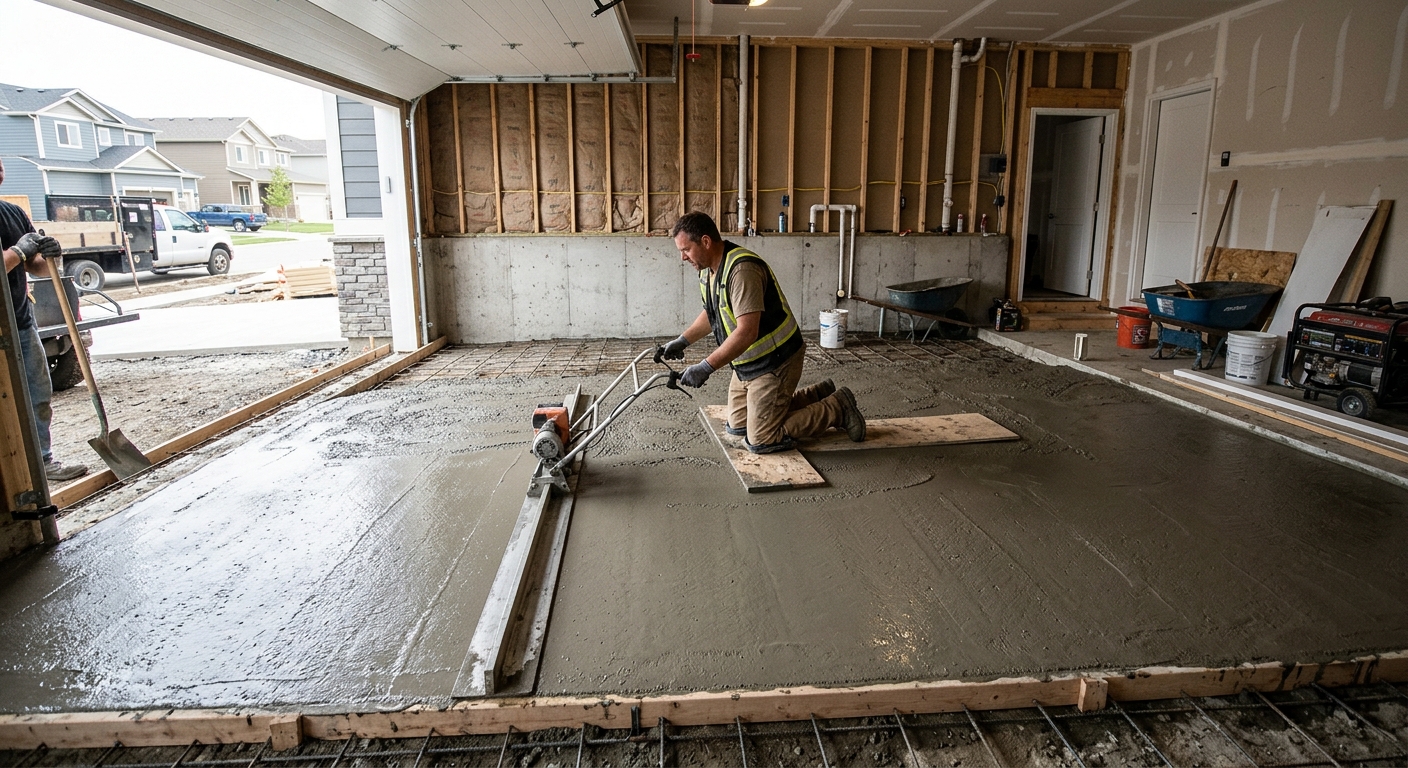
| Garage floor (interior slab) |
350–600 sq. ft. |
Vapour barrier; reinforcement as needed; proper thickness |
Plain finish |
$5,200 – $13,500 |
| Foundation footings (structural, below frost) |
Varies (linear ft. basis) |
Concrete placed below design frost; engineered requirements |
Structural concrete (not cosmetic) |
$180 – $300 |
Prices are estimates only and vary by project scope, site access and material selection.
What affects the price of concrete work in Victoria Hills
In Victoria Hills and the broader Toronto economic region, it’s common to see quotes for the “same” concrete job come in 30–50% apart. The difference usually isn’t the cement brand—it’s the hidden scope: how deep excavation needs to go, whether the contractor is building the right granular base, what reinforcement is actually included, and whether the crew can properly manage curing during cold or damp weather.
Frost depth and freeze–thaw cycles dictate specifications. In Ontario, most structural footings must extend below design frost depth (often in the range of 1.5–2.4 m depending on the design and site conditions), which means more excavation and more formwork for foundations. For exterior slabs like driveways and patios, contractors typically use air-entrained concrete mixes to survive freeze–thaw. When temperatures drop toward 10 °C or below, curing management becomes more labour-intensive—crews may add insulation blankets or heaters and must protect the surface longer. Finally, de-icing salts can accelerate surface wear and spalling if the mix, air content, and sealing approach are weak; sealing and correct jointing are not “optional” for durability.
Two examples that raise cost in Victoria Hills: (1) a driveway with limited truck access and soft soil often needs extra base and sometimes thicker slab design; (2) a stamped driveway requires skilled finishing and more labour per square foot. Conversely, costs can be lower when the site already has a well-drained, stable sub-base and you’re choosing plain concrete instead of stamped—at roughly $16 – $26 per sq. ft. for patio/walkway-type work, plain options often price substantially below decorative finishes that commonly land in the $24 – $40 per sq. ft. range.
Even if two homes are the same size, older housing stock can influence drainage patterns and base conditions. That’s why a “low” quote on flatwork sometimes doesn’t include proper base prep, which is exactly what drives premature cracking after winter.
| Price Factor |
Why It Matters |
Cost Impact |
| Frost line depth — determines footing depth and form height |
Deeper footings reduce frost heave risk but require more excavation and concrete volume |
Higher excavation/formwork can add significant cost on foundation or footing scope |
| Site preparation — excavation, grading, compacted granular base |
Concrete is only as good as the base; saturated or weak sub-base causes movement |
Good prep increases cost, but it prevents costly failures and rework |
| Reinforcement — rebar or wire mesh requirement |
Helps control cracking and supports slabs subjected to loads and freeze–thaw stress |
Reinforcement adds materials and labour; omitting it can reduce price short-term |
| Mix design — air-entrainment and compressive strength spec |
Air-entrainment is critical for exterior durability in freeze–thaw |
Proper mix raises material cost but reduces spalling and premature surface damage |
| Finish type — broom vs. stamped vs. exposed aggregate |
Decorative work requires extra labour, timing, and materials |
Stamped/exposed aggregate typically costs more than plain broom-finish |
| Pour size and concrete truck access to site |
Long carries, tight access, or multiple pours increase labour and logistics |
Access issues can add truck charges and labour for staging or smaller batches |
| Cold-weather curing precautions — heating and blankets |
Maintains strength gain and reduces surface defects when temperatures are low |
Often adds cost during shoulder season to protect the pour |
| Control joint pattern and sealing cost |
Joints manage where cracks happen; sealing helps resist de-icing salt wear |
Including sealing and correct jointing can add up-front cost but extends service life |
Permits & regulations in Ontario
In Ontario, concrete work isn’t all treated the same. Structural concrete—such as footings, foundation walls, and grade beams—typically requires a building permit, and many projects also rely on engineered drawings that the municipality reviews as part of permit issuance. Concrete flatwork like driveways, patios, and walkways usually does not require a permit on its own, unless it impacts lot grading, creates concerns with impervious surface coverage limits, or affects municipal right-of-way (for example, work near a sidewalk or driveway apron).
For Victoria Hills homeowners, a practical step-by-step approach is to verify the contractor before any demolition begins. First, request proof of liability insurance (a certificate of insurance showing coverage amounts and the project information where available). Second, confirm WSIB/WCB coverage for workers—ask for a clearance letter or a current confirmation document. Third, check the contractor’s Ontario registration/licence status through the relevant online registry (your contractor should be able to provide their business number or registration details to match). Finally, ask for references on projects of similar scope and site constraints (tight access, sloped lots, drainage issues).
If the scope includes excavation near foundations or any structural change, don’t assume it’s “just concrete.” Ask the contractor to identify what permits are required and who pulls them—then verify the permit paperwork matches the exact work being done.
Getting concrete right in Victoria Hills's freeze-thaw climate
Concrete failures in Victoria Hills usually trace back to three things: movement from weak or poorly prepared base, freeze–thaw damage from inadequate air-entrainment, and cracking that isn’t managed with the right control joints and curing. In a Toronto freeze–thaw environment, surface spalling is the classic problem when the mix isn’t designed for it or when the slab is exposed to de-icing salt before it has achieved durable strength.
To spec the job correctly, start with the base. Exterior slabs need a properly graded, compacted granular sub-base to reduce settlement and prevent water from saturating under the concrete. Next, require a freeze–thaw appropriate mix: for exterior flatwork, aim for 5–7% air content and a minimum 32 MPa compressive strength (and confirm it in writing on the quote/spec). Then lock in control joints. Joint spacing is what limits random cracking and creates predictable crack locations. Finally, curing and protection matter as much as placement—plan for at least 7 days curing under suitable conditions, and if temperatures trend low, you want cold-weather curing precautions included rather than “best effort.” After curing, schedule a penetrating sealer about 28 days post-pour to improve resistance to salt and moisture intrusion.
Here’s where dollars are justified: if a plain driveway quote is low but doesn’t include air-entrained mix, proper base, or joint layout, you may spend again within a few winters. By contrast, a decorative upgrade can be worth it when the fundamentals are correct. For example, upgrading a patio from plain (often around $16 – $26 per sq. ft.) to stamped (commonly $24 – $40 per sq. ft.) makes sense when you’re already paying for the right thickness, base, and joint pattern—otherwise the extra finish money won’t solve freeze–thaw wear.
| Spec |
Why It Matters in Victoria Hills |
What to Ask For |
Impact if Skipped |
| Compacted granular base (depth?) |
Reduces settlement and limits water saturation under the slab during freeze–thaw |
Granular base depth and compaction method (proof of thickness/compaction) |
Uneven movement, cracking, and premature edge failure |
| Air-entrained concrete mix (target air %?) |
Protects against freeze–thaw damage and reduces risk of surface spalling |
Minimum air content for exterior flatwork (typically 5–7%) |
Spalling, scaling, and rapid deterioration in salty winters |
| Compressive strength (MPa rating) |
Ensures strength gain and slab durability under seasonal stresses |
Minimum 32 MPa rating (confirm on quote/spec) |
Lower durability, surface wear, and higher likelihood of early cracking |
| Control joints (spacing per ACI guidelines) |
Controls where cracks happen as concrete shrinks/expands through seasons |
Joint spacing plan and timing (cut/saw schedule) |
Random cracking that damages appearance and allows water ingress |
| Minimum 7-day curing period |
Strength development is critical when curing slows during cooler weather |
How curing will be protected and monitored for at least 7 days |
Weak surface, increased permeability, and reduced long-term performance |
| Penetrating sealer (when applied after cure) |
Repels moisture and helps protect against de-icing salt wear |
Sealer type and application timing (around 28 days after pour) |
Faster salt-driven surface breakdown and more frequent maintenance |
How to choose a concrete work contractor in Victoria Hills
Choosing the right concrete contractor in Victoria Hills is about verifying capability, not just comparing lowest price. Start by confirming Ontario compliance: ask for proof of liability insurance and WSIB/WCB coverage (a clearance letter or up-to-date confirmation). Next, verify their business registration/licence status through the appropriate Ontario online registry—your contractor should be able to provide the registration details so you can match them to the registry record.
Then get 2–3 itemised written quotes. Avoid a single lump sum without details. You want line items for excavation/site prep, granular base, reinforcement (if included), concrete supply and air-entrainment specification, finishing labour, saw-cut timing and jointing, and whether sealing is included and when. Also check exclusions: Who disposes of concrete and excavation material? Is permit pulling included if the scope requires it for structural work? Are any drainage corrections included or treated as an extra?
Warranty matters too. Ask for the length and what it covers—often it’s workmanship-related, while product/manufacturer warranties cover specific materials. Find out if the warranty is transferable if you sell the home. Payment schedule should be conservative: never agree to more than 10–15% upfront. Hold back the remainder until the job is complete and you’ve confirmed key checkpoints (grade, base compaction, joints, final finish, and curing/protection practices).
Finally, request a start date and completion estimate in writing. With GTA crews, weather and curing windows can affect timelines—good contractors plan around it and communicate early.
- Provide proof of liability insurance before work starts
- Provide WSIB/WCB clearance/confirmation for workers
- Offer itemised quotes (base, reinforcement, concrete spec, labour, finishing)
- State the concrete mix spec in writing (air-entrainment and strength)
- Confirm footing depth and engineered requirements for structural scopes
- Explain drainage plan (slopes away from house, no water pooling)
- Show joint layout and timing for saw cutting
- Clarify curing protection for shoulder-season temperatures
- Confirm whether penetrating sealer is included and when it’s applied
- List what’s included for disposal of concrete/asphalt/soil and debris
- Verify rebar/mesh placement method and thickness assumptions
- Use a written payment schedule with a holdback until completion
Concrete red flags in Victoria Hills: crews quoting “cheap” without discussing air-entrainment or jointing, skipping proof of base compaction, no written mix/strength specification, pressuring for large upfront payments, and avoiding questions about curing and protection during cooler weather.
Frequently asked questions — concrete work in Victoria Hills
How much does concrete work cost in Victoria Hills?
In Victoria Hills, pricing depends on whether you’re doing exterior flatwork or structural concrete, plus site access and base preparation. For a practical baseline, concrete driveways typically fall around $18 – $28 per sq. ft. for standard work, while patios and walkways are often about $16 – $26 per sq. ft. Decorative upgrades like stamped concrete commonly run higher at roughly $24 – $40 per sq. ft., because of added labour, timing, and materials. Structural footings are usually quoted differently (often per linear foot), and budget ranges are commonly around $180 – $300. In the Toronto area, freeze–thaw conditions also encourage contractors to specify air-entrained mixes and proper curing—those specs cost a bit more upfront, but they protect against spalling and early cracking.
How deep must footings be for Victoria Hills's frost line?
For Victoria Hills and the broader Ontario market, structural footings must extend below the local design frost depth to reduce frost heave risk. In typical Ontario practice and per Ontario Building Code expectations, many structural footings are at least about 1.2 m (4 ft) below grade, but the exact design depth can vary by soil conditions and the engineered foundation design for your site. That means two homes on different lots can have different excavation depths and different concrete volumes even if they look similar at the surface. When you request a quote for foundation/footings, ask the contractor to confirm the footing depth matches the approved drawings, not “typical assumptions.”
Why does concrete crack in Victoria Hills and how is it prevented?
Concrete cracking in Victoria Hills is usually normal shrinkage and seasonal movement, made visible by the cold, wet winters and freeze–thaw cycles common across the Toronto region. If the slab is placed on a weak or uneven base, it can move and crack even faster. If the concrete isn’t air-entrained for exterior exposure, the freeze–thaw cycle can also damage the surface and allow widening cracks over time. Prevention is about managing where cracks happen: proper base prep, correct thickness, air-entrained mix, and a designed control joint pattern with timely saw cutting. Sealing also helps reduce moisture intrusion from de-icing salts. A solid contractor will specify these elements in writing—especially joint spacing and curing, which are often where lower bids fall short.
Stamped vs broom-finish concrete — cost difference?
Stamped concrete costs more than broom-finish because it involves additional materials (colour systems, release agent, stamps) and more skilled labour with tight timing during finishing. In the Victoria Hills area, broom-finish exterior work generally aligns with the lower end of typical exterior ranges—about $18 – $28 per sq. ft. for driveway-type work. Stamped concrete commonly lands higher, often around $24 – $40 per sq. ft., depending on pattern complexity, thickness requirements, and joint layout. The real value comparison isn’t just the finish price; it’s whether the contractor includes air-entrained concrete, proper base prep, and correct curing. Decorative work without durability specs won’t hold up well through GTA freeze–thaw cycles.
When is the best time to pour concrete in Victoria Hills?
For Victoria Hills homeowners, the “best time” is typically when temperatures stay safely above the contractor’s curing thresholds and the crew can protect the pour during the first critical days. In the Toronto economic region, exterior work is commonly concentrated in warmer months to support reliable curing—especially when temperatures can drop toward 10 °C or below in fall and shoulder season. Cold-weather precautions (like insulation blankets and/or heating) can allow pours later, but they add labour and material costs and require proper monitoring. If you’re planning a driveway, patio, or walkway, aim for a forecast-friendly window so you don’t pay extra to catch up on curing protection. Your contractor should also plan joint cutting timing and seal timing based on the pour date.
How long does concrete take to cure?
Concrete doesn’t “dry” in the way homeowners expect—it gains strength over time. For Victoria Hills exterior flatwork, a minimum curing period of about 7 days is commonly expected before you treat the slab as fully cured for typical residential use, provided curing conditions were appropriate. Strength continues developing well beyond that, and for most protective steps like a penetrating sealer, scheduling is often around 28 days after the pour. Curing is especially important in the Toronto area because freeze–thaw cycles can expose early-age concrete to temperature swings, surface scaling, and accelerated wear from moisture and de-icing salt. Ask your contractor how they’ll protect the slab during the first week (and what they’ll do if temperatures drop).