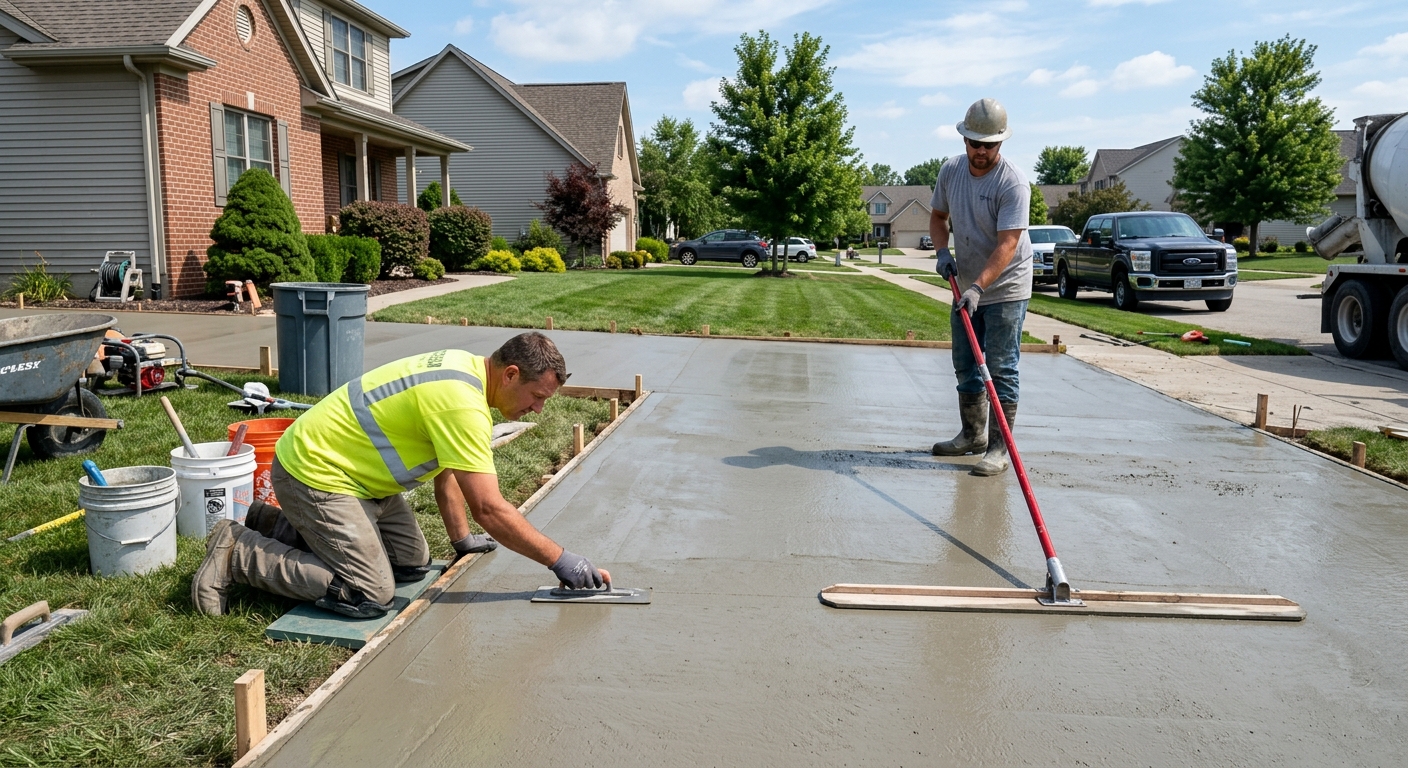
Concrete work options and costs in Rockcliffe Park
Rockcliffe Park homeowners typically book concrete work because it blends well with the neighbourhood’s mature lots and long driveway lanes. With a 2021 Census population of 1,888 (Statistics Canada, 2021 Census), the townhome and condo inventory is limited, so most concrete flatwork demand centres on single-detached properties and their driveways, patios and walkways. In a Toronto economic region shaped by busy trades, the availability of experienced crews can still tighten during peak exterior construction season—especially when multiple neighbours need the same cold-weather-critical work.
In this part of Ontario, concrete pricing is strongly influenced by frost depth and freeze–thaw cycles. Local specs usually require structural footings to extend at least 1.2 m below grade (based on the design frost depth for frost protection), and exterior slabs are typically built with air-entrained concrete, proper drainage, and joints that control where cracking occurs. Toronto’s humid fall and wet spring also means contractors spend more time on base moisture checks and curing protection. Pours near the cooler shoulder months often require longer protection and sometimes timed scheduling to maintain proper set and strength gain.
Demand is especially noticeable around the core residential streets near major commuter connections, where longer driveway approaches and frequent repairs after curb/utility work are common. If you’re comparing options, the cost difference between a standard broom-finish driveway and a stamped or exposed-aggregate look often comes down to prep time, material selection, and finishing complexity—see the table below.
| Application |
Typical Size |
Key Spec |
Finish Option |
Price Range |
| Concrete driveway (standard broom finish) |
20 ft x 10 ft (200 sq. ft.) |
Air-entrained mix, compacted granular base, control joints |
Broom finish |
$18,000–$28,000 |
| Exposed aggregate driveway |
20 ft x 10 ft (200 sq. ft.) |
Air-entrained mix with surface retarder, base drainage |
Exposed aggregate |
$24,000–$34,000 |
| Stamped concrete driveway or patio |
12 ft x 18 ft (216 sq. ft.) |
Air-entrained mix, thicker slab for detailing, sealer-ready surface |
Stamped pattern |
$24,000–$40,000 |
| Plain concrete patio or walkway |
10 ft x 12 ft (120 sq. ft.) |
Proper grade, compacted base, jointing |
Plain trowel/broom blend |
$16,000–$26,000 |
| Garage floor (interior slab) |
20 ft x 20 ft (400 sq. ft.) |
Vapour considerations if needed, 25–30 MPa typical spec |
Steel trowel finish or broom lightly |
$22,000–$36,000 |
| Foundation footings (structural, below frost) |
Per project (allowance for typical bearing lines) |
Below design frost depth, rebar, engineered sizing, waterproofing coordination |
Structural concrete |
$180,000–$300,000 |
Prices are estimates only and vary by project scope, site access and material selection.
What affects the price of concrete work in Rockcliffe Park
In the Toronto economic region, it’s common to see quotes for the “same” concrete job differ by 30–50%. The reason isn’t just the concrete itself—it’s what contractors include in prep, reinforcement, mix design, access, curing protection, and finishing time. For homeowners, that can be confusing, but it’s also where durability is won or lost in Rockcliffe Park’s freeze–thaw reality.
First, frost depth and freeze–thaw cycles dictate every structural spec in Ontario: footings typically must extend below design frost depth to prevent frost heave and differential movement. Second, exterior flatwork needs air-entrained concrete to withstand repeated expansion and contraction during winter temperature swings. Third, the pour season matters—when temperatures drop toward about 10 °C or below, crews need cold-weather precautions (insulation blankets, wind protection, and sometimes curing heat), which adds labour and material costs. Finally, de-icing salt accelerates surface wear and can cause spalling if the mix and sealing plan aren’t right; that’s why sealing schedules and surface preparation often show up as separate line items.
In Rockcliffe Park, a few practical factors push costs up: poor drainage around an existing driveway (extra demo and grading), tighter equipment access on narrower lanes (more hand-work), and older soils or fill that require deeper base build-up. Costs can come down when a new slab sits on clean, well-compacted granular base already verified to grade, or when the finish is broom rather than stamped. As a reference point, a standard driveway often aligns with the $18–$28 band, while stamped or decorative work in the GTA commonly sits higher—often within the $24–$40 range—because the finish process takes longer and requires more skilled labour and materials.
| Price Factor |
Why It Matters |
Cost Impact |
| Frost line depth — determines footing depth and form height |
Deeper footings reduce frost heave risk and stabilize structures |
Higher excavation and concrete volume can add major dollars |
| Site preparation — excavation, grading, compacted granular base |
Correct sub-base prevents pumping, settling and cracking |
Often the largest controllable variable between quotes |
| Reinforcement — rebar or wire mesh requirement |
Controls cracking and improves load capacity, especially slabs-on-grade |
Material and labour cost increases with thicker specs |
| Mix design — air-entrainment and compressive strength spec |
Air voids help survive freeze–thaw; strength supports long-term performance |
Improper mix leads to early failure and expensive rework |
| Finish type — broom vs. stamped vs. exposed aggregate |
Finishing complexity affects crew time, forms and surface products |
Decorative finishes typically cost more than standard broom |
| Pour size and concrete truck access to site |
Access limits can extend labour time and increase equipment needs |
Hand placement and short dumps can raise labour costs |
| Cold-weather curing precautions — heating and blankets |
Cold slows strength gain; protection helps achieve proper cure |
Adds labour/materials if scheduling slips into cooler weeks |
| Control joint pattern and sealing cost |
Jointing controls random cracking; sealing helps repel de-icing salts |
Skipping or underspecifying often voids durability expectations |
Permits & regulations in Ontario
In Ontario, structural concrete work almost always involves permitting and review. Specifically, work such as foundation walls, grade beams, and new concrete footings typically requires a building permit, and engineered drawings are often reviewed by the municipality (or their plan-review process) because these elements carry building loads. If you’re underpinning, replacing bearing footings, or making changes to structural supports, treat it as permit-required work.
Concrete flatwork—like patios, walkways and driveways—usually does not require a permit unless it affects lot grading, drainage, impervious surface coverage limits, or the municipal right-of-way/sidewalk driveway approach. Even then, requirements can vary based on whether your scope triggers grading approvals or curb/entrance changes. In Rockcliffe Park, I always recommend confirming with the local building/planning department before breaking ground, especially when replacing an existing driveway and adjusting drainage patterns.
Before signing, verify your contractor carries liability insurance and has the required coverage for workers (commonly WSIB in Ontario or the appropriate provincial coverage where applicable). Here’s a practical step-by-step homeowner check: (1) ask for a current certificate of insurance and confirm the expiry date and coverage limits; (2) request proof of coverage for workers and confirm it matches the project address; (3) verify the contractor’s credentials through Ontario’s public registry resources (search by company/contractor name and review whether their status is active); (4) ask for references from similar-scale residential concrete jobs in the GTA and confirm the same type of finish and freeze–thaw-ready specs.
Getting concrete right in Rockcliffe Park's freeze-thaw climate
Concrete failures in Rockcliffe Park usually trace back to water management, inadequate base prep, and mix/jointing choices that can’t handle freeze–thaw. When saturated soil expands against a slab, or when thin sections crack randomly, the first winter becomes the “test” concrete never wanted. The fix is to spec the job so it performs in Ontario’s temperature swings, not just when it looks good on pour day.
Start with base preparation: a compacted granular sub-base to the right depth for local soil conditions and design frost protection. Then lock in the mix design—exterior flatwork should be air-entrained (typically 5–7% target air content) to reduce freeze–thaw damage, and many residential specs use a minimum 32 MPa compressive strength for durability expectations. Control joints are equally important: plan a joint layout that gives cracking a “roadmap” rather than random crazing. For curing, plan for at least 7 days of proper curing under good conditions; in colder shoulder-season periods, crews often need insulation blankets and wind protection so strength gain continues. Finally, apply a penetrating sealer after cure—commonly around 28 days post-pour—so de-icing salt can’t easily penetrate and start surface breakdown.
Ask your contractor pointed questions: “What’s your base thickness and compaction method?”, “What air content are you targeting for the slab?”, and “What joint spacing are you proposing for my size?” The cheapest quotes often miss air-entrainment, leading to spalling and rough scaling. For a realistic dollars example: if a plain broom-finish driveway in the $18–$28 band includes the correct base and air-entrained mix, it can outperform a decorative alternative that’s underbuilt. Stamped concrete in the $24–$40 range may be worth it when the prep and curing plan are correct—because you’re paying for finishing labour, not for structural shortcuts.
| Spec |
Why It Matters in Rockcliffe Park |
What to Ask For |
Impact if Skipped |
| Compacted granular base (depth?) |
Prevents settlement and keeps water from saturating under the slab |
Base depth and compaction test/method for your subgrade |
Cracks, pumping, and uneven slabs during freeze–thaw |
| Air-entrained concrete mix (target air %?) |
Air voids protect against freeze–thaw expansion and surface scaling |
Target air content (commonly 5–7% for exterior flatwork) |
Spalling and scaling within a few winters |
| Compressive strength (MPa rating) |
Supports load performance and durability in Ontario conditions |
Minimum 32 MPa (or project-specific design strength) |
Premature wear, surface damage and reduced longevity |
| Control joints (spacing per ACI guidelines) |
Controls where cracks form, reducing random cracking |
Planned joint spacing for your slab dimensions |
Random cracking that can open pathways for water |
| Minimum 7-day curing period |
Ensures strength gain before exposure to winter conditions |
How they protect the slab during the first week |
Low strength, surface dusting and early deterioration |
| Penetrating sealer (when applied after cure) |
Repels water and helps resist de-icing salt damage |
Sealer product and timing (often around 28 days post-pour) |
Faster salt wear and higher risk of surface scaling |
How to choose a concrete work contractor in Rockcliffe Park
Choosing the right concrete contractor in Rockcliffe Park is less about flashy photos and more about proof: credentials, jobsite discipline, and a spec that survives freeze–thaw. Start with Ontario licensing/credentials as applicable for the contractor’s business status and type of work, then verify liability insurance and worker coverage. Ask for a current certificate of insurance (confirm company name, policy limits, and expiry date) and documentation of worker coverage. If they can’t provide it, assume extra risk is being pushed onto you.
Next, demand 2–3 itemised written quotes instead of one lump-sum. A proper quote breaks labour + materials (concrete, rebar/wire mesh, granular base, forms, finishing, sealing, and disposal) so you can compare like-for-like. Carefully review exclusions: Is concrete supply included? Is removal and disposal included? Is a permit pull included where structural work requires it? Will they handle grading and drainage so saturated soils don’t undermine the slab?
Warranty matters too. Look for workmanship warranty length and exactly what it covers (e.g., surface scaling, cracking within jointed areas, settlement). Clarify whether manufacturer/product warranties apply and whether they’re transferable if you sell. On payment, a safe approach is never more than 10–15% upfront; hold back a portion until completion and clean-up. Finally, insist on a timeline in writing—start date and realistic completion estimate—because in the Toronto area, cold snap scheduling can affect curing protection and finishing windows.
- Ask for proof of liability insurance with matching project address and current expiry.
- Confirm worker coverage documentation for Ontario jobs (request the appropriate certificates).
- Verify contractor business status using Ontario online resources (search by company/legal name).
- Get at least 2–3 itemised quotes (labour + materials + disposal + sealing).
- Insist on written scope: base prep depth, drainage plan, and thickness.
- Confirm mix spec: air-entrainment for exterior flatwork and minimum strength.
- Review reinforcement plan: mesh/rebar location and slab thickness.
- Ask for joint layout: spacing, location at edges, and sealing of joints.
- Confirm curing plan and minimum protection period (especially in cooler weeks).
- Clarify finishing method: broom vs stamped/exposed aggregate process and timing.
- Know payment schedule: 10–15% max deposit, retainage held until complete.
- Ask for a written start/completion schedule and who monitors weather curing.
Red flags we see too often include quotes that ignore base compaction details, contractors who can’t state their air-entrainment target for exterior work, skipping control joints “to avoid visible lines,” vague curing promises, and no clear plan for sealing after cure where de-icing salt is used.
Frequently asked questions — concrete work in Rockcliffe Park
How long does concrete take to cure?
Concrete cure time depends on temperature and the mix design, but for most residential flatwork in Rockcliffe Park, you should plan for a minimum of about 7 days of proper curing before treating it as fully “set.” That’s not just time sitting in place—the key is protection from cold winds and maintaining suitable conditions so strength gain continues. Even after early set, concrete keeps gaining strength for weeks. For exterior durability in Ontario freeze–thaw, many contractors also plan sealing around 28 days post-pour to help repel moisture and reduce de-icing salt impact. If your pour is scheduled near cooler weeks (near 10 °C or below), ask the contractor what they’ll do (blankets/heating and protection) so you don’t lose early strength and durability.
Do I need a permit for concrete work in Ontario?
In Ontario, it’s usually the structural concrete that triggers permits: new footings, foundation walls, grade beams and any changes to load-bearing supports typically require a building permit and often engineered drawings. For concrete flatwork—driveways, patios and walkways—permits are commonly not required unless your project affects lot grading, drainage, impervious surface coverage, or involves municipal right-of-way/entrance changes. For Rockcliffe Park homeowners, the safest approach is to confirm with the local authority before you start excavation, especially if the job involves re-grading slopes, changing drainage patterns, or ties into curb/sidewalk work. Also verify your contractor is insured and properly covered for workers, and ask what portion of the work is intended to be permit-handled.
Concrete vs pavers for a patio in Rockcliffe Park?
Concrete and pavers both work well for patios in Rockcliffe Park, but freeze–thaw performance comes down to what’s underneath. Concrete patios are typically fewer joints and can be cost-effective when properly built: a compacted granular base, correct slope for drainage, air-entrained concrete, and control joints. Pavers can look more “architectural” and allow easier localized repairs if one section heaves. That said, if your subgrade is marginal or water is trapped, both systems can struggle. If your priority is a clean, modern finish with predictable maintenance, plain concrete often fits within the $16–$26 band for patios/walkways. If you want the look of stone and you’re willing to manage joint sand and potential weed growth, pavers can be attractive—just ensure base prep is as disciplined as it would be for concrete.
How long does a concrete driveway last?
A well-built concrete driveway in Ontario commonly lasts for decades, but the real question is how it’s built for freeze–thaw and de-icing conditions. In Rockcliffe Park, the durability story is usually driven by four things: proper granular base compaction and drainage, air-entrained exterior concrete, correct slab thickness and reinforcement (where required), and an appropriate joint pattern with sealing. If you choose a standard driveway scope that’s priced within the typical $18–$28 range, and the contractor includes base prep, air entrainment, and jointing, you should expect strong long-term performance. If corners are cut—especially skipping air-entrainment or using insufficient base depth—you may see surface scaling or cracking earlier. Ask how they plan curing protection and when sealing is recommended for your driveway.
What is air-entrained concrete and why does it matter here?
Air-entrained concrete is mixed with tiny, evenly distributed air voids that give water a place to expand during freezing. In Rockcliffe Park and across Ontario’s Toronto region, freeze–thaw cycles are a major durability risk: without enough air entrainment, trapped water can expand against the cement paste and lead to surface scaling and spalling over repeated winters. That’s why exterior flatwork typically uses air-entrained mixes and why reputable contractors can talk about target air content (commonly around 5–7% for exterior slabs) and how the mix supports a minimum compressive strength spec. If a quote doesn’t mention air-entrainment for an exterior driveway, patio or walkway, ask questions. This one detail can mean the difference between a driveway that looks good for years versus one that needs resurfacing sooner.
How do I prepare the base for a concrete slab?
Base prep is where most quality (and most problems) begin. For a concrete slab in Rockcliffe Park, your contractor should excavate to the correct depth, remove organic material, and install a compacted granular sub-base sized to support the slab through frost movement and seasonal moisture changes. The base should be graded to drain correctly, so water doesn’t pond and saturate soil under the concrete. Proper compaction is essential—compaction isn’t “optional,” and a good contractor will explain their process and what they’re compacting to (often referencing fill/subgrade conditions). This is one reason quotes vary: if one contractor includes robust excavation and granular base work, they may price near the typical driveway band (for example $18–$28), while a thinner or less-detailed base can look cheaper but tends to fail sooner under freeze–thaw.