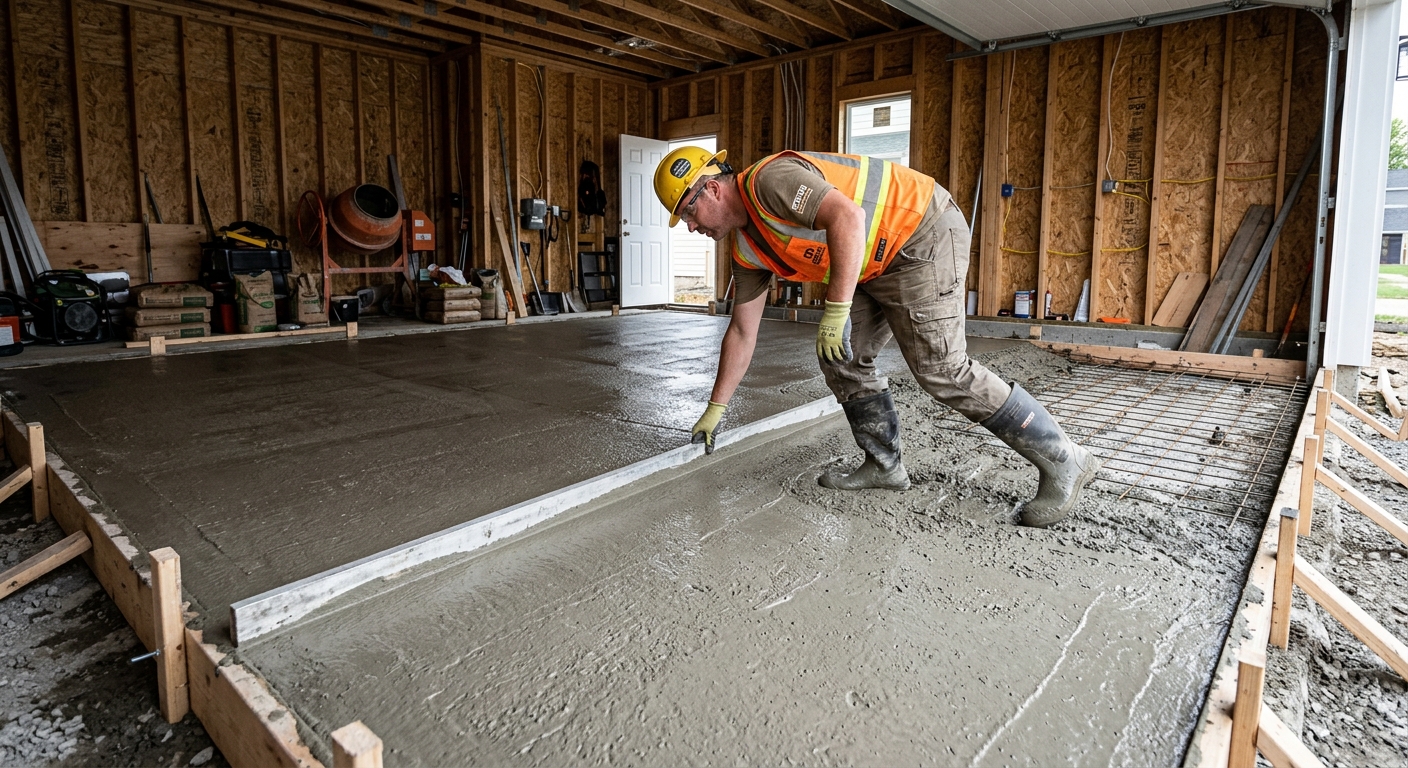
Concrete work options and costs in Napanee
Concrete work in Napanee is a big part of how homeowners finish driveways, patios and walkways, especially in established pockets such as Loyalist Township and the more residential edges along Bath Road. With Napanee’s population at 7,439 (Statistics Canada, 2021 Census), the local market is smaller than the GTA, so pricing is influenced by trucking distance, crew availability, and how quickly crews can schedule pours after site prep is complete. Most concrete flatwork demand comes from single-detached home properties—those are the typical setups that want new driveways, back patios and garage slabs. In the Toronto economic region, costs for concrete rise and fall with frost depth, freeze–thaw cycles and how long crews can reliably pour and cure during the year.
In this region, structural footings generally need to extend below design frost depth—commonly at least about 1.2 m (roughly 4 ft) below grade for many Ontario structural conditions—to reduce frost heave and differential movement. For exterior slabs like driveways and walkways, contractors usually specify air-entrained mixes, the right thickness, and properly spaced control joints to manage cracking under repeated freeze–thaw. That means quotes for the “same-looking” slab can vary based on base excavation and compacted granular depth, reinforcement choices, and whether the contractor can protect the pour during cooler stretches. Use the table below to compare typical scopes and realistic budget bands before you request itemised pricing.
| Application |
Typical Size |
Key Spec |
Finish Option |
Price Range |
| Concrete driveway (standard broom finish) |
12 ft x 24 ft (288 sq ft) |
150 mm slab, granular base + edge forms, control joints |
Broom finish, light saw cuts |
$5,200 – $8,100 |
| Exposed aggregate driveway |
12 ft x 24 ft (288 sq ft) |
175 mm slab, air-entrained mix, sealed and cured properly |
Surface retarder/exposed stone |
$6,500 – $10,500 |
| Stamped concrete driveway or patio |
12 ft x 18 ft (216 sq ft) |
175–200 mm slab depending on base, air-entrained mix |
Stamp pattern + integral or release color |
$6,200 – $10,300 |
| Plain concrete patio or walkway |
10 ft x 16 ft (160 sq ft) |
125–150 mm slab, compacted granular base, joints |
Smooth or broom edge, light broom finish |
$2,600 – $4,200 |
| Garage floor (interior slab) |
20 ft x 22 ft (440 sq ft) |
100–125 mm slab, vapor barrier (typical), joints where needed |
Smooth trowel finish or broom-scratch |
$7,500 – $13,500 |
| Foundation footings (structural, below frost) |
Per project (typical 6–10 lin ft per wall segment) |
Concrete to spec, excavation, forms, rebar per engineered design |
Hidden work (no decorative finish) |
$4,500 – $12,000 |
Prices are estimates only and vary by project scope, site access and material selection.
What affects the price of concrete work in Napanee
Two contractors can quote the “same” driveway and land 30–50% apart because concrete pricing isn’t just about the cement—it’s about excavation, base preparation, reinforcement, mix design, curing protection and traffic control. In the Toronto economic region, repeat freeze–thaw drives stricter specifications: footings and grade beams are built deeper to resist frost heave, and exterior slabs are typically air-entrained to better withstand moisture cycling. When temperatures drop toward 10 °C or below, contractors also spend more time protecting pours (insulating blankets, heating setups, and scheduling around weather), which increases labour and equipment costs.
In Napanee, these factors show up as practical differences you can measure on-site. For example, a driveway that needs extra subgrade removal and deeper compacted granular base will usually land closer to the higher band—if you’re budgeting for a standard broom driveway, plan that “nice base” work may push you from the mid toward the higher end of the typical $18–$28 per square foot range. Conversely, a simpler patio on stable, well-draining soils with easy access may stay nearer the lower end of the $16–$26 per square foot range. Finish upgrades can also change labour intensity: stamped concrete and exposed aggregate require more steps and materials, so they often justify the premium versus plain concrete when you want curb appeal that lasts.
Finally, don’t forget de-icing salt and surface wear. Poorly sealed exterior flatwork is more prone to surface damage in winter, which can turn a “cheap now” slab into a higher-cost repair plan later.
| Price Factor |
Why It Matters |
Cost Impact |
| Frost line depth — determines footing depth and form height |
Deeper footings reduce frost heave and movement at the slab edge and foundation |
Higher excavation and forming can add significant labour/material cost |
| Site preparation — excavation, grading, compacted granular base |
Base quality controls settlement; saturated soils expand and contract under freeze–thaw |
Extra haul-off and more granular material can raise the quote |
| Reinforcement — rebar or wire mesh requirement |
Helps control cracking and supports loads (especially driveways and garage floors) |
More material and additional labour for placement and support chairs |
| Mix design — air-entrainment and compressive strength spec |
Air entrainment helps prevent spalling during repeated freezing and thawing |
Specialty mix and compliance testing/documentation can increase material cost |
| Finish type — broom vs. stamped vs. exposed aggregate |
Finish drives labour time, edging, release agents/retarder and surface protection |
Stamped/exposed finishes typically add the most cost beyond plain flatwork |
| Pour size and concrete truck access to site |
Access affects how much concrete can be delivered efficiently and how long crews work |
Long carry distances or limited access can add labour and equipment |
| Cold-weather curing precautions — heating and blankets |
Proper early curing protects strength gain and prevents surface damage |
Blankets/heaters and scheduling can meaningfully increase cost during shoulder season |
| Control joint pattern and sealing cost |
Joints manage where cracks occur; sealing helps repel melt water and de-icing salts |
More saw-cut precision and sealer product/labour adds cost but reduces long-term failures |
Permits & regulations in Ontario
In Ontario, structural concrete work generally needs municipal approval because it’s part of the building’s load path. That typically includes foundation footings, foundation walls, grade beams and other structural elements—especially where engineered drawings are required for load transfer. Concrete flatwork such as patios, walkways and driveways usually does not require a permit unless the work affects lot grading, drainage, impervious surface coverage rules, or changes drainage patterns that influence neighbouring property or municipal right-of-way requirements. Even when a permit isn’t typical, you should still confirm with the local authority before you break ground, particularly if you’re removing existing curb cuts, changing runoff routes, or altering the slope toward a foundation.
To verify contractor credentials in Napanee, start with licensing and insurance documentation before you schedule excavation:
- Confirm liability insurance: request a current Certificate of Insurance showing your job-site address (if available) and coverage amounts.
- Verify WSIB/WCB coverage: ask for proof of clearance or account status (commonly provided as a letter or clearance document depending on the contractor’s setup).
- Check contractor references: request 2–3 similar projects in the last 12–24 months, including exterior flatwork in Ontario’s freeze–thaw climate.
- Ask about permit responsibility: clarify whether the contractor pulls the permit (for structural work) or requires the homeowner to do so.
For structural work, don’t proceed without documentation that aligns with municipal expectations; for exterior flatwork, still confirm drainage and grading impacts so you don’t get stuck with rework after inspection.
Getting concrete right in Napanee's freeze-thaw climate
Concrete fails in Napanee most often through spalling, random surface cracking, and premature scaling—almost always tied to base moisture/compaction problems, inadequate air-entrainment, poor curing, or weak joint planning. In a freeze–thaw environment shaped by repeated winter thawing and re-freezing, the freeze–thaw cycle expands water in pores; if your mix doesn’t have the right air system (and if the slab isn’t built on stable, compacted granular base), that expansion shows up as flaking and deterioration.
To spec the job correctly for Napanee, focus on five things. First, base preparation: compacted granular sub-base should be built to the correct depth for your soil condition and drainage so water doesn’t sit under the slab. Second, mix design: exterior flatwork should use air-entrained concrete, typically targeting about 5–7% air content, and meet a minimum 32 MPa compressive strength for typical residential work. Third, control joints: add joints at planned spacing to direct cracking into predictable lines rather than random breaks. Fourth, curing: plan for at least 7 days of proper curing conditions; when cold weather hits, curing protection becomes critical for early strength gain. Fifth, sealing: apply a penetrating sealer after cure (commonly after 28 days post-pour) so de-icing salts and melt water don’t aggressively attack the surface.
Here’s how pricing relates to performance: if you’re comparing a plain broom-finished patio to a stamped finish, you might be adding roughly $2–$4 per square foot for the decorative steps. That premium is usually justified when you also keep the boring essentials (base depth, air content, joint pattern) consistent—because it’s the “core spec,” not the stamp texture, that prevents spalling during Ontario winters.
| Spec |
Why It Matters in Napanee |
What to Ask For |
Impact if Skipped |
| Compacted granular base (depth?) |
Controls settlement and limits moisture migration under freeze–thaw |
Granular type and compacted depth plan based on your soil condition |
Uneven settling, cracking, and faster surface deterioration |
| Air-entrained concrete mix (target air %?) |
Reduces freeze–thaw damage and spalling during Ontario winter cycles |
Target air content (typically about 5–7% for exterior flatwork) and mix documentation |
More spalling/scaling, especially where melt water and salt contact the slab |
| Compressive strength (MPa rating) |
Supports structural and durability performance under loads and temperature swings |
Minimum 32 MPa compressive strength (or higher if engineered) |
Lower durability and increased cracking risk over time |
| Control joints (spacing per ACI guidelines) |
Directs cracking to planned lines under expansion/contraction |
Joint layout drawing and saw-cut timing plan |
Random cracking that weakens edges and accelerates water intrusion |
| Minimum 7-day curing period |
Early strength gain is essential before cold cycles and freeze–thaw start |
What curing method will be used and protection plan if temperatures drop |
Surface weakness, scaling, and reduced long-term performance |
| Penetrating sealer (when applied after cure) |
Helps repel melt water and reduces salt attack during winter |
Sealer type and application timing (commonly after 28 days post-pour) |
Faster surface breakdown and higher repair costs |
How to choose a concrete work contractor in Napanee
Choosing a concrete contractor in Napanee comes down to proof and process, not just the cheapest number. In Ontario, verify that the contractor has the right insurance and coverage for jobsite risk. Ask for a current Certificate of Liability Insurance (COI) before work starts—make sure the COI names appropriate parties if required—and confirm WSIB/WCB clearance (or account status documentation) so you’re not exposed if a worker is injured. Then, request 2–3 itemised written quotes that break out labour and materials (concrete, base/gravel, reinforcement, forms, saw cutting, disposal, sealer if included) rather than one lump sum you can’t compare.
When you review the scope, pay attention to what’s excluded: is demo and disposal included? Is permit pulling included for structural work? Are excavations and hauling included if soil conditions are worse than expected? A well-run concrete crew will also specify how they’ll protect the pour during cold weather—heating and blankets when temperatures fall—because this affects curing and strength gain. For warranty, ask for a workmanship warranty length and whether any product/manufacturer warranty applies separately. Also confirm if warranties are transferable if you sell your home.
For payment scheduling, never front-load more than about 10–15%. Keep a holdback until completion and final cleanup, and insist on a start date and estimated completion timeline in writing.
- Ask for proof of liability insurance (COI) and current WSIB/WCB clearance.
- Confirm who pulls permits for structural concrete if required.
- Request two or three recent exterior flatwork references in Ontario’s freeze–thaw conditions.
- Demand an itemised quote (labour, base prep, concrete, reinforcement, finishing, sealer, disposal).
- Verify slab thickness and base compaction plan—not just “concrete will be poured.”
- Ask for mix specification: air-entrainment target and minimum compressive strength.
- Confirm reinforcement details (mesh/rebar, placement height, chairs/supports).
- Review joint plan: spacing, saw-cut timing, and whether joints get sealed if specified.
- Ask how they handle drainage and runoff away from the foundation.
- Clarify truck access and how concrete will be handled across the site.
- Confirm curing/protection method for cold nights or early/late pours.
- Set payment terms: 10–15% maximum upfront; holdback until final inspection.
Concrete red flags in Napanee include: quotes that don’t mention air-entrainment or curing protection, missing itemised breakdown of base preparation and disposal, vague thickness specs (“typical slab”), refusal to provide insurance/WSIB documentation, and promising “no-joint” slabs or skipping sealer after cure.
Frequently asked questions — concrete work in Napanee
When is the best time to pour concrete in Napanee?
The best time for concrete pours in Napanee is typically late spring through early fall, when daytime temperatures stay warm enough for reliable curing. In the Ontario freeze–thaw environment, contractors need enough heat for early strength gain, so they often concentrate exterior work into the warmer months where curing is more consistent. If you’re planning a driveway or patio, aim for periods when the forecast stays favourable and crews can protect the slab during cool nights. Even then, a quality contractor will plan curing protection if temperatures fall toward 10 °C or below. If you’re comparing decorative upgrades, remember that stamped concrete and exposed aggregate still require the same durability specs—timing only changes the finishing schedule and curing protection steps, not the need for air-entrained concrete.
How long does concrete take to cure?
Concrete curing is often misunderstood. For most residential flatwork in Napanee, plan on at least 7 days of curing under proper conditions before you treat the slab as sufficiently stable for typical light use. However, full durability continues to develop beyond that point; many exterior durability steps (especially sealing) rely on a longer cure timeline. Sealing is commonly applied after the slab has cured—often at 28 days post-pour—so the surface is dry and hard enough to accept the penetrating sealer. If weather turns colder right after the pour, the contractor may use insulating blankets or temporary heating to protect early strength gain. Don’t rush traffic, and ask your contractor what curing method they’ll use on your specific pour date.
Do I need a permit for concrete work in Ontario?
In Ontario, structural concrete work like foundation footings, foundation walls and grade beams usually requires a building permit, often with engineered drawings reviewed by the municipality. Concrete flatwork such as patios, walkways and driveways usually does not require a permit unless it affects lot grading, drainage, impervious surface limits, or municipal right-of-way considerations. For Napanee homeowners, the practical takeaway is to confirm with the local authority before excavation—especially if you’re changing slopes toward a foundation, altering runoff patterns, or replacing an access route. Your contractor should also carry liability insurance and WSIB/WCB coverage. If the job is structural, ask directly whether the contractor will pull the permit and confirm you’ll be covered by the correct documentation before work begins.
Concrete vs pavers for a patio in Napanee?
Both can look great, but concrete generally wins on long-term performance when the base prep is done properly and you use air-entrained mix and well-planned joints. Pavers can be easier to patch if a single section fails, but they still rely on drainage and correct base layers; in Ontario’s freeze–thaw cycles, poor base drainage can cause heaving under both systems. Concrete patios are typically budget-friendly: plain patios and walkways often fall around $2,600 – $4,200 for a typical small-to-mid size scope, depending on thickness and finishing. Stamped concrete is higher, but it can deliver a “paver-like” look in a single monolithic slab. If curb appeal is your goal, ask for comparable square footage pricing and compare base specs—not just the decorative surface.
How long does a concrete driveway last?
A well-built concrete driveway in Ontario commonly lasts decades. The real-life lifespan depends on base preparation, slab thickness, air-entrained concrete for freeze–thaw durability, control joint planning, and whether the homeowner maintains the surface with proper sealing and mindful de-icing use. In Napanee, repeated winter melt water and salt exposure can accelerate surface deterioration if the slab is left unsealed or if water is allowed to pool against it. If you’re choosing between finishes, remember that a standard broom driveway is usually the most cost-effective route, while exposed aggregate or stamped finishes cost more but still require the same durability core: correct mix, correct base, and good curing. If you’re budgeting, the driveway range for a typical scope often lands around $5,200 – $8,100 for standard broom finishing, with decorative options generally higher.
What is air-entrained concrete and why does it matter here?
Air-entrained concrete is a mix designed with tiny air bubbles that provide space for water to expand when it freezes. In Napanee and across Ontario’s freeze–thaw climate, that air system is a key defence against spalling and scaling—surface damage where the top layers break down over time. Exterior flatwork without adequate air entrainment is much more likely to fail early, especially where de-icing salts and melt water contact the slab repeatedly. That’s why reputable GTA-region specifications typically include air-entrained mixes for driveways, patios and walkways, alongside the right thickness and proper control joints. If you’re comparing quotes, ask for the target air content (commonly about 5–7% for exterior flatwork) and confirm the contractor’s plan for curing protection during cold spells.