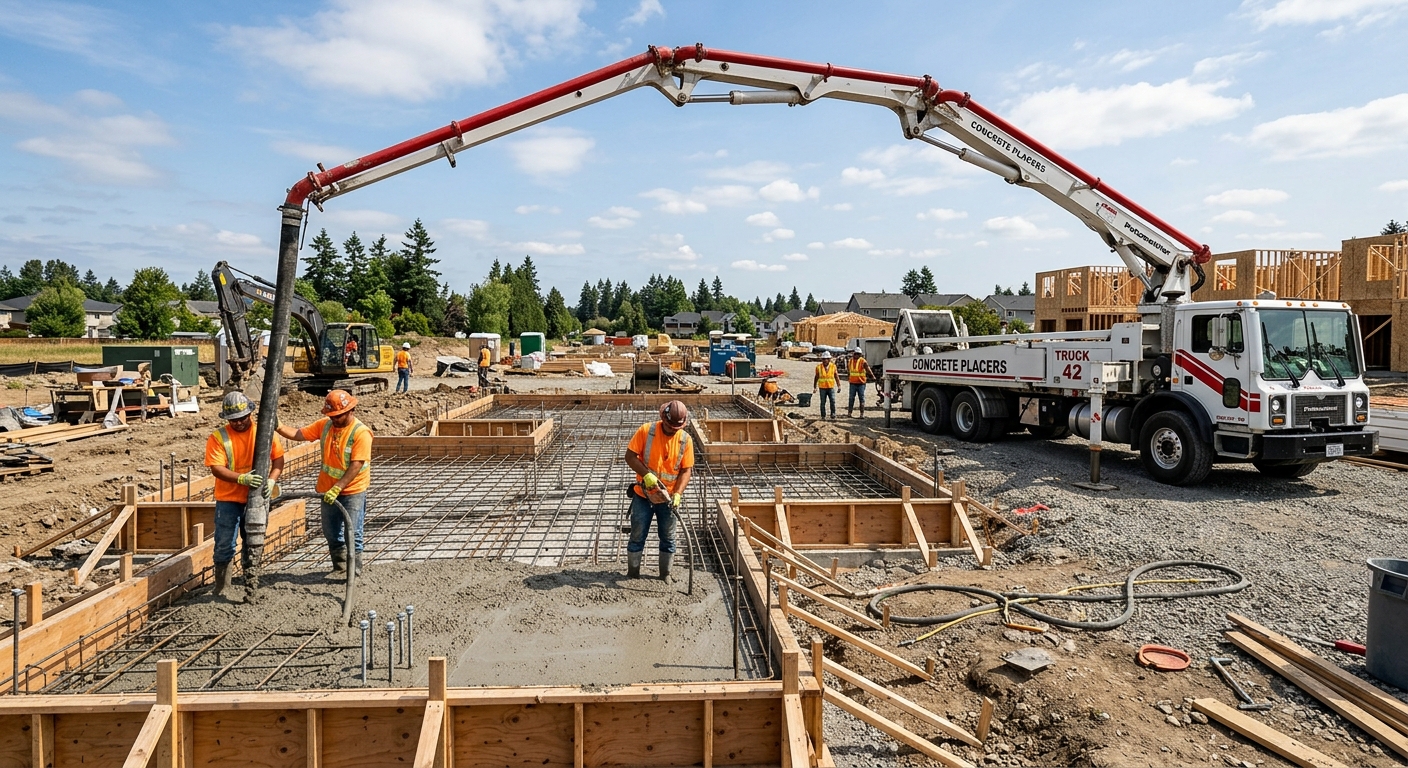
Concrete work options and costs in Brigadoon
Concrete work is a big part of everyday life in Brigadoon, Ontario—especially when you’re upgrading the look and performance of driveways, patios and walkways around the home. Brigadoon’s population was 3,315 in the 2021 Census, and the Toronto economic region keeps a steady demand for exterior flatwork as families refresh older homes and replace worn surfaces. In many streetscapes, the most common concrete needs are new or resurfaced driveways and backyard patio slabs, because these areas see heavy seasonal freeze–thaw stress and de-icing wear. (Statistics Canada, 2021 Census)
In the GTA, pricing isn’t just “more or less concrete.” It’s the whole system: deeper frost-sensitive footings where required, air-entrained concrete for exterior slabs, well-compacted granular base, and a control-joint plan to limit random cracking. The climate also affects scheduling—exterior work is typically concentrated in the warmer pour window so the concrete can cure properly, and colder snaps toward roughly 10 °C can require extra protection (blankets/heating) to keep quality on track.
Contractors also get busy in high-turnover pockets like the Brigadoon neighbourhoods closer to the Highway 400 corridor, where access can be tighter and there’s more competition for crews during peak months. If you’re comparing options, the table below helps you translate finish choices into real budget ranges for Brigadoon.
| Application |
Typical Size |
Key Spec |
Finish Option |
Price Range |
| Concrete driveway (standard broom finish) |
500 sq. ft. |
Air-entrained exterior mix, compacted granular base, control joints |
Broom finish |
$9,000–$14,000 |
| Exposed aggregate driveway |
500 sq. ft. |
Air-entrained mix, proper surface retarder/wash, curing protection |
Exposed aggregate |
$11,000–$16,000 |
| Stamped concrete driveway or patio |
400 sq. ft. |
Air-entrained exterior mix, base prep + joint pattern |
Stamp + release + seal |
$10,000–$16,000 |
| Plain concrete patio or walkway |
300 sq. ft. |
Well-drained base, edge forms, air-entrainment |
Steel-trowel then broom/float finish |
$4,800–$7,800 |
| Garage floor (interior slab) |
500 sq. ft. |
Vapour barrier, thickened edges where needed, wire mesh/rebar as specified |
Broom finish |
$7,500–$12,500 |
| Foundation footings (structural, below frost) |
House-size bearing footprint |
Engineered design, excavation, formwork, rebar, poured below design frost depth |
Structural concrete |
$18,000–$30,000 |
Prices are estimates only and vary by project scope, site access and material selection.
What affects the price of concrete work in Brigadoon
Two homeowners in the Toronto economic region can receive quotes that differ by 30 to 50% for the “same” slab because concrete pricing is really pricing the variables around it: site conditions, excavation and disposal, base preparation, concrete mix requirements for freeze–thaw, reinforcement, finishing complexity, and curing protection when weather turns. In Brigadoon, the seasonal freeze–thaw cycle drives the technical specs—and those specs drive labour and materials.
First, frost depth and ground movement matter. Structural footings must extend below the design frost depth to prevent frost heave and differential movement, and this is why footing and foundation scopes price differently than patios or walkways. Second, exterior slabs in the GTA need air-entrained concrete to survive the repeated freeze–thaw cycle. Third, the pour season can be shorter in cooler stretches of Ontario, so projects sometimes require cold-weather curing precautions (insulating blankets or heating) to hit proper strength and durability. Finally, de-icing salt contributes to surface spalling over time, so sealing and surface protection aren’t “optional extras” for driveways and patios that get salted every winter.
In Brigadoon, costs often rise when soil needs more import/grade correction or when access is tight (smaller driveways, limited truck placement). They also rise if you want premium finishes like stamped concrete (commonly priced around the $24–$40 per sq. ft. band) because crews require extra labour for forms, stamping and finishing. Costs can come down when you stick to a simpler broom-finished driveway (often closer to the $18–$28 per sq. ft. band) and the site drains well, reducing rework. If your home is older and the base is poor, expect higher prep costs—sometimes comparable to adding a premium finish—because fixing drainage and compaction prevents the “rebuild sooner than expected” cycle.
| Price Factor |
Why It Matters |
Cost Impact |
| Frost line depth — determines footing depth and form height |
Controls how far excavation and formwork must go to resist heave |
High for foundations/footings; can change scope dramatically |
| Site preparation — excavation, grading, compacted granular base |
Stabilizes the slab and reduces settlement cracking |
Often one of the biggest variables between quotes |
| Reinforcement — rebar or wire mesh requirement |
Improves performance under load and helps control cracking |
Moderate cost increase; essential on driveways and garage slabs |
| Mix design — air-entrainment and compressive strength spec |
Air-entrainment helps survive freeze–thaw; strength ensures durability |
Moderate materials difference that protects the long-term |
| Finish type — broom vs. stamped vs. exposed aggregate |
Complex finishes require more labour, tools and curing/sealing steps |
Can shift the job into the $24–$40/sq. ft. range for stamped work |
| Pour size and concrete truck access to site |
Truck placement affects labour time and whether extra pumping/handling is needed |
Low to high depending on access and distance |
| Cold-weather curing precautions — heating and blankets |
Helps concrete reach adequate strength when temperatures drop |
Can add notable labour and material costs on borderline days |
| Control joint pattern and sealing cost |
Jointing reduces random cracking; sealing reduces salt-driven surface damage |
Moderate; often worth it for exterior driveways and patios |
Permits & regulations in Ontario
In Ontario, structural concrete work typically requires municipal oversight. Footings, foundation walls, and grade beams are considered structural and usually require a building permit, often supported by engineered drawings that the municipality and building officials can review. Concrete flatwork like patios, walkways and driveways often does not require a permit by default—but it can require review if the work affects lot grading, drainage, or impervious surface coverage limits, or if the project impacts municipal right-of-way.
For Brigadoon homeowners, the practical approach is simple: before breaking ground, confirm with the local authority whether your scope triggers a permit. If you’re doing anything tied to the foundation system—new footings, underpinning, foundation wall repair, or foundation replacement—assume a permit is required.
Next, verify the contractor’s credentials in Ontario. Start by checking their licence/registration status through the province’s contractor licensing/registry resources where applicable, then ask for a current Certificate of Insurance naming you as an additional insured for liability. For coverage, request proof that they carry WSIB/WCB for workers. Finally, ask for references that match your job type (driveway vs. foundation) and similar scale—photos are helpful, but references confirm how the crew performed in the real freeze–thaw conditions of the GTA.
Getting concrete right in Brigadoon's freeze-thaw climate
Concrete failure in Brigadoon usually comes down to three things: water, the freeze–thaw cycle, and poor details (especially at joints and edges). If water gets under a slab or sits at the surface, it can freeze, expand, and gradually loosen the material. That’s why base preparation, mix design, control joints and curing protection must be specified as a system—not as separate “nice-to-haves.”
For base preparation, crews should install a properly graded and compacted granular sub-base to the right depth for your soil and site drainage, with attention to slope away from the house. For mix design, exterior concrete should be air-entrained—commonly in the 5–7% air range for freeze–thaw durability—and specified for at least 32 MPa compressive strength. Control joints must be planned to limit random cracking and give cracks somewhere predictable to form. Curing matters just as much: aim for a minimum 7-day cure under suitable protection, and when pouring near colder periods (around 10 °C or lower), cold-weather curing precautions may be needed to keep strength gain on schedule. Finally, apply a penetrating sealer after the concrete has fully cured—typically around 28 days post-pour—to repel de-icing salt and reduce surface degradation.
Here’s a dollar example that helps decision-making: if stamped concrete is priced in the $24–$40 per sq. ft. band versus broom-finished driveway work closer to $18–$28 per sq. ft., the upgrade is justified only when the base, air-entrainment and jointing are correct. If the base or mix is cut to save money, the aesthetic won’t last—cracking and scaling will still show up on expensive surfaces.
| Spec |
Why It Matters in Brigadoon |
What to Ask For |
Impact if Skipped |
| Compacted granular base (depth?) |
Prevents settlement and helps control water under slabs in freeze–thaw |
“What base thickness are you installing, and how do you compact it to spec?” |
More cracking, uneven slabs, and premature edge failure |
| Air-entrained concrete mix (target air %?) |
Air bubbles provide freeze–thaw durability outdoors |
“Confirm air content target—what’s the mix designed for on this exterior pour?” |
Spalling and scaling, especially with winter salt exposure |
| Compressive strength (MPa rating) |
Ensures the slab reaches adequate strength for durability and load |
“What MPa compressive strength are you specifying for the pour?” |
Surface weakness and early wear/standing water damage |
| Control joints (spacing per ACI guidelines) |
Controls where shrinkage cracks appear in cold-weather seasons |
“Show the joint layout and spacing for my slab size and pattern.” |
Random cracking and difficult-to-repair structural-looking damage |
| Minimum 7-day curing period |
Strength gain and durability depend on proper curing under GTA temperature swings |
“How will you protect the slab during curing, especially if temps drop?” |
Reduced strength, higher risk of scaling and joint deterioration |
| Penetrating sealer (when applied after cure) |
Helps repel moisture and de-icing salts that drive freeze–thaw deterioration |
“Which penetrating sealer are you using, and when will it be applied (typically after ~28 days)?” |
Faster salt damage and more surface spalling over multiple winters |
How to choose a concrete work contractor in Brigadoon
Choosing the right concrete contractor in Ontario is mostly about verification and clarity. First, verify Ontario licensing/registration as applicable, then request a current Certificate of Insurance showing general liability coverage and naming you as additional insured where required. Ask for proof of WSIB/WCB coverage for the crew. If the contractor can’t produce documents quickly or tries to “share later,” that’s a practical red flag—especially on exterior pours where delays due to paperwork often lead to rushed curing windows.
Second, get 2–3 itemised written quotes. Don’t accept a vague lump sum. A good quote breaks labour and materials (excavation, forms, base, reinforcement, concrete, finishing, joints, sealing, and any required protection for cold nights). Make sure the scope lists what’s included and what’s excluded: disposal/haul-away, sawcutting for joints, drainage adjustments, site protection, and whether the quote includes permitting and inspections if your scope requires them.
Third, compare warranty terms. Look for a workmanship warranty length and product/manufacturer warranty details, and ask whether it’s transferable if you sell your home. For payment schedule, never pay more than 10–15% upfront, and hold back payment until the job is complete and cleaned up properly. Finally, get a start date and a completion estimate in writing—concrete schedules in the GTA can shift quickly around temperature and rain forecasts.
- Confirm Ontario credentials/registration status before signing.
- Request current Certificate of Insurance (and additional insured wording).
- Provide proof of WSIB/WCB coverage for workers.
- Ask for 2–3 local references for similar work in the GTA.
- Get an itemised quote (labour + materials) rather than a lump sum.
- Confirm whether permit pulling is included if structural work is involved.
- Clarify disposal/haul-away for excess soil and concrete debris.
- Ask for base prep details: thickness, compaction method, and drainage slope.
- Confirm air-entrained mix and MPa strength for exterior pours.
- Review joint layout: spacing and sealing plan.
- Ask about curing protection plans if nights get cold.
- Confirm warranty terms and what triggers service (photos, timelines, repairs).
In Brigadoon, common red flags include contractors who won’t show joint layouts, promises of “no need to seal,” unclear air-entrainment/mix specs, refusal to provide insurance/WSIB documentation, and quotes that omit base thickness or drainage details—these are the fastest ways to end up with cracking and salt-related surface damage.
Frequently asked questions — concrete work in Brigadoon
What is a concrete overlay and is it suited to Brigadoon?
A concrete overlay is a bonded layer of new concrete (often micro-topping or overlay systems) installed over an existing slab after surface preparation—typically grinding, crack treatment, and sometimes bonding agents. In Brigadoon and across Ontario, overlays can be suited to driveways and patios when the original slab is structurally sound and drainage is corrected, because a proper bond helps resist freeze–thaw wear. If the original concrete is heaving, badly settled, or has widespread base failure, an overlay usually just “covers” the problem and the new surface can fail prematurely.
Cost-wise, overlays can be attractive versus full replacement, but pricing varies by prep intensity and thickness. If you’re comparing options, remember that a standard broom-finished driveway replacement often sits in the $18–$28 per sq. ft. band, while overlays depend heavily on condition. For exterior work in the Toronto area, make sure your contractor specifies freeze–thaw compatible materials and joint detailing—otherwise you can get cracking that mirrors the old slab.
How do I seal concrete to protect it in Brigadoon?
For concrete in Brigadoon, sealing is mainly about repelling water and de-icing salts that contribute to spalling during repeated freeze–thaw cycles. The best practice is to wait until the concrete has cured fully—commonly around 28 days post-pour—then clean thoroughly (no paint overspray, dust, or curing compounds) and apply a penetrating sealer that soaks in rather than just forming a film. Penetrating sealers tend to work better on exterior flatwork because they reduce moisture ingress while still allowing some breathability.
Ask your contractor which sealer they use and what coverage rate they plan to achieve. If you seal too early, trapped moisture can interfere with performance. Also confirm whether they recommend resealing intervals based on Toronto’s winter salt exposure. Done correctly, sealing complements the air-entrained mix and joint layout—those are the real durability drivers.
What is the difference between concrete and cement?
In everyday language people say “cement” and mean the finished slab, but technically they’re different. Cement is a key ingredient (a powder) used to make concrete. Concrete is the full engineered mix: cement plus water, fine and coarse aggregates (sand and stone), and often additives like air-entraining admixtures for freeze–thaw durability—especially important for exterior slabs in Ontario.
When you receive a quote in Brigadoon, the contractor should be able to explain the mix design: air content target for exterior work, and the minimum compressive strength (commonly at least 32 MPa for slab durability). Understanding the difference helps you verify that you’re paying for the right “whole mix system,” not just the name on a bag. If someone can’t discuss air-entrainment or strength, be cautious—those specs directly impact spalling resistance in our humid, salted winters.
How much does concrete work cost in Brigadoon?
Concrete pricing in Brigadoon depends on scope, access, and finish, but you can use the local budget bands for quick planning. For example, a concrete patio or walkway commonly lands around $16–$26 per sq. ft., while driveways typically fall around $18–$28 per sq. ft. for standard broom-finished work. If you want a stamped concrete driveway or patio, budgets often rise into the $24–$40 per sq. ft. range because the finish requires more labour, tooling, and careful curing/sealing.
Installation includes more than “pouring.” In the Toronto region, contractors often must manage deeper frost-sensitive base prep for exterior durability, and air-entrainment is standard for exterior pours to handle freeze–thaw. If you’re doing structural foundation footings, pricing is handled differently than flatwork—typically $180–$300 per linear foot depending on engineered scope and excavation conditions. For the most accurate numbers, request itemised quotes that break down base prep, reinforcement, and sealing.
How deep must footings be for Brigadoon's frost line?
Footing depth is determined by the design frost depth for Ontario and your soil conditions, not by a simple one-size number. In practice, many Ontario structural footings are set deep enough to extend at least about 1.2 m (roughly 4 ft) below grade to resist frost heave and differential movement. Your exact depth should match the engineered foundation design for your specific project and lot.
This matters because deeper excavation changes formwork height, rebar placement, and sometimes dewatering—so it affects cost. It also explains why foundation scopes are priced differently than driveways and patios. If you’re comparing contractor quotes on foundation work, ask for the engineered footing elevations and confirm they’re installing concrete below the design frost depth. For flatwork like patios and walkways, you still need solid granular base and drainage, but the “below frost” requirement generally applies to structural supports rather than decorative slabs.
Why does concrete crack in Brigadoon and how is it prevented?
Concrete cracks for predictable reasons, and in Brigadoon the biggest contributors are moisture movement and seasonal freeze–thaw. As temperatures swing, concrete undergoes thermal and shrinkage movement. If water can migrate under or into the slab and then freeze, it can expand and worsen stresses. Cracks are also more likely when base prep is weak or when the concrete mix isn’t properly air-entrained for exterior durability.
Prevention starts with a compacted granular base and good drainage away from the house, plus air-entrained concrete (typically targeting 5–7% air content for exterior flatwork) and adequate curing. Control joints are essential: they give cracks a planned path and limit random cracking. For spalling resistance, the air-entrainment spec is non-negotiable—poor mix design is a common cause of surface pop-outs after winters with repeated salt and freeze–thaw. Finally, sealing after full cure helps reduce salt-driven surface deterioration, but sealing can’t replace correct base prep and proper jointing.