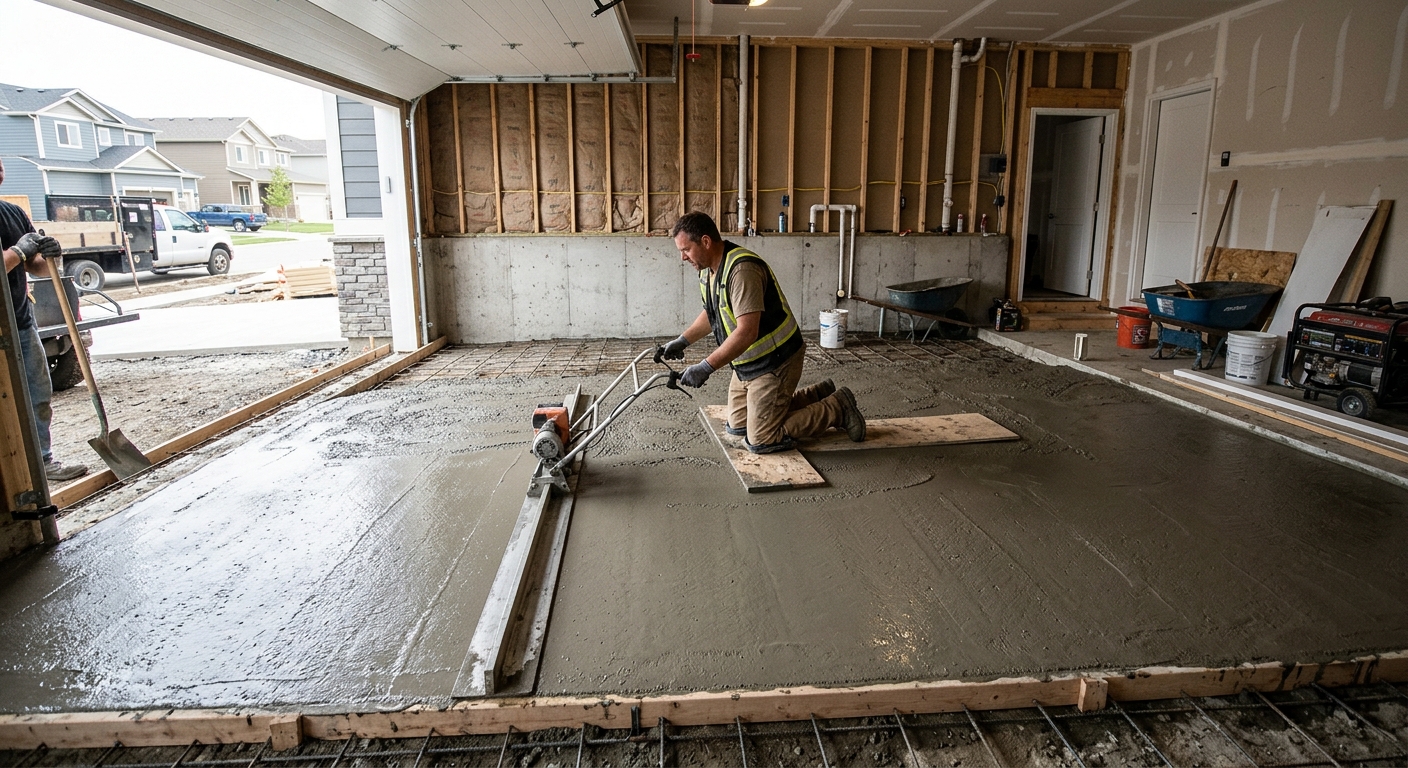
Concrete work options and costs in Cochrane
Cochrane is growing, and that means homeowners in town are increasingly upgrading driveways, patios and interior garage slabs to match the look and durability they expect around a 2020s home—while many neighbourhoods are still dominated by older housing stock. In fact, single-detached homes make up 66.5% of dwellings, and 63.1% of homes were built before 1981 (Statistics Canada, 2021 Census). That mix of older foundations and frequent exterior renovations drives steady demand for concrete flatwork in places like the downtown core and the newer growth pockets near Westside Road.
Pricing in Cochrane is also influenced by Ontario’s freeze–thaw behaviour and the way it dictates design choices. Even though Northeast BC pricing pressures in the data you provided are higher due to deeper frost and harsher winter conditions, Ontario still has its own cold-season realities: exterior concrete must be built to last through spring thaw, and it needs proper base prep, air-entrained mixes, and disciplined curing to reduce cracking and scaling. Contractors in Ontario also plan pours around weather, because cold snaps and early freezing can jeopardize strength gain and surface durability—especially on driveways and exposed patios that take de-icing salt year after year.
To compare options, use the table below as a practical starting point. Your final number will swing based on excavation depth, drainage needs, reinforcement, access for the concrete truck, and whether you want standard broom-finish concrete or a decorative finish like stamping or exposed aggregate.
| Application |
Typical Size |
Key Spec |
Finish Option |
Price Range |
| Concrete driveway (standard broom finish) |
400–600 sq. ft. |
Air-entrained exterior mix, compacted granular base |
Broom finish, control joints, sealer optional |
$18,000 – $28,000 |
| Exposed aggregate driveway |
400–600 sq. ft. |
Air-entrained mix, proper set time and wash timing |
Exposed surface aggregate (two-pass process) |
$22,000 – $34,000 |
| Stamped concrete driveway or patio |
300–500 sq. ft. |
Air-entrained exterior mix, colour hardeners |
Stamp pattern + integrated colour (or overlays) |
$25,000 – $40,000 |
| Plain concrete patio or walkway |
200–350 sq. ft. |
Air-entrained exterior mix, base and edging |
Smooth or broom finish, joints as required |
$3,000 – $8,750 |
| Garage floor (interior slab) |
300–500 sq. ft. |
Vapour barrier (if required), fibre or mesh, proper base |
Plain finish, optional densifier/sealer |
$9,000 – $15,000 |
| Foundation footings (structural, below frost) |
Per linear foot (typ. 40–120 LF total) |
Engineered thickness/steel, excavations below frost |
Structural concrete only (not decorative) |
$6,600 – $14,000 |
Prices are estimates only and vary by project scope, site access and material selection.
What affects the price of concrete work in Cochrane
You can get surprisingly different quotes for the “same” concrete job in the Northeast/Ontario market—often in the 30–50% range—because concrete pricing isn’t just about the slab or driveway square footage. It’s the whole system: excavation, base depth, reinforcement, mix design, weather protection, finish complexity, and how long the crew can work efficiently on your site. Two homeowners may both be installing a 500 sq. ft. driveway, but one has soft soils and poor drainage and needs deeper excavation, geotextile, and added base; the other has firm grade and straight-forward access. Those differences typically explain much of the spread.
Here’s what drives cost. First, frost line depth and freeze–thaw cycles dictate every exterior spec in Ontario: footings must extend below the design frost depth to prevent frost heave and slab movement. Second, exterior slabs need air-entrained concrete mixes so the freeze–thaw cycle doesn’t gradually damage the surface. Third, cold-season finishing requires cold-weather curing precautions. If you pour late in the season, crews may need insulated curing blankets, temperature monitoring, and sometimes heat protection—these add labour and material overhead. Finally, de-icing salt accelerates surface spalling if the mix and curing aren’t right, so sealing is a practical “small cost, big benefit” step.
In Cochrane, a driveway replacement on an older property (many built before 1981) can cost more when we find low spots, weak base, or an existing subgrade that requires removal and re-compaction. Conversely, a new patio in a well-prepped backyard on a stable base usually lands closer to the plain patio/walkway band (often around $15–$25 per sq. ft.), while decorative options like stamped concrete typically push into the stamped band (about $25–$40 per sq. ft. depending on scope) because of labour intensity and materials like colour hardeners and release agents.
| Price Factor |
Why It Matters |
Cost Impact |
| Frost line depth |
Determines footing depth, form height, and excavation volume |
Can materially increase labour and backfill; drives foundation/footings pricing |
| Site preparation |
Excavation, grading, and compacted granular base quality |
Weak subgrade adds removal, regrading, and additional granular supply |
| Reinforcement |
Rebar/wire mesh to control cracking and support loading |
Steel, tie-wire, chairs, and added labour increase cost |
| Mix design |
Air-entrainment and compressive strength for durability in freeze–thaw |
Premium mix and test/quality requirements can raise concrete supply cost |
| Finish type |
Broom vs. stamped vs. exposed aggregate needs different processes |
Decorative finishes add labour and materials; stamped and aggregate typically cost more |
| Pour size and concrete truck access to site |
Long walks, tight gates, or no washout location increases time |
Extra crew time, wheelbarrows/pumps, and schedule adjustments |
| Cold-weather curing precautions |
Heating/insulating blankets protect strength gain |
Adds material rental and hours; often required for late-season work |
| Control joint pattern and sealing cost |
Joints manage shrinkage cracking; sealing protects against salt scaling |
Cutting, sealing products, and additional labour—small per sq. ft., meaningful over time |
Permits & regulations in Ontario
In Ontario, concrete isn’t “automatically permit-free.” Structural concrete work—things like foundation footings, foundation walls, and grade beams—typically requires a building permit. Municipal review is common, and engineered drawings may be required depending on the scope and the house’s condition. For concrete flatwork (driveways, patios, and walkways), permits are less common, but they’re not guaranteed to be unnecessary: if your project changes lot grading, affects drainage direction, impacts impervious surface coverage rules, or is close to municipal right-of-way/sidewalk requirements, you may need municipal approval. Always check with the Town/City before you break ground.
Here’s how a homeowner in Cochrane can verify a contractor step by step:
- Ask for the contractor’s general liability insurance certificate (COI) and confirm it matches the company name on the quote.
- Request proof of WSIB coverage (or the appropriate clearance documentation) and verify coverage is active for the dates of work.
- Confirm whether the contractor is registered/licensed for the specific work scope (where applicable) and that subcontractors are covered too.
- Check references: request 2–3 similar-scale projects (e.g., driveways and patios on older homes, not just new builds).
- Look for jobsite-ready documentation: method statements for cold-weather curing, rebar schedules/inspection photos for structural pours, and a clear scope of work.
If they can’t provide insurance/coverage details promptly, treat it as a red flag—especially in a freeze–thaw climate where workmanship issues show up fast as scaling, spalling, or unwanted cracking.
Getting concrete right in Cochrane's freeze-thaw climate
Concrete failures in Cochrane are usually the predictable ones: surface scaling or spalling from salt, cracking from shrinkage and movement, and uneven settlement from a weak base. The fix is not “stronger concrete” alone—it’s the full specification. Start with base prep: compacted granular sub-base to the correct depth and proper moisture/compaction targets for local soil conditions. If the base is too thin or poorly compacted, the slab moves and control joints can’t do their job. Next is mix design: for exterior flatwork, air-entrainment is critical. A typical target is 5–7% air content for exterior work, paired with a minimum 32 MPa compressive strength. That combination helps the paste resist freeze–thaw damage.
Control joints matter as much as finishing. We cut or form joints early enough and space them to control where shrinkage cracking happens. Curing is where many “cheap” jobs fall down: aim for a minimum 7-day curing period under proper conditions. If you pour when cold nights are expected, curing blankets and temperature protection are essential to prevent early freezing, which can weaken the surface layer. Finally, sealing: apply a penetrating sealer after cure (often at 28 days) to repel de-icing salts and reduce water uptake into the surface.
To frame the dollars: if a standard broom-finish driveway comes in around the $18–$28 band, moving to stamped concrete can add labour and materials (often trending toward $25–$40 per sq. ft.). That higher cost is justified when you actually want decorative impact and you’re specifying the same durability requirements (air-entrainment, joints, curing) underneath the finish—not just pattern and colour.
| Spec |
Why It Matters in Cochrane |
What to Ask For |
Impact if Skipped |
| Compacted granular base (depth?) |
Prevents settlement and movement through freeze–thaw |
Base thickness and compaction method for your soil conditions |
Uneven slabs, voids, and cracking; joints lose effectiveness |
| Air-entrained concrete mix (target air %?) |
Protects against freeze–thaw scaling and spalling |
Air-entrainment specification (typ. 5–7% for exterior flatwork) |
Surface deterioration within seasons, especially with salt |
| Compressive strength (MPa rating) |
Ensures adequate strength gain for durability and wear resistance |
Minimum 32 MPa compressive strength |
Soft/weak surface, early raveling and increased cracking risk |
| Control joints (spacing per ACI guidelines) |
Directs shrinkage cracking to manageable locations |
Joint spacing plan and timing of sawing/cutting |
Random cracking and water infiltration at uncontrolled locations |
| Minimum 7-day curing period |
Builds strength and protects the surface through cold nights |
How curing will be handled; protection plan if temperatures drop |
Weak near-surface concrete and higher spalling risk |
| Penetrating sealer (when applied after cure) |
Reduces water and chloride intrusion from de-icing salts |
Penetrating sealer application after cure (often 28 days) |
More freeze–thaw damage and salt-driven deterioration |
How to choose a concrete work contractor in Cochrane
Choosing the right contractor matters as much as the concrete mix. In Ontario, start by verifying coverage and legitimacy. Ask for a current certificate of insurance (general liability) and confirm the company name and address on the COI match the quote. Next, request WSIB clearance/coverage documentation for the period they’ll be working. If a contractor relies heavily on subcontractors, make sure those subs are covered too—your “I thought they were insured” won’t fix a jobsite injury or a claim.
Then get 2–3 written itemised quotes—not just a single lump sum. You want labour and materials separated enough to see what’s included: excavation and disposal, granular base supply, reinforcement, pump or wheelbarrow method, concrete thickness, finish type, and finishing/curing steps. Confirm whether permits (if needed) are included, and whether disposal of concrete/soils is part of the price. A good contract also states the warranty length and what it covers (settlement, scaling/spalling, workmanship defects) and whether there’s a manufacturer warranty component for product-specific materials.
For payment, keep it reasonable: never pay more than 10–15% upfront. Hold back a portion until the job is complete, cleaned up, and any deficiencies are corrected. Ask for a written start date and realistic completion timeline—especially important in Cochrane when late-season conditions can compress curing windows. If they can’t explain curing plans or joint spacing in plain language, that’s a problem.
- Verify WSIB coverage with clearance documentation before work starts.
- Collect a current COI for general liability (active coverage dates).
- Ask for examples of similar Cochrane projects: driveways on older homes and exterior slabs.
- Use itemised quotes: excavation/base, reinforcement, concrete supply, finishing, curing protection.
- Confirm thickness and concrete strength spec (e.g., minimum 32 MPa) for exterior work.
- Require air-entrainment for exterior flatwork and cold-weather curing precautions if needed.
- Ask for joint plan: where joints go and how/when they’re cut.
- Check if sealing is included (and which product type: penetrating vs film-forming).
- Make sure drainage and grading tie-ins are included—especially at garage thresholds and eaves.
- Review exclusions: what happens if they find poor soil or unstable subgrade?
- Confirm disposal/recycling for removed materials is included or priced separately.
- Clarify warranty terms and who responds if there’s scaling, spalling, or uncontrolled cracking.
Concrete red flags in Cochrane: vague scopes with no base depth or mix specs; contractors who won’t discuss air-entrainment and curing; rushing joint cutting or skipping sealing where de-icing salt is expected; only accepting large upfront payments; and missing documentation (insurance/WSIB) or refusing to provide references on similar-size jobs.
Frequently asked questions — concrete work in Cochrane
What is a concrete overlay and is it suited to Cochrane?
A concrete overlay is a new cement-based layer placed on top of an existing concrete surface to improve appearance or correct minor issues without full replacement. In Cochrane and across Ontario’s freeze–thaw climate, overlays can work well when the existing slab is structurally sound—meaning it’s not significantly heaving, heavily spalled, or badly cracked with movement. If the base has failed, overlays can trap problems and the old issues will telegraph through. Overlays also need proper surface preparation (shotblasting/scarifying, cleaning, and bonding agents) and the correct product for exterior freeze–thaw exposure. In terms of cost, overlays are often positioned as a mid-cost alternative versus replacement; however, the “best value” depends on whether you can keep the old slab. If you’re currently seeing salt-driven scaling, a well-done overlay plus a penetrating sealer after cure is usually the safer direction than trying to hide deterioration.
How do I seal concrete to protect it in Cochrane?
In Cochrane, sealing is about reducing how water and chlorides from de-icing salts move into the concrete surface. The most effective homeowner-friendly approach is to use a penetrating sealer rather than a surface film, because penetrating products help reduce moisture uptake and slow salt damage. Timing matters: let the concrete cure properly first—commonly about 28 days—then apply sealer when the surface is clean and dry. Before sealing, confirm that the contractor used an exterior-appropriate concrete mix with air-entrainment and that joints are detailed correctly; sealing isn’t a substitute for durability specs. If you seal too early, you can trap moisture and reduce performance. If your driveway is in heavy traffic, ask about re-application intervals based on product guidance and your winter conditions. When you compare options, sealing is usually far cheaper than moving from a plain driveway to decorative finishes in the $18–$28 or $25–$40 bands, but it has an outsized impact on service life.
What is the difference between concrete and cement?
People often use “cement” and “concrete” interchangeably, but they’re not the same. Cement is one ingredient—typically Portland cement—that acts as the binder. Concrete is the complete mixture: cement plus water, sand, stone (aggregate), and often admixtures such as air-entrainment for exterior durability. In Ontario’s freeze–thaw conditions, the concrete mix design is what governs performance—especially for driveways, patios, and walkways that are exposed to moisture and de-icing salts. That’s why a good contractor should specify air-entrainment targets and compressive strength requirements rather than only saying “cement quality.” If you’re getting quotes around the $18–$28 band for a standard broom-finished driveway or the $15–$25 band for a plain patio, ask whether the supplier is providing an exterior air-entrained mix and what the curing plan is. The “cement” alone won’t tell you if the finished concrete will resist scaling over multiple winters.
How much does concrete work cost in Cochrane?
Concrete costs in Cochrane depend on scope, access, and the durability specs needed for freeze–thaw and salt. For context, a concrete driveway (standard broom finish) typically prices in the $18–$28 range, while a plain patio or walkway is often in the $15–$25 range. Decorative options push higher: stamped concrete commonly trends toward the $25–$40 range because of colour systems, release agents, additional labour, and more precise forming and finishing. Foundation footings (structural, below frost) are typically quoted separately and often land in the $55–$90 range depending on engineered requirements and excavation depth. The quotes can vary by 30–50% when one contractor includes deeper base excavation, reinforcement, and cold-weather curing protection while another doesn’t. Since many homes in Cochrane are older (63.1% built before 1981, Statistics Canada, 2021 Census), expect some projects to require extra base correction or drainage work, which increases the total.
How deep must footings be for Cochrane's frost line?
Footings must be placed below the design frost depth so frost can’t lift the soil and heave the foundation. In practice, the exact depth should follow the Ontario design requirements and any engineered foundation drawings for your property. While people sometimes talk about “one frost depth number,” the correct answer depends on your structural design, soil conditions, and the engineer/municipal review requirements. What you can verify as a homeowner is that your contractor is using the correct frost depth for Ontario structural design and that they’re excavating deep enough before placing structural concrete for footings and supporting elements. If you see a contractor proposing shallow excavation “to save cost,” that’s a major risk—freeze–thaw movement is one of the fastest ways to cause cracking and long-term foundation issues. For structural concrete permits and engineered requirements, confirm details with the municipality as part of your building process in Cochrane before the pour.
Why does concrete crack in Cochrane and how is it prevented?
Concrete cracks are common in Cochrane because the material shrinks as it cures and moves slightly with temperature and moisture changes through Ontario’s freeze–thaw cycles. The key is controlling where cracks happen and ensuring they don’t become a water/ice problem. The most common prevention steps are: compacted base preparation so the slab doesn’t settle; air-entrained exterior concrete mix so freeze–thaw doesn’t scale/spall the surface; and a proper control joint plan (spacing and timing) to direct shrinkage cracking. Curing is also critical—minimum 7-day curing under proper conditions—because early freezing can weaken the surface layer. Finally, sealing helps reduce chloride intrusion from de-icing salt, which supports durability even when minor cracking occurs at intended joints. If you’re comparing quotes in the $18–$28 driveway range versus a decorative $25–$40 option, don’t choose based on appearance alone—ask what the contractor is doing for mix design, joints, curing, and sealing. Those technical pieces usually determine whether you’re dealing with hairline shrinkage at joints or random cracking within the first few winters.