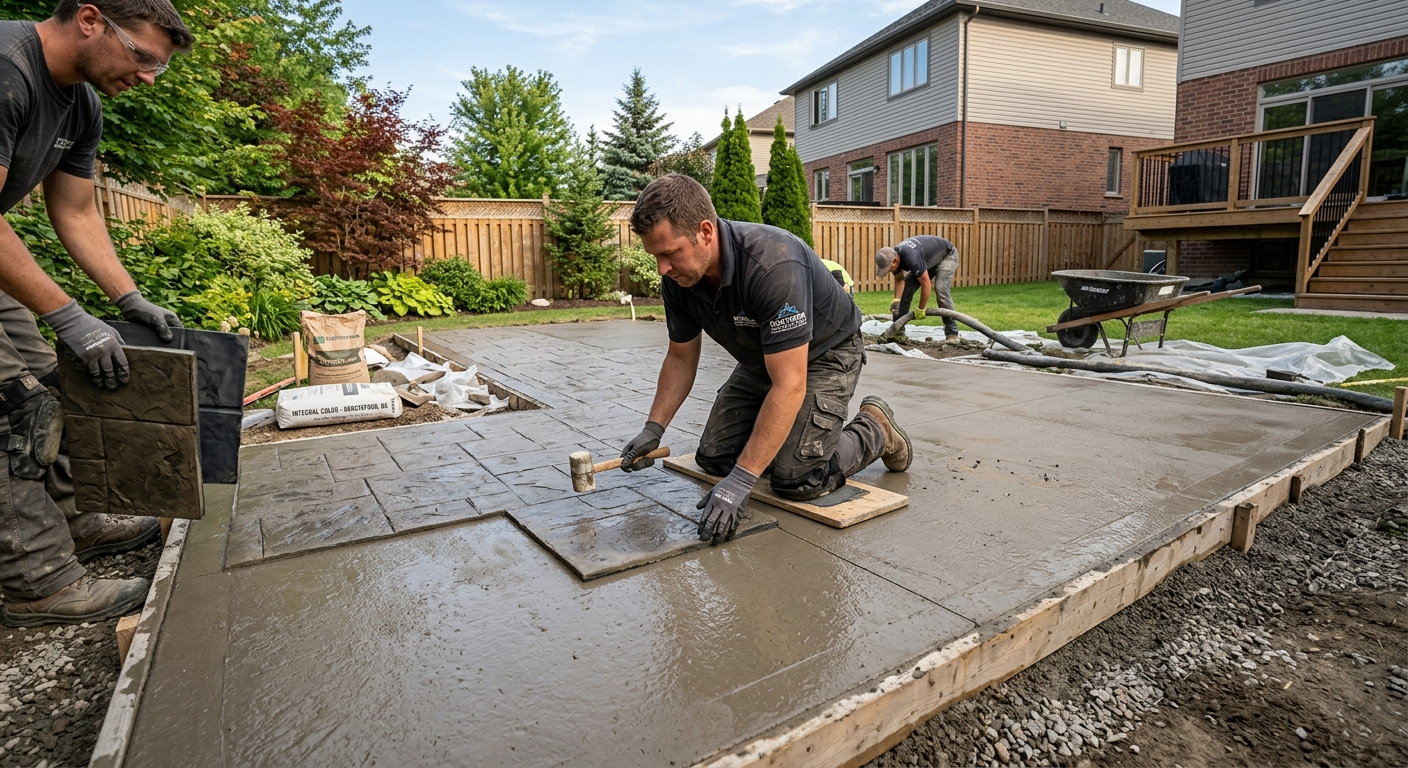
Concrete work options and costs in Winchester
In Winchester, concrete work tends to be busiest where homeowners want dependable exterior flatwork—driveways, patios and walkways that can handle Ontario’s freeze–thaw swings without heaving or spalling. Winchester is a small community (2,394 residents, Statistics Canada, 2021 Census), so many projects come from nearby rural properties and established neighbourhoods where access to stone, gravel and long-term trades can affect scheduling and pricing. In the Toronto economic region, most concrete demand is tied to family homes and renovations around winter-ready curb appeal; while the town is smaller than the city, the same frost-depth engineering and exterior concrete durability requirements apply. In practice, the “one-size” driveway you see online rarely matches what we build locally—because Toronto-area conditions influence everything from footing depth to mix design.
Quotes in the Toronto region often differ because contractors must plan for frost depth, drainage, and curing windows. Structural footings typically need to extend at least 1.2 m (about 4 ft) below grade to reduce frost-related movement, and exterior slabs are usually air-entrained to survive repeated freeze–thaw. The pour season is also shorter when temperatures trend toward 10 °C or below, which can add labour time for protection (insulation blankets, heated enclosures) and extend curing care.
In Winchester, trades frequently run projects in and around the Church Street / Main Street corridor and along nearby rural lanes where driveways require more prep and granular base to manage saturated soils. The table below compares typical Winnipeg? (Winchester) options and realistic price bands for homeowners deciding what to upgrade first.
| Application |
Typical Size |
Key Spec |
Finish Option |
Price Range |
| Concrete driveway (standard broom finish) |
400–500 sq. ft. |
Air-entrained mix, compacted granular base |
Broom finish, standard thickness |
$7,200–$14,000 |
| Exposed aggregate driveway |
400–500 sq. ft. |
Proper base, controlled wash/retard curing |
Exposed stone aggregate |
$9,200–$17,000 |
| Stamped concrete driveway or patio |
300–450 sq. ft. |
Air-entrained mix, joints to manage cracking |
Stamp pattern, release agent + sealer |
$10,500–$18,000 |
| Plain concrete patio or walkway |
200–350 sq. ft. |
Drainage slope, air-entrained exterior mix |
Steel trowel light broom, clean edges |
$3,200–$8,900 |
| Garage floor (interior slab) |
400–600 sq. ft. |
Vapour barrier, reinforcement where required |
Broom finish or smooth trowel (light) |
$8,500–$16,800 |
| Foundation footings (structural, below frost) |
Varies (e.g., 40–80 linear ft.) |
Below frost depth, reinforcement per engineer |
Structural concrete |
$7,200–$24,000 |
Prices are estimates only and vary by project scope, site access and material selection.
What affects the price of concrete work in Winchester
If you’re getting multiple quotes in Winchester, it’s common to see 30–50% swings for the “same” job. The differences usually come down to how each contractor handles frost protection, base prep, reinforcement, and curing in Ontario’s freeze–thaw climate. In the Toronto economic region, design choices aren’t optional: exterior work is built around controlling movement so the slab doesn’t float, heave, or crack. When a quote uses the cheapest concrete or skips proper granular base thickness, you’ll often feel the impact later as surface scaling, spalling, and lifting at edges.
Here’s what drives the price in a practical way. Frost depth and freeze–thaw cycles dictate footing depth and form height, with Ontario typically requiring structural footings to extend well below grade—around 1.2 m for many structural cases—so soils can’t lift from freezing water. Exterior slabs generally need air-entrained mixes to survive repeated cycles; when contractors specify air content properly, the cost of materials is higher but the durability is better. Cold-weather curing precautions are another factor: when temperatures fall toward 10 °C or below, crews may need insulating blankets and longer protection, and that labour time adds cost. De-icing salt can accelerate spalling, so sealing and good jointing matter.
In Winchester specifically, two common examples change the bill quickly. If your driveway ties into an existing grade that’s not draining, we may need extra excavation and drainage improvements before placing a slab—often moving the project from the lower end toward the mid-to-upper end of the driveway band (for example, $18–$28 per sq. ft. for concrete driveways). If you add a decorative finish like stamped concrete, you’re usually paying the decorative band (roughly $24–$40 per sq. ft.), which becomes justified when the pattern and joint plan reduce the likelihood of “patchwork” repairs later. Finally, older properties sometimes have soils that were backfilled without compaction control; addressing that with deeper base and proper compaction can add dollars upfront but prevents settlement cracks that are far more expensive to correct.
| Price Factor |
Why It Matters |
Cost Impact |
| Frost line depth — determines footing depth and form height |
Footings must extend below design frost to prevent heave |
Higher excavation and forming; can push structural work toward the upper range |
| Site preparation — excavation, grading, compacted granular base |
Saturated or poorly graded soils cause movement and cracking |
Extra labour and granular supply; often the largest controllable variable |
| Reinforcement — rebar or wire mesh requirement |
Improves crack control and slab performance under load |
Material + labour increases; increases cost especially on larger slabs |
| Mix design — air-entrainment and compressive strength spec |
Air-entrainment helps resist freeze–thaw damage |
More expensive concrete, but fewer failures and repairs |
| Finish type — broom vs. stamped vs. exposed aggregate |
Finish complexity affects timing, crew skill, and sealer needs |
Stamped/exposed typically moves you from base bands to decorative bands |
| Pour size and concrete truck access to site |
Access affects labour, pumping, and how efficiently we place concrete |
Pumping or additional equipment can add a noticeable premium |
| Cold-weather curing precautions — heating and blankets |
Lower temps slow strength gain and raise risk of surface defects |
Additional labour and materials for protection; increases overall timeline cost |
| Control joint pattern and sealing cost |
Joints manage cracking; sealing helps resist de-icing salt damage |
Small line items that prevent big long-term repair costs |
Permits & regulations in Ontario
In Ontario, whether you need a permit usually depends on what concrete elements you’re touching. Structural concrete work—like foundation walls, footings, grade beams, and any work that supports the building—requires a building permit and is commonly supported by engineered drawings reviewed as part of the municipal process. For example, if you’re adding a new foundation or altering load-bearing components, assume permit requirements apply. Concrete flatwork (patios, walkways, and most driveways) typically does not require a permit unless the work affects lot grading, drainage patterns, or municipal constraints related to impervious surface coverage, or if it impacts the municipal right-of-way. Even then, the permit trigger is often tied to grading/drainage rather than “concrete” itself.
For Winchester homeowners, use a simple verification process. First, confirm the contractor has liability insurance and WSIB/WCB coverage (where applicable to the worker/employer). Next, check whether a permit pull is required for your scope—your contractor should tell you which items require it and whether they’re included. Finally, ask for references on similar-scale projects in Ontario, ideally with exterior flatwork that has managed winter performance.
To verify credentials step-by-step: (1) look up the contractor’s information and registration details using Ontario’s online contractor/licensing resources (if applicable to their business model), (2) request an insurance certificate showing current liability coverage and confirm it includes your project address, and (3) request proof of WSIB/WCB clearance or coverage documentation in the name of the company doing the work. If they won’t provide documents up front, that’s a red flag before you sign anything.
Getting concrete right in Winchester's freeze-thaw climate
Concrete fails in Winchester’s winter when water gets into the wrong places, freezes, and expands—then repeats. In the Toronto economic region, the cycle is hard on exterior slabs, especially where drainage is poor or where air-entrainment and finishing practices aren’t matched to freeze–thaw conditions. The right specs start with base preparation: we install a compacted granular sub-base to the right depth for the site so the soil can’t pump water or settle under loads. For the concrete mix, exterior slabs should use air-entrained concrete; a typical target for exterior flatwork is 5–7% air content, along with a minimum 32 MPa compressive strength (or higher if your structural design requires it).
Next is cracking control. Control joints are placed and timed to limit random shrinkage cracking and help the slab “choose” where it cracks. Spacing and jointing plan should reflect slab dimensions and restraint conditions; then we protect and cure the concrete. Curing matters more than many homeowners expect: aim for at least 7 days of proper curing under suitable conditions. If you’re pouring near the cold edge of the season, crews may need insulation blankets or other cold-weather measures to avoid slow strength gain and surface scaling. Finally, sealing is your defence against de-icing salts; use a penetrating sealer applied after the slab has cured (often around 28 days) to help repel salt and water.
As a pricing reality check, if you compare a plain broom driveway option (often aligning with the $18–$28 per sq. ft. band) versus decorative stamped concrete (roughly $24–$40 per sq. ft.), the extra cost can be justified when the contractor also budgets for joint planning and proper curing. On a 400 sq. ft. driveway, that difference can be several thousand dollars—so you want the “premium” to go into durability details, not just the pattern stamps.
| Spec |
Why It Matters in Winchester |
What to Ask For |
Impact if Skipped |
| Compacted granular base (depth?) |
Reduces settlement and water pumping in freeze–thaw |
Specify granular thickness and compaction test method |
Edge lifting, uneven surface, early cracking |
| Air-entrained concrete mix (target air %?) |
Improves resistance to freeze–thaw scaling/spalling |
Target 5–7% air for exterior flatwork |
Spalling and surface loss within a few winters |
| Compressive strength (MPa rating) |
Ensures strength development for expected loads |
Minimum 32 MPa compressive strength |
Reduced durability and increased cracking risk |
| Control joints (spacing per ACI guidelines) |
Controls where cracks form during shrinkage |
Joint spacing plan based on slab geometry |
Random cracking and difficult cosmetic patching |
| Minimum 7-day curing period |
Strength gain protects the surface and edges |
Concrete protection and curing plan; note cold-weather steps |
Weak surface, scaling, and curling/edge problems |
| Penetrating sealer (when applied after cure) |
Repels water and helps resist de-icing salt damage |
Apply penetrating sealer about 28 days after pour |
Faster salt staining, increased spalling risk |
How to choose a concrete work contractor in Winchester
Choosing the right concrete contractor is mostly about verification and clarity. For Ontario work in Winchester, start with licensing and insurance. Ask for proof of liability insurance and confirm it matches your project location and effective dates. Then request documentation for WSIB/WCB coverage (or clearance, depending on the company’s situation). This isn’t just “paperwork”—it’s how you protect your property if a worker is injured or if there’s damage during excavation and placement. If a contractor can’t provide certificates quickly, move on.
Next, get 2–3 itemised written quotes. You want labour and materials broken out—excavation, granular base, reinforcement, concrete supply, forms, finishing, joints, sealing, and disposal—rather than a single lump sum. Review the scope line by line for exclusions: is the permit included (if required), is saw-cutting included, who hauls away surplus soil, and what’s included for protection during cold or wet weather? A strong workmanship warranty matters too. Ask for the warranty length, what it covers (cracking vs. spalling vs. surface defects), and whether it’s transferable if you sell your home.
On payment schedule, don’t let anyone push a big deposit. For most concrete jobs, I recommend no more than 10–15% upfront, with progress payments tied to completed milestones (base prep, steel/rebar installed, pour complete, finishing and curing steps). Keep a holdback until the final cleanup and any touch-ups are done. Finally, demand a written timeline: start date, cure/protection expectations, and completion estimate. That’s especially important in Winchester because a small temperature shift can delay curing readiness.
- Ask for their liability insurance certificate and verify coverage dates.
- Request WSIB/WCB proof or clearance documentation for the company doing the work.
- Confirm who pulls the permit if your scope includes structural work (footings/foundation elements) or affects grading/drainage.
- Get at least 2–3 itemised quotes with labour + materials (not just a total).
- Check whether excavation and disposal are included or billed separately.
- Confirm granular base thickness, compaction approach, and drainage slope details.
- Ask whether the mix is air-entrained for exterior slabs and what the target is.
- Verify reinforcement plan (rebar/wire mesh) and where it’s placed.
- Review the control joint plan (layout and cutting method/timing).
- Confirm curing/protection steps for pours near cold weather and who provides blankets/heating if needed.
- Ask when sealing is included and what type (penetrating vs. film-forming).
- Make sure the warranty is written, with a clear scope and duration.
Concrete red flags in Winchester: (1) “We pour anytime” without discussing cold-weather protection and curing timelines, (2) no discussion of drainage and granular base before the slab, (3) skipping air-entrained concrete claims for exterior work, (4) vague control joint wording (“we’ll add some joints later”), and (5) requesting large deposits up front with no milestone-based schedule.
Frequently asked questions — concrete work in Winchester
What is the difference between concrete and cement?
In Winchester, people often use “cement” and “concrete” as if they’re the same thing, but they’re not. Cement is one ingredient—typically Portland cement—that acts as the binder. Concrete is the full engineered mix: cement plus water, sand, gravel/stone (the aggregates), and sometimes air-entrainment admixtures for freeze–thaw durability. For exterior flatwork in Ontario’s winter (Winchester included), the air-entrainment part matters because it helps reduce freeze–thaw damage like scaling and spalling. When a contractor says they’re using “air-entrained concrete,” that’s about the final concrete mix design, not the cement bag by itself. If you’re comparing quotes, ask for the concrete specification (air content target and strength), because that’s where durability is actually decided.
How much does concrete work cost in Winchester?
Concrete pricing in Winchester typically tracks the broader Toronto economic region’s reality: deeper frost-related planning and freeze–thaw durability details. For budgeting, homeowners often start with the common per-square-foot bands. Driveways (concrete) are commonly estimated around $18–$28 per sq. ft., while patios and walkways often fall around $16–$26 per sq. ft. Decorative options like stamped concrete usually cost more, commonly in the $24–$40 per sq. ft. range due to labour time, finishing steps, and sealer requirements. The biggest quote drivers are site preparation (especially drainage and compacted granular base), reinforcement, and how the crew manages curing if the pour is near cooler temperatures.
How deep must footings be for Winchester's frost line?
For Winchester, the rule of thumb contractors follow is that structural footings must extend below the design frost depth to prevent frost heave. In Ontario work tied to the Toronto region, this is often planned so footings go at least about 1.2 m (roughly 4 ft) below grade, depending on your engineered design and site conditions. The exact required depth can vary with soil type, drainage, and the building design, which is why permits and engineered drawings are commonly involved for foundation work. In plain terms: if footings don’t go deep enough, water in the soil can freeze, expand, and push the foundation unevenly—leading to movement and cracks over time. That’s why reputable contractors price foundation work with excavation and proper below-frost construction included.
Why does concrete crack in Winchester and how is it prevented?
Concrete cracking is usually not a “mystery defect”—it’s predictable shrinkage and movement controlled through design and construction practices. In Winchester’s freeze–thaw climate, cracks can worsen when water infiltrates, freezes, and expands repeatedly, especially around edges and joints. Prevention starts with a well-compacted granular base so the slab doesn’t settle, plus air-entrainment for durability in winter. Control joints are the next key step: they’re intentionally placed so the slab cracks where you planned, not randomly. Proper curing for at least 7 days under suitable conditions also matters because slow strength gain or surface drying can contribute to cracking and scaling. Finally, sealing after curing (often around 28 days) helps keep de-icing salt and moisture from accelerating surface damage. A good joint + curing plan is what separates long-lived concrete from one that needs patching after a few seasons.
Stamped vs broom-finish concrete — cost difference?
In Winchester, broom-finish concrete is the more straightforward option—typical for driveways and walkways where you want clean, durable, easy-to-maintain surfaces. Stamped concrete costs more because it involves extra steps: stamping mats, release agent, careful timing, and usually additional finishing and sealing to protect the surface. That’s why the price band for stamped & decorative concrete commonly sits higher, about $24–$40 per sq. ft., compared with standard concrete work closer to driveway bands around $18–$28 per sq. ft. The real value depends on whether the decorative option is built on the right base and joints. If a contractor keeps the decorative finish but cuts corners on air-entrainment, joints, or curing, you’re paying extra for a problem.
When is the best time to pour concrete in Winchester?
The best time to pour concrete in Winchester is generally during the warmer part of the season when temperatures stay supportive for curing. In the Toronto region, crews often concentrate exterior pours in months when it’s practical to protect the concrete and maintain curing conditions—especially when temperatures begin approaching 10 °C or below. Pouring too late can require added cold-weather precautions like insulation blankets or heated protection to ensure strength develops properly and to reduce the risk of surface defects and freeze-related issues. Even if you can schedule a pour, you should ask your contractor how they’ll manage curing and protection if weather drops overnight. If stamped or exposed aggregate finishes are involved, timing and temperature control are even more critical to achieve consistent results.