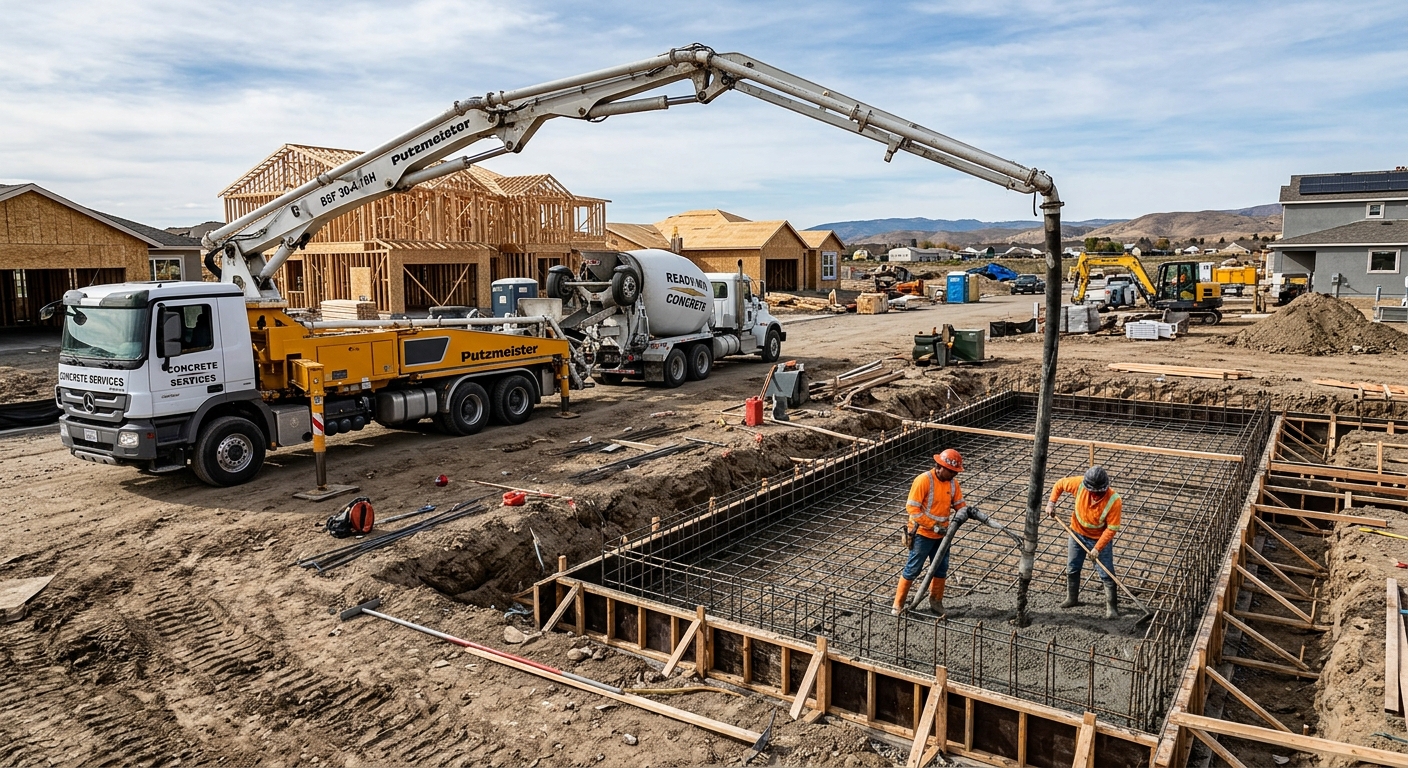
Concrete work options and costs in Cobourg
Cobourg homeowners typically see concrete crews year-round, because concrete flatwork is a practical fit for the housing stock—about 57.5% of dwellings are single-detached homes, and that’s the primary market for driveways, patios and walkways. With 6,275 homeowner households in the area, there’s steady demand for dependable, code-compliant concrete foundations as well as curbside curb appeal upgrades in well-used neighbourhoods like Victoria Park and the north end near Lake Ontario.
In the Muskoka–Kawarthas region, pricing is driven heavily by climate. Frost lines commonly run around the 4 ft range, so footings and foundations must be placed below frost to prevent heave, which increases excavation, forming and concrete volume. Freeze–thaw cycles through fall, winter and spring also push us toward air-entrained mixes, robust drainage, and a proper control-joint layout to reduce cracking and spalling. On top of that, the shorter practical pour season (roughly April–November) compresses scheduling and can raise labour and equipment costs versus warmer markets.
As a result, the “same-looking” project can land in different price bands depending on base depth, reinforcement, waterproofing, curing approach and finishing level. For budgeting, concrete driveway and slab work often starts in the $12,000–$25,000 range for standard pours, while stamped or decorative work moves upward—often into the $15,000–$35,000 band—because of premium materials and specialty finishing time. Use the table below as a practical way to compare options before you request itemised quotes.
| Application |
Typical Size |
Key Spec |
Finish Option |
Price Range |
| Concrete driveway (standard broom finish) |
400–600 sq. ft. |
Air-entrained mix, compacted granular base, control joints, dowels at approach |
Broom finish + standard edging |
$12,000–$20,000 |
| Exposed aggregate driveway |
400–600 sq. ft. |
Air-entrained mix with exposed stone blend, thicker top finish, curing care |
Exposed aggregate finish |
$18,000–$25,000 |
| Stamped concrete driveway or patio |
300–650 sq. ft. |
Air-entrained mix, integral colour, rebar/wire as required, joint plan for thermal movement |
Stamped + coloured release + sealcoat |
$15,000–$35,000 |
| Plain concrete patio or walkway |
200–400 sq. ft. |
Compacted sub-base, air-entrained mix, proper slope and drainage, joints |
Broom or smooth finish |
$4,000–$10,500 |
| Garage floor (interior slab) |
400–700 sq. ft. |
Vapour barrier (as spec’d), reinforcement, minimum thickness for loading |
Standard broom or smooth trowel (as requested) |
$10,000–$18,000 |
| Foundation footings (structural, below frost) |
Varies (typical 200–600 sq. ft. of footing area) |
Below-frost depth excavation, rebar cage, engineered waterproofing as required |
Structural concrete (utility finish) |
$18,000–$45,000 |
Prices are estimates only and vary by project scope, site access and material selection.
What affects the price of concrete work in Cobourg
In Cobourg and across Muskoka–Kawarthas, it’s common to see quotes for the “same” job vary by 30–50%. The spread usually isn’t because one contractor is cutting corners; it’s because key design and construction choices differ—especially around frost protection, base preparation, reinforcement, and finishing level. Even if two patios look identical at the surface, one may be built over a deeper compacted granular base with a better drainage plan, while another uses a thinner section or less robust mix spec.
Frost line depth and freeze–thaw cycles drive every specification in this region. Exterior work must be built to resist heave: footings and foundations need to extend below the design frost depth to prevent lateral soil movement, which means more excavation and taller forms. For flatwork and any exterior slab exposure, air-entrained concrete is essential to survive repeated freeze–thaw cycles. In addition, the shorter practical pour window means some jobs get scheduled into colder edges of the season. Cold-weather curing precautions (insulating blankets, heated enclosures where appropriate, and tighter temperature control) can add labour and equipment costs. Finally, de-icing salt is a real-world problem here; it increases surface deterioration risk, so sealing becomes a smart add-on for driveways and patios.
Two local examples you’ll see in Cobourg: (1) older lots with more mature trees often require extra removal and haul-off, pushing driveway pricing toward the upper side of the $12,000–$25,000 concrete slab band; and (2) properties near lake-influenced wet microclimates often need improved drainage and granular undercutting, which can justify moving from a basic patio budget toward $4,000–$12,000 depending on thickness and finish. Housing stock built before 1981 is common, and older base conditions sometimes require deeper prep and extra fill to get to a stable, compacted sub-base—this is where costs can move by thousands of dollars even before concrete arrives.
| Price Factor |
Why It Matters |
Cost Impact |
| Frost line depth — determines footing depth and form height |
Controls how deep excavations go to prevent frost heave. |
Higher depth increases excavation and concrete volume significantly |
| Site preparation — excavation, grading, compacted granular base |
Base stability prevents settlement and cracking. |
Unstable soil or poor drainage can add major labour and hauling time |
| Reinforcement — rebar or wire mesh requirement |
Controls crack widths and improves load capacity. |
More steel and proper placement raise material and labour costs |
| Mix design — air-entrainment and compressive strength spec |
Air-entrainment helps exterior concrete survive freeze–thaw. |
Premium mix and testing/verification can add cost per yard |
| Finish type — broom vs. stamped vs. exposed aggregate |
Finishing complexity affects time, labour and materials. |
Decorative work commonly pushes budgets from basic to premium bands |
| Pour size and concrete truck access to site |
Access limitations can require pumping or multiple loads. |
Pumping/extra coordination can add thousands on larger driveways |
| Cold-weather curing precautions — heating and blankets |
Protects strength gain when temperatures drop. |
Shorter pour season may increase scheduling and equipment expense |
| Control joint pattern and sealing cost |
Joints manage thermal movement; sealing reduces salt-related deterioration. |
Better joint design and sealer add small line-items that reduce failures |
Permits & regulations in Ontario
In Ontario, structural concrete work typically needs a permit and often engineered documentation that’s reviewed through the municipality. That means footings, foundation walls, grade beams and any structural elements tied to the building’s load path generally require a permit. For those jobs, you should expect the homeowner to coordinate permit/engineering steps before excavation, and the contractor should be comfortable working to the drawings and inspection hold points.
Concrete flatwork—driveways, patios and walkways—usually doesn’t require a permit on its own in Cobourg, unless it affects lot grading, stormwater flow, impervious surface coverage limits, or the municipal right-of-way (for example, work near a driveway approach/curb area). When a project impacts drainage routing or changes how water leaves the property, it’s worth checking first to avoid rework.
Before breaking ground, confirm your contractor is properly insured and accountable. A homeowner can verify basics by following three steps: (1) check Ontario contractor licensing/registration status through the appropriate provincial online resources; (2) request a current certificate of liability insurance showing coverage in place for the project dates; and (3) request proof of WSIB coverage (or the contractor’s applicable exemption/clearance documentation if they’re not required). Then ask for references from similar-scale jobs in Ontario so you can gauge finishing quality and reliability in a freeze–thaw climate like ours.
Getting concrete right in Cobourg's freeze-thaw climate
Concrete failures in Cobourg usually come down to five things: weak base prep, improper mix air content, poor jointing, rushed curing, and no protection against de-icing salt. In our freeze–thaw climate, the soil moves, water gets trapped, and surfaces are exposed to salt and moisture. If the concrete isn’t built to breathe and accommodate movement, you’ll see random cracking, scaling, and eventually spalling—especially on exterior driveways and patios.
To spec the job correctly, start with base preparation: excavate to the right depth for your local soil and frost considerations, then compact a granular sub-base in lifts. Next, require an air-entrained mix—for exterior flatwork we typically target 5–7% air content—plus a minimum 32 MPa compressive strength. For control joints, spacing and layout should limit random cracking; they’re not optional if you want predictable shrinkage cracks. Then nail down curing: plan for at least 7 days of proper curing conditions so the concrete reaches strength before it’s exposed. Finally, add sealing: a penetrating sealer applied after cure (often at about 28 days post-pour) helps repel de-icing salts and reduces moisture-driven deterioration.
One cost example: a basic broom-finished driveway may land in the $12,000–$20,000 range, while upgrading to a decorative stamped system often moves into the $15,000–$35,000 band. The price difference can be justified when the decorative job includes proper base depth, rebar/wire placement, and a sound joint/sealing plan. In Cobourg’s conditions, “looks” won’t hold up unless the engineering details are there.
| Spec |
Why It Matters in Cobourg |
What to Ask For |
Impact if Skipped |
| Compacted granular base (depth?) |
Stable base prevents settlement and reduces cracking under freeze–thaw expansion. |
Confirm excavated depth and granular lift compaction method; include drainage grade |
Uneven slabs, early cracking, and water pooling that accelerates spalling |
| Air-entrained concrete mix (target air %?) |
Air voids help concrete resist freeze–thaw damage when water expands. |
Require target air content of 5–7% for exterior flatwork |
Higher risk of scaling and spalling, especially where salt is used |
| Compressive strength (MPa rating) |
Adequate strength supports durability in cold-season exposure. |
Specify minimum 32 MPa compressive strength |
Surface wear, faster deterioration, and reduced long-term performance |
| Control joints (spacing per ACI guidelines) |
Manages shrinkage and temperature movement to control where cracks form. |
Ask for planned joint spacing, sawcut timing, and sealant plan where needed |
Random cracking and widened joints that let moisture reach reinforcement |
| Minimum 7-day curing period |
Strength gain must continue despite cold nights and variable spring temperatures. |
Confirm curing method, blankets/insulation if cold weather is expected |
Reduced strength and surface damage that can appear as early scaling |
| Penetrating sealer (when applied after cure) |
Helps repel salt-laden moisture and slows surface deterioration. |
Ask for penetrating sealer application at about 28 days post-pour |
Faster surface breakdown and more maintenance due to salt exposure |
How to choose a concrete work contractor in Cobourg
Start with contractor verification—especially important in a freeze–thaw market where workmanship quality shows up in the first few winters. In Ontario, ask your contractor for: (1) confirmation of appropriate licensing/registration for the work they’re doing; (2) a current certificate of liability insurance (and make sure it covers the project address); and (3) proof of WSIB coverage, or applicable documentation that explains coverage requirements. Don’t accept verbal assurances—ask for documents dated for the current season and confirm the certificate is valid for the job start/end dates.
Next, get 2–3 itemised written quotes. You’re looking for labour and material line-items, not a lump-sum that hides key differences. Ask whether the quote includes: excavation and hauling, granular base depth and compaction, reinforcement type/placement, forms, drainage provisions, sawcut timing for joints, and any required sealing. Confirm if permits are included (when they’re required), and whether disposal of concrete/asphalt is covered.
Warranty matters: ask for both workmanship warranty length and product/manufacturer warranty details, and confirm whether any warranty is transferable to future owners. For payment, keep upfront to 10–15% and plan a holdback until completion and punch-list items are done. Finally, request a written timeline with a start date range and completion estimate—because in Cobourg, weather can shift pours, and good contractors communicate and plan curing protection.
- Ask who the foreman is and whether they’ll be on-site during finishing and jointing
- Confirm mix type (air-entrained for exterior) and minimum strength (e.g., 32 MPa)
- Request base excavation depth and compacted granular base details (not just “we’ll prep it”)
- Verify reinforcement plan: dowels/rebar/wire mesh placement and coverage
- Ask how they handle drainage slope and water shedding away from the house
- Confirm control joint spacing plan and sawcut timing
- Ask for curing method (blankets/heating if cool nights are expected)
- Clarify if sealer is included (and when it’s applied after cure)
- Check insurance certificate dates and project address coverage
- Confirm WSIB coverage proof is current
- Make sure disposal/haul-away is explicitly listed in the quote
- Get start date and duration in writing, with contingency planning for rain/frost
Red flags to watch for: “one price fits all” quotes without base depth specs; refusing to show WSIB/insurance documents; skipping joint plans or curing precautions; vague language like “we’ll seal it if needed” (especially in Cobourg’s salt-and-freeze environment); and requests for large upfront payments beyond about 10–15% with no clear holdback tied to completion.
Frequently asked questions — concrete work in Cobourg
Do I need a permit for concrete work in Ontario?
In Ontario, permits are generally required for structural concrete such as footings, foundation walls, and grade beams, especially where the work ties into the building’s load path. For concrete flatwork—like driveways, patios and walkways—permits usually aren’t required by default, but they can be triggered if the work affects lot grading, stormwater drainage, impervious surface coverage, or the municipal right-of-way (for example, work that impacts a driveway approach or water routing). Since Cobourg’s freeze–thaw climate makes drainage and water shedding critical, it’s smart to confirm requirements before excavation. Always ask your contractor what they’re including in the scope and whether any municipal approvals are needed for your exact location.
Concrete vs pavers for a patio in Cobourg?
Both are viable in Cobourg, but the decision usually comes down to how you expect to maintain it. Concrete patio slabs can be cost-competitive—many plain patio/walkway projects land around $4,000–$10,500 depending on size and site prep—and a properly built slab with air-entrained concrete, correct base compaction, joints and curing can handle freeze–thaw well. Pavers often give you easier partial repairs (you can lift and replace individual stones), but they rely on excellent base drainage and correct bedding depth; otherwise, you can still get heaving or settling. If you want a low-maintenance, “set it and forget it” approach, broom-finished concrete is a strong choice. If you value modular repairs and a more varied surface, pavers can fit well.
How long does a concrete driveway last?
A well-built Cobourg driveway commonly lasts 20–30 years, and sometimes longer, depending on the base, air-entrained mix, jointing, curing, drainage and how much de-icing salt is used. The biggest early failure risks are spalling and scaling from inadequate air-entrainment, poor joint control, and shortcuts on base prep. That’s why exterior work should use air-entrained concrete and a consistent control joint plan to limit random cracking. Sealing (often applied around 28 days post-pour) helps repel moisture and salt. If you’re comparing options, budget realistically: standard driveway work often starts in the $12,000–$20,000 range, while more premium decorative choices can go higher, but the durability comes from the build quality—not just the appearance.
What is air-entrained concrete and why does it matter here?
Air-entrained concrete has microscopic air bubbles intentionally incorporated into the mix. In Cobourg’s freeze–thaw climate, those tiny voids give water a place to expand when it freezes, which reduces internal pressure and lowers the risk of scaling and spalling. Without proper air-entrainment, exterior slabs are more likely to deteriorate over repeated winter cycles—especially where salt and moisture combine near driveways and entries. For exterior flatwork, contractors typically target around 5–7% air content and use a minimum compressive strength specification (commonly 32 MPa or higher, depending on design). When you review quotes, ask what mix is being used and confirm it’s air-entrained for exterior exposure.
How do I prepare the base for a concrete slab?
Base prep is where durable slabs start, and it’s more than “level the ground.” In Cobourg, you want excavation to the correct depth for your site conditions, then placement of a compacted granular sub-base in lifts with proper moisture and compaction. For exterior work, drainage matters—your slab needs the right slope so water sheds away from structures and doesn’t sit in low spots. If your lot has older fill, soft soil, or water-prone areas, you may need undercutting and replacement with suitable granular material. A good contractor should spell this out in the quote (base depth, compaction approach, and drainage grading). If they can’t, it’s a sign the pricing may be missing the biggest durability drivers.
How do I compare concrete quotes?
To compare concrete quotes fairly in Ontario, don’t judge by the total price alone—line-items tell the real story. Ask each contractor for an itemised scope that covers excavation/hauling, granular base depth and compaction, reinforcement type and placement, air-entrained mix and strength spec, formwork, joint layout, curing approach, and whether sealing is included. Confirm what’s excluded (permit handling, disposal, protection during curing, site damage repair). Also check logistics: if truck access is tight, one quote might include pumping or additional staging while another doesn’t. For a homeowner reference point, a standard driveway bid might fall in the $12,000–$25,000 band, while stamped work commonly shifts into the $15,000–$35,000 range due to premium materials and finishing labour. Matching apples-to-apples is the fastest way to find value—and avoid expensive surprises after the pour.