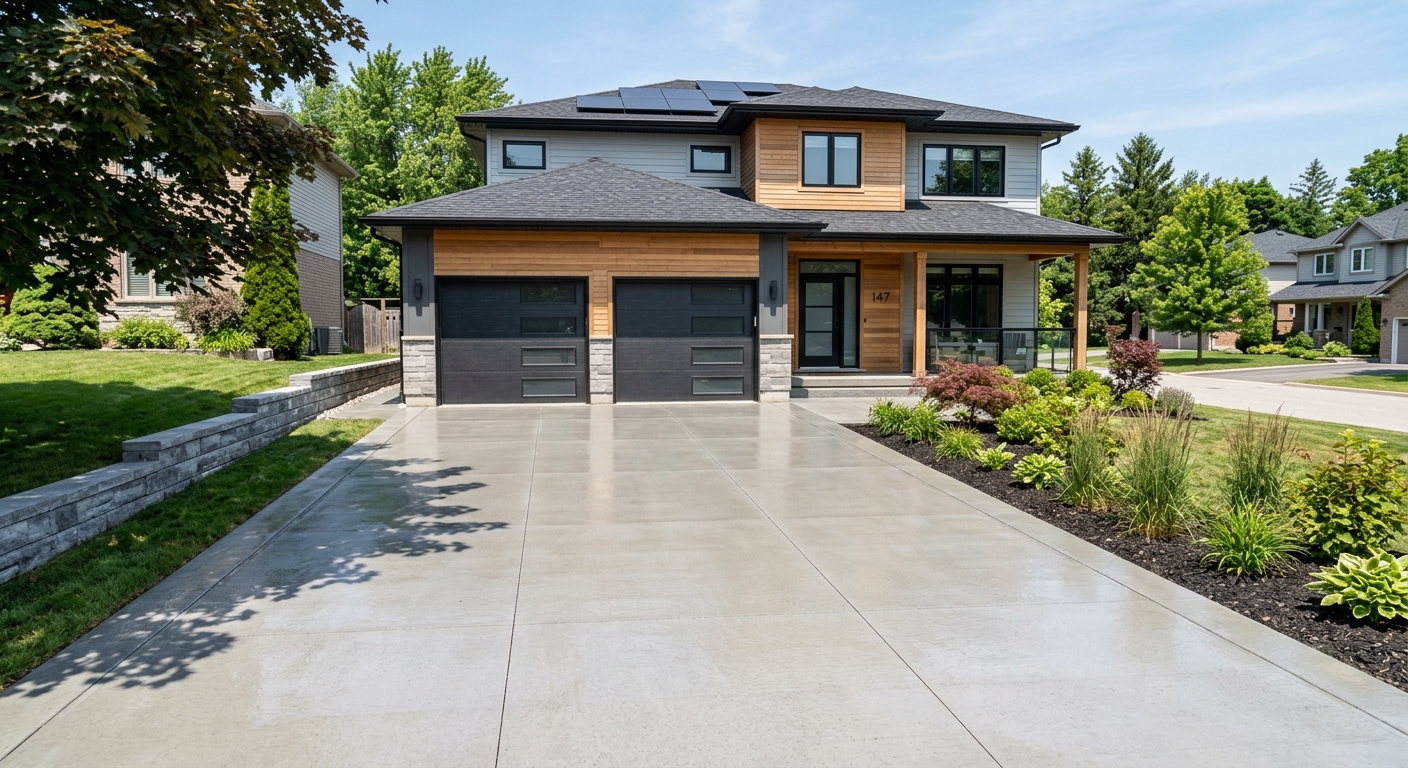
Concrete work options and costs in Alexandria
Concrete work in Alexandria, Ontario is usually easiest to plan around the frost and freeze–thaw reality of the Toronto economic region, and it starts with choosing the right application. Alexandria’s population is small—2,906 residents (Statistics Canada, 2021 Census)—so the local trades that do properly detailed flatwork and structural work can be booked quickly, especially when contractors get hit with multiple jobs after a thaw. Most concrete flatwork is tied to the housing stock and lot patterns; in many small towns like Alexandria, the driveway and yard upgrades are commonly for detached homes and older properties that need re-grading, drainage fixes, and crack-control upgrades rather than just “new concrete.”
Pricing also reflects how Ontario requires structural concrete to perform through winter movement. In the Toronto region, structural footings are typically set to extend at least 1.2 m (about 4 ft) below grade to reduce frost heave and differential settlement. Exterior slabs and walkways also need air-entrained mixes, thicker sections where needed, and well-planned control joints to manage cracking during repeated freeze–thaw cycles. That’s why even a similar driveway can land at a noticeably different number depending on excavation depth, base preparation, reinforcement, and finish. Sealing and surface protection matter too, because winter de-icing salts can accelerate spalling if the mix and curing weren’t right.
In Alexandria, demand is especially steady around the main residential areas near the town centre where access is tight and walkways connect to older foundation walls—those sites often require more careful excavation and drainage detailing. Use the table below to compare common options and realistic price ranges, then we can narrow the specs based on your soil condition and form access.
| Application |
Typical Size |
Key Spec |
Finish Option |
Price Range |
| Concrete driveway (standard broom finish) |
400–600 sq. ft. |
Air-entrained exterior mix, compacted granular base |
Broom finish |
$18,000–$28,000 |
| Exposed aggregate driveway |
400–600 sq. ft. |
Air-entrained exterior mix, proper surface retarder |
Exposed aggregate |
$24,000–$36,000 |
| Stamped concrete driveway or patio |
300–500 sq. ft. |
Air-entrained mix, thicker section at joints/edges |
Stamped pattern |
$28,000–$45,000 |
| Plain concrete patio or walkway |
200–400 sq. ft. |
Compacted base, slope for drainage, control joints |
Float/smooth finish |
$16,000–$26,000 |
| Garage floor (interior slab) |
300–500 sq. ft. |
Vapour barrier and proper slab thickness |
Smooth finish |
$14,000–$24,000 |
| Foundation footings (structural, below frost) |
Per linear ft. (approx. 120–220 ft total) |
Engineered reinforcement and frost-depth embed |
Formed structural concrete |
$21,600–$66,000 |
Prices are estimates only and vary by project scope, site access and material selection.
What affects the price of concrete work in Alexandria
If you’re getting quotes for the same driveway or patio in Alexandria, Ontario, it’s normal to see differences in the 30–50% range. A large part of that spread comes down to whether contractors price the “whole system” (base, drainage, reinforcement, mix design, joints, curing protection) or just the concrete at the surface. In the Toronto economic region, freeze–thaw cycles and frost depth dictate specs that can’t be skipped—structural footings generally need to extend below design frost depth (commonly 1.5–2.4 m in Ontario) to prevent frost heave and differential movement. Exterior slabs also need air-entrained concrete so the surface survives winter expansion and contraction.
Cold-weather curing precautions can add real labour and materials cost. When temperatures drop toward 10 °C or below, crews may need insulated blankets and/or curing protection to keep the concrete gaining strength properly, which is why exterior pours are concentrated in warmer months. De-icing salt is another Ontario-specific stressor: it can accelerate surface deterioration, so sealing (typically done after the cure) becomes more than an “upgrade” for walkways and driveway edges.
Concrete mix and finish choices change the price too. For example, a plain patio commonly sits closer to the $16–$26/sq. ft. band, while stamped driveway work often climbs into the decorative $24–$40/sq. ft. range because of labour, forming, and pattern mats. In older Alexandria properties, excavation depth and base condition can also swing costs: removing poor sub-base and bringing in proper granular base can add hours of labour and truckloads, while a clean, well-draining site can reduce prep work. If your foundation is older and you’re rebuilding steps or adding drainage, costs tend to move upward because access and proper slope become part of the structural durability plan.
| Price Factor |
Why It Matters |
Cost Impact |
| Frost line depth |
Determines footing depth and form height |
Higher depth increases excavation, concrete volume, and labour time |
| Site preparation |
Excavation, grading, compacted granular base |
Poor soils can add trucking, disposal, and extra base material |
| Reinforcement |
Rebar or wire mesh requirement |
Extra material and placement time; needed if loads or spans require it |
| Mix design |
Air-entrainment and compressive strength spec |
Exterior air-entrained mixes can cost more but reduce winter surface failures |
| Finish type |
Broom vs. stamped vs. exposed aggregate |
Decorative finishes add labour, tooling, and finishing time |
| Pour size and concrete truck access to site |
Shorter pours can reduce logistics and waste |
Limited access can require pumps, smaller batches, or more scheduling |
| Cold-weather curing precautions |
Heating and blankets |
Adds equipment/materials when pouring near colder thresholds |
| Control joint pattern and sealing cost |
Controls cracking and protects from salts |
More joints and proper sealing reduce long-term repair likelihood |
Permits & regulations in Ontario
In Ontario, concrete work isn’t automatically “one rule fits all.” Structural concrete—things like footings, foundation walls, and grade beams—typically requires a building permit. In many cases, the municipality will want engineered drawings reviewed before the work proceeds, especially if you’re changing loads, altering bearing conditions, or constructing new foundation elements. For concrete flatwork—driveways, patios, and walkways—a permit often isn’t required unless the project affects lot grading, impervious surface coverage limits, drainage flow to municipal areas, or work within the municipal right-of-way (for example, tie-ins near a curb or sidewalk). Always confirm with the local authority before breaking ground.
For contractor checks, start with proof of coverage and credentials. In Ontario, ask for:
- Liability insurance certificate (and verify it matches the address and type of work).
- WSIB/WCB clearance (workers’ compensation coverage letter or clearance status as applicable).
- Ontario licence/registration details relevant to concrete/contracting under provincial business requirements, plus any trade authorizations your project may require.
- References on similar-scale local jobs (driveways/patios and, if applicable, foundation work).
Step-by-step for Alexandria: request documents up front, verify them against the certificate dates and project description, then ask the contractor for their proof of current coverage. If anything looks incomplete or dated, that’s a red flag—concrete problems are expensive, and you don’t want to discover coverage gaps mid-pour.
Getting concrete right in Alexandria's freeze-thaw climate
In Alexandria’s Ontario freeze–thaw climate, concrete usually fails in predictable ways: surface scaling, spalling, and random cracking. The root cause is typically a combination of inadequate base support, poor mix durability, and cracks that weren’t controlled early enough. To spec the job correctly for the Toronto region, focus on five things: base preparation, mix design, control joints, curing, and sealing.
1) Base preparation: a compacted granular sub-base to the right depth for your soil and drainage conditions is what keeps the slab from settling and flexing. In frost-prone areas, saturated soils can expand and contract, stressing the concrete. 2) Mix design: for exterior flatwork, air-entrainment is critical (commonly 5–7% air content for durability) along with minimum compressive strength such as 32 MPa to meet performance expectations. 3) Control joints: joints should be spaced to limit random cracking and to create planned crack locations. 4) Curing: plan for at least 7 days of curing under suitable conditions; cold-weather pouring requires extra protection like insulated blankets so the concrete achieves strength before winter stress hits. 5) Sealing: a penetrating sealer applied after full cure (often around 28 days) helps repel de-icing salts and reduces surface deterioration.
When homeowners compare options, the cost difference often comes down to whether the contractor is buying durability or cutting corners. For instance, moving from plain broom-finish flatwork to stamped concrete might add roughly the difference between the $16–$26/sq. ft. plain band and the $24–$40/sq. ft. decorative band. That added spend is justified when the quote includes proper base compaction, air-entrained mix, and a joint plan—otherwise, you’re paying for appearance while inviting the same cracking and scaling. If a quote is “cheaper” but doesn’t mention base thickness, air content, or joint spacing, it’s usually not cheaper in the long run.
| Spec |
Why It Matters in Alexandria |
What to Ask For |
Impact if Skipped |
| Compacted granular base (depth?) |
Supports the slab through freeze–thaw movement |
Granular base depth and compaction method by soil condition |
Settling, cracking, and uneven wear |
| Air-entrained concrete mix (target air %?) |
Prevents freeze–thaw scaling/spalling |
Air content target (commonly 5–7% for exterior) |
Surface deterioration and spalling within a few winters |
| Compressive strength (MPa rating) |
Ensures durability and strength gain |
Minimum 32 MPa (or as specified by engineer/contract) |
Weak concrete that can crack under normal winter stresses |
| Control joints (spacing per ACI guidelines) |
Limits random cracking locations |
Joint spacing plan and saw-cut timing |
Wider uncontrolled cracks and moisture ingress |
| Minimum 7-day curing period |
Builds strength before temperature swings |
Curing method and protection details if temperatures drop |
Reduced strength and increased early-age damage |
| Penetrating sealer (when applied after cure) |
Repels salt and water on exterior flatwork |
Sealer type and timing (typically after full cure, around 28 days) |
Faster scaling and surface breakdown |
How to choose a concrete work contractor in Alexandria
Choosing the right contractor matters as much as the mix. In Ontario, start by verifying coverage and credentials, not just the price. Ask for a current liability insurance certificate and confirm the work is covered for your project address. Then request WSIB/WCB coverage clearance (a clearance status letter or equivalent proof). For licensing/registration, confirm the contractor’s business registration details and any trade authorizations that apply to the scope—especially if they’re doing structural work like footings and foundations that typically require engineered coordination and permits.
Get two to three itemised written quotes where labour and materials are broken down. You want to see line items like excavation, disposal, granular base, reinforcement, concrete supply, finishing, curing protection, and sealing (if included). Ask what’s excluded: permit pull costs, trenching/drain connections, saw-cutting, removal of old concrete, and disposal of concrete and soil. Concrete jobs can change quickly—your quote should explain how changes are priced and what triggers them.
Warranty is another differentiator. Ask for: a workmanship warranty length, whether the product/manufacturer warranty is separate, and whether any warranty is transferable to future owners (important for resale). For payment schedule, avoid paying large amounts upfront; a common safe approach is no more than 10–15% upfront, with a holdback until the job is complete and deficiencies are corrected. Finally, insist on a written start date and completion estimate so scheduling around freeze–thaw risk is transparent.
- Proof of liability insurance certificate (current dates) before signing.
- WSIB/WCB clearance status provided in writing.
- Itemised quote with base prep, reinforcement, and finishing listed separately.
- Clear specs: air-entrainment, minimum strength, thickness, and joint plan.
- Permit responsibility stated (who pulls it, if required).
- Disposal included or excluded (old concrete and excess soil).
- Access plan: how concrete will be moved/poured on your lot.
- Curing protection described if temperatures are expected near cooler thresholds.
- Sealing scope and timing (typically after curing) stated if you want salt protection.
- Workmanship warranty terms in writing and what “covered” means.
- Payment schedule with small deposit and holdback on completion.
- Timeline for site prep, pour, finishing, and any saw cuts.
Red flags in Alexandria concrete work include: quotes that don’t mention air-entrainment or joint spacing, “cheap” pricing that skips granular base compaction, no written scope for excavation/disposal, insisting on payment schedules without a holdback, and refusing to show insurance/WSIB proof or previous local references.
Frequently asked questions — concrete work in Alexandria
What is rebar and when is it required in Ontario?
Rebar (reinforcing steel) is added to concrete to handle tensile forces that plain concrete isn’t great at on its own. In Ontario, whether rebar is required depends on the engineered design and the function of the concrete element—not just tradition. For structural work like footings and foundation walls, rebar is commonly specified by engineers and the permit package because loads, soil conditions, and frost movement must be addressed. For exterior flatwork such as driveways and patios, rebar or wire mesh may be required when loads are higher, the slab is thicker/engineered, or the site has challenging soil support. In the Toronto region’s freeze–thaw environment, good base compaction and air-entrained concrete are still the foundation of durability, even when reinforcement is included. If your contractor can’t explain the reinforcement spec and how it matches your slab thickness and soil conditions, ask for the design basis and drawings.
How long does a concrete project take in Alexandria?
Typical concrete timelines in Alexandria, Ontario depend on the size of the area, site access, and weather conditions around curing. A straightforward small patio or walkway can often be completed in about a few days from setup to finish, but curing protection may extend the practical timeline before heavy use. For driveways and slabs, you’re usually looking at a preparatory phase (excavation, base prep, formwork), then the pour and finishing, then saw-cutting control joints and curing. If temperatures drop toward 10 °C or below, contractors may add insulation blankets to keep curing on track, which affects scheduling. For larger decorative work like stamped concrete, finishing takes longer during the pour-day process. Cost-wise, the job might fall into the plain patio band (for example, around the $16–$26/sq. ft. range), but the schedule can still stretch if the ground prep takes longer due to drainage or frost-susceptible subgrade. Your best timeline comes from an itemised quote that includes curing and protection plans—not just the pour date.
What is a concrete overlay and is it suited to Alexandria?
A concrete overlay is a new layer placed on top of existing concrete—sometimes with grinding/prep, bonding methods, and a new surface finish. It can be suited to Alexandria when the existing slab is still structurally sound (not heaving, severely cracked through, or failing at edges) and when proper surface preparation is achievable. If the old concrete is already moving due to frost or drainage issues, an overlay can hide symptoms while transferring problems upward, leading to early delamination or reflective cracking. In the Toronto economic region, freeze–thaw and de-icing salts make surface performance critical, so overlays can work well when contractors specify correct prep and bonding and include drainage improvements. Cost can be attractive versus complete replacement, but you should compare quotes to ensure it includes surface preparation, bonding, and the same durability specs (including air-entrainment and joint strategy). If you’re mainly looking for appearance, stamped overlays can be considered, but only when the substrate is stable. If your slab is lifting or the base is suspect, replacement is often the more durable option.
How do I seal concrete to protect it in Alexandria?
Sealing helps protect exterior concrete surfaces from water and de-icing salts, which are common in Ontario winters. For Alexandria projects, the usual approach is to apply a penetrating sealer after the concrete has cured—often around 28 days—so the concrete can dry and reach adequate strength. Before sealing, the surface must be clean and fully cured; wash out dirt, salts, and any contaminants that can interfere with penetration. If the concrete is new, don’t seal too early because trapped moisture can reduce performance and lead to patchy results. Ask your contractor what type of sealer they’re using (penetrating vs film-forming), and whether they recommend maintenance reapplications based on traffic and salt exposure. If your driveway or walkway is in a de-icing-heavy area, sealing is usually more than cosmetic—done correctly, it supports longer-term surface durability. When comparing quotes, confirm whether sealing is included and whether timing aligns with the concrete curing schedule.
What is the difference between concrete and cement?
Cement and concrete are related but not the same. Cement is one ingredient—typically Portland cement—that acts like the binder. Concrete is the final product made by mixing cement with water, sand, and gravel (and sometimes other materials like air-entraining agents, fibres, or admixtures depending on the spec). In Alexandria, Ontario, the important part for homeowners is usually the concrete spec: air-entrainment for freeze–thaw durability, minimum compressive strength (often 32 MPa for exterior durability requirements), proper thickness, and a correct base that drains and stays stable. The cement itself is often less visible in the quote, but the contractor should be able to tell you what concrete they’re supplying—especially the air content and intended performance for exterior exposure. If a quote only discusses “cement” without mentioning air-entrained mix, joints, and curing protection, that’s a gap you should clarify.
How much does concrete work cost in Alexandria?
Concrete costs in Alexandria typically align with the broader Toronto-region pricing, with the biggest swings caused by base preparation, reinforcement, access, and finish. For a plain exterior patio or walkway, many jobs land in the $16–$26 per square foot range, depending on thickness, site prep, and drainage details. Standard broom-finished driveway work often sits around the $18–$28 per square foot band. Decorative work costs more: stamped concrete driveways or patios commonly fall into the $24–$40 per square foot range because finishing labour and tooling are higher. Foundation/footings are priced differently because they’re structural: you’ll often see footing work priced with a typical band of about $180–$300 per linear foot depending on design, reinforcement, and frost-depth excavation. Beyond prices, Alexandria’s freeze–thaw climate means the “cheap” option can become expensive if it doesn’t include air-entrained mix, control joints, and proper curing protection.