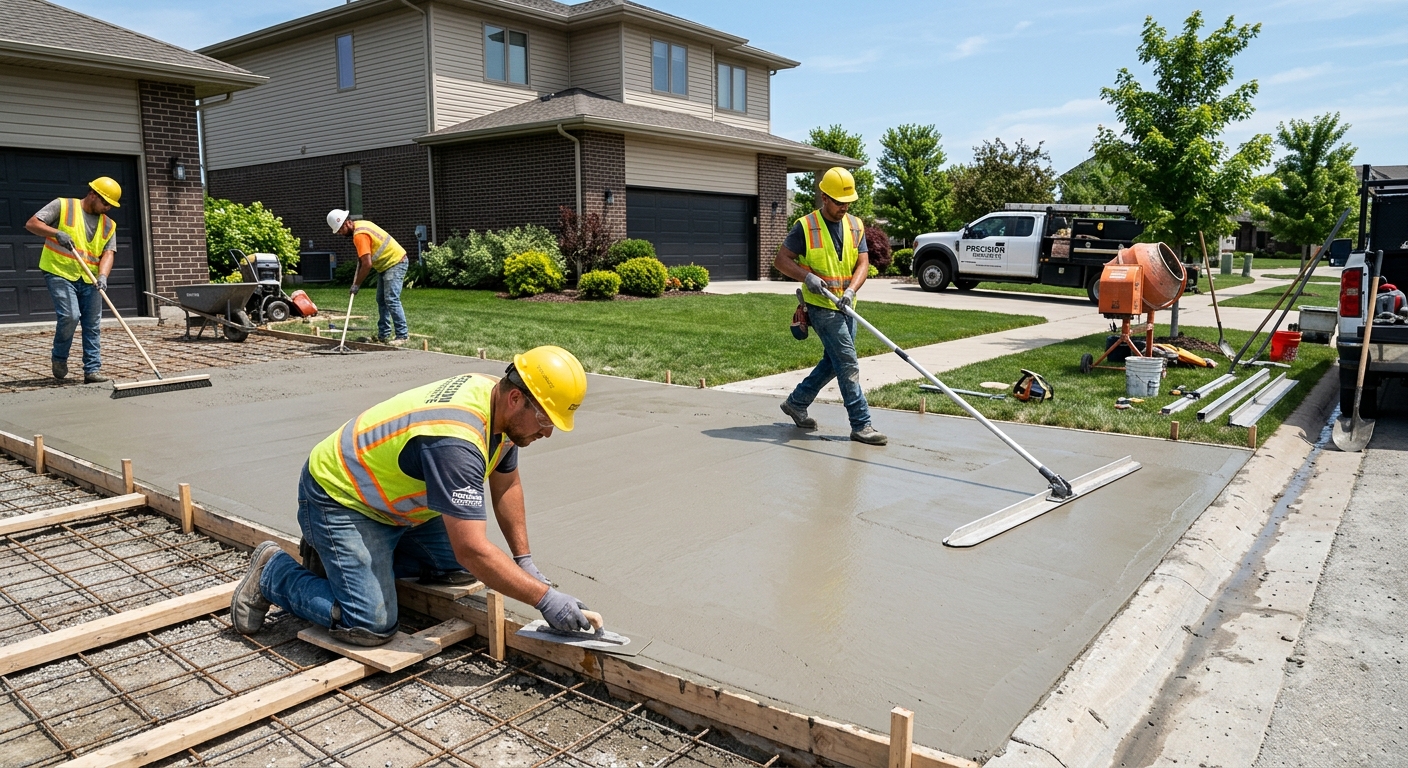
Concrete work options and costs in Popcorn House
Popcorn House, Ontario is a compact market for residential concrete, serving homeowners who want driveways, patios and walkways that can handle Toronto-area freeze–thaw. With a population of 7,889 (Statistics Canada, 2021 Census), you’ll still find plenty of concrete demand, especially in established neighbourhoods where properties are older and flatwork is due for replacement. In the GTA, a lot of these jobs are attached to single-family housing patterns—where a new driveway or patio isn’t optional for curb appeal and day-to-day function.
Toronto-region concrete pricing is heavily shaped by frost depth and winter cycling. Local specs commonly require exterior footings to extend at least 1.2 m (about 4 ft) below grade, and contractors design flatwork around air-entrained mixes, drainage, and control joints to reduce cracking during repeated freezes. That also affects contractor availability: exterior pours are concentrated in the warmer months to protect curing, and work that starts late in the season may require heating blankets and extra labour to keep concrete on-spec.
In Popcorn House, crews are especially busy around older residential pockets such as the Main Street corridor, where homeowners often update driveways and front walkways during spring property upgrades. To compare typical options, use the price ranges below as a starting point, then tighten the numbers with an itemised quote after a site check.
| Application |
Typical Size |
Key Spec |
Finish Option |
Price Range |
| Concrete driveway (standard broom finish) |
400–600 sq. ft. |
Air-entrained exterior mix, proper base and drainage, joints as needed |
Broom finish |
$18,000 – $28,000 |
| Exposed aggregate driveway |
400–600 sq. ft. |
Air-entrained mix, colour/aggregate selection, curing protection |
Exposed aggregate (wash/retarder) |
$22,000 – $33,000 |
| Stamped concrete driveway or patio |
250–450 sq. ft. |
Air-entrained mix, integral colour, release agent, joints |
Stamped pattern (e.g., stone/brick look) |
$24,000 – $40,000 |
| Plain concrete patio or walkway |
150–350 sq. ft. |
Compacted granular base, slope for drainage, air-entrained mix |
Steel-trowel finish or light broom |
$2,400 – $8,900 |
| Garage floor (interior slab) |
400–600 sq. ft. |
Vapour barrier where needed, thickened edges, crack control |
Float/trowel finish |
$9,000 – $16,000 |
| Foundation footings (structural, below frost) |
Per typical home wall runs |
Excavation + formwork, rebar as required, below-grade to design frost |
Structural concrete |
$180 – $300 |
Prices are estimates only and vary by project scope, site access and material selection.
What affects the price of concrete work in Popcorn House
In the Toronto economic region, it’s normal to see quotes for what looks like the “same” concrete job vary by 30–50%. The biggest reason is that concrete is a system: excavation, granular base, reinforcement, mix design, finish, curing conditions and joint layout all interact. Two contractors can price the same driveway size but use different thicknesses, different base preparation, or skip drainage details—those choices show up later as settlement or cracking, and they can also change how long the crew is on site.
Frost line depth and freeze–thaw cycles dictate nearly every spec in Ontario. Exterior flatwork needs adequate support and footing depth below grade (commonly at least 1.2 m in the region) to prevent frost heave and differential movement. That same freeze–thaw reality is why crews typically specify air-entrained mixes and proper control joints. Colder conditions also mean a shorter reliable pour season and more frequent cold-weather curing precautions—tarps, insulation blankets, and sometimes supplemental heating—when temperatures slide toward 10 °C or below. Finally, de-icing salt accelerates surface wear and can contribute to spalling if the concrete isn’t properly designed; sealing is often the difference between “looks fine” and “holds up.”
In Popcorn House, you’ll feel these variables in everyday examples: (1) older yards with poor drainage may require added sub-drainage and deeper base (raising costs versus a clean, well-draining slope); (2) a stamped upgrade often costs more than plain or broom-finish work, but it’s justified when you’re replacing a visibly tired front driveway and want long-term curb appeal—stamped often lands in the $24–$40 range compared with $18–$28 for many standard driveway builds.
| Price Factor |
Why It Matters |
Cost Impact |
| Frost line depth — determines footing depth and form height |
Proper below-grade depth prevents frost heave and foundation movement |
Higher depth increases excavation, labour and formwork |
| Site preparation — excavation, grading, compacted granular base |
Settlement cracks and rocking slabs start with poor base support |
More hauling and compaction time can push cost up |
| Reinforcement — rebar or wire mesh requirement |
Rebar/wire controls cracking and improves performance |
Added material + placement labour |
| Mix design — air-entrainment and compressive strength spec |
Freeze–thaw resistance and durability depend on correct mix |
Air-entrained and higher-spec mix can increase material cost |
| Finish type — broom vs. stamped vs. exposed aggregate |
Finish demands different labour, tools and timing |
Stamped/exposed typically cost more than broom/plain |
| Pour size and concrete truck access to site |
Limited access increases line-pumping, labour and setup time |
Hard access and small pours add cost per square foot |
| Cold-weather curing precautions — heating and blankets |
Protects strength gain so concrete doesn’t cure cold |
Extra materials + labour during shoulder season |
| Control joint pattern and sealing cost |
Joints manage shrinkage cracking; sealing reduces salt damage |
More layout detail and sealer add line-item cost |
Permits & regulations in Ontario
In Ontario, the key rule for concrete is that structural concrete work generally has greater regulatory scrutiny than decorative flatwork. Footings, foundation walls and grade beams are typically part of a structural system, so homeowners usually need a building permit and the drawings are often reviewed/required through the municipal process. For concrete flatwork—patios, walkways and driveways—the project often does not require a permit unless it changes lot grading, triggers impervious surface coverage limits, or affects municipal right-of-way/sidewalk areas. Even when a permit isn’t required, the contractor should still confirm setbacks and drainage expectations with the municipality.
Before breaking ground in Popcorn House, verify the contractor is properly insured and able to work legally on residential sites. Here’s the practical step-by-step: (1) Ask for a clearance letter or proof the contractor is in good standing for WSIB/WCB, depending on their coverage model; (2) Request a current certificate of insurance showing liability coverage; ensure it includes concrete-related operations and appropriate limits; and (3) Confirm their Ontario licence/registration through the appropriate online registry or licensing page relevant to their trade category (the contractor should tell you what registration applies to their company).
Also request references from similar-scale projects (e.g., exterior flatwork with freeze–thaw durability specs, not only interior slabs). A reputable Ontario contractor will welcome these checks rather than pushing back.
Getting concrete right in Popcorn House's freeze-thaw climate
Concrete fails in Popcorn House mostly because of freeze–thaw stress plus water movement. When water gets under a slab or sits in cracks, it expands on freeze and contracts on thaw—so the slab can lift, settle or crack. The fix is not just “more concrete”; it’s the right base, the right air-entrained mix, correct joint spacing and proper curing. For exterior pours in the Toronto market, we treat the base as the first line of defence: compacted granular sub-base to the correct depth (based on soil and frost considerations), with slopes and drainage that prevent water from pooling. Next is mix design: air-entrainment is critical, and exterior flatwork commonly targets about 5–7% air content to handle freeze–thaw. We also require minimum compressive strength (often 32 MPa for many residential exterior applications, depending on the specification).
Control joints are how you “tell” the concrete where to crack. In Popcorn House, you’ll often see joints cut or formed to guide shrinkage cracking, with sealing 28 days after pour once cure strength and weathering are appropriate. Minimum 7 days curing (under proper protection) matters because cold-soaked concrete won’t develop strength reliably—especially when temperatures fall in the shoulder season. If you’re offered a bargain pour in late fall without any heating blankets or cure protection, that’s usually where spalling risk starts.
Price-wise, you can justify upgrades. For example, a standard broom-finished driveway often falls into the $18–$28 range, while a stamped driveway can land in the $24–$40 range. You’re paying for extra finishing labour and timing control—not just “looks,” but also the extra attention required to keep stamped surfaces durable in freeze–thaw conditions.
| Spec |
Why It Matters in Popcorn House |
What to Ask For |
Impact if Skipped |
| Compacted granular base (depth?) |
Prevents water pumping and supports slab through freeze–thaw |
Base depth tied to soil and drainage plan; compaction proof if available |
Settlement, rocking, and cracking |
| Air-entrained concrete mix (target air %?) |
Improves freeze–thaw durability and reduces spalling risk |
Target air content about 5–7% for exterior flatwork |
Surface scaling/spalling after winters with salt and freeze cycles |
| Compressive strength (MPa rating) |
Strength gain supports long-term performance |
Specify minimum 32 MPa (or the project’s engineered requirement) |
Wear, early failure and increased cracking |
| Control joints (spacing per ACI guidelines) |
Controls where shrinkage cracks occur instead of random cracking |
Joint layout and spacing plan for the slab dimensions |
Random cracks and water infiltration |
| Minimum 7-day curing period |
Ensures proper strength development in Toronto’s variable temperatures |
Confirm curing method; protection plan when temps drop |
Weak surface, scaling and reduced durability |
| Penetrating sealer (when applied after cure) |
Repels de-icing salt water and slows surface degradation |
Penetrating sealer after cure—typically 28 days post-pour |
Faster deterioration and more frequent repairs |
How to choose a concrete work contractor in Popcorn House
Start by verifying the contractor’s Ontario compliance and ability to protect you financially. Ask for: (1) proof of liability insurance—request the certificate of insurance and confirm the coverage period matches your job dates; (2) WSIB/WCB clearance or proof of coverage—this is your protection if a worker is injured on your property; and (3) their applicable Ontario registration/licence for the work they’re doing. If they can’t provide documents quickly or they rely on “we’ll sort it later,” that’s a major concern.
Next, get 2–3 itemised written quotes. The best bids break down labour and materials rather than only giving one lump sum. You want line items for excavation/disposal, formwork (if needed), base prep and compacting, reinforcement, concrete supply/mix spec, finishing, saw-cutting or joint work, curing protection, and sealing (for exterior). Read the scope carefully: what’s excluded (removal of existing concrete, disposal, regrading, protection of landscaping, load-up and line pumping), whether the permit is pulled if required, and whether municipal inspections are supported.
Ask about warranty in plain language: workmanship warranty length, any exclusions, whether the product/manufacturer warranty is separate, and whether it’s transferable if you sell your home. For payment, never pay more than 10–15% upfront; use a holdback until the job is complete and surfaces are inspected. Finally, get a start date and a completion estimate in writing—Toronto shoulder-season delays happen, and you need clarity.
- Ask for current certificate of insurance and confirm concrete operations are covered.
- Request WSIB/WCB clearance or proof of coverage before work starts.
- Verify the Ontario licence/registration that applies to their concrete work scope.
- Get 2–3 quotes that list base prep, thickness assumptions, and reinforcement.
- Confirm exterior pours include air-entrained concrete and specified curing protection.
- Make sure the quote includes control joints, saw-cut timing, and joint sealing (if exterior).
- Clarify disposal/loading for removed concrete and any soil/stone hauling.
- Check whether rebar or mesh is included—or explicitly excluded—with reasons.
- Ask how they handle limited truck access and whether line pumping is included.
- Confirm finish expectations: broom, exposed aggregate, or stamped system specifics.
- Require a written warranty covering workmanship, and any finish/performance items.
- Use a payment schedule with a holdback and completion-based release.
Concrete red flags I see in Popcorn House: vague quotes with no thickness/base details, no mention of air-entrainment for exterior work, “we’ll seal whenever” without a 28-day cure plan, payment requests above 10–15% upfront, and contractors who skip joint planning (they can’t point to where shrinkage cracking will be controlled).
Frequently asked questions — concrete work in Popcorn House
What is rebar and when is it required in Ontario?
Rebar (reinforcing steel) is used to strengthen concrete and control cracking by adding tensile capacity. In Ontario, whether rebar is required depends on the structural design—typically for footings, foundation walls and grade beams, where loads and movement need engineering-level control. For exterior flatwork like driveways and patios, many residential jobs use wire mesh or reinforcement bars depending on thickness, soil conditions and whether the slab is designed for heavier loading. In Popcorn House’s freeze–thaw climate, the reinforcement choice should pair with air-entrained mix and proper base prep; otherwise, even reinforced concrete can still crack and allow water infiltration. If you’re replacing a driveway on older soil, ask the contractor to describe the assumed slab thickness and reinforcement to meet performance expectations.
How long does a concrete project take in Popcorn House?
Timing in Popcorn House is a mix of crew size, access, and cure requirements. A typical concrete flatwork job (like a walkway or small patio) can be done fast in terms of “pour days,” but the overall schedule includes prep and cure protection. Most exterior concrete needs at least 7 days to reach workable strength for normal foot traffic, with best durability performance after full curing and proper sealing (often 28 days for sealer application). Driveways and patios also depend on weather—Toronto-area temperatures and wet spring/fall conditions affect when contractors can start and how they protect the pour. Larger projects with excavation, removal, and rebar placement often take longer due to base compaction and form timing. Your contractor should provide a written start date and a realistic completion plan, not just a single “pour date.”
What is a concrete overlay and is it suited to Popcorn House?
A concrete overlay is a new layer poured over an existing slab after preparation, typically used to improve appearance and extend life without full demolition. In Popcorn House, overlays can work when the original concrete is structurally sound—no major settlement, no lifting, and cracks that aren’t actively moving. The climate matters: freeze–thaw plus water intrusion can keep breaking down weak bond lines if the base under the original slab is failing. Before considering an overlay, ask for a close assessment of existing cracking patterns, drainage, and whether dowels/anchoring and a compatible prep plan are included. If the driveway is already rocking or there are recurring spalls, full replacement is usually the better long-term answer, even if the upfront cost is higher. For reference, standard driveway replacement commonly sits around the $18–$28 range, while overlay options vary widely based on prep and thickness.
How do I seal concrete to protect it in Popcorn House?
Sealing is about managing moisture and salt exposure. For Popcorn House’s winters, use a penetrating sealer (not just a surface coating) intended to repel water and reduce de-icing salt impact. The timing matters: plan for sealer application after the concrete has cured—commonly around 28 days post-pour—so you don’t trap moisture inside the slab. Before sealing, the surface should be clean and properly dry; many failures come from sealing too early or sealing over dust, curing compounds, or contaminated surfaces. After sealing, avoid heavy traffic immediately and follow the product’s recoat schedule. Ask your contractor what sealer product they use, whether it’s compatible with air-entrained exterior mixes, and whether the quote includes surface prep and application labour. This step can make a noticeable difference versus unsealed concrete when winter salt is used.
What is the difference between concrete and cement?
Cement is one ingredient; concrete is the finished material. Cement is the binding agent mixed with water and aggregates (sand and gravel). When people say “cement,” they often mean the whole concrete mix. In Ontario practice, contractors specify the concrete’s performance—like air-entrainment for exterior flatwork—rather than focusing only on the cement brand. For Popcorn House, what matters is the concrete’s durability for freeze–thaw: air-entrainment (often targeted around 5–7% for exterior flatwork) and adequate compressive strength (commonly 32 MPa minimum for many residential specs). If you’re comparing quotes, ask what the concrete spec is (air content and strength) and whether curing protection is planned when temperatures drop toward the 10 °C range. That’s where durability decisions really happen.
How much does concrete work cost in Popcorn House?
Concrete costs in Popcorn House typically align with GTA pricing ranges and vary by base prep, reinforcement, finish and access. For a driveway replacement, many standard broom-finish jobs fall around the $18–$28 range, while stamped concrete often lands in the $24–$40 range depending on size and complexity. Patios and walkways commonly price in the $16–$26 band, with the final number depending on excavation and drainage details. Foundation footings are commonly quoted as a per-unit price and can fall in the $180–$300 range for structural work, with depth and reinforcement driving the real total. Your best protection is an itemised quote that lists excavation/disposal, granular base depth/compaction, mix and air-entrainment, reinforcement inclusion, joint pattern, and sealing. With freeze–thaw cycles, choosing a lower mix spec or skipping cure protection can save in the short term but cost more later.